Introduction
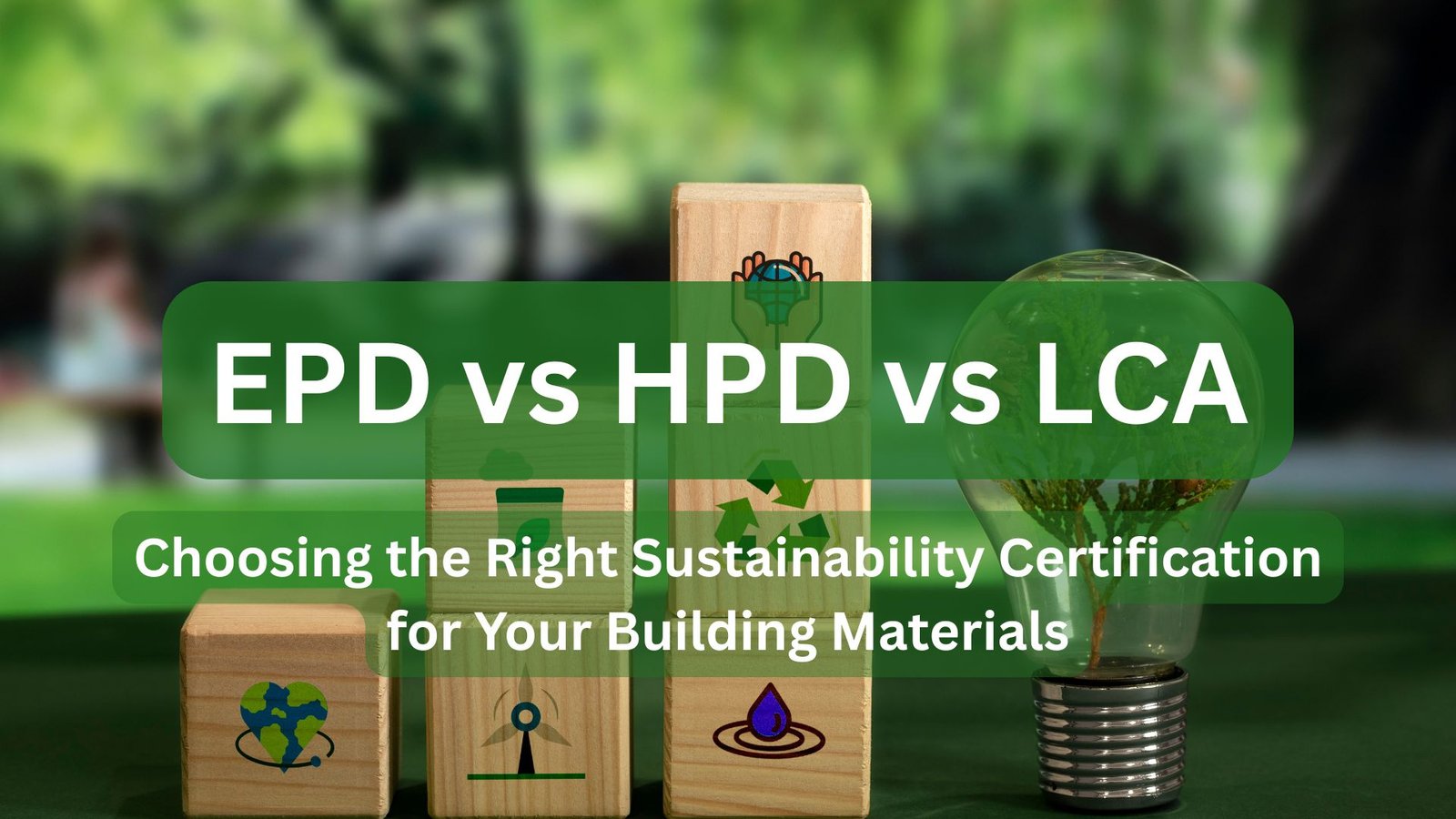
Sustainability certifications are more than checkboxes — they are proof of responsibility, compliance, and market advantage. For manufacturers and builders in UAE and GCC, EPD, HPD, and LCA are critical tools to demonstrate material transparency and secure green building projects.
Do you know which certification matters most for your materials? This guide will help you understand the differences, benefits, and actionable steps to adopt the right standard for your products.
Table of Contents
- What is an Environmental Product Declaration (EPD)?
- What is a Health Product Declaration (HPD)?
- What is Life Cycle Assessment (LCA)?
- Differences Between EPD, HPD, and LCA
- Why UAE Manufacturers Need These Certifications
- Actionable Steps to Implement EPD, HPD, and LCA
- Real-Time Examples: Case Studies in UAE Projects
- 2030 POV Scenario: Future-Proofing Your Materials
- Conclusion
- FAQs
1. What is an Environmental Product Declaration (EPD)?
An EPD is a verified document that quantifies the environmental impact of a product throughout its lifecycle — from raw material extraction to disposal. It enables architects, developers, and consultants to compare products objectively and supports green building certifications like LEED, BREEAM, and Mostadam.
- Key Points:
- Focuses on environmental impact metrics
- Verified by a third-party certification body
- Commonly used for concrete, flooring, insulation, and building materials
- Mini Q&A:
- Q: Can a product have multiple EPDs for different markets?
- A: Yes — manufacturers can issue EPDs based on regional standards for UAE, GCC, or global compliance.
2. What is a Health Product Declaration (HPD)?
An HPD focuses on the human health aspects of materials. It reports chemical contents and potential health impacts, allowing developers and architects to select safer building materials. HPDs are critical for wellness-focused certifications and indoor environmental quality standards.
- Key Points:
- Prioritizes material safety and occupant health
- Supports Well Certification and other health-based standards
- Ideal for flooring, paint, coatings, and furniture
- Mini Q&A:
- Q: Is HPD mandatory for green building projects in UAE?
- A: Not always, but it adds points for health-focused certifications and enhances material credibility.
3. What is Life Cycle Assessment (LCA)?
An LCA evaluates the environmental impact of a product across its entire lifecycle, including raw material extraction, production, transport, use, and disposal. It provides data that feeds into EPDs and informs sustainable design decisions.
- Key Points:
- Comprehensive environmental assessment tool
- Basis for EPD creation
- Enables manufacturers to reduce carbon footprint and resource usage
- Mini Q&A:
- Q: Can LCA alone certify a product for green building points?
- A: LCA provides data, but formal certifications like EPD or HPD are needed for compliance.
4. Differences Between EPD, HPD, and LCA
| Feature | EPD | HPD | LCA |
| Focus | Environmental impact | Human health and safety | Full product lifecycle impact |
| Verified By | Third-party certification | Self-reported / third-party verification | Analyst or consultant |
| Common Use | LEED, BREEAM, Mostadam points | WELL Certification, occupant health | Data for EPD, sustainability strategies |
| Metrics Provided | CO₂, energy, water, materials | Chemical content, hazards | Emissions, resource use, environmental impact |
| Outcome | Transparent reporting for sustainability | Safer material selection | Informed material improvement decisions |
Mini Q&A:
- Q: Can a product have EPD, HPD, and LCA simultaneously?
- A: Yes — using all three provides maximum transparency and market advantage.
5. Why UAE Manufacturers Need These Certifications
- Market Advantage: Architects and developers prefer EPD and HPD-backed products.
- Compliance: Meet green building standards in UAE, KSA, and GCC.
- Future-Proofing: Prepare for 2030 sustainability regulations.
- Customer Trust: Transparent material reporting boosts client confidence.
6. Actionable Steps to Implement EPD, HPD, and LCA
- Data Collection: Gather all production, material, and emissions data.
- Perform LCA: Analyze lifecycle impact using recognized methodologies.
- Develop EPD: Submit LCA results to a verified EPD program.
- Create HPD: Document chemical contents and health risks.
- Third-Party Verification: Get certifications validated.
- Marketing Integration: Publish EPD/HPD certificates and highlight in bids.
- Periodic Updates: Maintain certifications and update LCA as materials/processes change.
Pro Tip: Early collaboration with EPD/HPD consultants streamlines compliance and reduces costs.
7. Real-Time Examples: Case Studies in UAE Projects
- A flooring manufacturer in Dubai achieved LEED points by producing EPD-certified vinyl flooring.
- A paint supplier in Abu Dhabi gained WELL certification points with HPD transparency reports.
8. 2030 POV Scenario: Future-Proofing Your Materials
Imagine bidding for a mega UAE commercial project in 2030: only EPD, HPD, and verified LCA materials are considered. Products without proper documentation may be rejected, even if technically high quality. Adopting these certifications now ensures compliance and market advantage for the next decade.
Conclusion
Using EPD, HPD, and LCA together ensures that building materials are transparent, safe, and sustainable. UAE manufacturers can gain market trust, comply with green building standards, and prepare for future sustainability regulations. Take action today: collect your material data, perform lifecycle assessments, and partner with verified consultants. Do you get something new from this guide? Give us a thumbs up if yes!
FAQs
- What is the difference between EPD and HPD?
EPD measures environmental impact; HPD focuses on human health and chemical safety. - Do I need LCA if I already have EPD?
LCA provides the data for EPD, so yes — it’s essential for accurate certification. - Which materials require EPD in UAE?
Commonly concrete, flooring, insulation, paints, and furniture used in green building projects. - Is HPD mandatory for WELL certification?
Yes — HPD contributes points toward WELL certification and occupant health compliance. - How long does it take to obtain an EPD?
Typically 2–6 months depending on product complexity and data availability. - Can one product have multiple certifications?
Absolutely — EPD, HPD, and LCA can be applied to the same material for maximum transparency. - What is the cost of EPD certification in UAE?
Costs vary by product type, number of variants, and verification body; consulting with an EPD expert is recommended.