

Introduction
The construction industry in the Gulf Cooperation Council (GCC) is transforming rapidly. Countries like the UAE, Saudi Arabia, Qatar, and Oman are pushing hard toward sustainability goals. Vision 2030 in Saudi Arabia and the UAE’s net-zero targets are driving this change. Builders, manufacturers, and developers now face a common challenge: understanding environmental documentation.
Two terms keep appearing in sustainability conversations: EPD and LCA. Environmental Product Declaration (EPD) and Life Cycle Assessment (LCA) sound similar, but they serve different purposes. Many GCC professionals mix them up or think they’re the same thing. This confusion can cost time, money, and opportunities in green building projects.
Whether you’re a manufacturer in Dubai trying to export products, a contractor bidding on LEED-certified projects in Riyadh, or a developer following Estidama Pearl Rating guidelines in Abu Dhabi, knowing the difference matters. This guide breaks down EPD vs LCA in simple terms. You’ll learn what each one does, when to use them, and how they help your business win more sustainable construction projects across the Middle East.
Key Takeaways
- LCA is the process: Life Cycle Assessment measures environmental impacts throughout a product’s life, from raw materials to disposal
- EPD is the report: Environmental Product Declaration is a standardized document that communicates LCA results to the market
- LCA comes first: You need to complete an LCA before you can create an EPD
- EPDs follow standards: They use ISO 14025 and EN 15804 to ensure consistency across different products and manufacturers
- Both drive green building: LEED, BREEAM, and Estidama all recognize EPDs, which are built on LCA data
- GCC adoption is growing: More UAE and Saudi projects require environmental declarations as sustainability regulations tighten
- Investment pays off: Products with verified EPDs often win more contracts in competitive government and private tenders
What is Life Cycle Assessment (LCA)?
Life Cycle Assessment (LCA) is a scientific method that evaluates the environmental impact of a product throughout its entire life. Think of it as an environmental audit that tracks everything from raw material extraction to final disposal.
The Four Stages of LCA
LCA follows a structured approach defined by ISO 14040 and ISO 14044 standards:
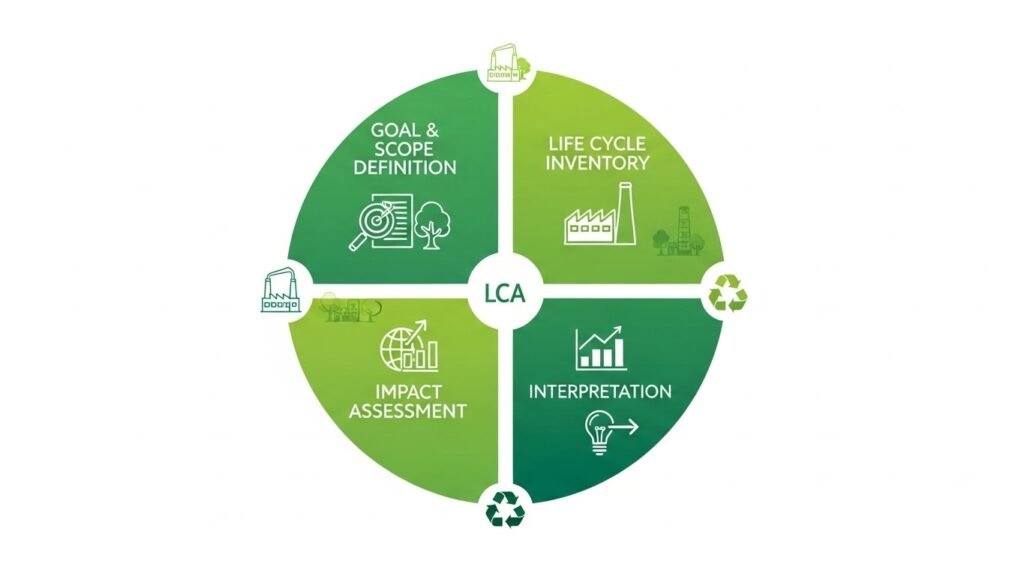
1. Goal and Scope Definition This stage sets boundaries for the study. You decide what product to analyze, what environmental impacts to measure, and how detailed the assessment needs to be. For example, a concrete manufacturer in Abu Dhabi might focus on Global Warming Potential (GWP) and water consumption.
2. Life Cycle Inventory (LCI) Here’s where you collect data. Every input (energy, water, materials) and output (emissions, waste) gets documented. This phase requires detailed records from your production processes, supplier information, and transportation data.
3. Life Cycle Impact Assessment (LCIA) The collected data gets translated into environmental impact categories. Common impacts include carbon footprint, water depletion, air pollution, and resource depletion. This helps you understand which stage of production causes the most environmental harm.
4. Interpretation Finally, you analyze results and identify improvement opportunities. Maybe your transportation accounts for 40% of emissions, suggesting a switch to local suppliers could reduce impact significantly.
Real-World LCA Applications in the GCC
In Dubai, a steel manufacturer used LCA to discover that their cooling systems consumed excessive energy. By upgrading equipment, they reduced carbon emissions by 25%. In Saudi Arabia, a glass producer found that switching to recycled content lowered their environmental footprint by 30%.
LCA isn’t just about compliance. It reveals cost-saving opportunities through energy efficiency and waste reduction. Many GCC manufacturers find that environmental improvements also boost their bottom line.
Did You Know? According to research, buildings account for nearly 40% of global carbon emissions. LCA helps identify which building materials contribute most to this problem, guiding better choices in construction.
What is Environmental Product Declaration (EPD)?
An Environmental Product Declaration (EPD) is a standardized document that communicates the environmental performance of a product. If LCA is the research paper, EPD is the executive summary that everyone can read and compare.
How EPDs Work
EPDs present LCA results in a standardized format following ISO 14025 and EN 15804+A2 standards. This standardization is crucial. It means an EPD for concrete in Dubai can be directly compared with concrete EPDs from Germany or Brazil.
Key Components of an EPD
Every EPD includes specific information:
- Product identification: What the product is and who makes it
- Declared unit: The functional unit being measured (like 1 cubic meter of concrete)
- System boundary: Which life cycle stages are included (cradle-to-gate, cradle-to-grave)
- Environmental indicators: Metrics like GWP, ozone depletion, acidification
- Additional information: Resource use, waste generation, and other relevant data
Product Category Rules (PCR)
EPDs must follow Product Category Rules. These are specific guidelines for product categories that ensure fair comparison. Concrete products follow one PCR, while aluminum products follow another. This prevents manufacturers from cherry-picking favorable data.
Third-Party Verification
Independent verification is essential for EPDs used in green building certifications. Organizations like UL Environment and The International EPD System verify EPD accuracy. This third-party audit ensures credibility, especially for government tenders in the UAE and Saudi Arabia.
EPD Types
Type III EPDs are the most common. They’re based on LCA and verified by independent parties. Type I (eco-labels) and Type II (self-declared claims) serve different purposes but lack the comprehensive LCA foundation.
Expert Quote “EPDs are becoming the passport for building materials in sustainable construction. Without one, you’re increasingly excluded from major projects in the Middle East,” says sustainability consultant based in Dubai specializing in GCC green building markets.
EPD vs LCA: The Core Differences
Understanding how EPD and LCA differ helps you make smarter decisions for your business. Here’s a detailed comparison:
Purpose and Function
LCA is an analytical tool. It’s the scientific method used to measure environmental impacts. Think of it as the research phase where you gather data, run calculations, and analyze results.
EPD is a communication tool. It takes LCA results and presents them in a standardized format that customers, architects, and project managers can understand and compare.
Process vs Document
LCA is a process that can take weeks or months. It involves data collection, modeling, calculations, and interpretation. The output is technical reports, graphs, and detailed findings.
EPD is a final document. After completing the LCA, you compile specific information according to PCR requirements. The EPD becomes a marketing tool and certification requirement.
Audience and Usage
LCA speaks to technical experts. Environmental engineers, sustainability managers, and internal teams use LCA for product development and improvement strategies.
EPD speaks to the market. Architects selecting materials, procurement managers comparing suppliers, and LEED consultants earning credits all rely on EPDs.
Standardization Level
LCA follows general standards (ISO 14040/14044) but allows flexibility in scope and methodology. Two LCAs for similar products might use different boundaries or assumptions.
EPD must strictly follow ISO 14025, EN 15804, and relevant PCRs. This rigid structure ensures comparability across different manufacturers and regions.
Verification Requirements
LCA can be internal or external. Companies often perform initial LCAs in-house to identify improvement areas before seeking external validation.
EPD requires third-party verification for use in green building certifications. An independent reviewer checks data accuracy, methodology compliance, and PCR adherence.
Cost and Timeline
LCA costs vary widely based on complexity. A simple cradle-to-gate LCA might cost $5,000-$15,000, while comprehensive assessments can exceed $50,000. Timeline ranges from 2-6 months.
EPD adds verification and registration costs. Total investment typically ranges from $8,000-$25,000 depending on product complexity and verification requirements. The process takes 3-8 months from start to publication.
Validity Period
LCA has no expiration. However, results become outdated as production processes change, requiring updates to maintain accuracy.
EPD typically remains valid for 5 years. After expiration, you must update the LCA and reverify the EPD to maintain its validity for certifications.
Myth vs Fact
Myth: “An EPD is just another name for an LCA.”
Fact: LCA is the assessment methodology, while EPD is the standardized communication format for sharing LCA results with the market.
How LCA and EPD Work Together
LCA and EPD aren’t competing options. They work together in a specific sequence that benefits your business.
The Sequential Relationship
- Conduct LCA: Start by performing a comprehensive life cycle assessment of your product
- Follow PCR: Ensure your LCA methodology aligns with the relevant Product Category Rules
- Compile EPD: Organize LCA results according to EPD standards and formats
- Seek Verification: Submit to an accredited program operator for third-party review
- Publish EPD: Once verified, register and publish your EPD for market use
- Use for Marketing: Leverage the EPD in tenders, certifications, and marketing materials
Real Example from the GCC
A flooring manufacturer in Jebel Ali, Dubai, wanted to export products to European markets. They started with an LCA that revealed their transportation emissions were higher than production emissions. After optimizing logistics, they created an EPD that showcased their improved environmental performance. The EPD helped them win contracts with three major European retailers and two LEED-certified projects in Abu Dhabi.
The Investment Perspective
Think of LCA as the foundation and EPD as the building. You need a solid foundation (accurate LCA data) to construct a reliable building (credible EPD). Skipping proper LCA to rush an EPD creates problems during verification and potentially misleads customers.
Why GCC Businesses Need Both
The Middle East construction market is evolving rapidly. Here’s why both LCA and EPD matter for your business in the UAE, Saudi Arabia, and broader GCC region.
Regulatory Drivers
UAE Green Building Regulations: Dubai and Abu Dhabi increasingly require environmental transparency. The Estidama Pearl Rating System awards points for EPDs in material selection.
Saudi Vision 2030: The Kingdom is prioritizing sustainable construction. Major projects like NEOM and The Line demand environmental documentation from suppliers.
Qatar Sustainability Standards: With continued infrastructure development, Qatar follows international green building standards that recognize EPDs.
Competitive Advantages
Manufacturers with EPDs win more contracts. A 2024 industry survey found that 67% of GCC developers prefer suppliers with verified environmental declarations. Government tenders increasingly make EPDs mandatory or award preference points.
LEED and BREEAM Credits
Projects pursuing LEED v4.1 certification can earn up to 2 points under the Building Product Disclosure and Optimization credits. EPDs help achieve these points. Similarly, BREEAM projects in the Gulf recognize EPD documentation for material transparency credits.
For detailed guidance on earning LEED credits, check out our comprehensive guide on LEED EPD certification for builders in the UAE and Saudi Arabia.
Export Opportunities
European and North American markets increasingly require EPDs. If you’re a GCC manufacturer exporting building materials, EPDs open doors to international markets where environmental transparency is mandatory.
Internal Improvements
LCA reveals inefficiencies in your production process. Many GCC manufacturers discover cost-saving opportunities through energy reduction, waste minimization, and optimized logistics when conducting their first LCA.
Did You Know? The global green building materials market is expected to reach $653 billion by 2028. EPDs serve as entry tickets to this growing market, especially for GCC manufacturers targeting international expansion.
How to Get Started: A Practical Roadmap
Ready to implement LCA and EPD for your products? Here’s a step-by-step approach tailored for GCC businesses.
Step 1: Assess Your Readiness
Ask yourself these questions:
- Do you have detailed production data (energy consumption, material inputs, waste outputs)?
- Can you access supplier information about raw materials?
- Do you have transportation and distribution data?
- Is your target market requesting or requiring EPDs?
Step 2: Choose the Right Scope
Decide on your LCA boundaries:
Cradle-to-Gate: From raw material extraction through your factory gate. This is most common for building materials and easier to control since it focuses on manufacturing.
Cradle-to-Grave: Includes installation, use phase, and end-of-life disposal. More comprehensive but requires assumptions about product use and disposal.
Cradle-to-Cradle: Considers recycling and circular economy principles. Ideal for materials designed for reuse or recycling.
For most GCC manufacturers, cradle-to-gate is the practical starting point. It covers what you can measure and control directly.
Step 3: Gather Data
Data collection is the most time-consuming phase. You’ll need:
- Energy bills and consumption records
- Raw material quantities and sources
- Production process details
- Transportation distances and methods
- Waste generation and management data
- Water consumption records
Digital tools and smart metering make this easier. Many GCC facilities are adopting IoT sensors that automatically track resource consumption.
Step 4: Find the Right Partner
Unless you have in-house LCA expertise, work with consultants who understand GCC markets. Look for:
- Experience with ISO 14040/14044 and ISO 14025
- Knowledge of relevant PCRs for your product category
- Relationships with EPD program operators
- Understanding of regional green building requirements
Learn more about selecting the right support through our ESG consulting services in Dubai.
Step 5: Complete the LCA
Your consultant will:
- Model your product system in specialized LCA software
- Calculate environmental impacts across categories
- Identify hotspots and improvement opportunities
- Prepare a detailed LCA report
This typically takes 2-4 months depending on data availability and product complexity.
Step 6: Develop and Verify the EPD
After completing the LCA:
- Compile data according to PCR requirements
- Draft the EPD document following standardized templates
- Submit to an EPD program operator for verification
- Address any reviewer questions or data requests
- Receive verification approval
Third-party verification adds 1-2 months to the timeline but ensures credibility.
Step 7: Publish and Promote
Once verified, your EPD gets registered in a public database. You can then:
- Share it with architects and specifiers
- Include it in tender submissions
- Feature it on your website and marketing materials
- Use it for LEED and BREEAM project documentation
For manufacturers new to this process, our EPD guide for manufacturers in the UAE, Saudi Arabia, and GCC provides additional detailed guidance.
Common Challenges and How to Overcome Them
GCC businesses face specific hurdles when implementing LCA and EPD programs. Here’s how to address them.
Challenge 1: Data Availability
Problem: Many manufacturers, especially SMEs, lack detailed production data or digital tracking systems.
Solution: Start with utility bills, supplier invoices, and basic production records. Estimate where exact data isn’t available, but document assumptions clearly. Consider investing in metering equipment for future accuracy.
Challenge 2: Supply Chain Transparency
Problem: Raw material suppliers may not share environmental data about their products.
Solution: Use industry-average data from databases like Ecoinvent or GaBi. While less precise than specific data, it’s acceptable for first-time LCAs. Build relationships with suppliers and request data for future updates.
Challenge 3: Cost Concerns
Problem: LCA and EPD development requires significant investment, challenging for smaller companies.
Solution: View it as marketing and market access investment, not just compliance cost. Consider group EPDs where multiple manufacturers share costs for similar products. Some GCC government programs offer sustainability grants that could offset expenses.
Challenge 4: Technical Complexity
Problem: LCA methodology involves complex calculations and environmental science expertise.
Solution: Partner with experienced consultants rather than attempting DIY approaches. The cost of errors or non-compliant EPDs exceeds consultant fees. Look for consultants who explain processes clearly and build internal capacity.
Challenge 5: Maintaining Currency
Problem: EPDs expire after 5 years, requiring ongoing investment to maintain validity.
Solution: Plan for EPD renewal from the start. Schedule LCA updates before expiration. Many improvements in production processes actually reduce costs while improving environmental performance, making updates worthwhile.
The Future of LCA and EPD in the GCC
Environmental transparency is becoming standard practice, not optional, across the Middle East. Here’s what to expect in coming years.
Digital EPDs and BIM Integration
Building Information Modeling (BIM) is mandatory for many GCC projects. Digital EPDs that integrate seamlessly with BIM software are emerging. This allows architects to automatically calculate project-level environmental impacts when selecting materials.
Discover how digital EPDs integrate with BIM models for seamless project documentation.
AI and Automation
Artificial intelligence is streamlining LCA data collection and calculations. Smart software can pull data from utility systems, identify patterns, and automate much of the inventory phase. This reduces costs and timelines significantly.
Mandatory Requirements
Based on current trends, many experts predict EPDs will become mandatory for certain product categories in GCC markets within 3-5 years. Early adopters gain competitive advantages before requirements become law.
Carbon Pricing
As the Middle East explores carbon pricing mechanisms, LCA data becomes crucial for calculating carbon taxes or accessing carbon credit programs. Companies with established LCA programs are better positioned to adapt to carbon pricing schemes.
Explore how EPDs influence carbon credits and trading in the Middle East for future-proofing your business.
Scope 3 Reporting
Large developers and contractors must report Scope 3 emissions (supply chain emissions) under emerging ESG frameworks. EPDs from suppliers make this reporting possible and accurate. Manufacturers without EPDs may lose access to major clients who need this data.
Learn more about using EPDs for Scope 3 emission reporting in your supply chain.
Key Takeaways
Understanding the difference between LCA and EPD is essential for GCC manufacturers and construction professionals navigating the sustainability landscape. Here’s what matters most:
- LCA is the assessment methodology that measures environmental impacts across a product’s life cycle
- EPD is the standardized communication format that shares LCA results with customers and markets
- You need to complete an LCA before developing an EPD
- Both follow international standards (ISO 14040/14044 for LCA, ISO 14025 for EPD)
- EPDs require third-party verification to be credible for green building certifications
- Investment in LCA and EPD pays off through competitive advantages, market access, and internal improvements
- GCC markets are rapidly adopting environmental transparency requirements
- Starting early gives you advantages before requirements become mandatory
Final Thoughts
The construction industry in the UAE, Saudi Arabia, and broader GCC region is at a sustainability turning point. Environmental transparency is shifting from nice-to-have to must-have. Understanding LCA and EPD isn’t just about compliance. It’s about positioning your business for long-term success in a market that increasingly values sustainability.
Whether you manufacture concrete in Dubai, produce steel in Riyadh, or supply interior finishes in Doha, the question isn’t if you’ll need LCA and EPD. It’s when. Companies that start now gain experience, build credibility, and secure competitive advantages before the rush begins.
The journey from conducting your first LCA to publishing a verified EPD takes time and investment. But it also reveals opportunities for improvement, opens new markets, and demonstrates leadership in sustainable construction. In a region committed to ambitious environmental goals, that leadership pays dividends.
Are you ready to take the first step toward environmental transparency? The time to start is now, while early-mover advantages still exist in the rapidly evolving GCC sustainability landscape.
Frequently Asked Questions (FAQ)
Q1: What’s the main difference between EPD and LCA?
LCA (Life Cycle Assessment) is the scientific process of measuring environmental impacts throughout a product’s life cycle. EPD (Environmental Product Declaration) is the standardized document that communicates LCA results to the market in a comparable format.
Q2: How much does EPD certification cost in the UAE and Saudi Arabia?
EPD development and verification typically costs between $8,000-$25,000 depending on product complexity, data availability, and verification requirements. This includes the LCA study, EPD compilation, third-party verification, and program operator fees.
Q3: Do I need an EPD to get LEED certification?
EPDs aren’t mandatory for all LEED projects, but they significantly help earn credits under “Building Product Disclosure and Optimization” categories. Projects can earn up to 2 points by using products with EPDs, making them highly valuable for certification.
Q4: How long does an EPD remain valid?
Most EPDs are valid for 5 years from publication date. After expiration, you need to update the underlying LCA with current data and undergo reverification to maintain validity for green building certifications and marketing purposes.
Q5: Can I create an EPD without doing an LCA first?
No, you cannot create a legitimate EPD without completing an LCA first. The LCA provides the environmental impact data that populates the EPD. Any EPD must be based on comprehensive life cycle assessment following ISO standards.
Q6: What’s the difference between cradle-to-gate and cradle-to-grave LCA?
Cradle-to-gate LCA measures impacts from raw material extraction through the factory gate, covering manufacturing. Cradle-to-grave extends through product use and end-of-life disposal. Most building material EPDs use cradle-to-gate with optional additional modules.
Q7: Are EPDs becoming mandatory in the GCC region?
While not yet mandatory in most cases, EPDs are increasingly required for government projects and preferred in private developments across the UAE and Saudi Arabia. Industry experts predict mandatory requirements for certain product categories within 3-5 years.
Glossary
Cradle-to-Gate: Life cycle assessment boundary from raw material extraction through the factory gate, excluding transportation to customer, use phase, and disposal.
Cradle-to-Grave: Comprehensive life cycle assessment covering all stages from raw material extraction through end-of-life disposal or recycling.
Embodied Carbon: Total greenhouse gas emissions associated with materials and construction processes throughout a building’s lifecycle, typically measured in kg CO2 equivalent.
Global Warming Potential (GWP): Measure of how much heat a greenhouse gas traps in the atmosphere relative to carbon dioxide, expressed in CO2 equivalents over a specific timeframe.
ISO 14025: International standard specifying requirements for Type III environmental declarations (EPDs), including use of life cycle assessment and product category rules.
Life Cycle Impact Assessment (LCIA): Phase of LCA where inventory data is translated into environmental impact indicators like global warming, acidification, and resource depletion.
Product Category Rules (PCR): Set of specific rules, requirements, and guidelines for developing EPDs for products within the same category to ensure comparability.
Scope 3 Emissions: Indirect greenhouse gas emissions from a company’s value chain, including purchased goods, transportation, and product use by customers.
Third-Party Verification: Independent review and validation of EPD content and underlying LCA by accredited verifiers to ensure accuracy and standard compliance.
Type III Environmental Declaration: Quantified environmental data for a product based on life cycle assessment and verified by independent third party, following ISO 14025 standard.