ATEX certification proves your equipment is safe to use in explosive atmospheres. It follows EU Directive 2014/34/EU. The process covers zone classification, risk assessment, technical documents, conformity assessment, testing, notified body review, the EU Declaration of Conformity, and CE plus ATEX marking.
Does your equipment work in a hazardous area? Then ATEX certification is not optional. It is a legal must for the European market.
The process can feel hard at first. But with a clear structure, it becomes simple to follow.
This guide breaks the ATEX process into plain, practical steps. You will learn what ATEX means, who needs it, and how categories work.
We also cover timelines, costs, common pitfalls, and how ATEX compares to IECEx. And for GCC exporters, we explain why it opens new doors.
What Is ATEX Certification?
ATEX certification confirms your equipment is safe for explosive atmospheres under EU Directive 2014/34/EU. ATEX is short for “Atmosphères Explosibles,” the French term for explosive atmospheres. It applies to both electrical and non-electrical equipment used near flammable gases, vapors, or dust.
Here’s why it matters. The certification proves your equipment will not spark an explosion in a risky area.
So it protects workers, sites, and nearby communities. That makes it a safety promise, not just a paper exercise.
ATEX also carries real legal weight. Without it, you cannot sell or install equipment in EU hazardous zones.
Skip it, and you risk fines, product recalls, and forced work stoppages.
Who Needs ATEX Certification?
You need ATEX certification if you place explosion-protected equipment on the EU market. This covers manufacturers, suppliers, exporters, OEMs, and assemblers. If your product runs in oil and gas, chemical, mining, or food sites, you likely need it.
You need ATEX certification if you are a:
- Manufacturer building equipment for hazardous areas
- Supplier selling certified products in the EU
- Exporter shipping industrial gear to Europe
- OEM fitting components into larger systems
- Assembler joining parts into finished equipment
The rules cover many product types. Common examples include:
- Electric motors and pumps
- Sensors and gas detection systems
- Control panels and junction boxes
- Lighting and luminaires
- Mechanical parts like gearboxes and seals
Think of a UAE control panel maker shipping to Europe. That firm needs ATEX before any sale goes through.
Understanding ATEX Equipment Categories
ATEX sorts equipment into three categories by risk level. The category sets how strict your certification path will be. Higher-risk zones need higher-category equipment with tougher checks. So the right category early saves you time and money later.
The table below links category, risk, and zone.
| Category | Protection Level | Typical Zone (Gas / Dust) | Certification Complexity |
| Category 1 | Very high protection | Zone 0 / Zone 20 | Highest—notified body required |
| Category 2 | High protection | Zone 1 / Zone 21 | High—notified body required |
| Category 3 | Normal protection | Zone 2 / Zone 22 | Lower—self-certification often allowed |
Here’s the simple rule. Category 1 must stay safe even with two faults at once.
Category 2 must stay safe during expected upsets. Category 3 stays safe in normal use.
The category also decides which assessment modules you follow. We explain those in Step 5.
ATEX Certification Process: Step-by-Step
The ATEX Certification process follows a clear order. Each step builds on the last one. So follow them in sequence to avoid delays and rework.
Step 1: Identify Equipment Type and Hazardous Zone
First, classify the area where your equipment will run. Zones depend on how often an explosive atmosphere appears.
- Zone 0 / Zone 20: Present all the time or for long periods
- Zone 1 / Zone 21: Likely during normal operation
- Zone 2 / Zone 22: Rare and short-lived
Zones 0, 1, and 2 cover gases. Zones 20, 21, and 22 cover dust.
Step 2: Determine the Applicable ATEX Category
Next, match the zone to the right category. Zone 0 or 20 needs Category 1. Zone 1 or 21 needs Category 2. Zone 2 or 22 needs Category 3.
This step sets your testing and oversight level. So get it right early to save cost.
Step 3: Conduct a Hazard and Risk Assessment
Now run an ignition hazard assessment. It shows how your equipment could spark an explosion.
The assessment must follow Annex II of the directive. It lists ignition sources and the controls you use to stop them.
Step 4: Prepare Technical Documentation
Then build a complete technical file. This file proves your equipment meets all key safety rules.
Include design drawings, risk assessments, test reports, material data, and user manuals. We list every document later in this guide.
Keep it tidy. Notified bodies and authorities will read it closely.
Step 5: Select the Correct Conformity Assessment Procedure
Conformity assessment uses a modular system. Each module sets a different level of checking. Your category decides which modules apply.
| Module | Name | What It Involves | Typical Use |
| Module A | Internal production control | Manufacturer self-assesses, no notified body needed | Category 3 |
| Module B | EU-Type Examination | Notified body checks design and tests samples | Category 1 and 2 |
| Module D | Production quality assurance | Notified body audits your quality system | Category 1 |
| Module F | Product verification | Notified body tests samples from each batch | Category 1 |
| Module G | Unit verification | Every single product gets checked and tested | Low-volume, high-risk |
So Modules B, D, F, and G all need a notified body. Module A lets you self-certify.
Step 6: Product Testing and Evaluation
With your file ready, your equipment goes to testing. It must meet the relevant EN 60079 standards. These standards set the safety rules for explosive-area equipment.
Testing checks your product under stress, heat, and faults. It confirms the product will not become an ignition source.
For non-electrical equipment, the EN ISO 80079 series often applies. So pick the right standard to avoid retesting.
Step 7: Notified Body Review and Certification
For Category 1 and 2 equipment, a notified body must review your file and results. A notified body is an independent organization approved by an EU member state.
It checks your design, confirms test results, and verifies compliance. If all is good, it issues an EU-Type Examination Certificate.
This certificate is core proof of compliance. It also tells buyers an expert checked your product.
Step 8: Issue the EU Declaration of Conformity
After certification, you write the EU Declaration of Conformity. This is your legal statement that the equipment meets Directive 2014/34/EU.
It must list the product, the directive, the standards, and notified body details. You, as the maker, own its accuracy.
Keep this document on file. Authorities can ask for it at any time.
Step 9: Apply CE Marking and ATEX Marking
Next, mark your product correctly. The CE mark shows EU compliance. The ATEX mark shows it is safe for explosive atmospheres.
The ATEX mark includes the Ex hexagon, equipment group, category, and atmosphere type. That means G for gas and D for dust. If a notified body is involved, its four-digit number sits next to the CE mark.
Get the marking right. Wrong or missing marks can block your market access.
Step 10: Maintain Ongoing Production and Quality Assurance
Certification is not a one-time job. You must keep production in line with the certified design.
For Category 1 equipment, a notified body audits your quality system regularly. This confirms every unit matches the approved sample.
Update your file whenever you change the design, materials, or process. So your certification stays valid over time.
Documents Required for ATEX Certification
A complete technical file is the heart of ATEX certification. Missing papers are a top cause of delay. Below is a checklist of the key documents to prepare before review.
| Document | Purpose |
| General product description | Explains what the equipment is and how it is used |
| Design and manufacturing drawings | Shows construction details and dimensions |
| Ignition hazard assessment | Identifies ignition sources and controls |
| List of standards applied | Confirms which EN 60079 or EN ISO 80079 standards apply |
| Test reports | Provides evidence of testing results |
| Risk assessment | Documents safety analysis under Annex II |
| Material data sheets | Confirms the materials suit the use |
| Wiring and circuit diagrams | Details electrical design for electrical equipment |
| Installation and user manual | Guides safe install, use, and maintenance |
| EU Declaration of Conformity | Legal statement of compliance |
Keep all papers clear, current, and well sorted. A strong file speeds up notified body review.
ATEX Certification Timeline
ATEX certification has no fixed schedule. The timeline depends on your equipment category and complexity. In practice, it runs from a few weeks to several months. Simple products move fast, while high-risk ones take longer.
Use these estimates as a rough guide:
- Simple equipment (Category 3): Often a few weeks, since self-certification usually applies.
- Medium-complexity equipment (Category 2): Often a few months, since testing and review apply.
- High-risk equipment (Category 1): The longest path, often several months, due to heavy testing and audits.
Design changes can stretch any timeline. So a clean, compliant product always moves faster.
Factors Affecting ATEX Certification Cost
ATEX cost changes from one product to the next. Five main factors drive the final figure: equipment category, product complexity, testing scope, number of variants, and notified body involvement. Higher categories and more testing push the cost up.
Key cost drivers include:
- Equipment category: Higher categories need more testing and oversight.
- Product complexity: Complex designs need more analysis.
- Testing scope: More tests mean higher cost.
- Number of variants: More models mean more work.
- Notified body involvement: Reviews and audits add to the bill.
So get your zone and documents right from day one. Early accuracy cuts expensive rework.
Common Challenges During ATEX Certification
Most delays come from avoidable mistakes. Five issues cause the biggest slowdowns: incomplete files, wrong zone classification, design non-conformities, testing failures, and documentation gaps. Spotting them early keeps your project on track.
Watch out for these traps:
- Incomplete technical files: Missing papers cause the most delays.
- Wrong zone classification: A wrong zone means the wrong category and rework.
- Design non-conformities: Designs that miss EN 60079 need changes.
- Testing failures: Failed products must be fixed and retested.
- Documentation gaps: Unclear records slow down the review.
Take this example. A pump maker picks the wrong zone, builds to Category 3, then learns the site needs Category 1.
That mistake forces a full redesign. Strong prep, or expert help, stops errors like this.
ATEX vs IECEx Certification
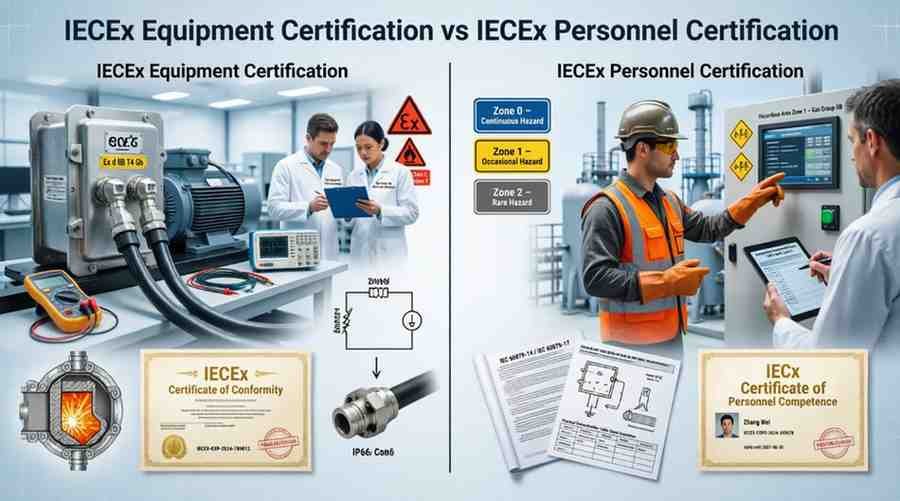
ATEX is a legal EU requirement. IECEx is a voluntary international scheme accepted worldwide. Both stop explosions in hazardous areas, but they serve different markets. ATEX opens the EU, while IECEx supports access across many countries.
The table below shows the key differences.
| Parameter | ATEX | IECEx |
| Scope | EU legal directive (2014/34/EU) | Voluntary international scheme |
| Geographic acceptance | European Economic Area | Accepted in many countries globally |
| Certification process | Conformity assessment plus CE marking | Centralized IECEx certificate system |
| Documentation | Technical file plus EU Declaration | IECEx Certificate of Conformity (CoC) |
| Market access | Mandatory for EU market | Supports access across many regions |
For many makers, holding both is the smart move. ATEX opens Europe, while IECEx widens global reach.
Benefits of ATEX Certification
ATEX certification does more than meet the law. It makes your products safer, builds trust, and grows your market reach. It also makes you eligible for major oil, gas, and petrochemical tenders.
Key benefits include:
- Legal EU market access for hazardous area equipment
- Better safety for workers, sites, and communities
- Stronger buyer trust through independent checks
- An edge over non-certified suppliers
- Eligibility for big tenders in oil, gas, and petrochemicals
- Lower liability through documented compliance
So certification is a smart investment, not just a hurdle.
Why GCC Manufacturers Pursue ATEX Certification
GCC manufacturers use ATEX certification to win export business. The region’s oil, gas, and petrochemical projects often demand ATEX or IECEx equipment. So certification opens European contracts and proves world-class safety to clients at home and abroad.
In the UAE, Saudi Arabia, Qatar, Oman, and Kuwait, energy projects lead the way. Many of these projects list ATEX equipment as a hard requirement.
ATEX lets GCC exporters bid for European work with confidence. It also builds credibility with global buyers.
Picture a Saudi junction box maker chasing a European refinery contract. ATEX certification makes that bid possible.
Frequently Asked Questions
What is the ATEX certification process?
The ATEX certification process proves equipment is safe for explosive atmospheres under EU Directive 2014/34/EU. It covers zone classification, risk assessment, documentation, testing, notified body review, and CE plus ATEX marking.
Is ATEX certification mandatory?
Yes. ATEX is a legal must for equipment sold for use in EU hazardous areas. Selling non-certified equipment there can bring fines and recalls.
Who needs ATEX certification?
Manufacturers, suppliers, exporters, OEMs, and assemblers all need it when products run in EU explosive atmospheres. This is common in oil and gas, chemical, and mining work.
How long does ATEX certification take?
It depends on category and complexity. Simple Category 3 products may take a few weeks. High-risk Category 1 equipment can take several months. Design changes stretch the timeline.
How much does ATEX certification cost?
Cost depends on category, product complexity, testing scope, number of variants, and notified body involvement. Good documents and the right zone help keep cost down.
What is a notified body in ATEX certification?
A notified body is an independent organization approved by an EU member state. It reviews files, checks testing, and issues EU-Type Examination Certificates for Category 1 and 2 equipment.
What documents are required for ATEX certification?
You need a complete technical file. It includes product descriptions, drawings, an ignition hazard assessment, test reports, the standards used, material data, and the EU Declaration of Conformity.
What is the difference between ATEX and IECEx?
ATEX is a mandatory EU directive. IECEx is a voluntary international scheme. ATEX opens the European market, while IECEx supports recognition across many countries.
What do ATEX equipment categories mean?
Categories set the protection level. Category 1 gives very high protection for the riskiest zones. Category 2 gives high protection. Category 3 gives normal protection for low-risk zones.
Can GCC manufacturers get ATEX certification?
Yes. Makers and exporters in the UAE, Saudi Arabia, Qatar, Oman, and Kuwait can achieve ATEX certification. It opens European markets and supports bids on big energy projects.
Take the Next Step Toward ATEX Compliance
ATEX certification protects lives, secures market access, and builds buyer trust. The path has several steps, but careful prep makes it simple.
Start by classifying your zone correctly and building a complete technical file. Then follow each step in order, through testing, review, and final marking.
Are you a manufacturer or exporter in the GCC? Expert guidance can simplify the whole journey.
The right support helps you dodge costly mistakes and certify faster. Ready to certify your equipment and win new export work?
Talk to our compliance specialists today. Take the first confident step toward ATEX approval.