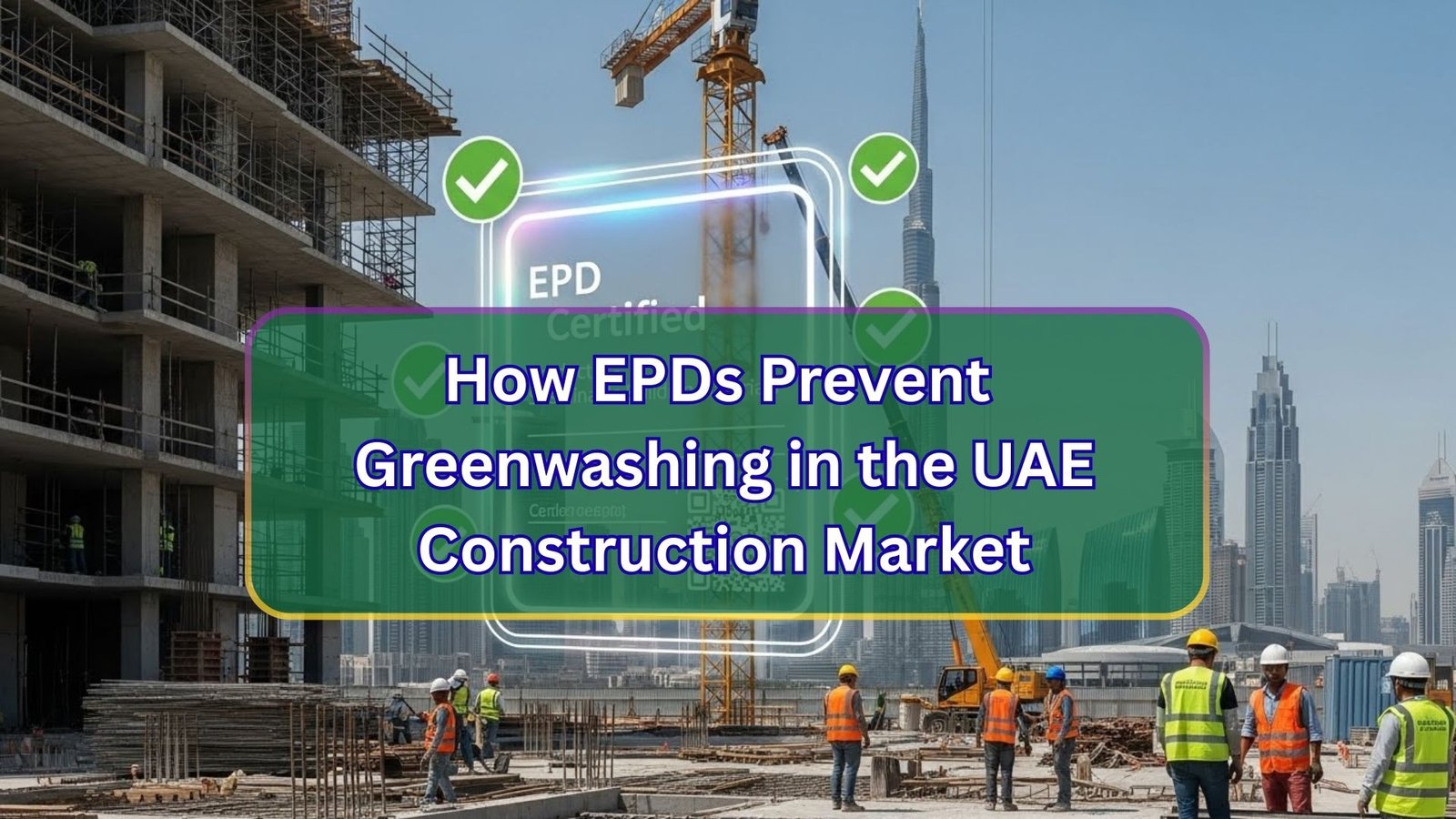
The UAE construction industry is racing toward sustainability. Developers promise net-zero buildings. Manufacturers advertise “eco-friendly” materials. Contractors bid on green projects. But here’s the uncomfortable truth: not all environmental claims stand up to scrutiny.
In Dubai’s competitive construction market, greenwashing has become a serious problem. Companies make vague sustainability promises without proof. This damages credibility, misleads buyers, and undermines genuine environmental efforts. For businesses in Abu Dhabi, Sharjah, and across the GCC, the question is urgent: how do you prove your green claims are real?
The answer lies in Environmental Product Declarations (EPDs). These third-party verified documents provide transparent, standardized environmental data based on Life Cycle Assessment (LCA). They’re quickly becoming the gold standard for combating greenwashing in Middle East construction markets.
Key Takeaways
- Greenwashing costs UAE businesses credibility and market opportunities in sustainable construction
- EPDs provide third-party verified environmental data that cannot be manipulated or exaggerated
- ISO 14025 and EN 15804 standards ensure EPD claims are measurable and comparable
- Major GCC projects now require EPDs for LEED, BREEAM, and Estidama certifications
- Manufacturers with verified EPDs gain competitive advantage in government tenders and international projects
- Digital EPDs enable seamless integration with BIM models for transparent reporting
- The next 5 years will likely see mandatory EPD requirements across GCC markets
What is Greenwashing in Construction?
Greenwashing happens when companies make misleading or unverified environmental claims about their products or services. In the construction sector, this might look like:
- Calling a product “sustainable” without defining what that means
- Using vague terms like “eco-friendly” or “green” without measurable data
- Cherry-picking favorable environmental attributes while hiding negative impacts
- Making claims without independent verification or testing
For example, a paint manufacturer might advertise “low emissions” without specifying which chemicals, in what quantities, or compared to what baseline. A concrete supplier might claim “reduced carbon footprint” without providing actual Global Warming Potential (GWP) data.
These practices aren’t just unethical. They create real problems for project developers, architects, and procurement teams trying to meet genuine sustainability requirements for LEED certification or Estidama Pearl Rating compliance.
Did You Know? A 2023 study found that over 40% of environmental claims made by construction material suppliers in the MENA region could not be substantiated with verified data.
Why Greenwashing is a Growing Problem in the UAE
The UAE is leading the Middle East’s green building revolution. Dubai has committed to making all new buildings green by 2030. Abu Dhabi’s Estidama program sets strict sustainability benchmarks. Saudi Arabia’s Vision 2030 prioritizes environmental responsibility.
This creates massive demand for sustainable materials. However, it also creates incentives for companies to exaggerate their environmental credentials. When procurement teams face pressure to select “green” options but lack tools to verify claims, greenwashing thrives.
The consequences are serious:
- Regulatory risk: Government projects increasingly require verified environmental documentation
- Reputation damage: Being caught making false claims destroys brand trust
- Lost opportunities: International developers now demand transparency
- Legal exposure: Consumer protection laws are tightening around environmental claims
- Market confusion: Real sustainable innovators struggle to differentiate themselves
The Cost of Unverified Claims
Consider a hypothetical scenario. A Dubai developer specifies “low-carbon concrete” for a high-rise project seeking LEED Gold certification. The supplier provided marketing materials claiming 30% carbon reduction. But when the LEED review team requests verified data, the supplier cannot provide Product Category Rules (PCR) compliant documentation.
The project loses valuable LEED credits. The developer faces delays. The supplier’s reputation suffers. All because environmental claims weren’t backed by proper verification.
What Makes EPDs the Solution to Greenwashing?
Environmental Product Declarations are the antidote to greenwashing because they provide standardized, verified, transparent environmental data. Here’s why they work:
1. Third-Party Verification
Unlike self-declared environmental claims, EPDs must be verified by independent, accredited third parties. Organizations like UL Environment and The International EPD System review the underlying Life Cycle Assessment data before issuing an EPD.
This verification ensures the data is accurate, complete, and follows internationally recognized methodologies. Companies cannot simply invent favorable numbers.
2. Standardized Methodology
EPDs follow strict standards, primarily ISO 14025 and EN 15804+A2. These standards define exactly how environmental impacts must be measured, calculated, and reported.
Every EPD must include:
- Global Warming Potential (GWP) in CO2 equivalents
- Ozone depletion potential
- Acidification potential
- Eutrophication potential
- Photochemical ozone creation potential
- Abiotic depletion of elements and fossil resources
- Water use
- Waste generation
This standardization means you can directly compare products. A concrete supplier’s EPD can be evaluated against competitors’ EPDs using identical metrics.
3. Complete Transparency
EPDs disclose environmental impacts across the entire product life cycle, from raw material extraction through manufacturing (cradle-to-gate) or even through disposal (cradle-to-grave). This comprehensive approach prevents companies from highlighting only favorable aspects while hiding problematic ones.
For instance, a steel manufacturer cannot claim “recycled content” while concealing high energy consumption during production. The LCA process captures all significant environmental inputs and outputs.
4. Product Category Rules (PCR)
EPDs must follow specific Product Category Rules for their material type. PCR documents define which life cycle stages to include, what data quality is required, and how calculations should be performed for specific product categories like concrete, glass, or insulation.
This ensures apples-to-apples comparisons. All concrete EPDs follow the same PCR, making it easy to evaluate different suppliers objectively.
Expert Quote: “EPDs transform vague sustainability marketing into quantifiable environmental performance data. They’re the difference between saying ‘we’re green’ and proving ‘here’s exactly how green we are, verified by independent experts.'” — Dr. Sarah Mitchell, Sustainable Construction Consultant
How EPDs Work: The Verification Process
Understanding how EPDs are created helps explain why they’re so effective against greenwashing. The process involves several rigorous steps:
Step 1: Conduct Life Cycle Assessment
The manufacturer works with LCA consultants to gather comprehensive data about their product. This includes:
- Raw material sourcing and extraction
- Transportation and logistics
- Manufacturing processes and energy use
- Packaging materials
- Product use phase (for some categories)
- End-of-life disposal or recycling
All data must meet quality standards defined in ISO 14044 and the relevant PCR.
Step 2: Follow Product Category Rules
The LCA must align with the appropriate PCR for the product type. For example, concrete EPDs follow different rules than steel EPDs because these materials have different production processes and environmental profiles.
Step 3: Independent Verification
An accredited third party reviews all data, calculations, and documentation. They verify:
- Data sources are reliable and current
- Calculations follow proper methodologies
- All required impact categories are included
- Claims are supported by evidence
- The PCR has been correctly applied
Step 4: EPD Publication
Once verified, the EPD is published in a program operator’s database like The International EPD System. The document includes detailed environmental data, verification statement, and validity period (typically 5 years).
Step 5: Ongoing Validation
EPDs must be updated when products change significantly or when they expire. This ensures data remains current and accurate.
This multi-step verification process makes it nearly impossible to make false claims. Every assertion must be backed by measured data and reviewed by independent experts.
Real-World Impact: EPDs in GCC Construction Projects
EPDs are already making a difference in preventing greenwashing across the UAE and broader GCC region. Here are practical examples:
LEED v4.1 Material Transparency
LEED v4.1 projects can earn up to 2 points under the Building Product Disclosure and Optimization credit by using products with EPDs. The credit specifically requires third-party verified EPDs, not self-declared environmental claims.
This requirement forces suppliers to provide real data or lose access to LEED projects. Developers can confidently specify materials knowing the environmental claims are verified.
Estidama Pearl Rating System
Abu Dhabi’s Estidama program rewards projects that use materials with verified environmental documentation. EPDs help projects earn Pearl ratings by providing the transparent data assessors need to evaluate material choices.
Without EPDs, projects must rely on generic industry data or incomplete information, making it harder to achieve higher Pearl ratings.
Saudi Vision 2030 Procurement
Saudi Arabia’s Vision 2030 includes ambitious sustainability targets. Government tenders increasingly require suppliers to demonstrate environmental credentials through verified documentation like EPDs.
Manufacturers without EPDs are being excluded from major infrastructure projects because they cannot substantiate their green claims.
International Developer Requirements
Major international developers operating in Dubai, Abu Dhabi, and Riyadh now mandate EPDs for building materials. They recognize that verified environmental data reduces project risk and ensures genuine sustainability performance.
This market pressure is driving rapid EPD adoption across the GCC supply chain.
EPD vs. Other Documentation: Why EPDs are Different
You might wonder how EPDs compare to other environmental documentation. Let’s clarify:
EPD vs. HPD
Health Product Declarations (HPDs) focus on ingredient transparency and human health impacts. They list chemical contents but don’t measure environmental impacts like carbon footprint or water use.
EPDs and HPDs serve different purposes. Many green building projects require both. Understanding the difference helps you choose the right documentation for your needs.
EPD vs. LCA
An LCA is the analytical study that measures environmental impacts. An EPD is the standardized, verified report that communicates those impacts to customers and stakeholders.
Think of it this way: LCA is the research; EPD is the published paper. You need an LCA to create an EPD, but the EPD adds verification, standardization, and credibility.
EPD vs. Self-Declared Environmental Claims
Some companies create their own “environmental reports” or “sustainability fact sheets.” These lack third-party verification and standardized methodology. They’re essentially marketing documents with no accountability.
EPDs are fundamentally different because they follow international standards and require independent verification. This makes them credible and comparable.
Myth vs. Fact:
- Myth: Any environmental report proves a product is sustainable
- Fact: Only third-party verified EPDs following ISO 14025 and EN 15804 standards provide credible, comparable environmental data
Getting Your EPD: A Practical Guide for UAE Manufacturers
If you’re a manufacturer in the UAE, Saudi Arabia, or broader GCC region, obtaining an EPD is becoming essential for market access. Here’s how to start:
1. Determine if You Need an EPD
Ask yourself:
- Do my customers request verified environmental data?
- Am I trying to sell to LEED or BREEAM projects?
- Do I participate in government tenders with sustainability requirements?
- Am I competing with manufacturers who have EPDs?
- Do I make environmental claims in my marketing?
If you answered yes to any of these, you likely need an EPD.
2. Find the Right PCR
Identify which Product Category Rules apply to your product. Your EPD consultant can help determine the correct PCR and whether one exists for your product category.
3. Collect Production Data
Gather detailed information about your manufacturing process, including energy use, water consumption, raw materials, waste generation, and transportation. Data quality is critical for verification.
4. Conduct the LCA
Work with experienced LCA consultants in Dubai or your region to perform the Life Cycle Assessment. This typically takes 2-4 months depending on data availability and product complexity.
5. Submit for Verification
Choose an accredited program operator and submit your LCA for third-party verification. The verification process usually takes 4-8 weeks.
6. Publish and Promote
Once verified, your EPD is published in the program database and you receive an EPD certificate. Now you can legitimately promote your product’s verified environmental performance.
7. Maintain and Update
Monitor your EPD’s expiration date and update it when your product or processes change significantly. Getting your first EPD is just the beginning of a commitment to transparency.
The Future: Will EPDs Become Mandatory in the GCC?
All signs point to EPDs becoming standard requirements across GCC construction markets within the next 5 years. Here’s why:
Regulatory Momentum
The UAE Ministry of Energy and Infrastructure is developing stricter building codes with enhanced sustainability requirements. Saudi Arabia’s building standards are evolving rapidly under Vision 2030. These regulations increasingly reference verified environmental documentation.
Market Demand
International developers, consulting engineers, and contractors operating in the region expect EPDs. As more suppliers obtain EPDs, those without them face competitive disadvantage.
Green Finance
Banks and financial institutions offering green financing for construction projects require verified sustainability credentials. EPDs provide the documentation needed to access favorable financing terms.
Carbon Pricing
As carbon pricing mechanisms develop in the Middle East, EPDs will become essential for calculating embodied carbon and participating in carbon credit markets. Understanding your product’s environmental footprint isn’t optional when carbon has a price.
Digital Integration
Digital EPDs that integrate with BIM models are becoming standard practice. This makes it easier than ever for designers and contractors to access and use verified environmental data in their projects.
Did You Know? The European Union has already made EPDs mandatory for many construction products under the Construction Products Regulation. The GCC region is watching this development closely and considering similar policies.
Take Action: Validate Your Green Claims Today
Greenwashing is no longer sustainable as a business strategy in the UAE construction market. Customers are getting smarter. Regulations are getting stricter. Competitors are getting verified EPDs.
The question isn’t whether you should validate your environmental claims—it’s how quickly you can get started. EPDs provide the credible, transparent, comparable environmental data that separates genuine sustainability leaders from greenwashers.
Whether you’re a manufacturer looking to access new markets, a developer seeking LEED credits, or a contractor competing for government tenders, EPDs are becoming essential business tools. They transform vague green marketing into quantified environmental performance.
Don’t let unverified claims hold your business back. Start your EPD journey today and prove your sustainability credentials with data that stands up to scrutiny.
Key Takeaways – Final Thoughts
EPDs are revolutionizing how the construction industry approaches environmental claims. They provide the transparency, verification, and standardization needed to combat greenwashing effectively. For businesses operating in the UAE, Saudi Arabia, and broader GCC region, EPDs are quickly moving from competitive advantage to market requirement.
The investment in obtaining an EPD pays dividends through enhanced credibility, access to green building projects, compliance with emerging regulations, and genuine differentiation in crowded markets. Most importantly, EPDs help the construction industry make real progress toward sustainability goals by ensuring environmental claims are backed by data, not just marketing.
As the Middle East construction sector continues its sustainability transformation, companies that embrace transparency through EPDs will lead the way. Those that rely on unverified green claims will find themselves left behind.
Frequently Asked Questions
Q: How much does EPD certification cost in the UAE?
A: EPD costs vary based on product complexity and data availability but typically range from $8,000-$25,000 USD. This includes LCA, verification, and program fees. Many manufacturers find this investment worthwhile given the market access and competitive advantages EPDs provide.
Q: How long does it take to get an EPD in the GCC region?
A: The complete EPD process usually takes 4-8 months from start to publication. This includes data collection, LCA, verification, and registration. Timeline depends on data quality, product complexity, and verifier availability.
Q: Do all construction materials need EPDs for LEED certification?
A: LEED doesn’t require EPDs for all materials, but projects earn valuable credits by using products with EPDs. LEED v4.1 awards points for material transparency, making EPDs highly beneficial for achieving higher certification levels.
Q: Can I create my own EPD without third-party verification?
A: No. By definition, EPDs must be independently verified by accredited third parties following ISO 14025 standards. Self-declared environmental claims are not EPDs and don’t carry the same credibility or acceptance in green building programs.
Q: How do EPDs differ from carbon footprint reports?
A: Carbon footprint reports typically measure only greenhouse gas emissions (GWP). EPDs provide comprehensive environmental data including water use, resource depletion, acidification, and multiple other impact categories. EPDs give a complete environmental profile, not just carbon data.
Q: Are EPDs recognized internationally for export products?
A: Yes. EPDs following ISO 14025 and EN 15804 are recognized globally. This makes them valuable for GCC manufacturers exporting to Europe, North America, or other international markets with green building requirements.
Q: What’s the difference between cradle-to-gate and cradle-to-grave EPDs?
A: Cradle-to-gate EPDs cover production stages from raw material extraction through factory gate. Cradle-to-grave EPDs include the entire life cycle including product use, maintenance, and end-of-life disposal. Most construction material EPDs are cradle-to-gate with optional modules for later life cycle stages.
Glossary of Terms
EPD (Environmental Product Declaration): A verified and standardized document that communicates transparent environmental information about a product’s life cycle impacts following ISO 14025.
Greenwashing: The practice of making misleading or unverified environmental claims about products, services, or company practices to appear more environmentally responsible than actually warranted.
LCA (Life Cycle Assessment): A systematic analysis of environmental impacts throughout a product’s entire life cycle from raw material extraction through disposal, following ISO 14040 and 14044 standards.
PCR (Product Category Rules): Specific rules and requirements for conducting LCAs and creating EPDs for particular product categories to ensure consistency and comparability between similar products.
GWP (Global Warming Potential): A measure of how much heat a greenhouse gas traps in the atmosphere compared to carbon dioxide, typically expressed as CO2 equivalents over a specific time period.
Third-Party Verification: Independent review and validation of EPD data and methodology by accredited experts not affiliated with the manufacturer to ensure accuracy and compliance with standards.
ISO 14025: International standard specifying requirements for Type III environmental declarations (EPDs) including use of LCA, program operator requirements, and verification procedures.
EN 15804: European standard providing the core Product Category Rules for construction products and services, widely adopted internationally for building material EPDs.
Embodied Carbon: The total greenhouse gas emissions associated with materials and construction processes throughout a building’s life cycle, increasingly important for net-zero construction goals.
Cradle-to-Gate: A life cycle assessment boundary that includes all stages from raw material extraction through the factory gate, commonly used for construction material EPDs as it covers manufacturer-controlled processes.