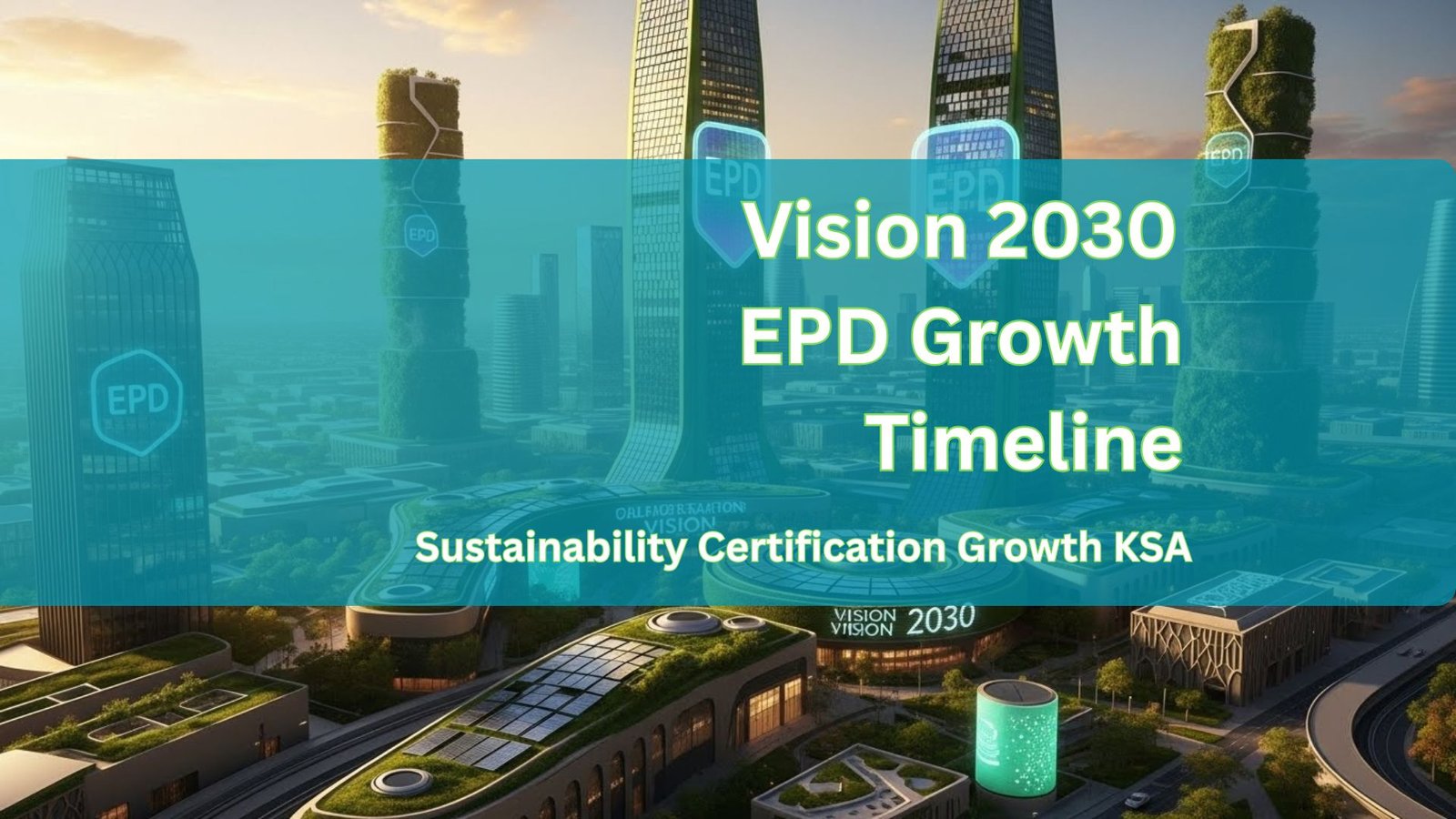
Saudi Arabia is transforming. From the futuristic cityscapes of NEOM to the luxury developments along the Red Sea coast, the kingdom is building its future with sustainability at the core. For manufacturers in KSA and those targeting the Saudi market, understanding how Environmental Product Declarations (EPDs) connect to Vision 2030 isn’t just about compliance anymore. It’s about capturing your share of one of the world’s most ambitious construction booms.
Vision 2030 represents more than economic diversification. It signals a fundamental shift in how Saudi Arabia approaches development, resource management, and environmental responsibility. The Saudi Green Initiative alone aims to plant 10 billion trees and reduce carbon emissions by 278 million tons annually. These aren’t distant goals—they’re reshaping procurement decisions, building codes, and market opportunities right now.
For manufacturers of building materials, MEP systems, interior finishes, and construction products, EPDs have emerged as the bridge between your products and Saudi Arabia’s sustainable future. This guide shows you exactly how to make that connection work for your business.
Key Takeaways
- Vision 2030 sustainability goals are driving demand for EPD Certification Saudi Arabia across all construction sectors
- Giga-projects like NEOM, Qiddiya, and Red Sea Development require comprehensive environmental documentation from suppliers
- EPDs support Saudi Green Initiative targets by quantifying embodied carbon and environmental impacts
- Manufacturers with verified EPDs gain preferential access to government tenders and major private developments
- The kingdom’s circular economy initiatives align perfectly with cradle-to-gate Life Cycle Assessment data in EPDs
- Local manufacturing receives priority under Vision 2030, and EPDs help demonstrate reduced transportation impacts
- Early EPD adoption positions manufacturers ahead of anticipated mandatory environmental disclosure requirements
Understanding Vision 2030’s Sustainability Framework
Saudi Arabia’s Vision 2030 rests on three pillars: a vibrant society, a thriving economy, and an ambitious nation. Environmental sustainability weaves through all three. The kingdom recognizes that long-term economic prosperity requires responsible resource management and climate action.
The Vision 2030 framework includes specific environmental targets that directly impact the construction industry. These include increasing renewable energy production, improving energy efficiency across all sectors, and developing a circular economy that minimizes waste. Each of these goals requires detailed environmental data—exactly what EPDs provide.
The Saudi Green Initiative’s Construction Connection
Announced as part of Vision 2030, the Saudi Green Initiative sets aggressive environmental targets. Beyond tree planting, the initiative focuses on reducing carbon intensity across the economy. Construction and building materials represent significant carbon sources, making them priority areas for intervention.
EPDs enable the measurement and verification needed to track progress toward these goals. When manufacturers provide detailed environmental data through standardized EPDs, project developers can calculate total project impacts, identify reduction opportunities, and demonstrate compliance with emerging sustainability requirements.
Did You Know? Saudi Arabia plans to invest over $186 billion in construction projects aligned with Vision 2030 between 2024 and 2030. More than 40% of these projects have explicit sustainability requirements that favor suppliers with environmental documentation.
How Mega-Projects are Driving EPD Demand
The scale of Saudi Arabia’s giga-projects is unprecedented. NEOM alone represents $500 billion in investment across 26,500 square kilometers. The Red Sea Project, Qiddiya entertainment city, and the expansion of Riyadh are reshaping the kingdom’s landscape. These projects share a common thread: ambitious sustainability commitments that require supplier transparency.
NEOM’s Environmental Standards
NEOM positions itself as the world’s most sustainable region. Powered entirely by renewable energy, the development mandates comprehensive environmental documentation for all building materials and systems. Suppliers must demonstrate not just compliance with basic standards but leadership in environmental performance.
EPD Certification Saudi Arabia has become practically mandatory for NEOM suppliers. The project’s procurement teams evaluate environmental impacts alongside cost and quality. Products with verified EPDs that show low embodied carbon, efficient manufacturing processes, and responsible sourcing gain significant advantages in bid evaluations.
Red Sea Development’s Material Requirements
The Red Sea Project takes a similarly rigorous approach. Covering 28,000 square kilometers of coastline and islands, the development commits to carbon neutrality and zero waste to landfill. These ambitious targets require detailed understanding of every material’s environmental footprint.
Architects and contractors working on Red Sea phases actively seek products with EPDs. The project’s sustainability framework awards points for material transparency, recycled content, and low environmental impact—all documented through Environmental Product Declarations following ISO 14025 standards.
Expert Insight “We’re seeing a fundamental shift in Saudi procurement. Five years ago, EPDs were rarely mentioned. Today, major projects won’t even consider suppliers without environmental documentation. It’s not about being green—it’s about proving you’re green,” reports a procurement specialist working on Vision 2030 projects.
The Business Case for EPDs in the Saudi Market
Understanding how EPDs align philosophically with Vision 2030 matters, but manufacturers need concrete business justification. The investment in EPD development—typically $8,000 to $25,000 per product—requires clear return potential. The Saudi market offers multiple pathways to ROI.
Government Procurement Advantages
Saudi government entities have begun incorporating environmental criteria into tender evaluations. While not always explicitly mandatory, EPDs strengthen proposals in multiple ways:
Technical Evaluation Scores: Tender evaluation matrices increasingly allocate points for environmental documentation. Proposals with verified EPDs score higher in technical assessments, sometimes making the difference between winning and losing contracts.
Prequalification Requirements: Some government agencies now include environmental documentation in supplier prequalification. Without EPDs or equivalent certifications, manufacturers may not even reach the bidding stage.
Value Engineering Recognition: When projects require value engineering, products with EPDs can demonstrate environmental value alongside cost considerations, protecting specifications during budget cuts.
Private Sector Demand Signals
Beyond government projects, Saudi Arabia’s private sector increasingly demands environmental transparency. International developers entering the market bring sustainability expectations from their home markets. Regional family offices and investment groups recognize that sustainable buildings command higher valuations and rental premiums.
This private sector evolution creates opportunity for prepared manufacturers. Those with EPDs can position products for premium segments while competitors remain stuck in commodity pricing battles.
Aligning Your EPD Strategy with Vision 2030 Priorities
Strategic alignment between your environmental documentation and Saudi national priorities strengthens market positioning. Vision 2030 emphasizes specific themes that manufacturers should reflect in their EPD development and marketing.
Circular Economy and Resource Efficiency
The kingdom’s circular economy program aims to minimize waste and maximize resource utilization. EPDs support this goal by documenting recycled content, recyclability potential, and end-of-life scenarios. Manufacturers who can demonstrate circular design principles through verified data gain favor with sustainability-focused buyers.
When developing your EPD, highlight circularity metrics prominently. Show percentage of recycled content, design for disassembly features, and recycling pathways. If your product supports building reuse or adaptive reuse strategies, quantify those benefits.
Localization and Made in Saudi
Vision 2030 prioritizes local manufacturing to reduce import dependence and create employment. For Saudi manufacturers, EPDs provide opportunity to highlight competitive advantages versus imported alternatives. Transportation impacts form part of every Life Cycle Assessment, and local production typically shows lower transportation footprints.
Even for imported products, EPDs help. By transparently documenting transportation impacts, you demonstrate honesty and provide data that project teams need for whole-building assessments. This transparency builds trust even when transportation impacts are higher.
Energy Efficiency and Renewable Energy
The kingdom’s massive investment in renewable energy creates opportunities for manufacturers to align messaging with national priorities. If your manufacturing processes use solar power or other renewables, EPDs document these advantages. Energy efficiency improvements in production likewise show in environmental data.
Products that enable building energy efficiency—insulation, glazing systems, efficient MEP equipment—should emphasize how their use-phase benefits align with Saudi energy goals. While EPDs typically focus on embodied impacts, some Product Category Rules (PCR) allow including use-phase performance, providing powerful marketing data.
Myth vs. Fact Myth: Only construction products need EPDs in Saudi Arabia. Fact: Demand is expanding rapidly to MEP systems, interior finishes, furniture, and building services equipment as projects pursue comprehensive sustainability documentation.
Navigating Saudi-Specific EPD Requirements
While EPDs follow international standards like ISO 14025 and EN 15804+A2, manufacturers targeting Saudi Arabia should understand market-specific considerations that influence EPD strategy and development.
Preferred Verification Bodies
Saudi project teams familiar with international green building certifications recognize established program operators. The International EPD System and programs certified by UL Environment carry strong credibility in the kingdom.
This recognition matters because some projects specify EPDs from accredited programs only. Self-declared environmental claims, even if following similar methodologies, don’t carry the same weight. Third-party verification from recognized bodies is essential for Saudi market success.
Arabic Language Considerations
While technical documentation in English remains standard for now, forward-thinking manufacturers are preparing Arabic versions of their EPDs. As sustainability considerations expand beyond international project teams to broader Saudi stakeholders, Arabic documentation will become increasingly valuable.
Some manufacturers include Arabic executive summaries with English technical details, providing accessibility without duplicating the entire LCA documentation. This approach balances cost with market needs.
PCR Selection for Regional Products
Manufacturers producing products specific to Middle Eastern construction should carefully consider Product Category Rules selection. Some traditional Saudi building materials or construction systems may not have perfectly matching PCRs. In these cases, working with experienced LCA consultants to identify the most appropriate existing PCR or potentially developing new ones becomes important.
Regional construction practices, climate considerations, and material availability all influence EPD relevance. Your EPD should reflect these realities to provide meaningful data for Saudi designers and specifiers.
Step-by-Step Guide to Obtaining Your EPD in KSA
For manufacturers ready to pursue EPD Certification Saudi Arabia, following a structured process ensures efficient development and maximum business value from your investment.
Phase 1: Preparation and Planning (Weeks 1-2)
Define Scope: Identify which products to prioritize based on sales volume, strategic importance, and target projects. Focus first on products most likely to appear in Vision 2030 mega-projects.
Assemble Your Team: Designate internal staff to lead the EPD project. This person should understand your manufacturing processes, have access to production data, and be able to coordinate with suppliers.
Budget Appropriately: Plan for consultant fees, verification costs, and internal staff time. Saudi-based consultants often offer competitive rates while understanding local market context.
Gather Preliminary Data: Begin collecting manufacturing data on energy consumption, raw materials, water use, and waste generation. Good existing records accelerate subsequent phases.
Phase 2: Life Cycle Assessment (Weeks 3-10)
Select LCA Consultant: Choose practitioners experienced with your product category and familiar with Saudi market requirements. Ask for references from other manufacturers who obtained EPDs.
Collect Detailed Data: Work with your consultant to gather comprehensive information on all lifecycle stages. This includes supplier data on raw materials, transportation details, and manufacturing process specifics.
Model Your Product: LCA specialists use software to model your product’s environmental impacts across categories like Global Warming Potential (GWP), acidification, eutrophication, and resource depletion.
Review Preliminary Results: Examine initial calculations to ensure they reflect your operations accurately. This review often reveals data gaps that need filling before proceeding.
Phase 3: Documentation and Verification (Weeks 11-16)
Prepare EPD Draft: Your consultant compiles results into standardized EPD format following applicable PCR requirements and EN 15804+A2 specifications.
Submit for Verification: An independent third-party verifier reviews your data, calculations, and documentation for accuracy and standard compliance.
Address Reviewer Comments: Verifiers typically request clarifications or corrections. Respond promptly to keep the process moving.
Receive Verification Statement: Upon successful review, the verifier issues a statement confirming your EPD meets all requirements.
Phase 4: Publication and Marketing (Weeks 17-20)
Register Your EPD: Submit to appropriate EPD program operators for official registration and publication in international databases.
Update Marketing Materials: Incorporate EPD information into technical datasheets, website content, and sales presentations.
Train Your Sales Team: Ensure sales staff understand what EPDs communicate, how they benefit customers, and when to emphasize environmental data.
Notify Key Customers: Proactively inform architects, contractors, and project developers in your network about your new EPD availability.
Did You Know? Manufacturers who communicate EPDs effectively see average specification increases of 25-40% within 18 months, according to industry surveys of the GCC construction market.
How EPDs Support LEED and BREEAM in Saudi Projects
International green building certifications remain important in Saudi Arabia despite strong local sustainability frameworks. Many Vision 2030 projects pursue LEED certification through the U.S. Green Building Council or BREEAM from the UK. Understanding how EPDs contribute to these certifications helps manufacturers communicate value effectively.
LEED v4.1 Materials and Resources Credits
LEED’s Materials and Resources category underwent significant evolution in version 4.1, placing greater emphasis on transparency and lifecycle thinking. EPDs directly support multiple credit opportunities:
Building Product Disclosure and Optimization – EPDs: Projects earn 1-2 points based on the percentage of permanently installed products with EPDs. One point requires 20 different products from five manufacturers; two points require 40 products from ten manufacturers.
Building Life-Cycle Impact Reduction: When projects conduct whole-building LCA, individual product EPDs provide the data needed for analysis. This credit rewards buildings that demonstrate reduced environmental impacts through material selection.
For manufacturers, this creates clear demand. Contractors working on LEED projects actively seek products with EPDs to help projects achieve materials credits. Your EPD makes specification easier and more likely.
BREEAM Material Requirements
BREEAM takes a slightly different approach but similarly values environmental transparency. The certification evaluates materials across environmental impact, responsible sourcing, and lifecycle performance. EPDs provide data for environmental impact assessment within BREEAM’s Materials category.
BREEAM projects in Saudi Arabia often pursue high ratings (Excellent or Outstanding) that require comprehensive material documentation. Products with EPDs streamline documentation and strengthen BREEAM submissions.
Connecting EPDs to Carbon Credit Opportunities
Saudi Arabia’s participation in global carbon markets and development of regional carbon trading mechanisms creates emerging opportunities for manufacturers with detailed environmental data. While still evolving, these markets will increasingly value the transparency EPDs provide.
Understanding Embodied Carbon Baselines
Carbon credit systems require baseline establishment before measuring improvements. EPDs document your current embodied carbon, creating the baseline from which future reductions can be measured and potentially monetized.
As Saudi Arabia develops its carbon pricing mechanisms under Vision 2030, products with established environmental baselines will be positioned to demonstrate continuous improvement. This documentation could translate to carbon credits or preferential treatment under future carbon regulations.
Supply Chain Emissions and Scope 3 Reporting
Large Saudi companies increasingly face pressure to report Scope 3 emissions—those occurring in their supply chain. When your products have EPDs, you make it easier for customers to calculate their Scope 3 footprints accurately.
This capability becomes a competitive advantage. Procurement teams prioritize suppliers who simplify their environmental reporting obligations. Your EPD transforms from a product-level certification to a supply chain enabler.
Expert Insight “We’re helping Saudi manufacturers understand that EPDs are strategic assets beyond marketing. They’re data infrastructure for the emerging carbon economy. Early investment positions companies to capture value as these markets mature,” notes a sustainability consultant working with regional manufacturers.
Common Questions Saudi Manufacturers Ask About EPDs
Based on hundreds of manufacturer conversations across the kingdom, several questions consistently arise. Addressing these helps clarify the EPD process and business case.
“Our Competitors Don’t Have EPDs Yet—Why Should We?”
First-mover advantage in the Saudi market is real. Major projects have long procurement timelines. Architects and specifiers developing designs today are building relationships with environmentally transparent suppliers. When competitors obtain EPDs later, you’ll already be specified on multiple projects.
Additionally, the learning curve matters. Your first EPD takes longer and costs more than subsequent ones. Starting now builds internal capability that becomes increasingly valuable as market requirements tighten.
“We’re a Small Manufacturer—Are EPDs Only for Large Companies?”
Size doesn’t determine EPD feasibility. Many Saudi SMEs have successfully obtained certifications. What matters is data quality and willingness to invest in the process. Smaller manufacturers sometimes have advantages—simpler supply chains and more direct control over production data.
Industry-wide EPDs offer another path. Multiple small manufacturers can collaborate on a single EPD representing typical production for their product category, sharing costs while gaining market access.
“How Do We Know Our EPD Will Actually Help Sales?”
Track specification rates before and after EPD publication. Monitor tender outcomes where environmental criteria are scored. Survey your architect and contractor customers about their needs. The data consistently shows EPDs improve commercial outcomes for manufacturers targeting sustainability-focused projects.
Set clear KPIs when beginning your EPD process. Measure inquiry volumes, tender success rates, and specification appearances. This data-driven approach proves ROI and justifies continued investment in environmental documentation.
Future-Proofing Your Business for Saudi Sustainability Mandates
The trajectory is clear: environmental documentation requirements will become more stringent, not less. Vision 2030’s mid-point review and ongoing policy development suggest mandatory disclosure requirements are coming to Saudi Arabia. Manufacturers who prepare now avoid scrambling later.
Anticipated Regulatory Developments
While no official mandatory EPD requirements exist yet for most Saudi construction, industry observers note several signals suggesting future mandates:
Building Code Evolution: The Saudi Building Code undergoes regular updates. Future revisions may incorporate environmental performance requirements similar to those emerging in European building codes.
Government Procurement Reform: Public procurement is modernizing to support Vision 2030 goals. Environmental criteria will likely become formal requirements rather than preferred attributes.
Green Finance Conditions: As sustainable finance grows in the kingdom, lenders may require environmental documentation for financed projects, creating indirect mandates for suppliers.
Building Internal Capability
Beyond obtaining EPDs for current products, forward-thinking manufacturers invest in building internal environmental management capability. This includes:
Data Collection Systems: Implementing robust tracking of energy, water, materials, and waste in production processes. Good data infrastructure makes future EPDs faster and cheaper to develop.
Staff Training: Educating engineers and managers about lifecycle thinking, environmental impacts, and continuous improvement opportunities revealed through LCA.
Supplier Engagement: Working with your supply chain to improve their environmental transparency. Upstream data quality directly affects your EPD quality and environmental performance improvement potential.
Myth vs. Fact Myth: Once you have an EPD, you’re done for years. Fact: While EPDs remain valid for five years, leading manufacturers use them as tools for continuous improvement, updating voluntarily when they make environmental performance improvements worth communicating.
Integrating EPDs with Your Saudi Marketing Strategy
Obtaining an EPD represents significant investment. Maximizing return requires strategic marketing that connects environmental documentation to customer needs and project requirements.
Technical Documentation Updates
Your EPD should appear prominently in technical materials that architects and engineers rely on for specification:
Product Datasheets: Include EPD availability as a key feature alongside technical performance specifications. Provide download links or QR codes for easy access.
BIM Objects: As Building Information Modeling becomes standard in Saudi projects, embed environmental data from your EPD into BIM objects. This integration allows designers to evaluate environmental impacts during design.
CEU Presentations: Continuing education programs for architects should incorporate environmental performance discussions, positioning your products as solutions for sustainability-focused projects.
Digital Marketing Approaches
Saudi Arabia has among the highest internet penetration rates globally. Digital marketing strategies should emphasize environmental credentials:
SEO Optimization: Ensure your website ranks for searches like “EPD certified [product] Saudi Arabia” or “sustainable [product category] Vision 2030.”
LinkedIn Targeting: The kingdom’s architect and engineering community is active on LinkedIn. Sponsored content highlighting your EPD can reach decision-makers efficiently.
Case Studies: Develop detailed case studies showing how your products contributed to successful sustainable projects. Name recognition from high-profile developments enhances credibility.
Trade Show and Direct Sales
Physical presence remains important in Saudi business culture. Translate EPD benefits into tangible sales messages:
The Big 5 Saudi: Major construction trade shows provide platforms to showcase environmental leadership. Display EPD certificates prominently and train booth staff to discuss environmental performance.
Lunch and Learns: Host sessions for architect and contractor offices where you present both technical performance and environmental data. Many firms actively seek this education as sustainability requirements increase.
Project-Specific Proposals: When responding to tenders or proposals, customize environmental messaging to align with each project’s specific sustainability goals.
Taking Action: Your EPD Roadmap for Saudi Success
Understanding how EPDs align with Vision 2030 is valuable. Implementation is what separates market leaders from followers. Whether you manufacture in Riyadh, Jeddah, Dammam, or anywhere in the kingdom, these actions will position your products for Saudi Arabia’s sustainable future.
Immediate Next Steps (This Month)
Audit Current Documentation: Review what environmental information you currently provide to customers. Identify gaps that EPDs would fill.
Research Major Projects: Study sustainability requirements for Vision 2030 mega-projects relevant to your products. Document how frequently EPDs are mentioned or required.
Connect with EPD Consultants: Reach out to LCA practitioners in Saudi Arabia or the broader GCC region. Request proposals and timeline estimates for your priority products.
Engage Leadership: Present the business case to decision-makers, emphasizing market access, competitive positioning, and alignment with national priorities.
Medium-Term Goals (Next Quarter)
Initiate EPD Development: Select your first product and begin formal LCA data collection with your chosen consultant.
Build Internal Capability: Implement data collection systems that will support both your current EPD and make future certifications easier.
Prepare Marketing Materials: Begin developing updated technical documentation, website content, and sales training materials that will launch when your EPD publishes.
Network Strategically: Attend industry events focusing on sustainable construction in Saudi Arabia. Build relationships with sustainability consultants, green building specialists, and project developers.
Long-Term Strategy (This Year)
Expand EPD Portfolio: After completing your first EPD, identify additional products that would benefit from certification.
Pursue Continuous Improvement: Use insights from your LCA to identify environmental performance improvement opportunities. Manufacturing efficiency often improves alongside environmental performance.
Share Your Story: Develop case studies and success stories that help other manufacturers understand EPD value. Positioning yourself as an environmental leader builds long-term brand strength.
Key Takeaways: EPDs as Vision 2030 Success Tools
The connection between Environmental Product Declarations and Saudi Vision 2030 runs deep. EPDs aren’t just compliance documents or marketing tools—they’re strategic assets that position manufacturers for success in the kingdom’s transformation.
Vision 2030 is reshaping Saudi Arabia’s construction industry fundamentally. The giga-projects grabbing international headlines represent only part of the story. Behind them lies systematic evolution of procurement practices, building standards, and market expectations around environmental performance.
Manufacturers who recognize this evolution and invest in proper environmental documentation today will capture disproportionate market share tomorrow. Your competitors without EPDs won’t simply be at a disadvantage—they’ll be excluded from major opportunities entirely.
The kingdom’s commitment to sustainability isn’t temporary or superficial. It reflects strategic thinking about long-term competitiveness, resource management, and quality of life. Aligning your business with these national priorities through verified environmental transparency positions you as a partner in Saudi Arabia’s future, not just a supplier to its present.
Final Thought Vision 2030 represents unprecedented opportunity for manufacturers who align with its priorities. EPD certification is your bridge to that opportunity. The question isn’t whether environmental documentation will become essential in Saudi Arabia—it’s whether you’ll have it ready when your next major project opportunity arrives.
Frequently Asked Questions
1. Is EPD certification mandatory for Vision 2030 projects in Saudi Arabia?
Currently, EPDs are not universally mandatory but are increasingly required or strongly preferred in major projects like NEOM and Red Sea Development. Government procurement scoring systems now allocate points for environmental documentation, making EPDs effectively essential for competitive bids even without explicit mandates.
2. How much does EPD development cost for Saudi manufacturers?
EPD costs typically range from $8,000 to $25,000 per product in the Saudi market, depending on product complexity, data availability, and consultant selection. Manufacturers with multiple similar products can reduce per-product costs by leveraging existing data and relationships with verification bodies.
3. Can we use international EPDs for the Saudi market or do we need Saudi-specific ones?
International EPDs following ISO 14025 and EN 15804+A2 standards are fully acceptable in Saudi Arabia. The standards are globally recognized, and major Saudi projects accept EPDs from established international program operators. However, highlighting local manufacturing or regional supply chain benefits can strengthen market positioning.
4. How do EPDs help with the Saudi Green Initiative targets?
EPDs provide quantified data on embodied carbon and environmental impacts that the Saudi Green Initiative needs to measure progress toward emission reduction targets. They enable transparent tracking of construction sector impacts and help identify areas for improvement aligned with national climate goals.
5. What happens if our manufacturing process changes after we obtain an EPD?
Minor operational variations typically don’t require immediate updates. However, significant changes to raw materials, energy sources, or production methods should be reflected in updated EPDs to maintain accuracy. EPDs remain valid for five years, at which point comprehensive updates are required regardless of changes.
6. Do we need Arabic language EPDs for the Saudi market?
English EPDs are currently standard and accepted across Saudi Arabia’s construction industry. However, some forward-thinking manufacturers are creating Arabic executive summaries to improve accessibility for broader stakeholder groups as sustainability awareness expands beyond international project teams.
7. How long does the complete EPD process take in Saudi Arabia?
From project initiation to publication, expect 4-6 months for your first EPD. This includes data collection (2-3 months), LCA calculation and documentation (4-6 weeks), third-party verification (4-6 weeks), and publication (2-3 weeks). Timeline depends heavily on data availability and responsiveness to verifier questions.
Glossary of Key Terms
1. Vision 2030: Saudi Arabia’s strategic framework for economic diversification and social development, including significant sustainability commitments and environmental targets.
2. Saudi Green Initiative: National program aimed at reducing carbon emissions by 278 million tons annually, planting 10 billion trees, and protecting natural ecosystems across Saudi Arabia.
3. Embodied Carbon: Total greenhouse gas emissions generated during a product’s manufacturing, transportation, and installation phases, measured in kilograms of CO2 equivalent.
4. Giga-Project: Large-scale development initiatives in Saudi Arabia including NEOM, Red Sea Project, and Qiddiya, representing hundreds of billions in investment and ambitious sustainability goals.
5. Product Category Rules (PCR): Standardized methodologies for conducting Life Cycle Assessments and developing EPDs for specific product categories, ensuring comparability between similar products.
6. Third-Party Verification: Independent review and validation of EPD data by accredited verifiers to ensure accuracy, completeness, and compliance with international standards.
7. Cradle-to-Gate: LCA system boundary covering all processes from raw material extraction through the manufacturing facility gate, excluding transportation, installation, use, and disposal phases.
8. Global Warming Potential (GWP): Measure of how much heat a greenhouse gas traps in the atmosphere relative to carbon dioxide, used to standardize climate impact assessments across different emissions.
9. Circular Economy: Economic system aimed at minimizing waste and maximizing resource utilization through design for longevity, reuse, refurbishment, remanufacturing, and recycling.
10. Scope 3 Emissions: Indirect greenhouse gas emissions occurring in a company’s value chain, including supplier operations, product transportation, and product use—areas where EPDs provide essential data.