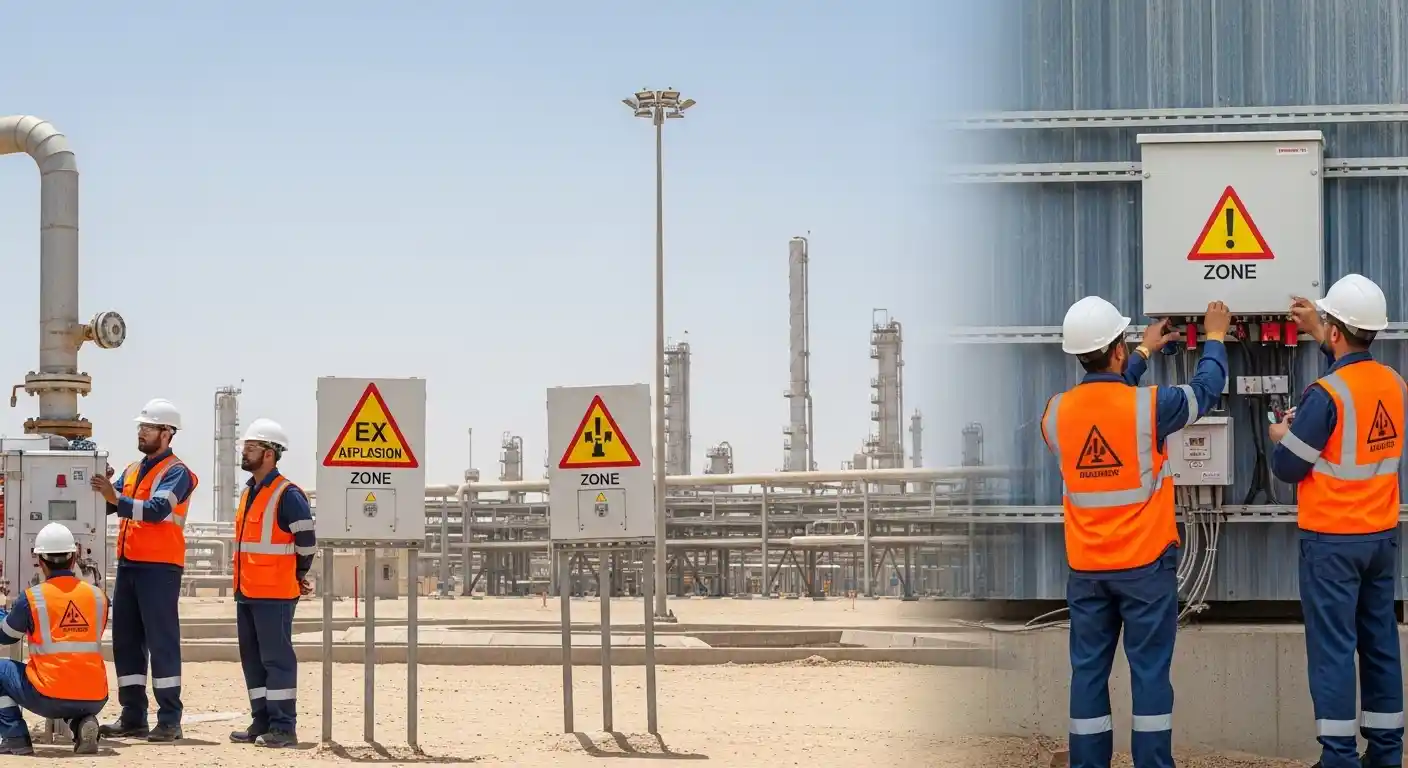

Introduction
The International Electrotechnical Commission’s Explosive Atmospheres Certification Scheme (IECEx) represents the global gold standard for hazardous area competence. Within this comprehensive framework, the Certificate of Personnel Competence (CoPC) validates individual professional capability to work safely and effectively in explosive atmosphere environments.
Across the GCC region—from Abu Dhabi’s offshore platforms to Riyadh’s petrochemical complexes, from Doha’s LNG terminals to Muscat’s refineries—IECEx CoPC certification increasingly distinguishes elite professionals from general practitioners. As international standards harmonize and multinational corporations standardize requirements, CoPC credentials provide the passport to premium global opportunities.
This definitive guide explores every aspect of IECEx CoPC certification, helping you understand competence levels, select appropriate units, navigate certification processes, and leverage credentials for maximum career advancement across the UAE, Saudi Arabia, Qatar, Oman, and beyond.
Key Takeaways
- IECEx CoPC offers three competence levels (1, 2, 3) based on experience and technical responsibility
- Certification uses modular “units” allowing customization to specific roles (Ex 00 through Ex 06)
- Unlike COMPEX’s practical focus, IECEx emphasizes theoretical knowledge and international standards
- Five-year validity period (vs COMPEX’s three years) reduces renewal frequency
- Global recognition in 30+ countries supports international career mobility
- GCC employers increasingly prefer or require IECEx for engineering, design, and inspection roles
- Costs range AED 4,500-15,000 depending on competence level and units selected
- Strategic combination with COMPEX creates comprehensive hazardous area credentials
- CoPC certification demonstrates commitment to international best practices and professional excellence
Understanding IECEx CoPC: What It Is and Why It Matters
The Certificate of Personnel Competence represents IECEx’s approach to validating individual professional capabilities in explosive atmosphere work. Understanding CoPC’s structure and purpose clarifies its value proposition.
What Is IECEx CoPC?
CoPC certifies that individuals possess:
- Theoretical knowledge of explosive atmosphere principles
- Understanding of relevant IEC 60079 series standards
- Ability to apply standards correctly in professional contexts
- Competence appropriate to their experience level and role
Unlike equipment or service certification, CoPC focuses exclusively on individual professional competence.
Why CoPC Matters in Modern Industry:
1. International Standardization
Global projects demand standardized competency frameworks. CoPC provides internationally consistent competence demonstration.
Benefits:
- Eliminates regional variation in competency interpretation
- Enables workforce mobility across international borders
- Satisfies multinational client requirements uniformly
- Supports project teams drawing from global talent pools
2. Regulatory Alignment
Many jurisdictions increasingly reference IECEx standards in regulations. CoPC demonstrates compliance with these evolving requirements.
Regulatory Context:
- IEC 60079-14 requires “competent persons” for hazardous area work
- IEC 60079-17 mandates qualified personnel for inspection/maintenance
- CoPC provides recognized evidence meeting these requirements
- Reduces organizational compliance risk and liability
3. Professional Differentiation
In competitive markets, CoPC credentials distinguish committed professionals from general practitioners.
Market Advantages:
- Access to positions specifying IECEx requirements
- Salary premiums for internationally recognized competence
- Enhanced credibility with clients and employers
- Career progression into specialist and senior roles
4. Knowledge Depth and Currency
CoPC certification process ensures comprehensive theoretical understanding and current standards knowledge.
Technical Benefits:
- Deep understanding of IEC 60079 series standards
- Ability to interpret and apply standards correctly
- Recognition of standards updates and revisions
- Theoretical foundation supporting complex problem-solving
The comprehensive IECEx CoPC certification guide provides detailed insights into this credential’s professional value.
IECEx CoPC Competence Levels Explained
CoPC uses three-tier competence level structure matching professional experience and technical responsibility. Understanding levels helps you target appropriate certification.
Level 1: Foundation Competence
Target Audience:
- Entry-level technicians and operators
- Personnel requiring awareness and basic competence
- Those supporting hazardous area work without direct responsibility
- Professionals early in hazardous area careers (2-5 years experience)
Typical Roles:
- Junior electrical technicians
- Maintenance assistants
- Operations personnel in hazardous areas
- Support staff requiring competence awareness
Knowledge Scope:
- Fundamental explosive atmosphere concepts
- Basic area classification understanding
- Introduction to protection methods
- Elementary equipment recognition
- Awareness of standards and compliance requirements
Typical Training Duration: 3-5 days
Cost Range (GCC): AED 2,500-4,500
Level 2: Intermediate/Technical Competence
Target Audience:
- Experienced technicians and engineers
- Specialists in installation, inspection, or maintenance
- Personnel with direct technical responsibility
- Professionals with 5-10 years relevant experience
Typical Roles:
- Electrical engineers and senior technicians
- Installation and commissioning specialists
- Inspection and certification personnel
- Maintenance planners and supervisors
- Project engineers overseeing hazardous area work
Knowledge Scope:
- Comprehensive equipment protection principles
- Detailed area classification methodologies
- Installation, inspection, or maintenance specialization
- Standards interpretation and application
- Technical decision-making and problem-solving
Typical Training Duration: 5-8 days (unit-dependent)
Cost Range (GCC): AED 4,000-8,000
Level 3: Advanced/Expert Competence
Target Audience:
- Senior engineers and technical authorities
- Design professionals and consultants
- Personnel with ultimate technical responsibility
- Experts with 10+ years specialized experience
Typical Roles:
- Design engineers creating hazardous area systems
- Technical authorities with approval responsibilities
- Senior consultants and specialists
- Standards development participants
- Expert witnesses and auditors
Knowledge Scope:
- Advanced design principles and methodologies
- Complex problem-solving and novel applications
- Comprehensive standards mastery
- Risk assessment and deviation management
- Technical leadership and decision authority
Typical Training Duration: 10-15 days (unit-dependent)
Cost Range (GCC): AED 8,000-15,000
Competence Level Comparison:
| Aspect | Level 1 | Level 2 | Level 3 |
|---|---|---|---|
| Experience Typical | 2-5 years | 5-10 years | 10+ years |
| Responsibility | Supervised work | Independent technical work | Technical authority |
| Knowledge Depth | Fundamental | Comprehensive | Expert |
| Decision Scope | Routine tasks | Technical judgments | Complex approvals |
| Standards Focus | Awareness | Application | Interpretation |
| Career Stage | Entry-level | Mid-career professional | Senior specialist |
| Typical Salary (GCC) | AED 8,000-15,000 | AED 15,000-30,000 | AED 30,000-60,000+ |
Choose the level matching your current experience and responsibility rather than aspirational goals. Progression to higher levels occurs naturally as your career advances.
IECEx CoPC Units: Building Your Custom Certification
Unlike fixed module structures, IECEx uses flexible “unit” system allowing customized certification matching specific roles. Understanding units helps you build optimal credential combination.
Core Units Available:
Ex 00: Explosive Atmospheres – Core
Foundational unit required for all CoPC certifications regardless of level.
Content Coverage:
- Explosive atmosphere formation principles
- Fire triangle and ignition sources
- Flammable limits and combustion
- Area classification fundamentals (Zones 0-2, 20-22)
- Temperature classes and gas groups
- Equipment protection concepts overview
- Regulatory frameworks and standards structure
Who Needs This: Everyone pursuing CoPC certification
Typical Duration: Included in Level 1 (3-5 days), reviewed in higher levels
Ex 01: Electrical Installations – Installation
Specialized unit for installation and construction professionals.
Content Focus:
- Cable selection and installation requirements
- Cable gland types and installation
- Equipment mounting and enclosure integrity
- Earthing and bonding requirements
- Installation verification and testing
- Documentation and as-built records
- Commissioning procedures
Best For:
- Installation engineers and supervisors
- Construction project managers
- Commissioning specialists
- Field engineers
Typical Duration: 2-3 days (Level 2), 3-4 days (Level 3)
Ex 02: Electrical Installations – Inspection
Specialized unit for inspection and verification professionals.
Content Focus:
- Inspection methodologies (visual, close, detailed)
- Installation defect identification
- Inspection frequency and scheduling
- Documentation and reporting requirements
- Certification and compliance verification
- Maintenance standard application
- Competency requirements for inspectors
Best For:
- Inspection specialists and auditors
- QA/QC engineers
- Certification body personnel
- Third-party verification professionals
Typical Duration: 2-3 days (Level 2), 3-5 days (Level 3)
Ex 03: Electrical Installations – Maintenance
Specialized unit for maintenance and repair professionals.
Content Focus:
- Maintenance planning and execution
- Protection integrity during maintenance
- Component replacement and approval
- Testing and verification after work
- Refurbishment vs replacement decisions
- Maintenance documentation requirements
- Fault finding and troubleshooting
Best For:
- Maintenance engineers and technicians
- Asset integrity professionals
- Workshop supervisors
- Maintenance planners
Typical Duration: 2-3 days (Level 2), 3-4 days (Level 3)
Ex 04: Electrical Installations – Design
Advanced unit for design professionals (typically Level 3 only).
Content Focus:
- Hazardous area electrical system design
- Equipment selection and specification
- Installation design and detailing
- Risk assessment and management
- Standards interpretation for design
- Design verification and approval
- Novel application engineering
Best For:
- Design engineers
- Principal engineers
- Technical authorities for design
- Engineering consultants
Typical Duration: 4-6 days (Level 3)
Ex 05: Process Instrumentation
Specialized unit for instrumentation and control professionals.
Content Focus:
- Instrumentation system design principles
- Field device selection and installation
- Intrinsic safety system design
- Signal circuits and earthing
- Functional safety integration
- Instrumentation inspection and maintenance
- Documentation and loop diagrams
Best For:
- Instrumentation engineers
- Control systems specialists
- I&C maintenance personnel
- Process automation professionals
Typical Duration: 3-5 days (unit and level dependent)
Ex 06: Mechanical Equipment
Specialized unit for mechanical professionals working with rotating equipment and mechanical systems in hazardous areas.
Content Focus:
- Non-electrical ignition sources
- Mechanical equipment protection
- Hot surface management
- Rotating equipment in hazardous areas
- Mechanical installation requirements
- Mechanical inspection principles
- Maintenance of mechanical equipment
Best For:
- Mechanical engineers
- Rotating equipment specialists
- Mechanical maintenance personnel
- Vibration analysts
Typical Duration: 3-4 days
Unit Selection Strategies:
Strategy 1: Role-Based Selection
Choose units directly supporting your current job responsibilities:
Examples:
- Installation Engineer: Ex 00 + Ex 01
- Inspection Specialist: Ex 00 + Ex 02
- Maintenance Supervisor: Ex 00 + Ex 03
- Design Engineer: Ex 00 + Ex 04
- Instrumentation Engineer: Ex 00 + Ex 05
Strategy 2: Career Progression Selection
Add units progressively as career evolves:
Progression Example:
- Year 1-3: Level 1 (Ex 00)
- Year 4-6: Level 2 (Ex 00 + Ex 01 or Ex 02)
- Year 7-10: Level 2 (Add Ex 03)
- Year 10+: Level 3 (Ex 00 + Ex 04)
Strategy 3: Comprehensive Versatility
Pursue multiple units for maximum flexibility:
Comprehensive Options:
- Ex 00 + Ex 01 + Ex 02 + Ex 03 (complete electrical competence)
- Ex 00 + Ex 01 + Ex 05 (electrical + instrumentation)
- Ex 00 + Ex 02 + Ex 06 (inspection across disciplines)
This approach maximizes career options but requires greater time and financial investment.
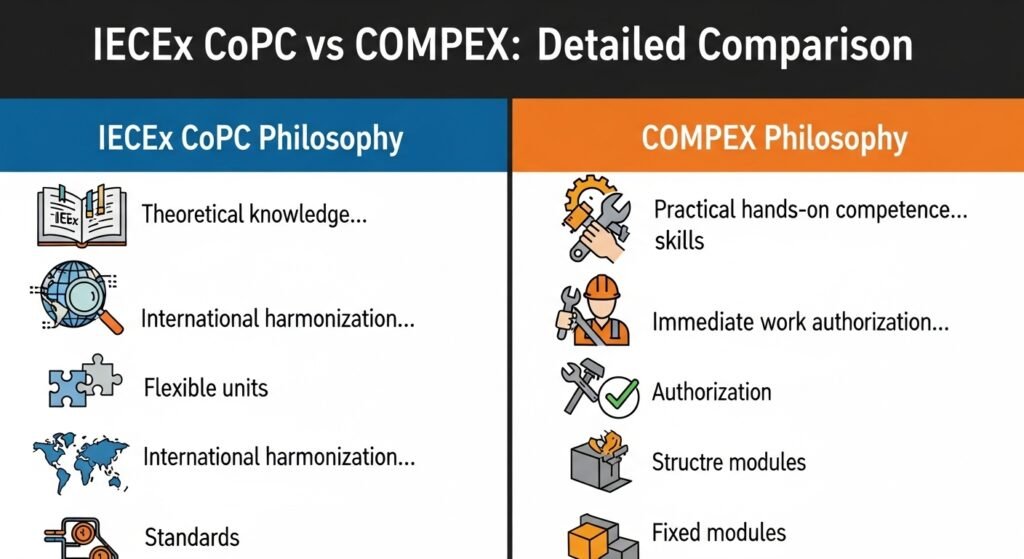
IECEx CoPC vs COMPEX: Detailed Comparison
Many professionals wonder whether to pursue IECEx CoPC, COMPEX, or both. Understanding detailed differences helps you decide strategically.
Fundamental Philosophical Differences:
IECEx CoPC Philosophy:
- Theoretical knowledge and standards mastery
- International harmonization and consistency
- Competence levels matching experience
- Flexible unit-based customization
- Standards interpretation emphasis
COMPEX Philosophy:
- Practical hands-on competence
- Immediate work authorization
- Fixed module structure (Ex01-Ex04)
- Practical assessment alongside theory
- UK-originated, internationally adopted
Detailed Comparison Table:
| Aspect | IECEx CoPC | COMPEX |
|---|---|---|
| Primary Focus | Theoretical knowledge & standards | Practical competence & application |
| Assessment | Written examination (theory) | Written + practical assessment |
| Structure | 3 levels + flexible units | 4 fixed modules |
| Validity | 5 years | 3 years |
| Renewal | CPD-based or reassessment | Refresher training + exam |
| Recognition | 30+ countries globally | Strong in GCC, UK, Asia-Pacific |
| Standards Depth | Comprehensive IEC 60079 focus | Practical standards application |
| Cost (GCC) | AED 4,500-15,000 | AED 3,500-8,000 |
| Training Duration | 3-15 days (level-dependent) | 5-10 days (all modules) |
| Best For | Engineers, designers, consultants | Technicians, field personnel, operators |
| Industry Preference | Design firms, multinationals, consultancies | Operators, construction, maintenance |
| Career Stage | All stages with level progression | Early to mid-career primarily |
When to Choose IECEx CoPC:
Choose CoPC if you:
- Hold engineering or design roles
- Work for international corporations
- Need recognized credentials across multiple countries
- Value comprehensive theoretical understanding
- Target consultancy or senior technical positions
- Work in jurisdictions emphasizing IEC standards
- Plan career spanning multiple global markets
When to Choose COMPEX:
Choose COMPEX if you:
- Perform hands-on installation, maintenance, or inspection work
- Work primarily in GCC operational contexts
- Need practical competence validation
- Prefer shorter training duration
- Target field technician or operational roles
- Work for operators emphasizing practical skills
- Value practical assessment alongside theory
When to Choose Both:
Pursue dual certification if you:
- Hold or aspire to senior technical positions
- Want maximum career flexibility
- Work in organizations with diverse project types
- Target technical authority designations
- Plan international consulting practice
- Seek premium compensation commands
- Value comprehensive competence (theory + practice)
Understanding COMPEX vs IECEx: understanding the key differences helps you make informed strategic decisions aligned with career goals.
IECEx CoPC Certification Process: Step-by-Step
Navigating the CoPC certification process systematically increases success probability. Follow this comprehensive pathway.
Step 1: Assess Your Eligibility and Readiness
Before enrolling, evaluate prerequisites and preparation:
Experience Requirements:
- Level 1: 2-5 years relevant experience typically
- Level 2: 5-10 years demonstrated competence
- Level 3: 10+ years specialized expertise
Educational Background:
- Technical education relevant to your target units
- Engineering degree beneficial but not always mandatory
- Demonstrated technical competence in your field
Knowledge Baseline:
- Solid understanding of electrical or mechanical fundamentals
- Familiarity with hazardous area concepts
- Experience reading technical standards
- Professional English literacy
Step 2: Select Appropriate Level and Units
Choose certification matching your current role and experience:
Selection Considerations:
- Current job responsibilities and scope
- Years of relevant experience honestly assessed
- Technical decision-making authority you hold
- Career goals for next 3-5 years
- Budget and time available for training
Common Selection Examples:
- Junior Engineer (3 years exp): Level 1, Ex 00
- Experienced Technician (7 years): Level 2, Ex 00 + Ex 01 or Ex 03
- Senior Inspector (8 years): Level 2, Ex 00 + Ex 02
- Design Engineer (12 years): Level 3, Ex 00 + Ex 04
- Technical Authority (15 years): Level 3, Ex 00 + Ex 02 + Ex 04
Step 3: Choose Accredited Training Provider
Select quality training center ensuring proper preparation:
Verification Steps:
- Confirm IECEx Training Body (ExTB) accreditation status
- Review instructor qualifications and experience
- Check facility quality and learning resources
- Research historical examination pass rates
- Compare costs and value comprehensively
- Assess post-training support availability
Research IECEx certification training providers across the GCC.
Step 4: Complete Training Course
Attend full training program with active engagement:
Training Optimization:
- Arrive prepared with basic knowledge reviewed
- Take comprehensive notes during sessions
- Ask questions immediately when concepts confuse
- Participate actively in discussions and exercises
- Study each evening reviewing day’s content
- Identify weak areas requiring extra study
- Build relationships with instructors and peers
Step 5: Prepare for Examination
Dedicate focused study time post-training:
Examination Preparation:
- Review all training notes systematically
- Study IEC 60079 standards sections covered
- Practice with provided sample questions
- Focus on weak areas identified
- Form study groups if possible
- Schedule mock examinations
- Manage time effectively during preparation period
Recommended Study Time:
- Level 1: 20-40 hours post-training
- Level 2: 40-60 hours post-training
- Level 3: 60-80 hours post-training
Step 6: Take Certification Examination
Attend scheduled examination prepared and confident:
Examination Day:
- Arrive early, well-rested
- Bring required identification
- Have permitted materials (if any)
- Read all questions carefully
- Manage time effectively (don’t dwell on difficult questions)
- Answer all questions (no blank submissions)
- Review answers if time permits
Examination Format:
- Multiple choice questions
- Technical scenario analysis
- Standards interpretation exercises
- Calculation problems (where applicable)
- Duration: 90-240 minutes depending on level and units
Step 7: Receive Results and Certificate
Results typically arrive within 2-4 weeks:
Upon Passing:
- Certificate processed and issued (4-8 weeks)
- Registration in IECEx CoPC database
- Digital certificate access often available sooner
- Physical certificate mailed to address
Certificate Includes:
- Your name and identification details
- Competence level achieved
- Units successfully completed
- Issue date and expiry date (5 years)
- Unique certificate number
- IECEx scheme logos and authentication
Step 8: Leverage Your Certification
Immediately begin using your new credential:
Activation Steps:
- Update resume/CV with certification details
- Add credential to LinkedIn and professional profiles
- Inform current employer (provide certificate copy)
- Update internal competency systems
- Begin seeking advancement or better opportunities
- Set calendar reminders for 5-year renewal
If You Don’t Pass Initial Attempt:
Don’t despair—many successful professionals require resits:
Resit Strategy:
- Request detailed feedback on weak areas
- Target study toward specific gaps
- Consider additional coaching if available
- Allow adequate preparation time before resit
- Maintain confidence—knowledge exists, refine application
Most schemes allow 2-3 resit attempts before requiring retraining.
IECEx CoPC Renewal and Maintenance Requirements
CoPC certificates require renewal every five years. Understanding maintenance obligations ensures continuous credential validity.
Five-Year Validity Period:
CoPC’s longer validity (vs COMPEX’s 3 years) reduces renewal frequency but demands ongoing competence maintenance.
Renewal Pathways:
Option 1: CPD-Based Renewal
Demonstrate continuing professional development throughout validity period:
CPD Requirements:
- Documented minimum CPD hours in relevant activities
- Typically 40-80 hours over 5-year period
- CPD categories: training, conferences, self-study, project work, standards committee participation
- Maintain CPD log with dates, activities, learning outcomes
CPD Documentation:
- Course certificates and training records
- Conference attendance proof
- Published papers or presentations
- Project documentation showing competence application
- Committee participation records
- Professional reading logs
Option 2: Refresher Assessment
Complete abbreviated refresher program and simplified examination:
Refresher Characteristics:
- Shorter than initial training (typically 30-50% duration)
- Focuses on standards updates and key concepts
- Simplified assessment vs initial examination
- Usually offered by training providers near expiry
Costs: Typically 40-60% of initial certification cost
Option 3: Full Re-Certification
If CPD insufficient or preference for complete refresh:
Full Recertification:
- Complete initial training and examination again
- Resets knowledge comprehensively
- Most expensive and time-consuming option
- Typically only necessary if certification lapsed significantly
Renewal Timeline and Planning:
5-Year Validity Management:
Years 1-3: Focus on role performanceRetry
KH
Continue
and accumulating CPD naturally through work activities, training attended, and professional development
Year 4: Begin systematic CPD documentation
- Review accumulated activities and record them formally
- Identify any CPD gaps requiring attention
- Attend relevant conferences or training to supplement
- Maintain organized CPD portfolio
18 Months Before Expiry: Initiate renewal planning
- Contact certification body about renewal procedures
- Assess CPD sufficiency for renewal eligibility
- Determine whether refresher assessment needed
- Budget for renewal costs
12 Months Before Expiry: Finalize renewal approach
- Submit CPD documentation if pursuing CPD-based renewal
- Register for refresher training if required
- Allocate time and budget for renewal activities
- Communicate with employer about renewal plans
6 Months Before Expiry: Execute renewal
- Complete any required refresher training
- Submit all renewal documentation
- Pay renewal fees
- Confirm renewal processing timeline
Before Expiry: Receive renewed certificate
- Updated certificate with new 5-year validity
- Continuous certification status maintained
- Updated registration in IECEx database
- No employment disruption from expired credentials
Renewal Costs (GCC Typical):
CPD-Based Renewal:
- Administrative processing: AED 500-1,000
- No additional training costs if CPD sufficient
- Total: AED 500-1,000
Refresher Assessment Renewal:
- Refresher training: AED 2,000-5,000
- Assessment fees: AED 500-1,500
- Administrative processing: AED 500-1,000
- Total: AED 3,000-7,500
Full Re-Certification:
- Initial certification costs apply
- Level 1: AED 2,500-4,500
- Level 2: AED 4,000-8,000
- Level 3: AED 8,000-15,000
Renewal Best Practices:
- Document CPD Throughout Validity Period: Don’t wait until renewal approaches—maintain running CPD log from Day 1
- Exceed Minimum Requirements: Aim for 20-30% more than minimum CPD hours providing buffer for renewal
- Diversify CPD Activities: Mix training, conferences, self-study, and practical application for well-rounded development
- Align CPD with Career Goals: Choose professional development activities supporting your career trajectory
- Leverage Employer Support: Many employers sponsor renewal training recognizing certification’s business value
- Plan Early: Don’t leave renewal to last minute—complications can cause unwanted certification lapses
- Consider Renewal Location: International professionals might time renewal with home country visits for cost savings
Understanding the importance of continuing education in COMPEX training and certification applies equally to IECEx—continuous learning maintains competence relevance.
IECEx CoPC for Different Industry Sectors
IECEx CoPC benefits professionals across diverse industries. Understanding sector-specific applications helps you leverage certification effectively.
Oil & Gas Sector:
Upstream (Exploration & Production):
- Offshore platform electrical systems
- Wellhead and production facility installations
- Remote field operations
- Subsea equipment and controls
Relevant Units: Ex 00 + Ex 01 (installation), Ex 02 (inspection), Ex 03 (maintenance)
Midstream (Processing & Transportation):
- Gas processing plants
- Pipeline compression stations
- LNG liquefaction facilities
- Storage and terminal operations
Relevant Units: Ex 00 + Ex 02 (inspection focus), Ex 04 (design for major facilities)
Downstream (Refining & Distribution):
- Crude distillation units
- Catalytic cracking systems
- Product blending and storage
- Distribution terminals
Relevant Units: Ex 00 + Ex 03 (maintenance), Ex 04 (design engineers), Ex 05 (instrumentation)
Petrochemical Manufacturing:
Process Industries:
- Chemical synthesis plants
- Polymer production facilities
- Solvent manufacturing
- Specialty chemical production
IECEx Advantages:
- Complex process control systems requiring Ex 05 competence
- Design of specialized equipment requiring Ex 04 expertise
- Integration with functional safety systems
- International customer base valuing IECEx credentials
Relevant Units: Ex 00 + Ex 04 (design), Ex 05 (instrumentation), Ex 02 (QA/verification)
Pharmaceutical Manufacturing:
Hazardous Pharmaceutical Operations:
- Solvent-based synthesis processes
- Spray drying operations
- Coating and granulation systems
- Extraction processes
IECEx Benefits:
- Regulatory frameworks increasingly reference IEC standards
- Quality management system integration
- International harmonization supporting global operations
- FDA and EMA guidelines aligning with IEC principles
Relevant Units: Ex 00 + Ex 02 (inspection/validation), Ex 03 (maintenance in cleanroom environments)
Power Generation:
Generation Facilities:
- Combined cycle gas turbines
- Thermal power plants
- Hydrogen fuel systems (emerging)
- Battery energy storage (hazardous off-gassing)
IECEx Application:
- Generator auxiliary systems in hazardous zones
- Fuel handling and storage areas
- Emergency systems and backup power
- Integration with renewable energy systems
Relevant Units: Ex 00 + Ex 01 (installation), Ex 03 (maintenance), Ex 04 (design for major facilities)
Food Processing:
Combustible Dust Environments:
- Grain processing and milling
- Sugar production and refining
- Flour and powder processing
- Flavoring and ingredient production
Dust Focus:
- Ex 05-Ex 06 addressing combustible dust hazards
- Mechanical equipment emphasis (Ex 06)
- Dust explosion prevention systems
- Cleaning and housekeeping standards
Relevant Units: Ex 00 + Ex 06 (mechanical equipment), Ex 02 (inspection)
Mining & Minerals:
Extractive Industries:
- Underground mining operations
- Surface coal handling
- Mineral processing with dust hazards
- Explosive storage and handling
Sector Characteristics:
- Severe environmental conditions
- Mobile and temporary installations
- Battery-powered equipment increasing
- Stringent safety requirements
Relevant Units: Ex 00 + Ex 01 (installation), Ex 03 (maintenance), Ex 06 (mechanical)
Maritime & Offshore:
Marine Applications:
- Tanker cargo systems
- Offshore supply vessels
- FPSO (Floating Production) facilities
- Port hazardous cargo handling
Maritime Context:
- Shipboard installations and inspections
- Offshore platform supply and maintenance
- International maritime regulations
- Classification society requirements
Relevant Units: Ex 00 + Ex 02 (inspection emphasis), Ex 03 (maintenance at sea)
Each sector emphasizes different IECEx units and competence levels. Align your certification with your industry sector’s specific requirements and career opportunities.
Geographic Considerations: IECEx CoPC in GCC Countries
IECEx recognition varies slightly across GCC nations. Understanding regional nuances helps you position certification effectively.
United Arab Emirates:
Market Characteristics:
- Rapid IECEx adoption by multinational operators
- ADNOC increasingly specifying IECEx requirements
- Dubai’s industrial diversification creating demand
- Strong international contractor presence
Training Availability:
- Multiple ExTB training bodies in Abu Dhabi and Dubai
- IECEx certification centre Abu Dhabi offerings
- Regular course scheduling year-round
- English and occasionally Arabic instruction
Employer Preferences:
- Engineering and design firms prefer IECEx
- Operations roles often accept COMPEX or IECEx
- Senior positions increasingly requesting both
- International projects specifying IECEx
Salary Implications:
- IECEx premium over non-certified: 20-35%
- Dual certification (COMPEX + IECEx): 30-45% premium
- Level 3 CoPC commands senior compensation
Saudi Arabia:
Market Dynamics:
- Vision 2030 driving international standards adoption
- Aramco projects increasingly incorporating IECEx
- SABIC and major operators aligning with global standards
- Mega-projects attracting international workforce
Recognition Trends:
- Traditional COMPEX dominance gradually shifting
- IECEx gaining acceptance particularly in engineering roles
- Some projects now specifying IECEx explicitly
- Future trajectory favoring international standards
Career Strategy:
- COMPEX remains valuable for immediate opportunities
- IECEx positioning for future-oriented careers
- Dual certification optimal for Saudi market currently
- Level 2-3 CoPC opening senior positions
Learn about IECEx certification in Saudi Arabia opportunities.
Qatar:
Market Context:
- Qatar Petroleum historically favored COMPEX
- LNG projects increasingly international in scope
- World Cup infrastructure legacy maintaining activity
- Growing engineering services sector
IECEx Position:
- Gradual recognition increase
- Engineering consultancies valuing IECEx
- Operations remain COMPEX-dominant
- Multinational contractors requesting IECEx
Recommendation:
- COMPEX primary for operational roles
- IECEx valuable for engineering positions
- Consider both for maximum market access
- Monitor trend toward international standards
Oman:
Market Overview:
- PDO operations traditionally COMPEX-focused
- Smaller market with concentrated employers
- BP and international operators present
- Growing industrial diversification
IECEx Acceptance:
- Limited but growing recognition
- International contractors bringing IECEx requirements
- Engineering roles beginning to value credential
- Operations remain primarily COMPEX
Strategy:
- COMPEX provides better immediate access
- IECEx positions for international contractor roles
- Dual certification if career flexibility priority
- Consider IECEx for consultancy aspirations
Bahrain & Kuwait:
Regional Context:
- Smaller markets with mixed recognition
- Both credentials generally accepted
- Employer-specific preferences vary
- Regional mobility considerations important
Approach:
- Research specific employer preferences
- Consider broader GCC career mobility
- IECEx valuable for international credentials
- COMPEX sufficient for many regional opportunities
Cross-Border Considerations:
Intra-GCC Mobility: IECEx’s international recognition facilitates movement across GCC countries better than region-specific credentials.
Benefits:
- Single certification valid across all GCC nations
- No re-certification required when changing countries
- Consistent competence demonstration
- Career flexibility across regional markets
Strategic Positioning:
- Early-career: Choose based on immediate job market
- Mid-career: Consider adding international credential
- Senior-career: Dual certification provides maximum options
- Consultancy: IECEx essential for international clients
Combining IECEx CoPC with COMPEX for Maximum Career Value
Many professionals pursue both IECEx and COMPEX certifications. This dual-credential strategy offers powerful advantages despite higher initial investment.
The Dual Certification Value Proposition:
Comprehensive Competence:
- Theoretical depth (IECEx) + Practical skills (COMPEX)
- Standards knowledge + Hands-on capability
- International recognition + Regional acceptance
- Design competence + Field implementation
Maximum Market Access:
- Qualifies for positions specifying either standard
- Appeals to both operational and engineering employers
- Suitable for roles bridging design and execution
- No opportunity missed due to credential gaps
Premium Compensation:
- Dual-certified professionals command 25-40% salary premiums
- Demonstrates exceptional commitment to competence
- Justifies senior-level compensation
- Negotiation leverage in job offers
Career Flexibility:
- Move between operational and engineering roles
- Transition between industries and sectors
- Work across multiple international markets
- Pivot career direction without recertification
Strategic Dual Certification Pathways:
Pathway 1: Sequential Approach (Recommended)
Phase 1: Pursue certification matching current role
- Operations/field roles: Start with COMPEX
- Engineering/design roles: Start with IECEx CoPC
- Duration: 5-10 days, Cost: AED 3,500-8,000
Phase 2: Work 1-3 years applying initial certification
- Build practical experience
- Identify competence gaps
- Clarify long-term career direction
- Save for second certification
Phase 3: Add complementary certification
- COMPEX holders add IECEx for theoretical depth
- IECEx holders add COMPEX for practical validation
- Duration: 5-10 days, Cost: AED 3,500-8,000
- Total investment: AED 7,000-16,000 spread over years
Advantages:
- Manageable financial commitment
- Career-driven prioritization
- Experience informs second certification value
- Progressive competence building
Pathway 2: Concurrent Approach
Combined Programs: Some training centers offer integrated COMPEX + IECEx programs
Structure:
- Extended training (2-3 weeks)
- Overlapping content streamlined
- Comprehensive assessment coverage
- Single intensive certification period
Advantages:
- Fastest completion timeline
- Potential bundled cost savings (10-20%)
- Immediate comprehensive credentials
- Single training disruption period
Disadvantages:
- High upfront investment (AED 10,000-18,000)
- Intensive learning demanding sustained focus
- Limited experience to contextualize training
- Risk of information overload
Best For: Experienced professionals with strong fundamentals requiring formal credentials matching existing competence
Pathway 3: Role-Transition Approach
Use Second Certification to Enable Career Transition:
Example Scenario:
- Start: Field technician with COMPEX
- Goal: Transition to engineering role
- Strategy: Pursue IECEx CoPC Level 2 + relevant engineering development
- Outcome: Qualified for engineering positions combining field and design competence
Application:
- Operations to engineering transitions
- Technical to management progressions
- Specialist to technical authority advancement
- Employee to consultant transitions
Content Overlap Considerations:
Overlapping Topics (study once, apply to both):
- Fundamental explosive atmosphere principles
- Area classification concepts
- Equipment protection types overview
- Basic standards structure
- Safety principles and risk management
Complementary Content (unique to each):
- COMPEX unique: Practical installation techniques, hands-on inspection methods, field troubleshooting
- IECEx unique: Deep standards interpretation, theoretical design principles, advanced technical concepts
Efficiency Gains:
- Second certification requires ~40% less study than learning independently
- Overlapping concepts reinforce understanding
- Different perspectives deepen competence
- Combined knowledge exceeds sum of parts
Explore COMPEX and IECEx certification combined programs for efficient dual credentialing.
Common IECEx CoPC Certification Challenges and Solutions
Understanding typical obstacles helps you prepare proactive solutions ensuring certification success.
Challenge #1: Meeting Experience Prerequisites
The Issue: Higher competence levels require substantial documented experience you may lack
Manifestation:
- Level 2 requires 5-10 years experience
- Level 3 demands 10+ years specialized expertise
- Documentation of experience can be difficult
- Proving competence depth challenging
Solutions:
- Start with appropriate level matching current experience honestly
- Document all relevant work systematically (projects, responsibilities, training)
- Obtain employer letters confirming experience and competencies
- Build portfolio demonstrating progressive responsibility growth
- Progress to higher levels as genuine experience accumulates
- Don’t rush to higher levels prematurely—competence must match claims
Challenge #2: Theoretical Examination Difficulty
The Issue: IECEx emphasizes theoretical knowledge testing differently than practical-focused certifications
Manifestation:
- Struggles with standards interpretation questions
- Difficulty applying theory to novel scenarios
- Calculation problems challenging some candidates
- Multiple choice subtleties requiring careful reading
Solutions:
- Dedicate substantial time to standards study (not just training notes)
- Focus on understanding principles vs memorizing facts
- Practice applying concepts to different scenarios
- Work through sample problems repeatedly
- Form study groups discussing difficult concepts
- Request additional instructor support during training
- Allow adequate preparation time post-training (40-80 hours depending on level)
Challenge #3: Standards Document Accessibility
The Issue: IEC 60079 standards are copyrighted and expensive to purchase
Manifestation:
- Standards cost hundreds to thousands of dollars for complete set
- Training materials may only summarize standards
- Full standards needed for comprehensive understanding
- Budget constraints limiting standards access
Solutions:
- Training centers typically provide standards access during courses
- Employer technical libraries may have standards available
- Some professional associations offer member access
- Online standards previews show structure and key sections
- Focus on standards sections most relevant to your units
- Prioritize purchasing most critical standards if budget limited
- Leverage instructor expertise to clarify standards content
Challenge #4: Balancing Theoretical vs Practical Knowledge
The Issue: Experienced practitioners sometimes struggle with theoretical formalization
Manifestation:
- “I know how to do it but can’t explain the theory”
- Practical solutions don’t match textbook approaches
- Frustration with “academic” vs “real world” perceived disconnect
- Difficulty articulating competence in examination format
Solutions:
- Recognize that both theory and practice are valuable and complementary
- Use practical experience to contextualize theoretical concepts
- Frame examination as explaining “why” behind the “how” you already know
- Practice verbalizing technical reasoning and decision-making
- Appreciate that theory enables novel problem-solving beyond routine work
- View certification as formalizing and expanding existing competence
Challenge #5: Long Training Duration and Work Disruption
The Issue: Higher-level IECEx training requires extended time away from work
Manifestation:
- Level 3 programs may span 10-15 days
- Multiple units extend duration significantly
- Work responsibilities compete for attention
- Project commitments conflict with training schedules
Solutions:
- Plan training during slower work periods (between projects, low seasons)
- Negotiate adequate time off with employer emphasizing business benefits
- Choose training providers offering flexible scheduling (weekends, modular delivery)
- Consider splitting units across multiple training periods
- Seek employer sponsorship recognizing training value
- Frame as professional development investment benefiting organization
- Block calendar well in advance preventing scheduling conflicts
Challenge #6: High Certification Investment
The Issue: IECEx certification costs substantially more than some alternative credentials
Manifestation:
- Level 3 programs: AED 8,000-15,000
- Multiple units multiply costs
- Self-funding challenges for many professionals
- ROI uncertainty before experiencing benefits
Solutions:
- Negotiate employer sponsorship presenting business case
- Progressive certification spreading investment over years
- Start with essential units, add others as needs/budget allow
- Calculate lifetime ROI (certification pays for itself within 6-18 months typically)
- Consider training in lower-cost markets (India) if feasible
- View as career investment with compounding returns
- Research payment plans some providers offer
- Factor in salary increases justifying initial investment
Challenge #7: Maintaining Certification Currency
The Issue: Five-year validity requires ongoing CPD and eventual renewal
Manifestation:
- Difficulty accumulating documented CPD hours
- Busy schedules limiting professional development time
- Renewal costs and time requirements
- Risk of expiry during career transitions or gaps
Solutions:
- Start CPD documentation immediately after initial certification
- Build CPD into regular work activities (training, conferences, reading)
- Set calendar reminders at multiple intervals before expiry
- Budget annually for eventual renewal costs
- Pursue CPD aligned with career development goals
- Leverage employer-sponsored training for CPD credit
- Plan renewal timing during career stability periods
- Consider renewal location (home country vs work country) for cost optimization
Frequently Asked Questions (FAQ)
Q: What is the main difference between IECEx CoPC levels 1, 2, and 3?
The primary differences are experience requirements and technical responsibility scope. Level 1 suits entry-level professionals (2-5 years experience) performing supervised work. Level 2 targets mid-career professionals (5-10 years) with independent technical responsibilities. Level 3 addresses senior experts (10+ years) holding technical authority and design responsibilities. Knowledge depth, decision-making scope, and complexity of problems addressed increase progressively through levels.
Q: Can I skip Level 1 and go directly to Level 2 or 3 if I have sufficient experience?
Yes, if you meet experience and competence requirements, you can pursue Level 2 or 3 directly. Many mid-career professionals enter IECEx at Level 2, and senior experts begin at Level 3. However, ensure your theoretical knowledge matches your practical experience—the examination tests standards understanding requiring study even for highly experienced professionals. Training providers assess readiness during enrollment.
Q: Is IECEx CoPC certification recognized by employers in the UAE and Saudi Arabia?
Yes, IECEx recognition in GCC countries is growing rapidly, especially among multinational operators and major national oil companies. ADNOC, Saudi Aramco contractors, and international engineering firms increasingly specify or prefer IECEx credentials. While COMPEX traditionally dominated GCC markets, IECEx adoption accelerates as international standards harmonize. For maximum market access, consider both certifications—many senior positions now prefer dual-certified candidates.
Q: How long does it take to complete IECEx CoPC certification from start to finish?
Timeline varies by competence level: Level 1 typically requires 8-12 weeks (training scheduling, 3-5 day course, examination, certificate processing); Level 2 spans 10-14 weeks (5-8 day training, extended preparation); Level 3 takes 12-16 weeks (10-15 day training, substantial study time). Add time for selecting providers, arranging financing/time off, and post-training preparation. Total elapsed time depends partly on training center scheduling and your preparation pace.
Q: Do I need both Ex 00 and other units, or can I just certify in specific units like Ex 02?
Ex 00 (core explosive atmosphere fundamentals) is required foundation for all IECEx CoPC certifications regardless of level or specialization. You cannot certify in Ex 02, Ex 04, or other units without including Ex 00. Think of Ex 00 as mandatory foundation with other units as specializations. Most certifications combine Ex 00 + 1-2 specialized units matching job responsibilities.
Q: What happens if my IECEx CoPC certificate expires—can I still renew it?
Grace periods vary by certification body, but generally you can renew within 6-12 months post-expiry through standard renewal process (CPD documentation or refresher assessment). Beyond grace period, you may need complete recertification. Don’t let certificates expire—plan renewal 12-18 months in advance. If certification has lapsed, contact certification body about reinstatement options before assuming complete recertification is necessary.
Q: Can I use IECEx CoPC for COMPEX credit, or do I need to certify completely separately?
IECEx and COMPEX are independent certification schemes without formal credit transfer or equivalency. You must complete both certifications separately if pursuing dual credentials. However, substantial content overlap means studying for one significantly reduces preparation time for the other (approximately 40% efficiency gain). Some training providers offer combined programs recognizing this overlap, completing both certifications more efficiently than pursuing independently.
Q: Is online IECEx CoPC training available, or must I attend in-person?
Most IECEx training currently requires in-person attendance, particularly for assessment administration. Some training bodies offer hybrid formats with online theoretical modules and in-person practical sessions and examinations. Fully online IECEx CoPC is limited currently due to examination integrity and quality assurance requirements. Check with specific IECEx certification training providers about current delivery format options.
Conclusion
IECEx CoPC certification represents the pinnacle of internationally recognized hazardous area competence. Through its structured competence levels, flexible unit system, and emphasis on theoretical mastery, CoPC credentials distinguish elite professionals commanding premium positions across global markets.
Whether you pursue Level 1 as career foundation, Level 2 for specialized technical roles, or Level 3 for senior technical authority positions, IECEx CoPC demonstrates your commitment to international standards and professional excellence. The five-year validity, global recognition in 30+ countries, and alignment with IEC standards position CoPC as future-proof investment in your long-term career trajectory.
The GCC region’s evolution toward international standards harmonization makes IECEx increasingly valuable. Early adopters position themselves ahead of market trends, accessing opportunities and compensation levels unavailable to professionals relying solely on regional credentials. Combined with COMPEX for comprehensive competence or pursued independently for theoretical depth, IECEx CoPC opens doors across engineering, design, inspection, and consultancy specializations.
Don’t delay investing in this globally recognized credential. The oil, gas, petrochemical, and industrial sectors’ continued expansion creates sustained demand for IECEx-certified professionals. Your certification journey begins with strategic planning, quality training selection, and committed preparation—rewards follow through enhanced opportunities, international mobility, and career-long professional recognition.
Ready to pursue globally recognized hazardous area competence? Explore IECEx CoPC certification guide and IECEx certification in UAE programs today. Your investment in international professional standards delivers compounding returns throughout your entire career.
What level of IECEx CoPC matches your current experience and career aspirations? How could international certification transform your professional trajectory and earning potential?
Glossary
IECEx: International Electrotechnical Commission System for Certification to Standards Relating to Equipment for Use in Explosive Atmospheres
CoPC: Certificate of Personnel Competence—IECEx credential validating individual professional competence in hazardous area work
Competence Level: IECEx certification tier (1, 2, or 3) based on experience, knowledge depth, and technical responsibility
Ex Unit: Individual competency module within IECEx CoPC structure (Ex 00 through Ex 06) covering specific technical scope
IEC 60079: International standard series governing equipment and installations for explosive atmospheres
ExTB: IECEx Training Body—organization accredited to deliver IECEx training and certification
CPD: Continuing Professional Development—ongoing learning activities required for certification maintenance and renewal
Explosive Atmosphere: Environment where flammable substances mixed with air could ignite causing explosion
Hazardous Area: Location where explosive atmospheres may occur requiring specialized equipment and work practices
Zone Classification: System categorizing locations by explosion likelihood and duration (Zones 0-2 for gases, 20-22 for dusts)
Protection Type: Equipment design method preventing ignition of explosive atmospheres (flameproof, intrinsically safe, etc.)
Technical Authority: Senior professional with ultimate responsibility for hazardous area technical decisions and compliance