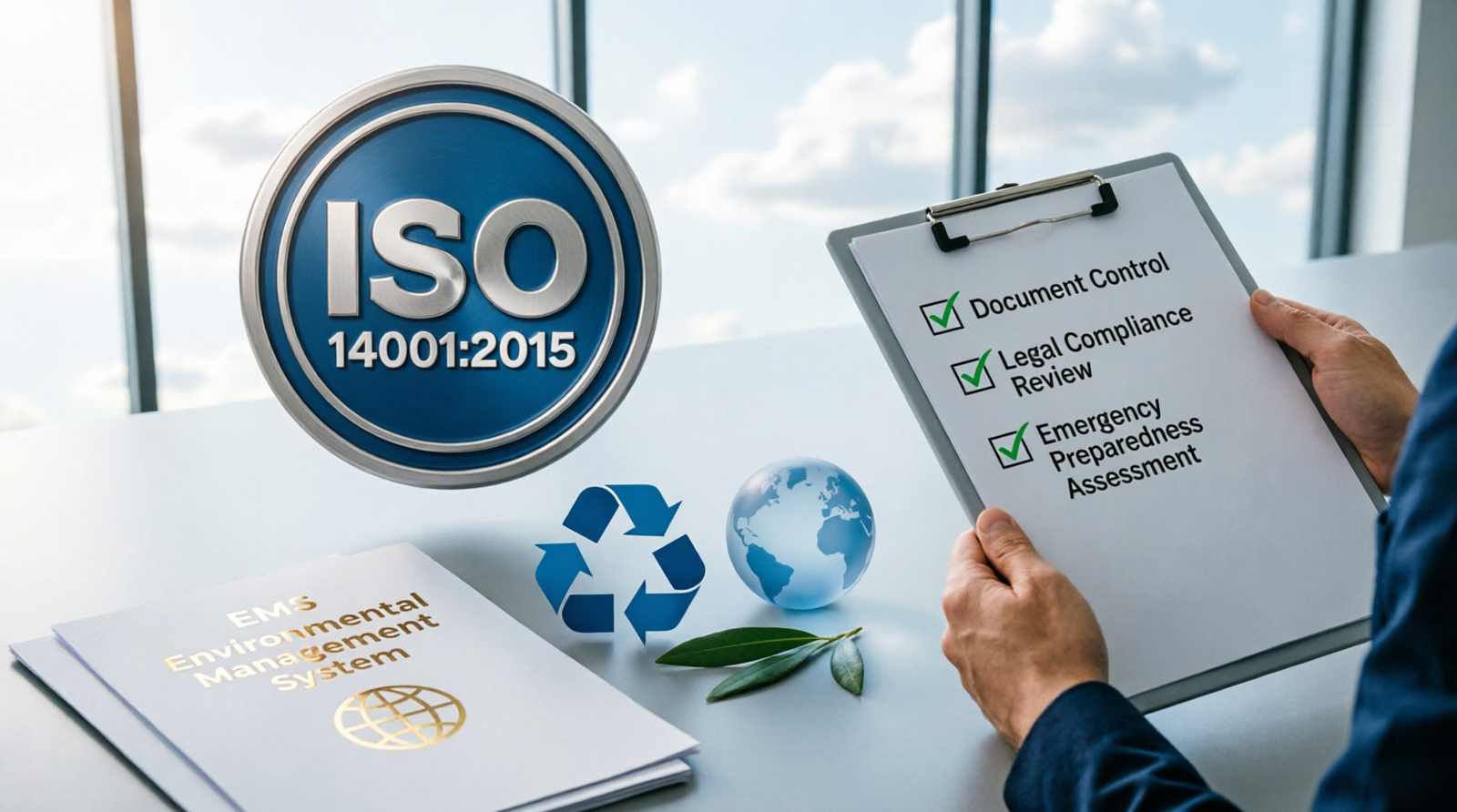
Most businesses prepare for the wrong things. They print documents, tidy files, and brief managers the week before the audit. Then the auditor walks the floor and finds three nonconformities in the first hour.
This checklist tells you what auditors actually look for — clause by clause — so you fix the real gaps before audit day.
What Is an ISO 14001 Audit?
An ISO 14001 audit is a structured review of your Environmental Management System. It checks two things. First, does your EMS meet the requirements of the standard. Second, is it actually working in practice — not just on paper.
There are two types of audits you will face:
| Audit Type | Who Conducts It | When |
|---|---|---|
| Internal audit | Your own trained auditor | At least once per year |
| External audit | Accredited certification body | Initial, surveillance, recertification |
Both follow the same ISO 14001 structure. This checklist covers both.
If you want to understand the full certification timeline before diving into audit preparation, the ISO 14001 certification process explains each stage from gap analysis to final approval.
Clause 4: Context of the Organisation — Checklist
Auditors check:
- Is there a documented list of internal and external issues affecting environmental performance?
- Have interested parties been identified — clients, regulators, local communities?
- Are their environmental requirements documented?
- Has the EMS scope been defined in writing and is it appropriate for the organisation?
Common finding: Scope is too vague. “All operations” is not enough. The scope must name locations, activities, and boundaries.
Clause 5: Leadership — Checklist
Auditors check:
- Is there a signed environmental policy that is current and version-controlled?
- Does the policy commit to legal compliance and continual improvement?
- Have roles and responsibilities for the EMS been formally assigned?
- Can top management explain the environmental policy and their role in it?
Auditors will interview your senior management. Not just ask to see a signature. If your CEO cannot explain what your top environmental objective is, that is a finding.
The policy must also be communicated to all staff. Posting it on a noticeboard is not enough. Auditors will ask employees if they have seen it and what it means for their work.
Clause 6: Planning — Checklist
This clause generates more nonconformities than any other. Pay close attention.
Aspects and Impacts
- Is there a documented aspects and impacts register?
- Does it cover all activities, products, and services within the EMS scope?
- Does it include both normal operations and emergency situations?
- Have significant aspects been identified using a consistent methodology?
- Has the register been reviewed within the last 12 months?
- Has it been updated when operations changed?
A register that was built during certification and never touched since will fail. Auditors check the last review date and cross-reference it against any operational changes in the business.
Legal Register
- Does a legal register exist?
- Does it cover all applicable UAE environmental laws, permits, and regulations?
- Has it been reviewed recently — within the last 6 months ideally?
- Is there evidence of a compliance evaluation against each legal requirement?
If you are operating in a free zone, your legal register must include zone-specific environmental requirements alongside federal and emirate-level regulations.
Objectives
- Are environmental objectives documented?
- Do they include measurable targets, deadlines, and named responsible persons?
- Is there a tracking system showing progress?
- Are objectives consistent with the significant aspects identified?
Auditors do not penalise businesses for missing targets. They penalise businesses that have no tracking system or cannot explain why a target was missed.
Understanding the full scope of what ISO 14001 requires in clause 6 helps you build a register and objectives framework that will hold up under scrutiny.
Clause 7: Support — Checklist
Competence and Training
- Is there a list of roles whose work affects environmental performance?
- Are training records maintained for each of those roles?
- Is training current — covering any procedure changes or new operations?
- Have new employees been trained before starting environmentally significant work?
Auditors spot-check training records. They pick two or three employees at random and ask to see their training history. If records are missing or out of date, that is a nonconformity.
Awareness
- Do employees know the environmental policy?
- Can they explain how their specific role affects the environment?
- Do they know what to do if an environmental incident occurs?
This is tested through staff interviews — not document reviews.
Communication
- Is there a documented communication plan for environmental matters?
- Does it cover both internal communication (staff) and external communication (clients, regulators)?
- Are records of external communications maintained?
Documentation Control
- Are all EMS documents version-controlled with dates?
- Are obsolete versions removed or clearly marked?
- Are documents accessible to the people who need them?
A full breakdown of which documents are mandatory and how to control them is covered in the ISO 14001 documentation requirements guide.
Clause 8: Operations — Checklist
Operational Controls
- Are there written procedures for all activities linked to significant environmental aspects?
- Are those procedures actually being followed on the floor?
- Are contractors and suppliers given environmental requirements before starting work?
This is where floor-walking audits catch businesses out. The procedure exists. But the operator on the production line has never seen it. Or the subcontractor on site was never briefed.
Auditors observe real operations. They do not just read files.
Emergency Preparedness
- Is there a documented emergency response procedure?
- Does it cover all realistic emergency scenarios for your operations?
- Has at least one emergency drill been conducted in the last 12 months?
- Are drill records documented — date, scenario, findings, improvements made?
Common scenarios auditors expect to see covered in UAE businesses:
- Chemical or fuel spill
- Fire near hazardous materials storage
- Wastewater overflow or discharge
- Generator fuel leak
If you cannot produce a drill record, that is a minor nonconformity at minimum.
Clause 9: Performance Evaluation — Checklist
Monitoring and Measurement
- Are key environmental metrics being measured regularly?
- Are records complete — no gaps in monthly data?
- Are measurement methods consistent and documented?
- Is the data being used to evaluate performance against objectives?
Common metrics auditors check:
| Metric | Typical Frequency |
|---|---|
| Electricity consumption | Monthly |
| Water usage | Monthly |
| Waste generated by type | Monthly |
| Fuel consumption | Monthly |
| Chemical inventory | Quarterly |
Missing two or three months of data is a common finding. Build data collection into daily or weekly routines — not a scramble at month end.
Legal Compliance Evaluation
- Has a formal compliance evaluation been conducted within the last 12 months?
- Is it documented with evidence for each legal requirement reviewed?
- Were any compliance gaps found? If so, were they addressed?
Internal Audit
- Was the internal audit planned in advance?
- Did it cover all clauses of ISO 14001?
- Were findings documented — both conformities and nonconformities?
- Were corrective actions raised for all nonconformities?
- Have those corrective actions been closed?
If you need a structured approach to running the internal audit itself, the ISO 14001 internal audit process covers how to plan, conduct, and document it properly.
Management Review
- Was a management review held within the last 12 months?
- Are minutes documented?
- Do the minutes show all mandatory agenda items were covered?
- Were actions assigned with owners and deadlines?
- Were previous actions followed up?
Clause 10: Improvement — Checklist
- Is there a documented process for handling nonconformities?
- Are corrective actions investigating root causes — not just symptoms?
- Are corrective actions tracked to closure with evidence?
- Is there evidence of continual improvement — not just reactive fixes?
Auditors look for a pattern of improvement over time. One corrective action record is not enough. They want to see a functioning system that catches problems and learns from them.
Understanding how to maintain this system year-round — between audits — is what separates businesses that keep their certificate from those that scramble every 12 months. The ISO 14001 maintenance guide covers the full annual cycle.
Pre-Audit Preparation: Two-Week Checklist
Use this in the two weeks before any external audit:
- Aspects register reviewed and current
- Legal register reviewed with compliance evaluation complete
- All monitoring records available for the last 12 months
- Training records complete for all relevant staff
- Internal audit report finalised with corrective actions closed
- Management review minutes available
- Emergency drill record available
- All previous audit nonconformities closed with evidence
- EMS documents version-controlled and accessible
- Key staff briefed on their roles and what to expect
What Happens If Nonconformities Are Found?
Nonconformities come in two levels:
| Level | Definition | Consequence |
|---|---|---|
| Minor | A single lapse or gap that does not indicate system failure | Corrective action required before next audit |
| Major | A complete failure of a requirement or pattern of minor issues | Certificate withheld or suspended until resolved |
One or two minor nonconformities in a surveillance audit is normal. A major nonconformity is serious but not fatal — if you respond quickly with a proper corrective action plan.
Frequently Asked Questions
What does an ISO 14001 auditor check first?
Most auditors start with your aspects and impacts register and legal register. These two documents tell them immediately whether your EMS is being maintained or just sitting on a shelf.
How long does an ISO 14001 audit take?
A surveillance audit for a small to medium business typically takes one to two days. Initial certification and recertification audits take two to three days depending on the size and complexity of your operations.
Can I fail an ISO 14001 audit?
You cannot pass or fail in the traditional sense. But if major nonconformities are found and not resolved within the agreed timeframe, your certificate can be withheld or suspended.
How do I prepare staff for an audit?
Brief them on the environmental policy, their specific responsibilities, and what to do if asked a question they cannot answer. Tell them to be honest — auditors respond much better to “I don’t know, let me find out” than to a wrong answer given confidently.
What is the difference between a conformity and a nonconformity?
A conformity means a requirement is being met. A nonconformity means a requirement is not being met or evidence is missing. Both are documented in the audit report.
For businesses planning to get certified or currently preparing for their first audit, the ISO 14001 certification in Dubai and UAE page covers local requirements and how the process works in the UAE context.