Getting certified is the first step. Keeping it is the real work. Many businesses pass their initial audit — then lose certification at the first surveillance audit because they stopped maintaining the system.
This guide tells you exactly what maintenance looks like year by year.
Why Maintenance Matters More Than Initial Certification
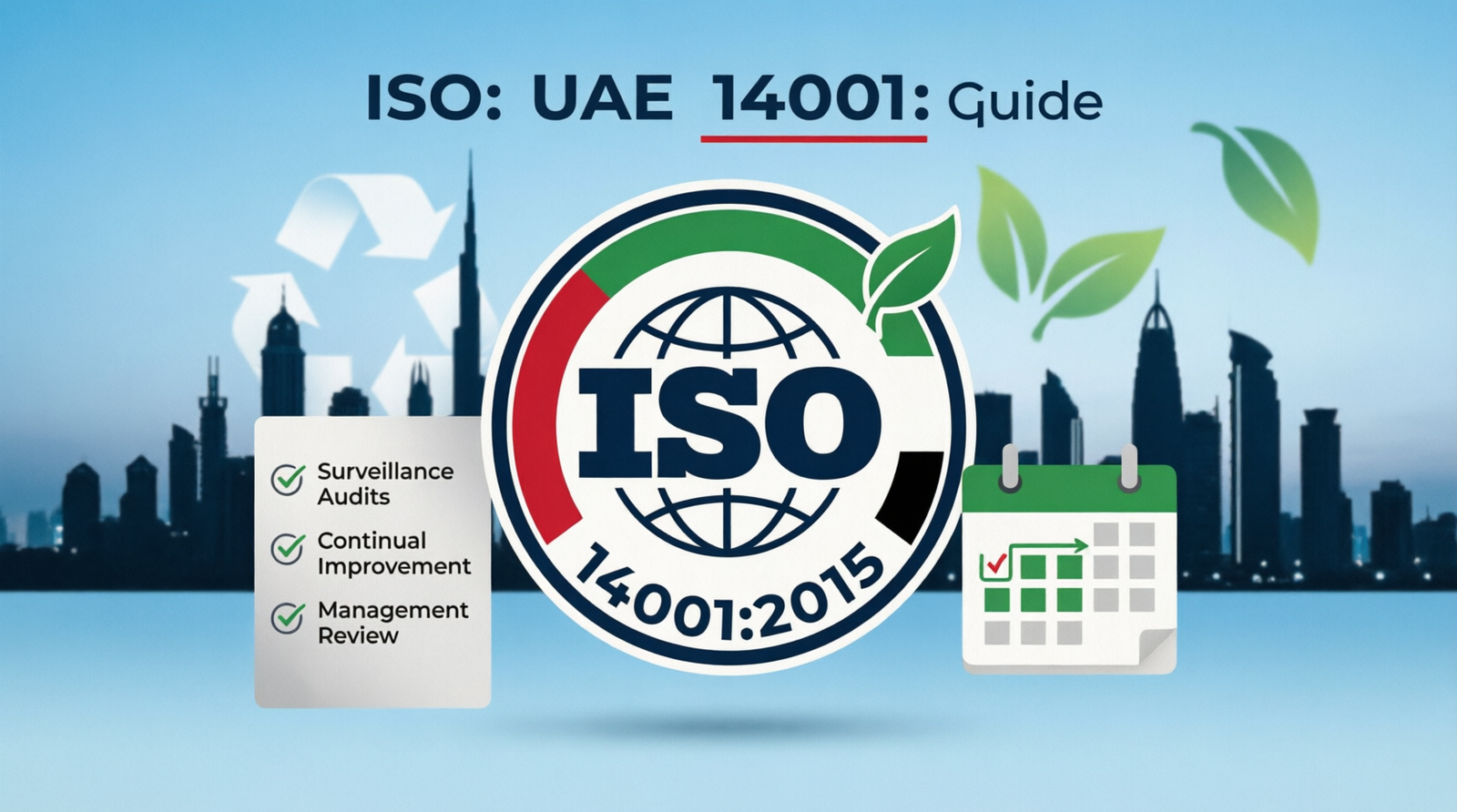
Your ISO 14001 certificate is valid for 3 years. But it is not guaranteed for 3 years. Certification bodies conduct surveillance audits every 12 months. If your system has collapsed, they can suspend or withdraw your certificate.
A facility manager in Abu Dhabi once described it well: “We treated certification like a finish line. It is actually a starting line.”
Maintenance is not about doing extra work. It is about keeping the system you built — running consistently, updating it when things change, and fixing problems before auditors find them.
What Happens After You Get Certified?
Once you receive your ISO 14001 certificate, this is your ongoing schedule:
| Activity | Frequency |
|---|---|
| Monitor environmental metrics | Monthly |
| Review legal register | Every 6 months minimum |
| Conduct internal audit | At least once per year |
| Management review meeting | At least once per year |
| Surveillance audit by certification body | Year 1 and Year 2 |
| Recertification audit | Year 3 |
Miss any of these and you create risk. Miss multiple and you will face nonconformities.
1. Keep Your Environmental Aspects Register Current
Your aspects and impacts register was accurate on the day you were certified. It will not stay accurate on its own.
Update it when:
- You add new equipment or processes
- You move to a new facility or expand an existing one
- You start using new chemicals or materials
- You take on a new type of project or client
- Environmental regulations change
Example: A food processing company in Dubai added a new production line in year two. They forgot to update the aspects register. The surveillance auditor flagged it as a major nonconformity. Certification was nearly suspended.
Review your register formally every 6 months. Update it immediately when operations change — do not wait for the scheduled review.
Related: ISO 14001 Documentation Requirements
2. Keep Your Legal Register Up to Date
Environmental law in the UAE changes. New regulations are issued. Existing laws are amended. Permit conditions get updated.
Your legal register must reflect the current situation — not what was in force when you first built it.
Assign one person to own the legal register. Their job is to:
- Monitor regulatory updates from Dubai Municipality, Abu Dhabi Environment Agency, and federal bodies
- Check free zone environmental requirements if applicable
- Update the register when changes occur
- Record the date of each review
Auditors always check the last review date on your legal register. If it has not been touched in 18 months, that is a finding.
UAE-specific sources to monitor:
- Ministry of Climate Change and Environment (MOCCAE)
- Dubai Municipality Environmental Health Section
- Abu Dhabi Environment Agency (EAD)
- Estidama updates for construction businesses
- JAFZA, DAFZA, KIZAD regulations if operating in free zones
3. Track Your Environmental Objectives
You set measurable environmental objectives during certification. Now you must track progress against them every single month.
Do not wait until the management review to discover you missed a target. By then it is too late to correct course.
Set up a simple monthly tracker:
| Objective | Target | Jan | Feb | Mar | Status |
|---|---|---|---|---|---|
| Reduce water use | 20% reduction | 18% | 19% | 21% | On track |
| Reduce waste to landfill | 30% reduction | 10% | 12% | 15% | Behind |
If you are behind on a target, document why. Show what corrective action you are taking. Auditors do not penalise businesses for missing targets. They penalise businesses for ignoring missed targets.
4. Maintain Your Monitoring and Measurement Records
You must continue collecting environmental data throughout the year. This data is the evidence that your EMS is functioning.
Keep monthly records of:
- Energy consumption (electricity, diesel, gas)
- Water usage
- Waste generated and disposal method
- Vehicle fuel consumption if relevant
- Chemical usage and storage levels
- Any environmental incidents or near-misses
Store records in an organised, accessible format. When the surveillance auditor asks for 12 months of energy data, you must produce it immediately — not spend two days searching for it.
A construction company in Ras Al Khaimah lost a surveillance audit because their site supervisors collected data on paper but nobody transferred it to the central system. Three months of records were missing.
Build the habit from day one. Collect data, record it centrally, and back it up.
5. Conduct Your Internal Audit Properly
The internal audit is your most powerful maintenance tool. Done properly, it finds problems before the certification body does.
Most businesses treat internal audits as a box-ticking exercise. That is a mistake.
How to Run an Effective Internal Audit
Plan the audit at the start of each year. Do not leave it until two weeks before the surveillance audit.
Cover all clauses of ISO 14001 over the course of the year. You do not have to audit everything at once. You can split it across two or three audits.
Your internal auditor must be independent. They cannot audit their own work. In small businesses, this sometimes means using an external auditor for the internal audit role.
During the audit, do not just check documents. Observe actual operations. Talk to staff. Ask them what they do when an environmental incident occurs. Ask them where they dispose of waste. Real auditing happens on the floor, not at a desk.
Document every finding — conformities and nonconformities. Raise corrective actions for every nonconformity. Track them to closure before the surveillance audit.
Related: ISO 14001 Internal Audit Process
Related: ISO 14001 Audit Checklist Guide
6. Hold a Meaningful Management Review
The management review is not a formality. It is the moment where leadership looks at the whole EMS and decides what needs to change.
Hold it at least once a year. Many certified businesses in the UAE hold it twice — once mid-year and once before the surveillance audit.
What the Management Review Must Cover
- Results of internal audits
- Progress on environmental objectives
- Legal compliance status
- Environmental incidents and corrective actions
- Feedback from external parties
- Changes in operations or regulations that affect the EMS
- Resources needed for the next period
- Opportunities for improvement
Record the meeting in formal minutes. Show who attended, what was discussed, and what decisions were made. Assign actions with owners and deadlines.
Auditors read management review minutes carefully. They check if the review was substantive or just a rubber stamp.
7. Handle Nonconformities and Corrective Actions Properly
Things will go wrong during normal operations. A chemical spill. A missed legal deadline. A procedure not followed on site. This is normal. What matters is how you respond.
The Correct Response to a Nonconformity
Step 1 — Contain it. Stop the immediate problem from getting worse.
Step 2 — Investigate the root cause. Why did it happen? Not just what happened.
Step 3 — Fix the root cause. A surface fix will not satisfy an auditor.
Step 4 — Verify the fix worked. Check that the same problem has not recurred.
Step 5 — Document everything. Every step, every date, every person involved.
Common root cause errors businesses make:
| Nonconformity | Wrong Root Cause | Correct Root Cause |
|---|---|---|
| Staff disposed of waste incorrectly | Staff did not follow procedure | No training was given on the procedure |
| Chemical spill not reported | Staff forgot | No clear reporting process communicated |
| Legal register out of date | Nobody updated it | No owner assigned for the task |
Fix the system. Not just the symptom.
8. Keep Your Team Trained and Aware
Staff change. New people join. Roles shift. Your training programme must keep up.
Every new employee whose work affects environmental performance must be trained before they start that work — not six months later.
Run a refresher session at least once a year for existing staff. Cover:
- Any changes to the environmental policy
- Updates to procedures or controls
- Lessons learned from any incidents or near-misses
- Progress on environmental objectives
Keep a training record for every session. Record who attended, what was covered, and the date. Auditors spot-check training records during surveillance audits.
9. Prepare for Your Surveillance Audit
Surveillance audits happen in year one and year two of your certificate. They are shorter than the initial certification audit but just as important.
What Surveillance Auditors Focus On
- Have corrective actions from the previous audit been closed?
- Is the EMS still being maintained — or has it been forgotten?
- Are monitoring records complete and current?
- Has the legal register been reviewed?
- Has an internal audit been completed?
- Has a management review been held?
Two to four weeks before the surveillance audit, run a quick internal review. Check every item on that list. Fix anything that is incomplete.
Do not surprise yourself on audit day.
10. Prepare for Recertification in Year 3
Recertification is a full audit — similar to your original certification audit. The auditor reviews the entire EMS from scratch.
Start preparing six months before your certificate expires. Do not leave it to the last month.
Recertification preparation checklist:
- All corrective actions from years 1 and 2 closed
- Aspects register reviewed and current
- Legal register reviewed and current
- Three years of monitoring data available
- Internal audit completed within the last 12 months
- Management review completed within the last 12 months
- Objectives tracked with full history
- Training records complete and up to date
Related: ISO 14001 Certification Process Step by Step
The Most Common Reasons Businesses Lose Certification
These are real patterns seen in UAE surveillance audits:
| Reason | How to Avoid It |
|---|---|
| Internal audit not completed | Schedule it at the start of the year |
| Legal register not updated | Assign a named owner with a review calendar |
| Corrective actions left open | Set deadlines and track weekly |
| Monitoring data gaps | Build data collection into daily operations |
| Management review not held | Book it in the annual calendar from day one |
| Staff turnover with no retraining | Induct new staff on EMS before they start work |
None of these failures are complicated. All of them are avoidable.
How Much Does Ongoing Maintenance Cost?
Maintenance costs are much lower than initial certification. For most UAE businesses, annual maintenance involves:
- Internal audit — can be done by a trained internal auditor at no extra cost
- Surveillance audit fee — typically AED 3,000 to AED 8,000 depending on certification body and business size
- Consultant support if needed — optional, typically AED 2,000 to AED 5,000 per year
The bigger cost of poor maintenance is losing the certificate — and having to restart the process from scratch.
Related: ISO 14001 Certification Cost in UAE
Frequently Asked Questions
How often are ISO 14001 surveillance audits conducted?
Surveillance audits are conducted annually — in year one and year two after initial certification. A full recertification audit happens in year three.
Can ISO 14001 certification be suspended?
Yes. If a surveillance audit finds major nonconformities that are not resolved within the agreed timeframe, the certification body can suspend or withdraw your certificate.
How long does it take to prepare for a surveillance audit?
If your EMS has been maintained properly throughout the year, two to four weeks of preparation is enough. If the system has been neglected, it can take two to three months to get back in order.
What is the difference between a surveillance audit and a recertification audit?
A surveillance audit is a partial review — it checks that the EMS is still being maintained. A recertification audit is a full review of the entire EMS, similar to the original certification audit.
Do I need a consultant to maintain ISO 14001?
No. Many UAE businesses maintain their EMS internally after the first year. A consultant is useful if your team lacks time or expertise, or when preparing for recertification.
What happens if we miss our surveillance audit date?
Contact your certification body immediately. Most will allow a short extension. Repeated delays or missed audits can lead to certificate suspension.
Related: What Are ISO 14001 Requirements
Related: Benefits of ISO 14001 for Businesses
Related: ISO 14001 Certification in Dubai UAE
Main page: ISO 14001 Certification