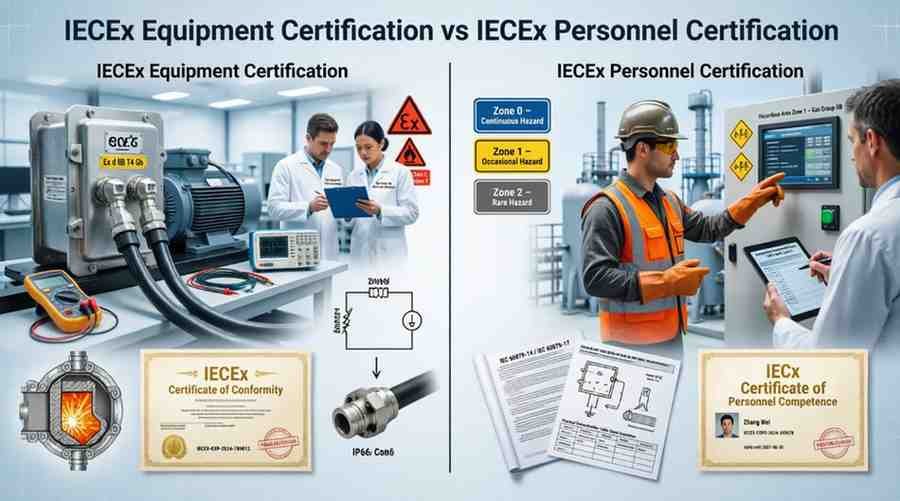
IECEx Equipment Certification applies to manufacturers and verifies that Ex equipment meets IEC 60079 safety standards for use in explosive atmospheres. IECEx Personnel Certification (CoPC) applies to individuals and confirms their competence to install, inspect, maintain, or design that same equipment. Both serve different purposes, and some organizations need both.
Working in hazardous areas means navigating two separate certification paths—and confusing them is more common than you might think.
An oil and gas company might specify “IECEx certified” in a project brief, leaving engineers uncertain whether that refers to the equipment on site, the personnel operating it, or both. Equipment manufacturers face a similar gap: their products may be fully certified, but their field teams lack the verified competence to install them correctly.
This post breaks down IECEx Equipment Certification and IECEx Personnel Certification side by side—what each one covers, who needs it, how they differ, and how to determine which certification applies to your situation.
What Is IECEx Equipment Certification?
IECEx Equipment Certification confirms that a specific piece of Ex equipment—a motor, control panel, sensor, or enclosure—meets the safety standards set by the IEC 60079 series for use in explosive atmospheres.
The certification is issued by an IECEx-recognized Certification Body (ExCB) after independent testing, design assessment, and factory inspection. Once certified, the equipment receives an IECEx Certificate of Conformity and may carry the IECEx mark.
Purpose: To verify that equipment will not become an ignition source in a hazardous location—even under specified fault conditions.
Certification scope: Covers the design, construction, and manufacturing quality of the equipment itself.
Testing requirements: Includes laboratory testing against applicable IEC 60079 standards (e.g., IEC 60079-1 for flameproof enclosures, IEC 60079-11 for intrinsic safety), design documentation review, and ongoing factory quality system audits.
Who is involved: Equipment manufacturers, OEM suppliers, Ex equipment designers, and product companies seeking market access in countries where IECEx is recognized.
What Is IECEx Personnel Certification?
IECEx Personnel Certification—formally called the IECEx Certificate of Personnel Competence (CoPC)—is an internationally recognized credential that verifies an individual’s ability to work safely in explosive atmospheres.
It is issued under the IECEx Personnel Competence Scheme, governed by the International Electrotechnical Commission (IEC), and accepted across 40+ countries. Unlike a standard training certificate, the CoPC is a third-party, competency-based qualification that assesses both theoretical knowledge and practical skills. Learn more about IECEx CoPC training pathways.
IECEx CoPC Certification: Confirms that a person understands explosion protection principles, IEC 60079 standards, zone classifications, and protection concepts—and can apply that knowledge safely in the field.
Competency requirements: Candidates must complete training, pass written examinations, and—for most units—complete a hands-on practical assessment on real Ex equipment.
Professionals covered: Electrical engineers, instrumentation engineers, installation technicians, maintenance personnel, inspectors, auditors, and project engineers working in hazardous areas.
IECEx Equipment Certification vs Personnel Certification: Quick Comparison
| Factor | IECEx Equipment Certification | IECEx Personnel Certification (CoPC) |
|---|---|---|
| Purpose | Certifies that Ex equipment is safe for use in explosive atmospheres | Certifies that an individual is competent to work in explosive atmospheres |
| Applies To | Electrical and mechanical equipment (motors, sensors, panels, glands) | Engineers, technicians, inspectors, and maintenance professionals |
| Main Users | Manufacturers, OEM suppliers, equipment designers | Electricians, instrumentation engineers, inspection teams, site technicians |
| Assessment Method | Laboratory testing, design review, factory quality audits | Written exams, practical assessments, experience verification |
| Certification Output | IECEx Certificate of Conformity (for the product) | IECEx Certificate of Personnel Competence (for the individual) |
Who Needs IECEx Equipment Certification?
IECEx Equipment Certification is required by organizations that manufacture or supply Ex equipment for use in hazardous locations. If your business produces products that will be used in explosive atmospheres—whether in oil and gas, chemical, pharmaceutical, or mining sectors—you need this certification to access international markets.
Manufacturers producing motors, junction boxes, control panels, luminaires, or instrumentation for hazardous areas must certify each product model separately against the relevant IEC 60079 standard.
OEM suppliers who integrate Ex-certified components into larger systems may also need product-level certification, depending on how the final product is classified.
Equipment designers working for manufacturers or engineering consultancies often support the certification process by preparing design documentation, selecting protection concepts, and liaising with ExCBs during the approval process.
Ex product companies seeking to sell in markets where IECEx is recognized—including the UAE, Saudi Arabia, Qatar, Australia, and the UK—must obtain IECEx certification to demonstrate compliance and gain market access.
Without equipment certification, manufacturers cannot legally claim IECEx conformity for their products, and many project specifications will exclude non-certified equipment outright.
Who Needs IECEx Personnel Certification?
IECEx Personnel Certification applies to individuals who work with Ex equipment in the field. It is the relevant certification for anyone who installs, inspects, maintains, tests, designs, or audits explosion-protected systems in classified hazardous areas.
The following roles benefit most from IECEx CoPC certification. For region-specific information, explore IECEx certification requirements in the UAE and GCC.
Electrical engineers working in oil and gas, petrochemical, or pharmaceutical facilities need CoPC to demonstrate competency in zone classification, equipment selection, and safe installation practices in accordance with IEC 60079 standards.
Installation teams perform direct hands-on work with Ex equipment on site. CoPC confirms they can fit, wire, and commission explosion-protected systems correctly.
Maintenance professionals carry out routine servicing, fault-finding, and repair work on Ex equipment. Certification proves they understand how to carry out these tasks without compromising the equipment’s explosion protection integrity.
Inspectors conduct visual, close, and detailed inspections of Ex installations according to IEC 60079-17. CoPC validates that they can identify defects, non-compliance, and safety risks accurately.
Technicians across a range of disciplines—instrumentation, electrical, mechanical—need CoPC when their work involves Ex equipment in classified zones.
Major operators across the GCC, including ADNOC, Saudi Aramco, and QatarEnergy, list IECEx competency requirements in their contractor qualification criteria and project specifications.
IECEx CoPC Certification Categories
The IECEx Personnel Competence Scheme uses a modular structure. Each competency unit (Ex 000 through Ex 010) targets a specific area of hazardous area work. Candidates select units that match their job role.
| Unit | Focus Area | Typical Roles |
|---|---|---|
| Ex 000 | Basic awareness of explosive atmospheres | All personnel working near hazardous areas |
| Ex 001 | Core IEC 60079 principles and protection concepts | Foundation unit—required for most role paths |
| Ex 002 | Hazardous area classification (zones, gas groups) | Safety engineers, plant designers |
| Ex 003 | Installation of Ex equipment and wiring systems | Installation technicians, electricians |
| Ex 004 | Maintenance of Ex equipment | Maintenance engineers and technicians |
| Ex 005 | Overhaul and repair of Ex equipment | Workshop technicians, repair specialists |
| Ex 006 | Testing electrical installations | QA/QC engineers, compliance teams |
| Ex 007 | Visual and close inspection | Inspection engineers |
| Ex 008 | Detailed inspection | Senior inspectors, audit-ready personnel |
| Ex 009 | Design of electrical installations in hazardous areas | Design engineers |
| Ex 010 | Audit inspection | Regulatory inspectors, auditors |
Certificates are valid for five years and must be renewed through reassessment. The IECEx online database allows employers to verify certificate status instantly—a key advantage for contractor mobilization and project compliance.
For a full breakdown of zones, protection concepts, and how they relate to CoPC requirements, see our guide on IECEx zones and protection concepts.
Can a Company Need Both Certifications?
Yes—and many do. Equipment Certification and Personnel Certification operate in parallel, and several business scenarios require both.
Equipment manufacturer with a field service division: A company that manufactures Ex motors and also provides installation and commissioning services needs Equipment Certification for its products and CoPC certification for its field engineers. Both are required to deliver a fully compliant end-to-end solution.
EPC contractor managing Ex installations: Engineering, procurement, and construction firms typically do not manufacture equipment—they procure IECEx certified equipment from approved suppliers and use IECEx CoPC-certified personnel to install and commission it. Here, the contractor verifies equipment certification on behalf of the client while maintaining personnel certification for its own workforce.
Oil and gas operating company: The facility uses IECEx certified equipment (purchased from manufacturers) and employs or contracts IECEx certified personnel to inspect and maintain it. Both certifications are part of the company’s hazardous area compliance framework.
Training and inspection service provider: Organizations offering IECEx inspection or maintenance services to third parties must demonstrate personnel competence through CoPC. If they also repair Ex equipment in a workshop, a Service Facility Certification may apply as well.
Understanding which certifications your organization holds—and which it relies on from suppliers and contractors—is a key part of hazardous area compliance management.
How to Choose the Right IECEx Certification
Use this checklist to identify the certification path that applies to your situation.
Choose IECEx Equipment Certification if:
- You manufacture or supply Ex equipment for hazardous locations
- Your products need to carry the IECEx mark for international market access
- You are an OEM supplier providing components integrated into Ex systems
- Your customers or project specifications require IECEx certified equipment
- You operate a service facility that repairs or reconditions Ex equipment
Choose IECEx Personnel Certification (CoPC) if:
- You are an engineer, technician, or inspector working in hazardous areas
- Your job involves installing, maintaining, or inspecting Ex equipment on site
- Your employer, client, or project contract requires verified competence
- You work in oil and gas, petrochemical, mining, or pharmaceutical industries
- You want internationally recognized proof of your hazardous area skills
Consider both if:
- Your organization manufactures Ex equipment AND provides installation or maintenance services
- You are an EPC contractor managing Ex projects from design through commissioning
- Your company’s scope includes equipment supply, installation, and ongoing inspection
For guidance on how IECEx compares to alternative schemes in the GCC market, review our IECEx vs CompEx comparison guide. For a detailed breakdown of training costs and investment planning, see our IECEx certification cost guide.
Make the Right Certification Decision
Choosing between IECEx Equipment Certification and IECEx Personnel Certification is not complicated once you understand what each one confirms. Equipment Certification validates the product. Personnel Certification validates the person. Many industrial environments require both—and knowing which applies to your role or organization is the first step toward full hazardous area compliance.
If you are a manufacturer seeking market access, equipment certification is your starting point. If you are an engineer or technician working in classified zones, IECEx CoPC is the credential you need.
Ready to move forward? Explore our complete IECEx training guide for 2026 or contact Extrainings to discuss the right certification pathway for your role, team, or organization.
Frequently Asked Questions
What is the difference between IECEx Equipment Certification and IECEx Personnel Certification?
IECEx Equipment Certification verifies that a product—such as a motor, sensor, or control panel—meets IEC 60079 safety standards for use in explosive atmospheres. IECEx Personnel Certification (CoPC) verifies that an individual has the knowledge and practical skills to work safely with Ex equipment in hazardous areas. Equipment certification applies to manufacturers and product suppliers. Personnel certification applies to engineers, technicians, and inspectors.
What is IECEx CoPC and who issues it?
IECEx CoPC stands for Certificate of Personnel Competence. It is issued by an IECEx-recognized Certification Body (ExCB) after a candidate completes training, passes written examinations, and—for most competency units—completes a practical assessment on real Ex equipment. The certificate is listed in the IECEx online database for instant verification.
Who needs IECEx Equipment Certification?
Equipment manufacturers, OEM suppliers, and Ex product companies that produce or supply explosion-protected equipment for use in hazardous locations need IECEx Equipment Certification. It is required to carry the IECEx mark and access international markets where IECEx is recognized.
Who needs IECEx CoPC Certification?
Engineers, technicians, inspectors, maintenance professionals, and auditors who work directly with Ex equipment in classified hazardous areas need IECEx CoPC. It is commonly required by major operators in the oil and gas, petrochemical, mining, and pharmaceutical sectors—including ADNOC, Saudi Aramco, and QatarEnergy.
Which IECEx certification do I need as an engineer?
If you install, inspect, maintain, test, design, or audit Ex equipment in hazardous areas, you need IECEx Personnel Certification (CoPC). Select competency units based on your job role—for example, Ex 003 for installation, Ex 007 and Ex 008 for inspection, or Ex 009 for design engineering.
Can a company need both IECEx Equipment and Personnel Certification?
Yes. A manufacturer that also provides field installation or maintenance services typically needs both. Equipment Certification covers their products. CoPC certification covers their field engineers. EPC contractors and oil and gas operating companies often manage both through their supply chain and workforce compliance programs.
How long is an IECEx CoPC certificate valid?
An IECEx CoPC certificate is valid for five years. Renewal requires reassessment or refresher training to confirm continued competence. Certificates are publicly verifiable through the IECEx online certification database, which employers can check during hiring or contractor qualification reviews.