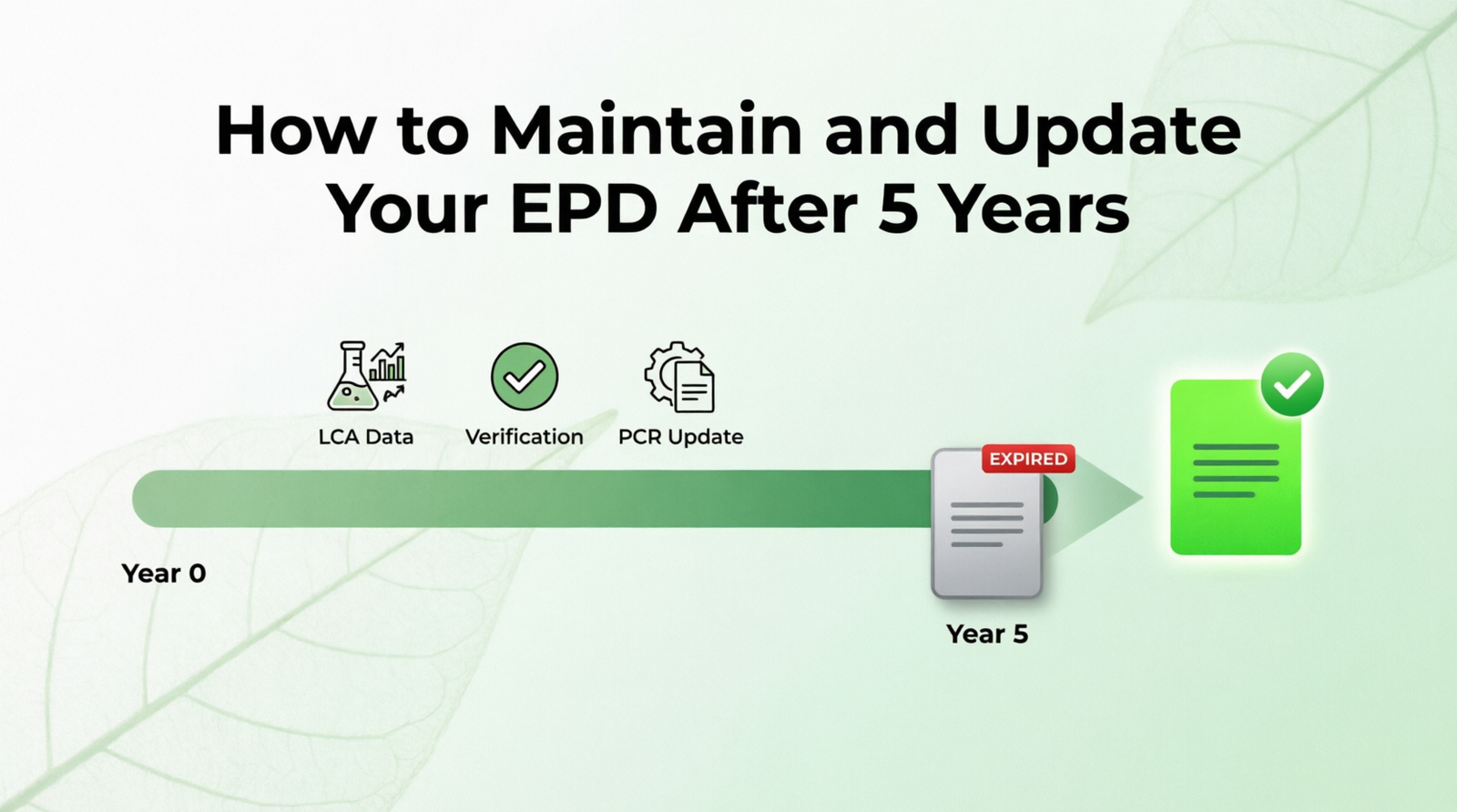
An Environmental Product Declaration usually stays valid for five years. After that, manufacturers must renew or revise it to keep using it in tenders, green building submittals, and export markets. Missing this deadline can quietly disqualify you from live bids.
This guide walks through exactly what triggers an update, how the renewal process works, and how to avoid the mistakes that stall it.
What Is the Validity Period of an Environmental Product Declaration?
Most Environmental Product Declarations stay valid for five years from their verification date. Program operators print this “valid to” date directly on the certificate.
A few details matter here:
- The five-year window starts at verification, not at product launch
- Program operators, not manufacturers, set this rule through their General Programme Instructions
- Some Product Category Rules (PCR) set shorter or different windows for specific product types
- An EPD stays usable in tenders and building certifications only within this window
Once that date passes, the declaration can’t back up your environmental claims anymore. Buyers and certifiers will flag it.
Why Should You Review Your EPD After Five Years?
You should review your EPD after five years because production data, energy sources, and standards all shift over that time. An outdated EPD can misrepresent your product’s real footprint.
A few reasons this review matters:
- Manufacturing processes often improve or change within five years
- Energy grids shift, changing the carbon intensity behind your product
- Standards like EN 15804 get updated, and new EPDs must follow the latest version
- Buyers increasingly check expiry dates before accepting an EPD in submittals
Review our Complete Environmental Product Declarations Guide if you’re still working out the basics before your first renewal.
What Changes Require an EPD Update?
Any change to raw materials, manufacturing, or energy source can require an EPD update, even before the five-year mark. Small shifts in supply chain can shift your environmental numbers.
Changes that typically trigger an update:
- Raw materials – switching suppliers or material composition
- Manufacturing process – new equipment or production methods
- Factory location – relocating production changes energy and transport data
- Energy source – shifting from grid power to renewables, or the reverse
- Packaging – material or weight changes affect the transport and disposal stages
- Transportation – new shipping routes or methods change transport emissions
- Product formulation – any recipe or component change affects the LCA
- Environmental performance – a result that worsens by more than 10 percent needs an earlier update
If any of these apply to your product, don’t wait for the five-year mark. Update sooner to stay accurate.
Difference Between EPD Renewal and EPD Revision
EPD renewal republishes an EPD using current data after its validity window closes. EPD revision updates an active EPD mid-cycle because something material changed.
Here’s how they differ in practice:
- Renewal happens after the five-year expiry, using a fresh LCA and current PCR
- Revision happens during the validity period, triggered by a specific product or process change
- Renewal resets your five-year validity clock from the new verification date
- Revision keeps your original expiry date unless the change is significant enough to require a full new EPD
- Both require third-party verification before publication
Confusing the two often leads manufacturers to delay action until it’s too late. Know which one applies to your situation.
Step-by-Step EPD Update Process
Updating an EPD follows a clear five-step sequence, from data collection through republishing. Skipping steps usually causes delays later in verification.
- Collect current production data – gather updated material, energy, and process figures
- Run a new Life Cycle Assessment – recalculate impacts using the latest PCR
- Draft the updated EPD report – document results following EN 15804 and ISO 14025 formatting
- Submit for third-party verification – an accredited verifier checks the data and math
- Republish through your program operator – release the updated EPD and replace it everywhere it’s used
Each step depends on the one before it. Rushing the data collection stage almost always creates rework during verification.
Role of Life Cycle Assessment (LCA) in EPD Updates
A Life Cycle Assessment measures your product’s environmental impact from raw material through disposal. It’s the technical engine behind every EPD update.
What the LCA needs to reflect accurately:
- Current raw material sourcing and quantities
- Present-day manufacturing energy use
- Updated transportation distances and methods
- End-of-life handling, including recycling or disposal
An outdated LCA produces an outdated EPD, even if the paperwork looks current. Refreshing this data is the real work behind every renewal.
Role of Product Category Rules (PCR) in EPD Updates
Product Category Rules define exactly how your LCA and EPD must be structured for your specific product type. PCRs get revised periodically, and renewals must follow the current version.
Why this matters for your update:
- PCRs specify which environmental indicators your EPD must report
- Older PCR versions eventually sunset and can’t be used for new EPDs
- EN 15804+A2 became the required standard for new construction product EPDs from July 2022
- Your existing EPD stays valid under its original PCR until expiry, but renewal requires the current version
Check which PCR version applies to your product category before starting your update. Using an outdated PCR gets your submission rejected.
Third-Party Verification Requirements
Every updated EPD needs independent verification before it can be republished. This step confirms your data, calculations, and PCR compliance are accurate.
What verification typically involves:
- An accredited, independent verifier reviews your LCA and EPD report
- They check data quality, calculation methods, and PCR compliance
- Verification for an update generally takes two to four weeks
- The verifier issues a formal statement confirming the EPD meets ISO 14025 Type III requirements
Skipping or rushing this step risks rejection by your program operator, which adds delay right when you need speed.
Common Challenges During Environmental Product Declaration Renewal
Manufacturers commonly struggle with outdated data, unclear PCR versions, and tight bid deadlines during renewal. Planning ahead avoids most of these problems.
Frequent challenges include:
- Missing or incomplete production records from the past five years
- Confusion over which PCR version currently applies
- Underestimating how long verification actually takes
- Waiting until a live tender forces urgent action
Common Mistakes to Avoid
Most EPD renewal problems come from waiting too long or skipping proper data collection. A few repeat mistakes cause most of the trouble.
- Waiting until the expiry date to start the renewal process
- Reusing old LCA data without checking for real production changes
- Submitting under an outdated PCR version
- Skipping verification steps to save time
- Failing to update the EPD across all platforms, including LEED and tender submittals
Best Practices for Maintaining an EPD
Manufacturers who stay compliant treat EPD renewal as an ongoing task, not a one-time event. A few habits keep this process smooth.
- Track your EPD’s expiry date at least nine months in advance
- Keep production, energy, and material records updated continuously
- Monitor PCR updates relevant to your product category
- Build renewal costs into your annual sustainability budget
- Work with the same verifier or consultant across renewal cycles for consistency
Benefits of Keeping Your Environmental Product Declaration Updated
An updated EPD keeps you eligible for green building projects, international tenders, and procurement shortlists. It also protects your brand’s sustainability credibility.
- Continued eligibility for LEED, Estidama, and similar green building programs
- Avoids disqualification from live tenders due to expired documentation
- Reflects real, current environmental performance to buyers
- Strengthens your position in procurement processes that favor verified data
- Supports continued access to European and international export markets
Real Example
A UAE-based construction materials manufacturer needed to keep supplying a European infrastructure project. Their original EPD, published five years earlier, was nearing its expiry date.
The manufacturer had switched to a new energy-efficient production line since publishing. That change alone justified a full data refresh, not just a simple republish.
They collected updated production data, ran a new LCA under the current PCR, and completed third-party verification within six weeks. The updated EPD kept their product eligible for the project’s green procurement requirements.
Missing that renewal window would have meant losing the contract entirely.
EPD Maintenance Checklist
Use this checklist to track your renewal readiness:
- ✓ Confirm your EPD’s exact expiry date
- ✓ Check whether the applicable PCR has changed since original publication
- ✓ Review production changes since your last EPD was verified
- ✓ Collect updated material, energy, and transport data
- ✓ Confirm whether you need a renewal or a mid-cycle revision
- ✓ Schedule third-party verification at least two months before any bid deadline
- ✓ Update the EPD across all submittal platforms once republished
Frequently Asked Questions
How long is an Environmental Product Declaration valid?
Most EPDs stay valid for five years from their verification date.
What happens if my EPD expires?
An expired EPD can no longer support environmental claims in tenders or certifications.
Do I need a new LCA for every EPD renewal?
Yes. Renewal requires a fresh Life Cycle Assessment using current production data.
What’s the difference between EPD renewal and revision?
Renewal happens after expiry. Revision happens mid-cycle due to a specific product change.
How long does EPD verification take?
Verification for an update typically takes two to four weeks.
Does a small product change require a full EPD update?
Usually not, unless it changes environmental results by more than 10 percent.
Can I use an old PCR version for my renewal?
No. Renewals must follow the current PCR version for your product category.
How much does EPD renewal cost?
Renewal typically costs 30 to 50 percent of the original EPD’s development fee.
Does relocating my factory require an EPD update?
Yes. Factory location changes affect energy and transport data used in the LCA.
Can I keep using my EPD while it’s being renewed?
Only until its printed expiry date. After that, it can’t be used in submittals.
Keeping your Environmental Product Declarations (EPDs) current protects your access to green procurement and international projects. Don’t wait for expiry to start the process. Contact Envirolink for support with EPD renewal, verification, and updates, and review How to Get an Environmental Product Declaration in the UAE if you’re planning your first submission alongside a renewal.