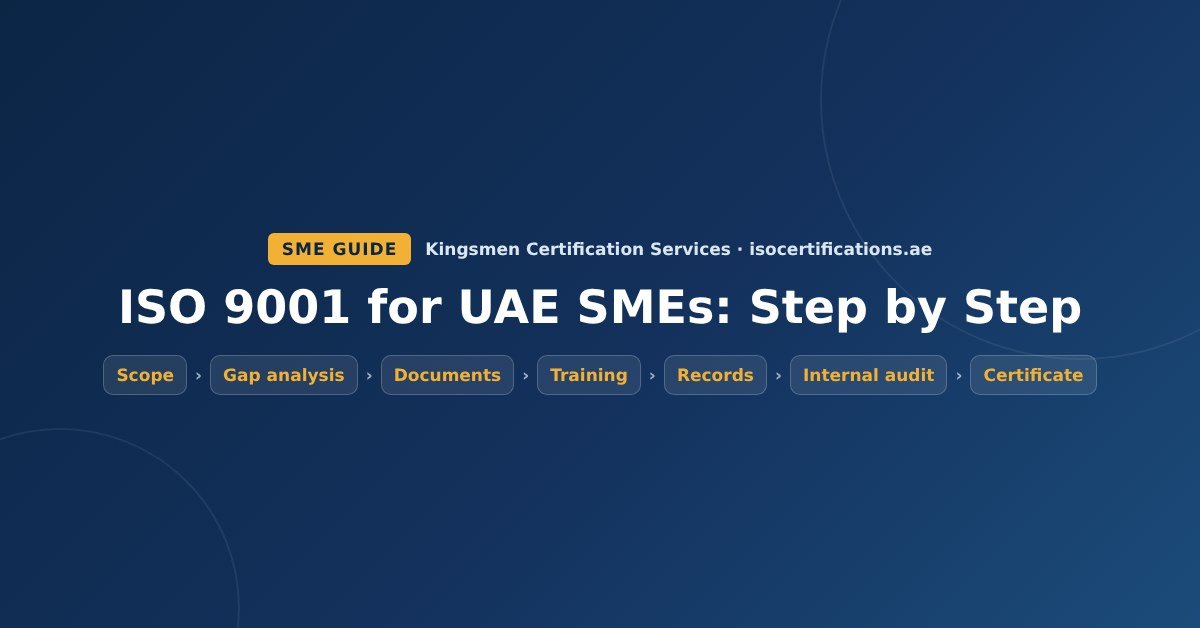
Most UAE small businesses meet ISO 9001 the same way. A big client or a tender asks for it, often with a short deadline. Then the owner has to work out what it involves, how long it takes and where to start. This guide walks through that journey in plain words, step by step, for a small or mid-sized UAE company.
What ISO 9001 Means for a Small Business
ISO 9001 is the international standard for quality management. For a small business, it means a simple, written way of running the company. An outside auditor can then check it. It covers how you take orders, deliver work, handle complaints, choose suppliers and fix problems. Then it asks you to keep improving.
The standard does not tell you how to run your trade. Instead, it asks you to decide your own methods, write them down and follow them. So a 12-person trading firm and a 300-person contractor can both meet it. The difference lies in how much detail each one needs.
For the full standard, local timelines and support, see this page on ISO 9001 certification.
Why UAE SMEs Need It
The main reason is access to buyers. Government entities, utilities, developers, main contractors and large private companies often list ISO 9001 in tenders and supplier forms. Some make it a must, while others give extra points. Either way, it often decides whether a small firm reaches the shortlist.
There are internal gains too. Clear processes cut errors, rework and complaints. New staff learn faster, because the steps are written down. Owners also gain better data, such as on-time delivery and complaint trends. As a result, the business depends less on one or two key people.
New to the topic? This short guide explains what ISO certification means for a company.
ISO 9001 in Different UAE Sectors
The standard stays the same, but each sector applies it differently. So it helps to see what a quality system looks like in your own type of business. The examples below show where small UAE firms usually focus their effort first.
- Trading firms: supplier approval, incoming checks, stock control and delivery accuracy.
- Contractors: project plans, inspection records, subcontractor control and handover.
- Logistics firms: on-time delivery, damage records and driver training.
- Service firms: client briefs, service reports and feedback follow-up.
- Manufacturers: production checks, calibration and non-conforming product.
Start with the processes that touch your customers most. Those areas give the biggest quality gains, and auditors look at them first. Then extend the same habits to support work, such as purchasing and HR.
Step 1: Set Your Scope
Start by deciding what the certificate will cover. List the activities, products and services you sell, plus the sites where you do the work. Keep it honest. If you trade and also install equipment, include both. Otherwise, a buyer who orders installation may not accept the certificate.
Also list every site, including warehouses and branches in other emirates. One certificate can cover several sites, as long as each follows the same system. However, the auditor may visit any of them, so each site needs its own records.
Step 2: Run a Gap Analysis
A gap analysis compares how you work today with what ISO 9001 asks for. Most small firms already do many things right, such as checking orders or dealing with complaints. The gap analysis shows what is missing, such as written objectives, an internal audit or a formal management review.
Write the result as a short action list with owners and dates. That list becomes your project plan. It also helps you estimate the time and effort needed. Many firms ask a consultant for this step, because an outside view spots gaps that insiders miss.
Step 3: Write Only the Documents You Need
ISO 9001 asks for fewer documents than most people think. You need a scope, a quality policy, quality objectives and a few key procedures. You also need records that prove the system works. Everything else is your choice. So keep documents short and write them in your own words.
- Quality policy: a short statement signed by top management.
- Objectives: two to four measurable targets, such as on-time delivery.
- Risk register: what could go wrong and how you control it.
- Key procedures: sales, purchasing, operations and complaints.
- Records: training, supplier checks, customer feedback and corrective actions.
For a full checklist of documents and records, see this guide to ISO certification requirements.
Step 4: Train Your Team
Training turns your documents into daily habits. Every employee needs to know the quality policy, their own duties and what to do when something goes wrong. Short, practical sessions work best for busy teams. In fact, a one-hour briefing per team often covers most needs in a small business.
Auditors talk to staff during the audit. They ask simple questions about each person’s role in quality. They also ask what happens when a customer complains. So practise these answers in training. Confident, honest answers impress auditors more than memorised text.
Step 5: Run the System and Keep Records
Next, run the system for a few weeks before the audit. Use your new forms, log customer feedback, check suppliers and record corrective actions. These records prove that the system works in practice, not only on paper. Auditors sample them closely, and they check dates and signatures.
Keep records simple, and keep them in one shared place that every manager can reach. A shared spreadsheet or a basic form often works better than complex software. What matters is that the records are complete, dated and easy to find on audit day.
Step 6: Internal Audit and Management Review
Before the external audit, check the system yourself. An internal audit compares what you do with what your documents say. Then close every finding. After that, top management holds a management review to look at results, objectives, complaints and audit findings. Both steps are required by the standard.
Many small firms ask a consultant or a trained outside auditor to run the first internal audit. An independent eye finds more gaps, and it gives the team practice at being audited.
Step 7: The Certification Audit
Finally, an accredited certification body audits you in two stages. Stage 1 reviews your documents and readiness. Stage 2 tests the system on site through interviews, record checks and site walks. If the auditor raises findings, you close them. Then the body issues the certificate.
The certificate stays valid for three years. During that time, the body returns each year for a shorter surveillance audit. In year three, a recertification audit renews it.
What Auditors Look For
Auditors want evidence that your system works every day, not only on paper. They usually start with the scope and policy, then follow a real order from enquiry to delivery. Along the way, they check records, talk to staff and look at how you handle problems. A clear, honest trail impresses them most.
- Customer focus: how you capture requirements and handle feedback.
- Supplier control: an approved supplier list and real checks.
- Corrective action: problems found, causes and fixes.
- Objectives: targets that you actually measure and review.
- Leadership: top management involved in the review, not just signing forms.
Small firms often worry about this stage. Yet auditors expect a simple system in a small business. They look for control and honesty, not thick manuals or complex software.
How Long and How Much?
Most UAE SMEs prepare for ISO 9001 in about 6 to 12 weeks. A small single-site firm with good habits moves faster. Multi-site firms take longer. The budget depends on your headcount, sites and readiness, plus the certification body’s audit fee.
Always ask for a quote that splits consultancy and audit fees, so you can compare offers fairly. For the main price factors, see this guide to ISO certification cost in the UAE.
Timeline at a Glance
The table below shows a typical timeline for a small UAE company with one site. Larger firms follow the same stages, but each one takes longer.
| Week | Stage | Output |
|---|---|---|
| 1 | Scope and gap analysis | Action list |
| 2–4 | Documents and forms | Quality system documents |
| 4–5 | Staff training | Training records |
| 5–9 | Run the system | Working records |
| 9–10 | Internal audit and review | Audit report and minutes |
| 10–12 | Certification audit | ISO 9001 certificate |
How to Choose Help
You will usually work with two separate firms. A consultant helps you build the system, while an accredited certification body audits you. The two roles must stay apart. So be careful with any firm that offers to write your system and certify it as well.
When you compare providers, ask about accreditation, sector experience, scope, timeline and three-year costs. This guide on choosing ISO 9001 certification companies covers a full checklist.
Keeping the Certificate After Year One
The certificate is the start, not the finish. After certification, the system needs a little time every month. Review complaints, check objectives, update supplier records and hold short team briefings. Then plan the yearly internal audit and management review before each surveillance visit.
Many small firms name one person as the quality owner. That person tracks dates, collects records and reminds managers of their tasks. In most SMEs, this takes a few hours a month. As a result, surveillance audits stay short and calm.
Adding Other Standards Later
Once ISO 9001 runs well, adding a second standard is much easier. Contractors often add ISO 14001 and ISO 45001. IT firms often add ISO 27001. Because these standards share the same structure, you reuse your policy, internal audit and management review. So the second project usually takes less time than the first.
Which standards do buyers ask for in each emirate? See this guide to ISO certification across the UAE.
Common Mistakes Small Firms Make
Most first-audit problems come from a few repeat mistakes. Each one is easy to avoid with a little planning.
- Template manuals: long documents that describe another company.
- Late records: logs created the week before the audit.
- Weak objectives: targets that nobody measures.
- Open findings: internal audit actions still not closed.
- Cheap, unaccredited certificates: certificates buyers later reject.
Frequently Asked Questions
Is ISO 9001 mandatory for UAE companies?
For most companies, it is voluntary. However, many tenders and large buyers ask for it, so in practice it often decides whether you can bid. Check your tender documents and supplier forms to see how often your buyers request it.
Can a company with five staff get ISO 9001?
Yes. ISO 9001 suits firms of every size. A very small company can keep documents short and records simple. In fact, small teams often prepare faster, because fewer people need training.
Do we need special software?
No. Many small firms run ISO 9001 with simple forms, spreadsheets and shared folders. Software can help larger firms, but it is not a requirement. What matters is that records are complete and easy to find.
What does it cost to keep the certificate?
After the first year, you pay the certification body for each surveillance audit. Then you pay a larger fee for recertification in year three. Internal costs are mostly staff time. Many firms also keep a consultant on a small yearly retainer for internal audits.
Is the certificate valid outside Dubai?
Yes. ISO 9001 is an international standard, so the certificate counts in every emirate and abroad. For local support in the city, see this page on ISO certification in Dubai.
Final Thoughts
ISO 9001 is one of the most practical steps a UAE SME can take to win bigger contracts. Start with an honest scope, keep documents short and build records into daily work. Then the audit becomes a confirmation of good habits, not a last-minute rush. Over time, those habits also make the business easier to grow, sell or hand over.
This guide comes from the ISO advisory team at Kingsmen Certification Services. The team has supported UAE companies with ISO projects since 2014.