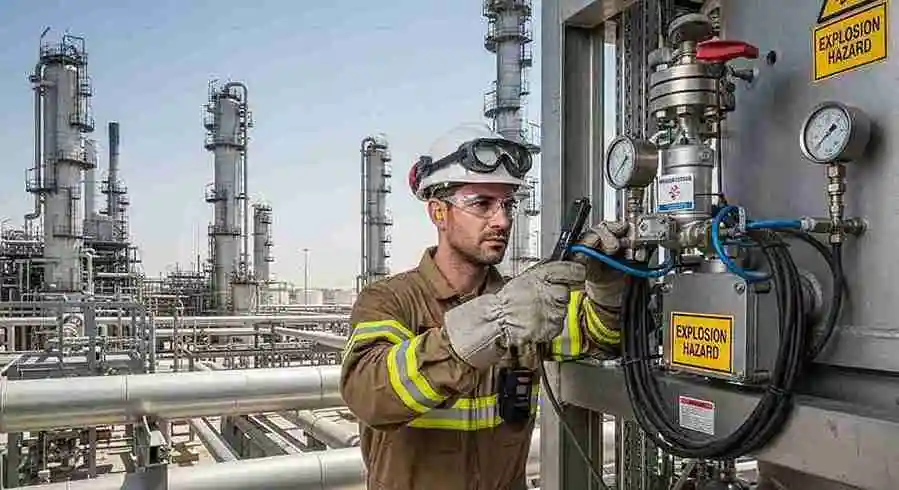
You are a mechanical engineer. You work on pumps, pipelines, compressors, and rotating equipment. Your job takes you deep inside oil refineries, gas plants, and chemical facilities every day.
Here is the question: are you certified to work there safely?
Most non-electrical engineers assume CompEx does not apply to them. That assumption is costly. Hazardous area rules apply to everyone on site — not just electricians. One gap in knowledge can trigger a fire, an explosion, or worse.
CompEx certification for mechanical engineers closes that gap. This guide shows you exactly how — and where to get certified across the GCC in 2026.
Who is CompEx Certification For?
CompEx is for anyone who works in or near explosive atmospheres. The scheme was built around electrical competency. But it has grown far beyond that.
Today, CompEx covers:
- Mechanical engineers
- Instrumentation engineers
- QA/QC engineers
- Maintenance engineers
- Safety officers and HSE professionals
- Project supervisors and site managers
If your job brings you into a hazardous area, CompEx applies to you. Full stop.
Explore the full course range: CompEx Certification for Mechanical & Non-Electrical Engineers — Extrainings
What Does CompEx Actually Test?
CompEx certification tests real competency. It is not a one-day awareness seminar. It combines written theory exams with hands-on practical assessments.
To pass, you must prove you understand:
- Hazardous area zone classifications (Zone 0, 1, 2)
- Ex equipment protection concepts and markings
- Safe installation and inspection practices
- Risk identification in explosive atmospheres
- Relevant international standards — IEC 60079 series
Pass both parts. Earn the certificate. Prove your competency to any employer in the GCC or globally.
Why This Matters in Oil & Gas
Oil refineries and gas processing plants run on flammable materials. Gases, vapours, and combustible dust are present at all times. Any ignition source — a spark, a hot surface, friction — can trigger an explosion.
CompEx-certified engineers know how to remove those risks. They follow the right procedures. They use the right equipment. They keep sites safe.
Read: How CompEx Certification Reduces Explosion Risk in Oil & Gas Facilities
Read: Why CompEx Certification is Important for Hazardous Environments
The Misconception That Costs Engineers Jobs
Here is the most common mistake non-electrical engineers make:
“CompEx is only for electricians. I do mechanical work. It does not apply to me.”
This is wrong — and it is increasingly expensive to believe it.
Major EPC contractors and energy operators across UAE, Saudi Arabia, and Qatar now require CompEx certification for all personnel working in hazardous areas. That includes mechanical engineers. It includes QA/QC teams. It includes maintenance supervisors.
Engineers without a valid certificate are turned away at the gate. Contracts are lost. Project roles are filled by certified candidates instead.
The good news? Getting certified is straightforward. The right module exists for your role right now.
Which CompEx Modules Suit Mechanical Engineers?
Choosing the right module is the most important first step. Here is a clear guide based on your role and site responsibilities.
CompEx Foundation — ExF (Awareness Level)
ExF is the entry point for non-electrical professionals. It covers hazardous area awareness, zone classifications, protection concepts, and basic safety principles. No prior electrical knowledge is needed.
ExF suits: site managers, supervisors, HSE officers, procurement staff, and anyone who enters hazardous areas but does not perform hands-on technical work.
Course details: CompEx Foundation ExF — Extrainings
CompEx Foundation Plus — ExF+ (Technical Awareness)
ExF+ goes one level deeper. It is designed for engineers who work directly with equipment in hazardous areas but do not carry out electrical installation or inspection.
ExF+ suits: mechanical engineers, maintenance planners, QA/QC engineers, and rotating equipment specialists working inside classified zones.
Course details: CompEx Foundation Plus ExF+ — Extrainings
Ex01–Ex04 (Gas & Vapours — Full Competency)
Ex01–Ex04 are the core CompEx units. They cover electrical installation, inspection, and maintenance in gas and vapour explosive atmospheres.
These modules are primarily for electrical and instrumentation engineers. However, mechanical engineers who work closely alongside electrical teams — or who want the highest level of site competency — can also complete Ex01–Ex04.
These are the most recognised CompEx units across GCC project sites.
Related: CompEx Certification for Instrumentation Engineers
Ex05–Ex06 (Dust Hazardous Areas)
Ex05–Ex06 cover combustible dust environments. These apply to mechanical engineers in cement plants, food processing, grain storage, pharmaceuticals, and chemical manufacturing.
If your facility handles combustible dust, Ex05–Ex06 is your primary route — not Ex01–Ex04.
CompEx Module Selector — Which One is Right for You?
| Your Role | Recommended Module | Duration |
|---|---|---|
| Site manager / HSE officer | ExF (Foundation) | 1–2 days |
| Mechanical / maintenance engineer | ExF+ (Foundation Plus) | 2–3 days |
| Engineer working with electrical teams | Ex01–Ex04 | 3–5 days |
| Engineer in dust hazard environments | Ex05–Ex06 | 3–5 days |
| Expired certificate — renewal needed | RPP Refresher (Ex01R–Ex04R) | 2–3 days |
Not sure which applies to you? Contact Extrainings for a free module recommendation →
Why GCC Employers Demand CompEx in 2026
The GCC energy sector is the largest in the world. It is also one of the most regulated. Compliance requirements have tightened across UAE, Saudi Arabia, and Qatar in recent years.
UAE — Growing Mandatory Requirements
Oil and gas operators and industrial facility managers across the UAE now include CompEx in their contractor and vendor pre-qualification checklists. Engineers without it face rejection at the pre-qualification stage — before they even reach the interview.
See: CompEx Certification in UAE | CompEx Training in Sharjah
Saudi Arabia — Jubail, Yanbu & Major Project Sites
Saudi Arabia’s industrial cities — particularly Jubail — host some of the world’s largest petrochemical complexes. Contractors working on these sites must meet strict competency requirements. CompEx certification satisfies those requirements for hazardous area personnel.
See: CompEx Certification in Jubail — Saudi Industrial City
Qatar — LNG and Offshore Projects
Qatar’s LNG and offshore energy expansion continues at pace. International project standards apply across all major contracts. CompEx is widely accepted as the personnel competency standard for hazardous area workers on these projects.
See: CompEx Certification in UAE & Qatar — Fees and IECEx Overview
CompEx vs IECEx vs ATEX — Simple Comparison
Three certification names come up in every GCC project briefing. Here is what each one means:
| Scheme | What It Certifies | Who Needs It | GCC Acceptance |
|---|---|---|---|
| CompEx | The person — competency to work in hazardous areas | Engineers, technicians, supervisors | Widely accepted |
| IECEx | The person + the equipment | Personnel and equipment suppliers | Growing acceptance |
| ATEX | The equipment — explosion protection marking | Equipment manufacturers (EU) | Equipment marking only |
The key difference: CompEx and IECEx certify people. ATEX certifies equipment. For mechanical engineers working on GCC project sites, CompEx is the most practical and recognised route.
Deep dive: CompEx vs IECEx — Key Differences Explained
Eligibility — What Do You Need to Enroll?
CompEx is accessible to a wide range of engineering professionals. Requirements vary slightly by module level.
For ExF and ExF+ (Foundation Routes)
- No electrical background required
- No minimum years of experience required
- Basic familiarity with industrial plant environments is helpful
- Valid ID and a passport-size photograph
For Ex01–Ex04 (Core Competency Modules)
- 1–2 years of relevant site or engineering experience recommended
- Engineering diploma or degree preferred
- Familiarity with electrical or instrumentation systems helpful
- Valid ID, educational certificates, and work experience letter or CV
How the Certification Process Works
Step 1 — Choose Your Module
Use the module selector table above to identify the right course for your role. If you are unsure, contact Extrainings. We help you pick the right starting point based on your job and site responsibilities.
Step 2 — Attend Theory Training
Theory sessions cover zone classification, protection standards, Ex equipment markings, and safe work procedures. Sessions are delivered in classroom or blended formats depending on location.
Step 3 — Complete Practical Assessment
You work with real Ex-rated equipment in a controlled environment. Assessors watch you apply safe procedures hands-on. This is where competency is truly tested.
Step 4 — Pass and Receive Certificate
Clear the written exam and the practical assessment. Your CompEx certificate is issued. It is valid for 5 years and recognised globally.
Step 5 — Plan Your Renewal Early
Do not wait until your certificate expires. Use the CompEx RPP Refresher Programme to revalidate without sitting the full course again.
Resit support available: Practical Resit | Theory Resit
CompEx Certification Cost in UAE, Saudi Arabia, and Qatar
Costs depend on the module, training location, and whether you book as an individual or a group. We do not list fixed prices here — rates are updated regularly to stay competitive across all three regions.
Contact Extrainings directly for a current, accurate quote. Group bookings and corporate packages are available.
Get a Pricing Quote — Contact Extrainings →
Career Impact for Mechanical Engineers
CompEx certification changes your career position in the GCC job market. Here is how:
You Become Site-Eligible
Many high-value oil and gas project sites require CompEx as a condition of entry. Certified engineers get site access. Non-certified engineers do not. It is that direct.
You Earn More
Certified engineers consistently earn more than non-certified counterparts. Employers pay for verified competency on safety-critical projects. CompEx is one of the fastest ways to justify a salary step up in the GCC.
You Compete Globally
CompEx is recognised in the UK, Europe, and across international energy projects — not just the GCC. One certificate. Global credibility.
Read: 6 Powerful Benefits of Earning Your CompEx Qualification
Read: CompEx for Electrical Engineers — Career Scope and Benefits
Why Mechanical Engineers Choose Extrainings
Extrainings delivers CompEx and IECEx training across UAE, Saudi Arabia, and Qatar. We are not a general training company. We are a specialist hazardous area certification centre.
- Certified assessors — All trainers hold active CompEx certification and real site experience
- GCC-aligned content — Training is built around the standards major GCC energy employers require
- Multi-location delivery — UAE, Sharjah, Jubail, Qatar, and India
- Corporate training — Group bookings, on-site delivery, and team packages available
- End-to-end support — From module selection to certificate issue, we guide you through every step
View CompEx Courses for Mechanical & Non-Electrical Engineers →
Book a Free Consultation with Extrainings →
Frequently Asked Questions
Is CompEx certification only for electricians?
No. CompEx is for anyone working in or near hazardous explosive atmospheres. Mechanical engineers, QA/QC engineers, safety officers, and maintenance professionals all qualify. The Foundation (ExF) and Foundation Plus (ExF+) courses are built specifically for non-electrical engineers.
Which CompEx module is best for a mechanical engineer?
Most mechanical engineers start with ExF+ (Foundation Plus). It covers hazardous area awareness and safe work practices for engineers who interact directly with equipment in classified zones. Engineers who work closely with electrical systems may also consider Ex01–Ex04.
Is CompEx recognised in Saudi Arabia and Qatar?
Yes. CompEx is widely recognised across the GCC including Saudi Arabia and Qatar. Major oil, gas, and petrochemical operators and EPC contractors accept it as a personnel competency standard for hazardous area work.
How long does it take to get CompEx certified?
Foundation (ExF) courses take 1–2 days. Foundation Plus (ExF+) takes 2–3 days. Ex01–Ex04 programmes take 3–5 days including theory, practical training, and assessment. Contact Extrainings for your specific schedule.
Can I do CompEx training in UAE or Saudi Arabia?
Yes. Extrainings delivers CompEx training across UAE, Sharjah, and Jubail in Saudi Arabia. Training is also available in Qatar and India. Contact us to confirm the next available schedule in your location.
What happens if I fail part of the CompEx assessment?
You can resit the part you failed within 12 months. Theory and practical resits are available separately. You do not need to repeat the full course. See the Practical Resit and Theory Resit pages for details.
Conclusion
CompEx certification for mechanical engineers is not a nice-to-have in the GCC anymore. It is a site entry requirement. It is a career differentiator. It is proof that you can work safely where it matters most.
Whether you choose ExF, ExF+, or the full Ex01–Ex04 route — the right path is clear. The right training centre is ready.
Do not wait for a contract to fall through. Get certified before the next project starts.