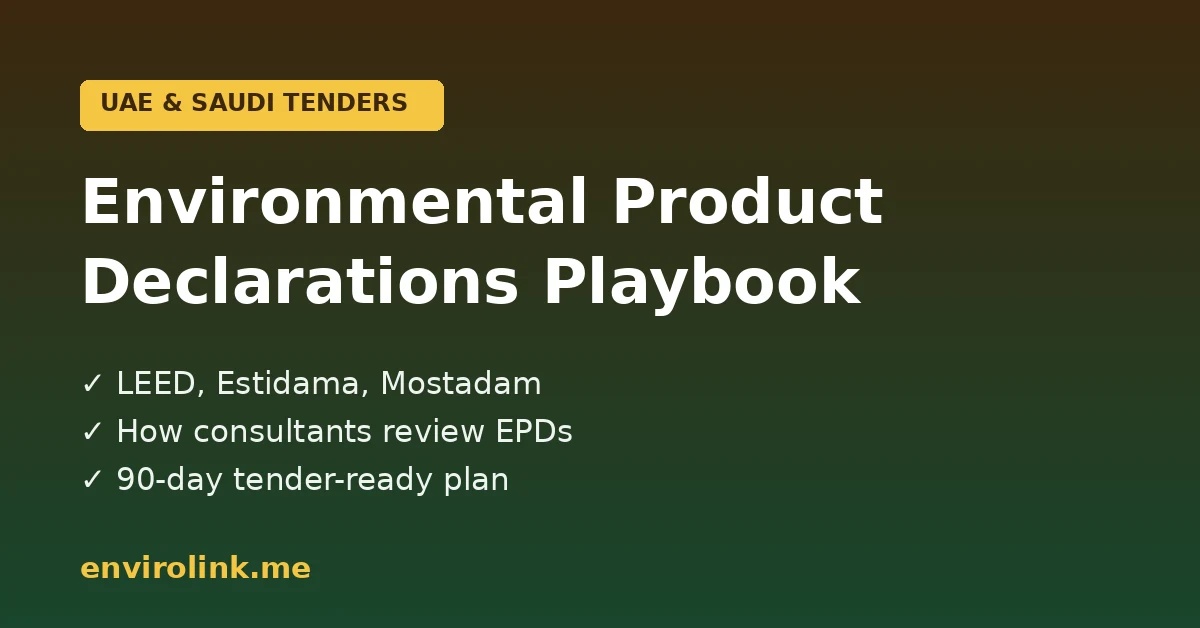
Environmental product declarations are third-party reports that show a product’s impact on the planet. They follow ISO 14025 and EN 15804. In UAE and Saudi construction tenders, consultants use them to score materials for LEED, Estidama, Mostadam and embodied carbon targets. Suppliers with published EPDs pass prequalification more easily and give project teams the data they need.
A few years ago, most GCC tenders asked for price, delivery time and a test report. Today, many add one more line: environmental data. So, suppliers who cannot answer that line start losing ground, even when their product is excellent.
This playbook shows how environmental product declarations now shape tenders in the UAE and Saudi Arabia. It also shows how your business can use them to win more work.
Why Tenders Now Ask for Environmental Data
Three forces drive this change. First, green building rating systems reward verified product data. Second, large developers set carbon targets for their projects. Third, investors want proof of real progress on climate goals.
The UAE has set a Net Zero 2050 target, and Saudi Arabia has committed to net zero by 2060. These goals filter down to the projects that public and private developers build. As a result, consultants now ask suppliers for numbers rather than general green claims.
That includes giga-projects and government buildings too. Many of them follow rating systems or internal sustainability rules that value EPD data. In practice, this makes environmental product declarations a real factor in which materials make the approved list.
Where EPDs Fit in GCC Rating Systems
Each rating system uses EPD data in its own way. However, they share one idea. Verified, comparable data earns credit, while marketing claims do not.
- LEED v4.1: One materials credit rewards projects that use at least 20 products with EPDs. Those products must come from five or more makers.
- Estidama Pearl Rating: Abu Dhabi projects value material transparency and lower-impact products.
- Mostadam: Saudi Arabia’s rating system encourages responsible material choices and environmental data.
- Al Sa’fat: Dubai’s green building system supports sustainable materials in new buildings.
- GSAS and BREEAM: Both systems also give weight to life cycle data in material choices.
So, one well-built EPD can support your product across several rating systems at once. That makes it one of the most efficient sustainability investments a supplier can make.
How Consultants Actually Review Your EPD
It helps to see your EPD through the eyes of the person scoring it. Most sustainability consultants follow a short checklist.
- Is the EPD a verified Type III declaration?
- Does it follow ISO 14025 and EN 15804 or ISO 21930?
- Does a recognised program operator publish it?
- Is it still within its validity period?
- Does it cover the exact product and factory supplied to the project?
If any answer is “no,” the consultant may reject the document. So, a quick internal check before every submittal saves you from last-minute surprises.
Five Ways Suppliers Lose Points in Tenders
We see the same problems across UAE and Saudi submittals. Each one is easy to avoid once you know it.
Sending a Brochure Instead of an EPD
Phrases like “eco-friendly” or “low carbon” do not count. Consultants need the published EPD with its registration number. Otherwise, they simply skip your product in their credit calculations.
Using an Expired Document
Most construction EPDs stay valid for five years. After that, they no longer support new submittals. So, track the expiry date and plan renewal well ahead. Our guide on EPD validity and renewal in the GCC explains the timing.
Submitting a Parent Company’s EPD
An EPD for a factory in Europe does not represent a plant in Jebel Ali or Dammam. Consultants check the factory location. That is why regional manufacturers need EPDs that reflect their own operations.
Missing the Submittal Format
Many consultants want a short summary sheet beside the full EPD. It lists the registration number, validity and key results. Suppliers who provide it make the reviewer’s job easy, and that goodwill matters.
Starting Too Late
An EPD usually takes 8 to 14 weeks after your data is ready. If you wait for a tender to start, you will miss it. Instead, build your EPD before the next big project lands.
Building an EPD Strategy for Your Product Range
You do not need an EPD for every product on day one. Instead, start where the demand is strongest.
- Rank your products by tender exposure. Which items appear most in LEED and government projects?
- Group similar products. One EPD can often cover several sizes or finishes.
- Plan your data year. Use a full, recent year of production records.
- Pick an operator your markets trust. This avoids paying for a second EPD later.
- Set a renewal calendar. Know when each EPD expires.
Want the full picture of cost drivers and timelines? See how EnviroLink delivers environmental product declarations for UAE and GCC manufacturers.
A Simple 90-Day Plan to Get Tender-Ready
If your team has no EPD yet, this short plan gets you moving. It fits around normal factory work, so nobody needs to stop production.
- Days 1 to 15: Pick your top products and name one data owner. Then collect a full year of energy, material and waste records.
- Days 16 to 45: Your EPD partner checks the data, picks the PCR and builds the life cycle model.
- Days 46 to 75: The verifier reviews the work. Your team answers any questions quickly.
- Days 76 to 90: The program operator publishes the EPD. Then your sales team adds it to data sheets and tender packs.
Of course, real projects vary. Clean data shortens the plan, while missing records stretch it. Still, a clear plan like this shows clients that you take their sustainability goals seriously. Many consultants respond well to a supplier who shares a firm publication date, even before the EPD is live.
EPDs Also Open Export Doors
Environmental product declarations do more than win local tenders. European buyers increasingly expect EN 15804 data from their suppliers. Meanwhile, carbon rules such as the EU’s Carbon Border Adjustment Mechanism push importers to look closely at embedded emissions.
So, a GCC manufacturer with a verified EPD speaks the language that European procurement teams understand. To learn more about this route, read EnviroLink’s article on EPDs for GCC exporters selling to Europe.
Turn Your EPD Into a Tender Asset
Once you publish your EPD, make sure every tender team knows about it. Small actions here bring big returns.
- Add the registration number to every product data sheet.
- Prepare a one-page summary for consultants.
- Include the EPD in prequalification packs for new developers.
- Brief your sales team on what the key numbers mean.
- Share updates when you lower your product’s footprint.
That way, your EPD works for you in every project, not just the one that triggered it.
Frequently Asked Questions
Are environmental product declarations mandatory in Saudi Arabia?
There is no general legal rule that every product must have an EPD in Saudi Arabia today. However, rating systems such as Mostadam and LEED, along with large developers’ sustainability rules, increasingly value EPD data. In practice, suppliers to major projects often find an EPD helps them stay on approved lists.
Which standards should an EPD follow for GCC tenders?
Your EPD should follow ISO 14025 for Type III declarations. For construction products, it should also follow EN 15804 or ISO 21930. The underlying life cycle assessment follows ISO 14040 and ISO 14044. Consultants across the UAE and Saudi Arabia check these standards first.
Can one EPD support LEED and Estidama together?
Yes, in many cases. A verified EPD built to ISO 14025 and EN 15804 provides the data that several rating systems value. The project consultant then applies it to the credits in each system. So, one EPD often supports your product across different project types.
How long does it take to get an EPD for a tender?
Most single-product EPDs take around 8 to 14 weeks after your data is complete. Product groups and multiple factories can take longer. Because tenders move quickly, the smart approach is to build your EPD before a project asks for it.
What does a consultant look for in my EPD?
They check that it is a verified Type III EPD, published by a recognised program operator and still valid. They also confirm it covers the product and factory you supply. A short summary sheet with the registration number makes their review faster and easier.
Is a carbon footprint report the same as an EPD?
No. A product carbon footprint reports only greenhouse gas emissions. An EPD covers many impact areas, such as energy, water, emissions and waste, and needs third-party verification. That is why rating systems and consultants usually give more weight to an EPD.
Preparing for your next UAE or Saudi tender? Contact EnviroLink to plan environmental product declarations for the products that matter most to your sales pipeline.