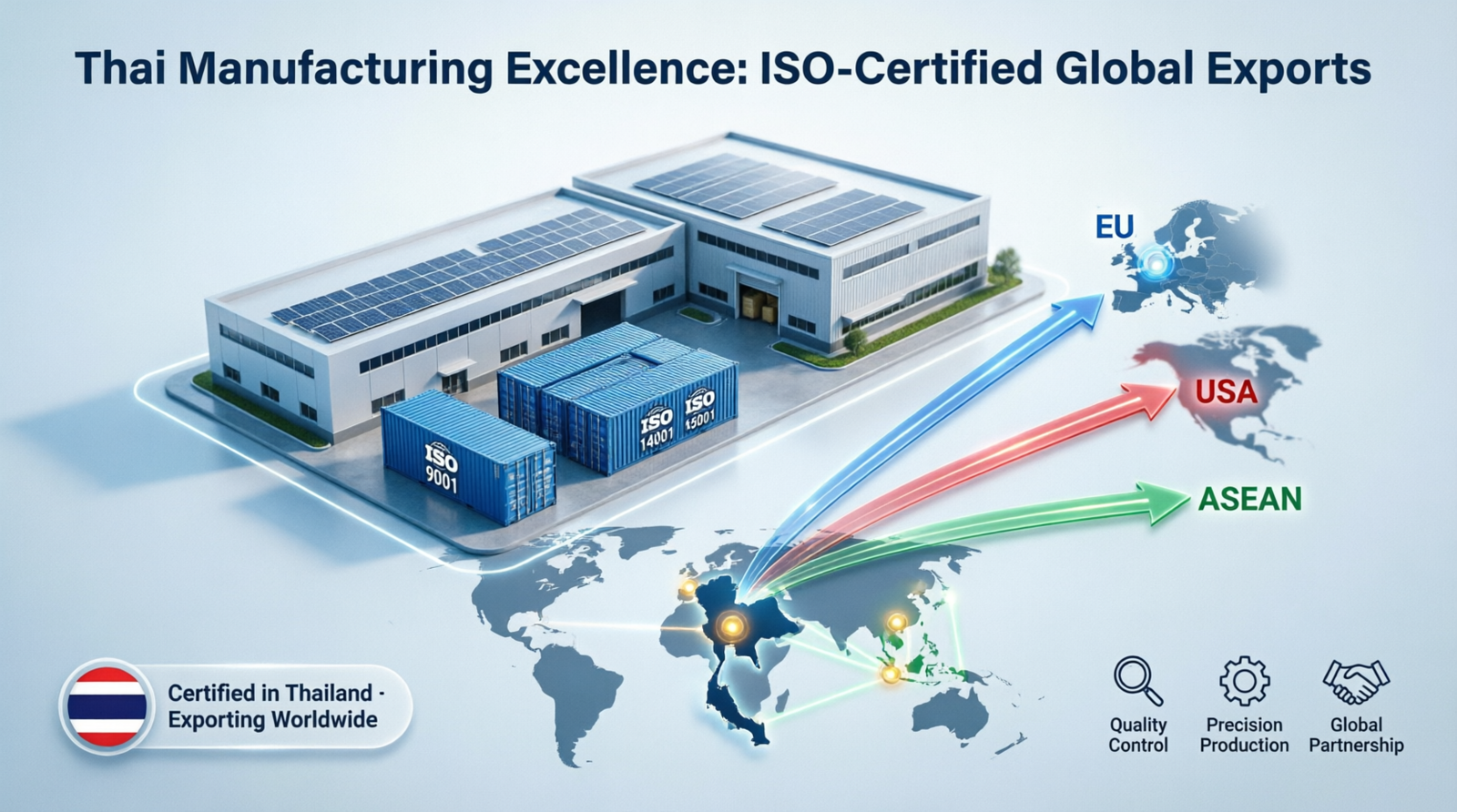
ISO certification gives Thai manufacturers a documented quality system that overseas buyers can verify before placing an order. It replaces guesswork with proof, and that proof opens doors to international supply chains that would otherwise stay closed.
For factory owners eyeing export growth, this single document often decides whether a buyer responds to an inquiry or skips straight to the next supplier.
Why Do Thai Manufacturers Need ISO Certification for Export?
International buyers need proof that a factory delivers consistent quality before they sign a contract. ISO certification provides exactly that proof, backed by an independent audit.
Without it, a Thai exporter has to rely on relationship trust, sample shipments, and hope. That works occasionally. It doesn’t scale.
Consider a furniture manufacturer in Samut Prakan trying to win a European retail chain. The buyer’s compliance team requested ISO 9001 documentation before reviewing a single sample. No certificate meant no further conversation, regardless of product quality or price.
Global buyers expect three things from suppliers: documented processes, traceable quality records, and independent verification. ISO certification delivers all three in one package, which is why it shows up so often in vendor approval checklists.
How ISO Certification Builds Trust With International Buyers
Trust between a Thai factory and an overseas buyer rarely comes from a single sales call. It comes from evidence the buyer can check independently.
Multinational companies run structured supplier approval processes. These processes typically score vendors on quality systems, safety compliance, and environmental practices. ISO certification answers several of these scoring categories at once.
A mid-sized electronics assembler in Chonburi experienced this directly. After achieving ISO 9001 certification, their procurement contact stopped requesting on-site audits before each new order. The certificate did that verification work instead.
This matters most with German, Japanese, and Scandinavian buyers, who often treat certification as a non-negotiable gate rather than a nice-to-have credential.
Which ISO Standards Help Thai Manufacturers Export Globally?
Different export markets and product categories call for different standards. Most manufacturers start with one core certification, then add others as buyer requirements demand.
| Standard | Purpose | Export Benefit |
|---|---|---|
| ISO 9001 | Quality management system | Builds buyer confidence in consistent output |
| ISO 14001 | Environmental management system | Meets ESG requirements from EU and Western buyers |
| ISO 45001 | Occupational health and safety | Satisfies labor compliance checks in supplier audits |
| ISO 13485 | Medical device quality management | Required for EU and US medical device market access |
| ISO 22301 | Business continuity management | Reassures buyers about supply chain disruption risk |
Manufacturers exporting general industrial goods usually start with ISO 9001 certification for manufacturers. Those targeting environmentally conscious markets often add ISO 14001 environmental management certification soon after. Factories with safety-sensitive operations frequently pursue ISO 45001 workplace safety certification alongside it.
Medical device exporters follow a different path entirely. Buyers in the EU and US specifically require ISO 13485 certification for medical device manufacturers, since general quality certification alone doesn’t satisfy their regulatory checks.
How ISO 9001 Helps Manufacturing Companies Win Overseas Contracts
ISO 9001 builds a quality management system around your existing production process. It doesn’t replace how you manufacture. It documents it, tightens it, and proves it works.
Procurement teams at large buyers use ISO 9001 status as an early filter. A supplier without it often gets removed from the shortlist before pricing discussions even start.
A textile exporter in Rayong used ISO 9001 documentation to win a contract with a Middle Eastern retail group. The buyer’s RFQ explicitly listed certification as a submission requirement, not a preference.
Before approaching new international buyers, manufacturers should check a few things:
- Confirm your quality records match your documented procedures
- Review your supplier and incoming material inspection process
- Check that corrective action records are current and complete
- Verify your certificate is active and not approaching renewal
Does ISO Certification Make Export Compliance Easier?
Yes. Certification standardizes the documentation that buyers, customs officials, and auditors all ask for separately.
International buyers frequently request audit reports, quality manuals, and corrective action logs during onboarding. Certified manufacturers already have these documents organized and ready to share.
This also shortens customer audits significantly. Buyers familiar with ISO 9001 structure know exactly where to look for traceability records, reducing the time their auditors spend on-site.
Manufacturers without certification face a slower, more manual compliance process. Every buyer asks for documentation in a different format, and every audit starts from scratch.
What Problems Can ISO Certification Help Manufacturers Avoid?
Several recurring export problems trace back to weak or undocumented quality systems.
Rejected supplier applications happen often when a factory can’t produce requested quality documentation during buyer onboarding. Certification solves this before it becomes a problem.
Quality complaints escalate faster without a documented corrective action process. ISO certification requires root-cause tracking, which catches recurring issues before they reach the customer repeatedly.
Audit failures during customer visits usually stem from gaps between written procedures and actual floor practice. Certified manufacturers close that gap through regular internal audits.
Inconsistent production across shifts or batches damages buyer confidence quickly. A documented quality management system standardizes how work gets done, regardless of which team is on the floor.
ISO Certification Process for Thai Export Manufacturers
The certification path follows a consistent structure across most ISO standards.
- Gap assessment — Compare current operations against the chosen ISO standard’s requirements.
- Documentation — Build quality manuals, procedures, and records aligned with the standard.
- Implementation — Apply documented procedures across daily factory operations.
- Internal audit — Test the system internally before the official certification audit.
- Certification audit — An accredited certification body conducts the formal assessment and issues the certificate.
Manufacturers in industrial hubs like ISO certification in Bangkok, ISO certification in Chonburi, and ISO certification in Rayong often move through this process faster, since certification bodies and consultants operate locally in these regions.
How Much Does ISO Certification Help a Factory Grow Internationally?
The growth impact depends on how reliant your target buyers are on certification during vendor selection.
A plastics manufacturer in the Eastern Economic Corridor saw a concrete shift after certification. Within one year, three new buyers in Europe approached them directly, citing certification status during initial outreach.
Not every buyer demands certification immediately. Smaller, price-focused buyers sometimes skip this requirement. But enterprise buyers, government tenders, and multinational retailers almost always expect it.
The decision comes down to your buyer profile. If your growth plan targets larger international accounts, certification is rarely optional for long.
Common ISO Certification Mistakes Thai Manufacturers Make
A few mistakes repeat across manufacturers pursuing certification for the first time.
- Treating documentation as a one-time task instead of an ongoing record-keeping habit
- Skipping internal audits before the official certification audit
- Choosing a certification body without checking accreditation status
- Letting the certificate lapse by missing scheduled surveillance audits
- Pursuing certification without training staff on actual procedures
Manufacturers managing multiple standards together often benefit from an integrated management system certification, which combines quality, environmental, and safety requirements into one streamlined audit process instead of three separate ones.
Sector-specific operations also carry their own certification nuances. Manufacturers in manufacturing industry ISO certification, automotive ISO certification, chemical industry ISO certification, and electrical and electronic industry certification each face slightly different buyer expectations worth reviewing early.
Training matters just as much as documentation. Programs like ISO lead auditor training and ISO awareness training help staff understand the system they’re expected to maintain daily, not just during the audit week.
Frequently Asked Questions
What ISO certification is best for manufacturers in Thailand?
ISO 9001 works as the foundation for most manufacturers. Sector-specific needs, like medical devices or chemicals, may call for additional standards on top of it.
Does ISO certification help export products?
Yes. It builds buyer confidence, speeds up supplier approval, and satisfies documentation requirements that many international buyers require before placing orders.
Is ISO certification required for international buyers?
It’s not legally mandatory in most cases, but many enterprise buyers and government tenders treat it as a non-negotiable requirement during vendor selection.
How long does ISO certification take in Thailand?
Most manufacturers complete the full process, from gap assessment to certification audit, within two to four months, depending on current readiness.
How much does ISO certification cost in Thailand?
Costs vary based on factory size, complexity, and chosen certification body. Smaller manufacturers typically pay less than large multi-site operations.
Can small factories get ISO certified?
Yes. ISO standards scale to organization size. Small factories follow the same certification structure, just with simpler documentation requirements.
What documents are needed for ISO certification?
Manufacturers need a quality policy, documented procedures, process records, internal audit reports, and corrective action logs specific to their chosen standard.
Conclusion
ISO certification turns your factory’s quality practices into something international buyers can verify, trust, and act on quickly. It shortens supplier approval timelines, reduces audit friction, and keeps your business competitive against certified rivals.
Contact our ISO certification experts to understand the right certification approach for your business.