Introduction:
Your reputation is your most valuable business asset. One bad review can cost you a client. One quality failure can cost you a contract. But what if there was a proven system that signals trust before you even walk into the room?
That system is ISO certification — and it changes everything.
A small logistics company in Dubai lost a major government tender. Not because of price. Not because of experience. Because they weren’t ISO certified — and their competitor was. That one certificate made the difference between winning and losing a multi-million dirham deal.
What Is ISO Certification and Why Does It Signal Trust?
ISO certification is an internationally recognized stamp of quality. It tells clients, partners, and regulators one thing clearly: this business follows a verified standard.
ISO stands for the International Organization for Standardization. Their frameworks cover everything from quality management to cybersecurity to food safety.
When a business earns ISO certification, an independent auditor confirms that the systems are real. Not just policies on paper — actual processes that work.
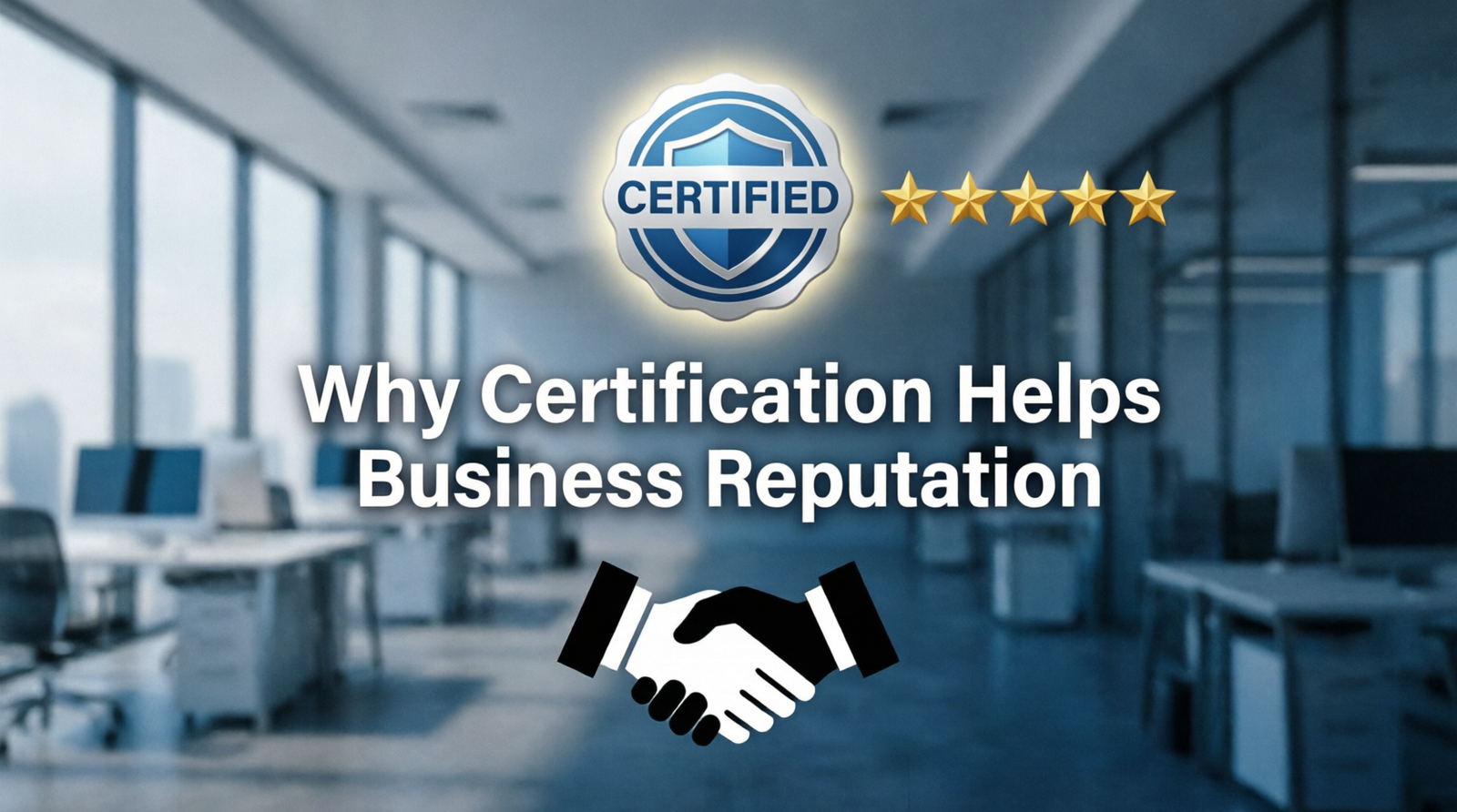
This matters because trust is hard to build and easy to destroy. Certification gives you a shortcut to credibility.
Key certifications that build reputation:
- ISO 9001 Certification — Quality Management Systems
- ISO 27001 Certification — Information Security
- ISO 14001 Certification — Environmental Management
- ISO 45001 Certification — Occupational Health & Safety
- ISO 22000 Certification — Food Safety Management
How Certification Directly Improves Business Reputation
Think of certification like a doctor’s licence. You wouldn’t trust a surgeon without one. Your clients feel the same way about your business.
Here’s how it works in practice.
1. It removes doubt instantly.
When a potential client sees your ISO certificate, they skip the lengthy vetting process. The independent audit already did that job. You become the low-risk choice.
2. It proves consistency.
Anyone can deliver quality once. Certified businesses deliver it every time. ISO frameworks force you to document your processes — so your team performs the same way whether the boss is watching or not.
3. It opens doors to bigger contracts.
Government tenders, enterprise clients, and international markets often require ISO certification. Without it, you’re simply not eligible.
“ISO certification isn’t just a badge — it’s a business development tool.” — Common feedback from certified SMEs across the UAE
The Surprising Truth About Reputation and Risk Perception
Here’s an insight most businesses miss: reputation isn’t just about what you do well. It’s about how much risk you pose.
Every client asking “should I hire this vendor?” is really asking: “What’s the chance this goes wrong?”
Certification lowers that perceived risk dramatically.
A 2023 survey by the International Trade Centre found that certified SMEs were 35% more likely to win new clients than non-certified competitors in the same sector. That’s not a small edge. That’s a structural advantage.
When you hold a recognised certification — say, ISO 9001 for quality or ISO 27001 for information security — you’re telling the market: we’ve already been tested.
Real Story: How One Certification Transformed a Company’s Market Position
A mid-sized IT services firm in Abu Dhabi was struggling to compete with larger players. Their service quality was strong, but they had no way to prove it quickly to enterprise clients.
They pursued ISO 20000 certification — the global standard for IT service management.
Within six months of certification:
- They qualified for two government tenders they couldn’t enter before
- Their client renewal rate increased by 22%
- A regional bank shortlisted them as a preferred vendor for the first time
The certification didn’t change what they did. It changed how the market perceived them.
That’s the power of a verified reputation.
Certification Builds Internal Reputation Too
Most businesses focus on external reputation — clients, partners, investors. But certification also builds something equally valuable: internal credibility.
When your team works within a certified system, they know the standards are real. Processes are documented. Roles are clear. Performance is measurable.
This does three things:
- Reduces errors — because everyone follows the same verified process
- Increases accountability — because deviations are tracked and corrected
- Boosts employee confidence — because staff know they work for a professional organisation
For businesses managing workplace safety, ISO 45001 certification sends a powerful message to employees: your safety matters here. That builds loyalty and reduces turnover.
For companies handling sensitive data, ISO 27001 tells your team that security isn’t an afterthought — it’s built into how you operate.
How Certification Helps You Stand Out in Competitive Markets
The UAE and broader GCC markets are increasingly competitive. Local businesses now compete with international players in almost every sector.
In that environment, differentiation is everything.
ISO certification is one of the clearest differentiators available. It’s not a marketing claim — it’s an audited, verifiable fact. Competitors can copy your pricing, your website, even your proposals. They cannot copy your certification without doing the real work.
Sectors where certification reputation matters most:
- Construction and engineering — clients demand quality management compliance
- Food and hospitality — food safety certifications like ISO 22000 are often non-negotiable
- Healthcare and pharma — regulatory bodies require documented management systems
- IT and technology services — data protection standards like ISO 27001 are expected
- Manufacturing — quality and environmental standards signal reliability to global buyers
If your competitors are certified and you’re not, you’re already at a disadvantage. If they’re not certified and you are, you hold a visible edge.
The Framework: Three Levels of Reputation Certification Builds
Think of certification as building reputation at three levels simultaneously.
Level 1 — Market Reputation
Your brand is recognised as quality-driven. Clients choose you with more confidence. Tenders become accessible.
Level 2 — Operational Reputation
Your processes are proven. Errors drop. Consistency improves. Delivery becomes predictable.
Level 3 — Relational Reputation
Partners, suppliers, and regulators trust you more. Relationships deepen. Opportunities compound.
Most businesses only think about Level 1. The real value is in all three working together.
Conclusion: Certification Is a Reputation Investment, Not a Cost
The businesses winning the best contracts in 2025 and beyond share one trait: they made trust visible.
ISO certification is the most effective way to do that. It’s not a box-ticking exercise. It’s a strategic move that signals quality, reduces perceived risk, and opens markets that would otherwise stay closed.
Whether you’re in food safety, IT services, construction, or environmental management — there’s an ISO standard designed to validate exactly what you do.
Your actionable takeaway: Choose the ISO certification most relevant to your industry. Start the process this quarter. The businesses that certify now will hold a reputation advantage that compounds every year.
Ready to Certify Your Business?
If you’re ready to build a reputation your clients trust and your competitors can’t ignore, we’re here to help.
👉 Explore ISO 9001 Certification — the world’s most recognised quality management standard.
👉 Learn about ISO 27001 for information security — essential for businesses handling sensitive data.
👉 See all ISO certification options — find the right standard for your industry.
Have questions about which certification fits your business? Drop a comment below or reach out to our team. We’ll help you choose the right path.