Introduction
A single unqualified decision near a gas leak or a dust-filled process line can trigger a catastrophic explosion. That is the reality of hazardous area work.
Employers do not just want experienced staff anymore. They want documented, internationally recognized competence.
That is exactly what IECEx Training delivers. It prepares electrical engineers, instrumentation technicians, and safety professionals to work safely with Ex-rated equipment — and it is the required step before earning IECEx Certification.
This guide covers everything you need before enrolling: what the training involves, which competency units apply to your role, the full certification pathway, and how to choose a provider that actually prepares you for assessment day. For the complete pathway breakdown, see our full IECEx Training guide.
What Is IECEx Training?
IECEx Training is structured instruction that prepares professionals for IECEx Certificate of Personnel Competence (CoPC) assessments, covering IEC 60079 standards, explosion protection concepts, and hands-on skills for hazardous area work. It is delivered by IECEx Recognized Training Providers (RTPs) and combines classroom theory with practical workshops.
Training itself does not certify you. Certification only happens after an approved Certification Body (ExCB) assesses your knowledge and practical skill. But almost no candidate passes that assessment without proper preparation first — the exams are detailed, and the practical component uses real Ex equipment.
Good IECEx Training programs cover:
- Explosive atmosphere fundamentals and ignition risk
- Equipment protection techniques (flameproof, intrinsic safety, increased safety, pressurization, and others)
- Zone classification for gas, vapour, and dust environments
- Installation, inspection, maintenance, and repair principles
- Documentation and standards compliance under IEC 60079
Why IECEx Training Is Important for Hazardous Area Professionals
IECEx Training matters because explosive atmospheres leave no room for guesswork — a poorly maintained connection or misapplied protection technique can trigger an explosion. Structured training builds the technical judgment needed to work safely, while also opening the door to internationally recognized certification.
Beyond safety, there are real professional stakes:
- Employability. Many operators screen candidates by certification status before reviewing CVs.
- Legal and contractual alignment. Contractor safety systems increasingly reference IECEx competence.
- Career mobility. Training that leads to CoPC certification travels with you across 30+ countries.
- Confidence on site. Trained personnel make faster, safer decisions during inspections and repairs.
This is especially visible across the UAE, Saudi Arabia, Qatar, and the broader GCC, where operators like ADNOC, Saudi Aramco, and QatarEnergy increasingly build IECEx competence requirements into contractor prequalification. Singapore’s refining and petrochemical sector shows the same pattern, with IECEx training demand rising alongside new hazardous-area capacity.
Who Should Attend IECEx Training?
IECEx Training is designed for anyone who installs, inspects, maintains, repairs, or designs electrical equipment in explosive atmospheres. This includes electrical and instrumentation engineers, maintenance technicians, HSE officers, and inspectors working across oil and gas, petrochemical, and manufacturing sites.
Typical attendees:
- Electrical and instrumentation engineers
- Maintenance and repair technicians
- Hazardous area inspectors
- Design engineers specifying Ex equipment
- HSE officers and safety supervisors
- Contractors bidding on hazardous-area scopes
Sectors driving demand: oil and gas (onshore and offshore), petrochemical processing, industrial manufacturing with combustible dust exposure, and electrical engineering/EPC contracting firms delivering hazardous-area projects.
IECEx CoPC Training Explained
IECEx CoPC Training is preparatory instruction aligned to the Certificate of Personnel Competence scheme, the personnel-certification branch of the IECEx System. It prepares candidates for both the written exam and the practical assessment required to earn a CoPC, which is valid for five years once issued.
A few things worth knowing before you commit to a course:
- CoPC uses a modular structure — you train and certify only for the units relevant to your job.
- Certificates are published on the public IECEx register, so employers can verify them instantly.
- Training does not guarantee certification — only a passed assessment against IECEx OD 503 does. Choose a provider that runs realistic, exam-style practice.
For the full breakdown of the certification pathway itself, see our dedicated IECEx Certification guide.
IECEx Competency Units Explained
IECEx competency units define the specific skills a candidate is assessed on, ranging from basic hazardous area awareness to design and repair. Unlike CompEx’s “Ex01–Ex06” module numbering, official IECEx units use three-digit codes — Ex 000 through Ex 010 — each tied to a distinct work function.
Here is a quick reference to the core units most candidates encounter:
| Unit | Focus Area |
|---|---|
| Ex 000 | Basic knowledge and awareness to enter a classified hazardous area |
| Ex 001 | Apply basic principles of protection in explosive atmospheres (prerequisite for all other units) |
| Ex 002 | Perform classification of hazardous areas |
| Ex 003 | Install explosion-protected equipment and wiring systems |
| Ex 004 | Maintain equipment in explosive atmospheres |
| Ex 006 | Test electrical installations in or associated with explosive atmospheres |
| Ex 007 | Perform visual and close inspection of installations |
| Ex 008 | Perform detailed inspection of installations |
| Ex 009 | Design electrical installations in explosive atmospheres |
A note on “Ex01–Ex06”: Many candidates search this term expecting IECEx units, but it actually describes CompEx modules — a separate UK-originated scheme. If your target employer specifically lists “IECEx CoPC,” confirm which unit numbers apply; if they list “Ex01–Ex04” or similar, they likely mean CompEx. Your training provider should help you map your job role to the correct scheme and unit combination.
Most candidates start with Ex 001 as the mandatory foundation, then add role-specific units — installation, maintenance, inspection, or design — depending on their actual job function.
IECEx Training Process Step-by-Step
The IECEx training process starts with identifying your target competency units, then progresses through instructor-led theory, hands-on practical sessions, and exam preparation before you sit the formal ExCB assessment. Most programs run several days per unit combination.
- Assess your role and required units. Match your job function (installation, inspection, maintenance, design) to the relevant Ex units.
- Enrol with a Recognized Training Provider. Confirm the provider holds current IECEx RTP status.
- Complete classroom theory. Covering standards, protection principles, and zone classification.
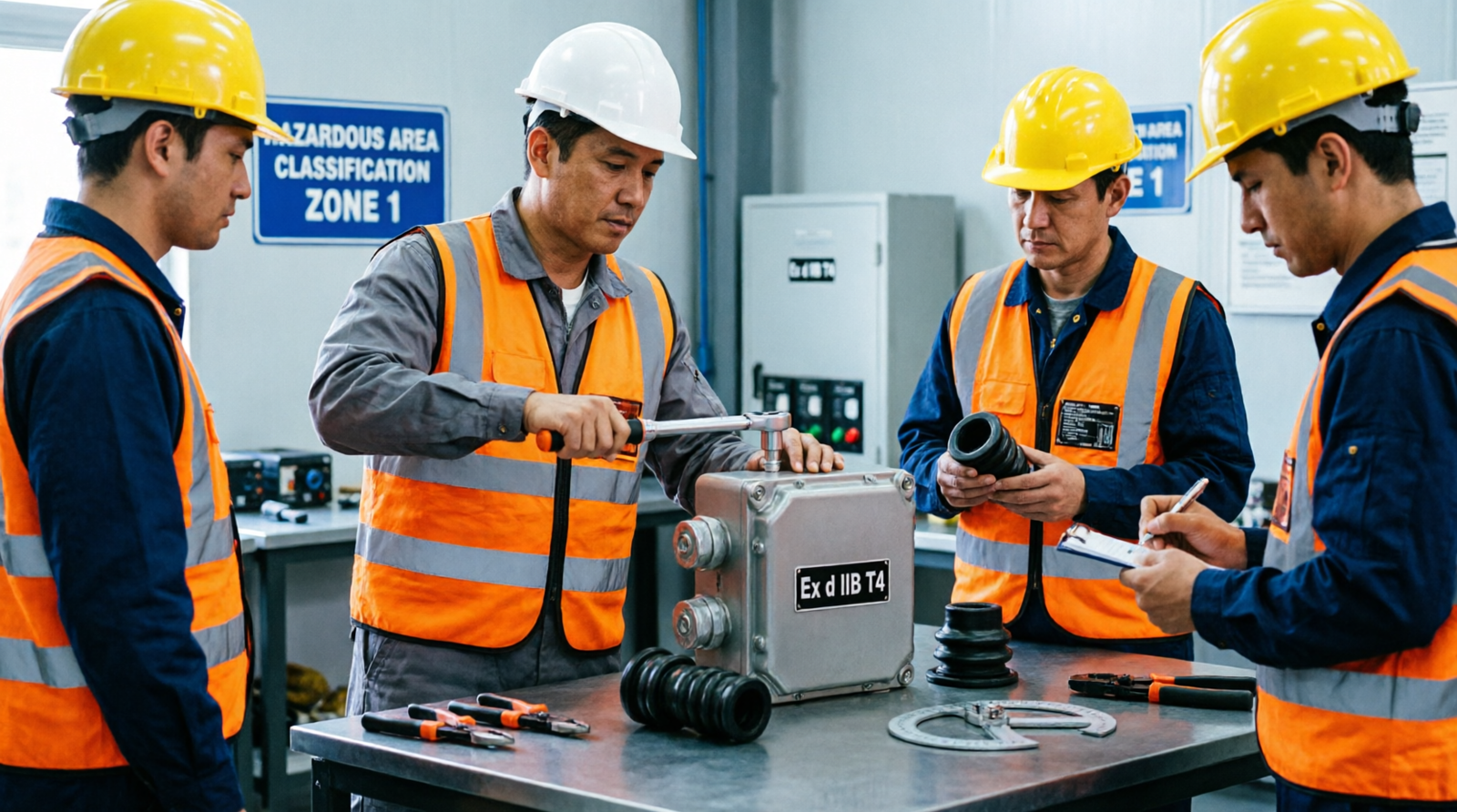
- Complete practical workshops. Hands-on work with real Ex equipment — cable glands, terminations, flameproof joints, inspection routines.
- Sit mock assessments. Strong providers run practice exams mirroring the real ExCB format.
- Apply through an approved Certification Body. Submit your application with supporting experience evidence.
- Sit the formal theoretical and practical assessment. Administered directly by the ExCB, not the training provider.
- Receive your CoPC. Once both components are passed, your certificate is issued and published on the IECEx register.
IECEx Training Checklist
- You know which competency units match your role
- You have confirmed your provider’s current IECEx RTP status
- You have relevant hazardous area work experience documented
- You have practiced with real or simulated Ex equipment, not theory alone
- You have taken at least one mock/practice assessment
- You understand your target ExCB’s application requirements
Skills You Learn Through IECEx Training
- Zone classification — identifying and categorizing hazardous areas by gas, vapour, or dust risk
- Equipment protection techniques — flameproof (Ex d), intrinsic safety (Ex i), increased safety (Ex e), and pressurization (Ex p)
- Safe installation practices — cable glanding, termination, and enclosure integrity
- Inspection methodology — visual, close, and detailed inspection grades under IEC 60079-17
- Maintenance and repair judgment — knowing when equipment can be safely repaired versus replaced
- Documentation and compliance — recording findings in line with international standards
Benefits of IECEx Training for Career Growth
- Stronger job prospects — many GCC and international employers shortlist trained, certification-track candidates first
- Higher earning potential — certified hazardous-area specialists typically command premium rates
- Global mobility — skills and credentials transfer across IECEx member countries
- Reduced site risk — trained personnel make safer, faster decisions during real incidents
- Career progression — a pathway from foundational units toward design, audit, and supervisory roles
IECEx Training Requirements and Eligibility
Most IECEx Training programs accept candidates with a relevant electrical, instrumentation, or mechanical trade background, though formal training itself has no strict prerequisite beyond basic literacy in the subject. Certification, however, generally requires around three years of demonstrated hazardous area work experience for most units.
Typical eligibility expectations:
- Electrical, instrumentation, or mechanical trade qualification (or equivalent practical experience)
- Basic understanding of electrical systems and site safety practices
- Relevant work experience for the certification stage (unit-dependent, often around 3 years)
- English proficiency sufficient for technical exams, where courses are delivered in English
How to Choose the Right IECEx Training Provider
Choose an IECEx Training provider with current Recognized Training Provider (RTP) status, instructors with real hazardous-area field experience, and practical sessions using genuine Ex equipment rather than diagrams alone. Verify claims directly rather than relying on marketing copy.
Common Learner Mistakes
- Choosing a provider based on price alone, then struggling in the practical assessment due to weak hands-on preparation
- Skipping mock assessments, which are often the biggest predictor of exam-day performance
- Enrolling in the wrong unit combination, wasting time and course fees on units that don’t match the job role
- Assuming a training certificate equals CoPC certification — only an ExCB can issue that
Expert Tip
Ask any prospective provider how many hours of hands-on practical time are included, not just classroom hours. Candidates who train extensively on real equipment consistently outperform those trained mostly through slides and lectures.
Why Choose Extrainings for IECEx Training
Extrainings, part of the Kingsmen Group, delivers IECEx Training across the UAE, Saudi Arabia, and the wider GCC with instructors who bring direct hazardous-area field experience, not just classroom theory.
Our programs are structured around the specific competency units your role requires, backed by hands-on practice with real Ex equipment and exam-style mock assessments, so candidates walk into their formal ExCB assessment prepared and confident.
Start with our complete IECEx Training guide, or explore the full certification pathway on our IECEx Certification page.
Frequently Asked Questions
What is IECEx Training?
IECEx Training is preparatory instruction covering IEC 60079 standards, explosion protection techniques, and practical hazardous-area skills. It prepares candidates for the formal assessment required to earn an IECEx Certificate of Personnel Competence.
Who needs IECEx Training?
Electrical and instrumentation engineers, maintenance technicians, inspectors, and safety officers working with equipment in explosive atmospheres typically need it, especially in oil and gas, petrochemical, and manufacturing sectors.
How can I become IECEx certified?
Identify the right competency units for your role, complete training with a Recognized Training Provider, then apply through an approved Certification Body for the theoretical and practical assessment. Certification follows once both are passed.
Which IECEx course should I take?
It depends on your job function. Installation roles typically need Ex 001 and Ex 003, inspection roles need Ex 007 or Ex 008, and maintenance roles need Ex 004. A good training provider will help map your role to the correct units.
Is IECEx Training mandatory?
There is no single global legal mandate, but training is effectively required in practice, since the certification exams are too demanding to pass without structured preparation covering standards and hands-on equipment work.
How long does IECEx Training take?
Duration depends on the unit combination selected, typically ranging from a few days for a single unit to over a week for multiple units combined with practical workshops and mock assessments.
What are IECEx Ex001 and Ex004?
Ex 001 is the foundational unit covering basic principles of protection in explosive atmospheres and is a prerequisite for other units. Ex 004 covers maintenance of equipment in explosive atmospheres.
What is IECEx CoPC training?
IECEx CoPC training is instruction specifically aligned to the Certificate of Personnel Competence scheme, preparing candidates for the modular units they will be formally assessed on by an approved Certification Body.
Can IECEx Training be done online?
Some theoretical components can be delivered online, but the practical assessment component requires in-person, hands-on evaluation with real Ex equipment at an approved facility.
What is the difference between IECEx Training and IECEx Certification?
Training is preparation delivered by a Recognized Training Provider. Certification is the formal credential issued only by an approved Certification Body after passing both theoretical and practical assessments.
Ready to Start Your IECEx Training?
Hazardous area work demands more than experience — it demands verified competence.
Get started with expert-led IECEx Training or explore the complete IECEx Certification pathway with ExTrainings, part of the Kingsmen Group. Contact our team today to map out the right units for your role.