Many businesses lose months trying to get ISO 9001 certified. They start without a plan. They build the wrong documents. They enter audits with gaps they didn’t know existed.
The result? Delays, unexpected costs, and failed audits that could have been avoided entirely.
ISO 9001 certification is not complicated — but it must be done in the right sequence. Miss one step and every step after it becomes harder. Follow the right order and certification becomes a predictable, manageable process.
Let’s break it down step by step.
What Is the ISO 9001 Certification Process?
The ISO 9001 certification process is the structured path your business follows to build, implement, and verify a Quality Management System (QMS). It begins with understanding your current gaps and ends with an independent auditor confirming your system meets the international standard.
The process has three core phases: implementation, audit, and certification. Each phase contains defined steps. Understanding what each step demands — before you begin — is what separates businesses that certify quickly from those that spend months going in circles.
Before starting, it helps to understand the full scope of ISO 9001 requirements. Knowing what the standard expects at each clause level makes every subsequent step faster and cleaner.
Why Businesses in UAE & Saudi Arabia Need ISO 9001 Process Clarity
In the UAE and Saudi Arabia, ISO 9001 is no longer just a quality credential. Government agencies, large contractors, and international clients increasingly require it before awarding contracts or approving suppliers.
Compliance pressure is growing. Tender requirements are tightening. Businesses without certification are being excluded from opportunities they previously won on reputation alone.
Process clarity matters because confusion costs money. Businesses that don’t understand the steps hire consultants too late, miss document requirements, and enter audits unprepared. Budget accurately from the start — review the full ISO 9001 certification cost in UAE before you commit to a timeline.
- Win government and private sector tenders in UAE and Saudi Arabia
- Meet rising compliance requirements across Gulf markets
- Build credibility with international clients and supply chains
- Reduce internal waste, rework, and operational inconsistency
- Gain a measurable competitive edge over uncertified competitors
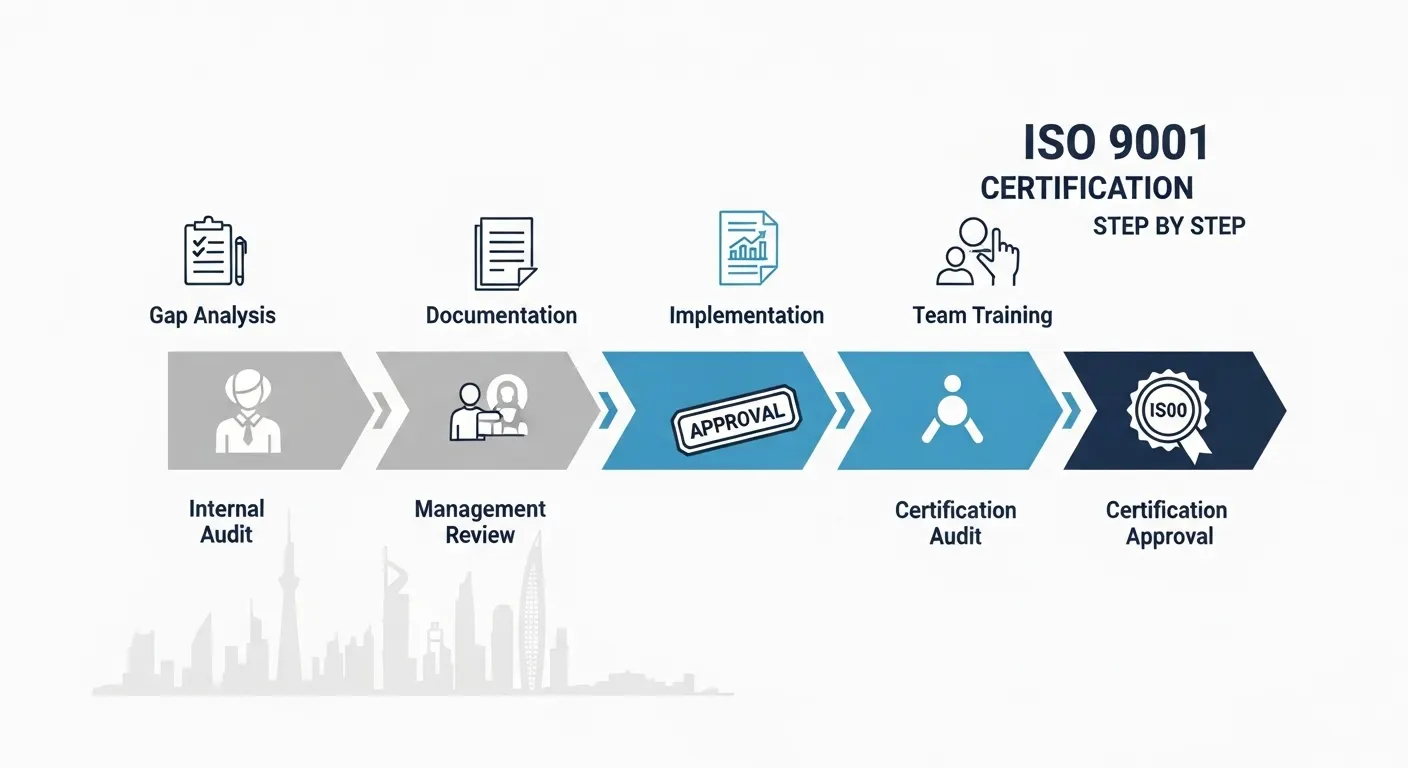
ISO 9001 Certification Process – Step by Step
Follow these seven steps in order. Each one prepares you for the next. Skipping steps is the most common — and most expensive — mistake businesses make.
Step 1 – Gap Analysis
Start by comparing your current operations against ISO 9001 requirements. A gap analysis identifies what already meets the standard and what needs to change. It produces a clear, prioritised action list.
This step avoids costly mistakes later. Businesses that skip gap analysis consistently discover major problems during the certification audit — when fixing them is far more disruptive and expensive.
- Map existing processes against ISO 9001 clauses
- Identify missing documentation, controls, and procedures
- Assess staff awareness and training gaps
- Build a realistic implementation plan with clear timelines
Step 2 – Documentation Setup
ISO 9001 requires a defined set of documents. They don’t need to be lengthy — they need to be accurate. Every document must reflect how your business actually operates, not how you wish it did.
Core documents include your Quality Policy, Quality Objectives, process procedures, work instructions, and record templates. For a complete list of what’s mandatory and what’s recommended, review the full ISO 9001 documentation requirements.
Documentation needs vary by industry. For ISO certification for construction companies, key documents include site inspection checklists, subcontractor approval records, and project quality plans. For ISO standards for logistics businesses, the focus shifts to delivery performance records, vehicle maintenance logs, and warehouse control procedures.
- Write or update your Quality Policy and Objectives
- Document all key processes with defined responsibilities
- Create record templates for audits, reviews, and complaints
- Set up a document control and version management system
Step 3 – Implementation
This is where your documented processes go live. Train every team member on their role in the QMS. Apply new procedures across all relevant departments. Check compliance from day one — not just before the audit.
Most companies fail here due to poor execution. Leaders disengage after the initial training session. Staff revert to old habits within weeks. By the time the auditor arrives, the gap between documented process and actual practice is obvious.
- Train all relevant staff before going live
- Apply procedures consistently across every department
- Monitor compliance weekly during the first month
- Log all actions, issues found, and corrections made
Step 4 – Internal Audit
Before the external certification audit, you must audit your own system. An internal audit checks whether your QMS works as designed. It finds weaknesses before the external auditor does.
Use a trained auditor who is independent of the area being reviewed. Review documents, observe processes, and interview staff. Record every finding. Follow the full ISO 9001 internal audit process to make sure nothing is missed.
- Plan and schedule audits across all relevant departments
- Check compliance against each applicable ISO 9001 clause
- Document all findings — major, minor, and observations
- Issue corrective action requests and track them to closure
Step 5 – Management Review
Top management must formally review QMS performance. This is a mandatory ISO 9001 requirement. The review covers audit results, customer feedback, quality objective performance, and resource needs.
Document the meeting in full. Certification auditors specifically check for evidence that this review took place and that leadership made documented decisions based on the findings.
- Review internal audit findings and corrective action status
- Assess customer satisfaction data and complaint trends
- Evaluate performance against quality objectives and KPIs
- Record all decisions with assigned owners and deadlines
Step 6 – Certification Audit
Now the external certification body reviews your system. The audit runs in two stages. Stage 1 is a document review — the auditor checks your QMS documentation against ISO 9001 requirements. Stage 2 is an on-site audit — they verify your system works in daily practice.
Use our ISO 9001 audit checklist guide to prepare thoroughly before the auditor arrives. Stage 1 findings must be resolved before Stage 2 begins. Both stages must be passed to receive certification.
- Submit all required documents ahead of Stage 1
- Address every Stage 1 finding before the on-site visit
- Brief your team on likely auditor questions
- Respond to all Stage 2 non-conformities within the agreed timeframe
Step 7 – Certification Approval
Pass both audit stages and the certification body issues your ISO 9001 certificate. It is valid for three years. Annual surveillance audits in years one and two confirm your system stays active. A full recertification audit is required at the end of year three.
Certification is not the finish line. Businesses that treat their QMS as a living system — reviewing and improving it continuously — get far more value from their investment than those that file the certificate and disengage.
- Receive and display your ISO 9001 certificate
- Schedule and prepare for annual surveillance audits
- Continue monitoring quality objectives and customer feedback
- Review and improve your QMS on an ongoing basis
ISO 9001 Certification Timeline (Realistic)
Timelines depend on your business size and how prepared you are at the start. Here is an honest range based on real implementation experience.
- Small business (up to 20 staff): 2 to 4 weeks
- Medium business (20–100 staff): 4 to 6 weeks
- Large business (100+ staff): 6 to 12 weeks
Preparation quality determines where you land on that range — not business size alone. Businesses that begin with a thorough gap analysis and use experienced consultants consistently certify faster.
Regional timelines vary slightly based on local certification body schedules. Review the specific process for ISO certification in UAE, ISO certification in Saudi Arabia, or ISO certification in Qatar to understand local audit scheduling and accreditation requirements.
What Documents Are Required for ISO 9001?
ISO 9001 specifies both mandatory documents and recommended records. Missing any mandatory item will result in a non-conformity during your certification audit.
- Quality Policy and documented Quality Objectives
- Scope of the Quality Management System
- Risk and opportunity assessment records
- Competence records and staff training logs
- Documented process procedures and work instructions
- Equipment calibration and maintenance records
- Internal audit plans, reports, and corrective actions
- Management review minutes and decisions
- Non-conformance reports and corrective action logs
- Customer feedback and complaint records
Industry-specific requirements add to this list. Oil and gas companies maintain detailed safety and environmental compliance logs. Medical device manufacturers require strict hygiene, sterilisation, and traceability records. Automotive suppliers document every production stage with part-level traceability. Chemical businesses add hazardous material handling and disposal records to the standard QMS set.
ISO 9001 Process Across Industries
ISO 9001 applies to every industry. The framework is the same. The emphasis shifts depending on what your business does and who your customers are.
In construction, the QMS centres on project quality planning, site inspection procedures, and subcontractor management. Every project needs a traceable quality record from design through to handover. Companies pursuing ISO certification for construction companies must pay close attention to daily site records and non-conformance close-out processes.
In logistics and transport, on-time delivery, vehicle maintenance, and warehouse accuracy are the core focus areas. Businesses working toward ISO standards for logistics need real-time tracking data and clear escalation procedures for delays or damage incidents.
In the medical sector, ISO 9001 underpins regulatory compliance. Equipment calibration, supplier qualification, and sterilisation records are central to every audit. In automotive manufacturing, part traceability and defect prevention processes are non-negotiable at every stage of the production line.
Common Mistakes in ISO 9001 Certification
Most certification delays come from the same avoidable errors. This increases cost and delays certification — often by weeks or months that were entirely preventable.
- Documents that don’t reflect reality: Auditors ask operational staff to explain procedures. If the answer doesn’t match the document, that’s a non-conformity.
- Weak management commitment: ISO 9001 requires visible leadership involvement. If senior management disengages, the system loses credibility fast.
- Skipping staff training: Team members who don’t understand the QMS create compliance gaps at every audit point.
- Superficial internal audits: A box-ticking internal audit leaves real problems for the certification auditor to find at the worst possible moment.
- No corrective action follow-up: Identifying a problem without closing the corrective action is a major non-conformity in its own right.
- Choosing a non-accredited certification body: Certificates from unaccredited bodies are regularly rejected by clients and government agencies across the Gulf.
How to Get ISO 9001 Certified Faster
Speed comes from preparation — not shortcuts. These steps consistently cut certification timelines for businesses across the UAE, Saudi Arabia, and the wider Gulf region.
- Start with a professional gap analysis: Know exactly what needs to change before spending anything on implementation.
- Use proven document templates: Industry-tested templates save weeks of drafting time and reduce the risk of missing mandatory content.
- Train your team before implementation begins: Awareness training upfront dramatically reduces compliance errors during the implementation phase.
- Work with an experienced ISO consultant: A consultant who knows your industry and the local certification landscape will cut months off your timeline.
- Run a mock audit before the real one: A pre-certification review identifies hidden gaps and prepares your staff to answer auditor questions with confidence.
- Choose an accredited certification body early: Audit slots book up. Confirm your auditor early to avoid scheduling delays that push back your certificate date.
If you are a smaller business, the benefits of ISO 9001 for small businesses make the investment particularly worthwhile — faster market access, stronger client trust, and a leaner, more consistent operation.
Also worth reviewing: the key differences between ISO 9001 vs ISO 14001 if your business has environmental obligations alongside quality requirements. Many Gulf businesses pursue both certifications simultaneously to maximise efficiency and reduce overall cost.
Frequently Asked Questions
How do I start the ISO 9001 certification process?
Start with a gap analysis. Compare your current quality practices against ISO 9001 requirements. This tells you exactly what needs to change and in what order. Starting without this step is the single biggest cause of wasted time and money.
What are the main ISO 9001 process steps?
The seven steps are: gap analysis, documentation setup, implementation, internal audit, management review, certification audit, and certification approval. Each step must be completed before moving to the next. For the full clause-by-clause breakdown, see our ISO 9001 certification process step by step guide.
How long does ISO 9001 certification take in the UAE?
Small businesses typically complete the process in 2 to 4 weeks. Medium businesses take 4 to 6 weeks. Larger organisations with multiple departments or sites may need 6 to 12 weeks. Starting with solid preparation consistently shortens every timeline.
What happens during the ISO 9001 certification audit?
The certification audit has two stages. Stage 1 reviews your documentation remotely. Stage 2 is an on-site visit where auditors verify that your processes work as documented. They interview staff, review records, and observe operations. Both stages must be passed to receive your certificate.
Is ISO 9001 mandatory for businesses in Saudi Arabia?
It is not legally mandatory for every business. However, many government ministries, large contractors, and international clients in Saudi Arabia now require ISO 9001 before awarding contracts. Under Vision 2030, quality certification requirements are increasing steadily across all key sectors.
Conclusion
ISO 9001 certification is achievable for any business — when you follow the right steps in the right order. The process is not complicated. What makes it difficult is skipping preparation, underestimating documentation, and entering audits without testing your own system first.
Start with a gap analysis. Build accurate documentation. Implement with discipline. Audit yourself honestly. Walk into your certification audit with confidence.
Businesses across the UAE, Saudi Arabia, and Qatar that get this right win more contracts, reduce operational waste, and build lasting client trust. The investment pays back faster than most expect.
Ready to start? Get expert help today — our ISO consultants will guide you from gap analysis to certificate in hand, on time and on budget.