ISO 14001 has clear requirements. Meet them and you get certified. Miss them and you fail the audit. This guide breaks down every requirement in plain English — so you know exactly what your business needs to do.
What Does ISO 14001 Actually Require?
ISO 14001 requires your business to build and maintain an Environmental Management System (EMS). The EMS must cover how you identify, control, and improve your environmental impact.
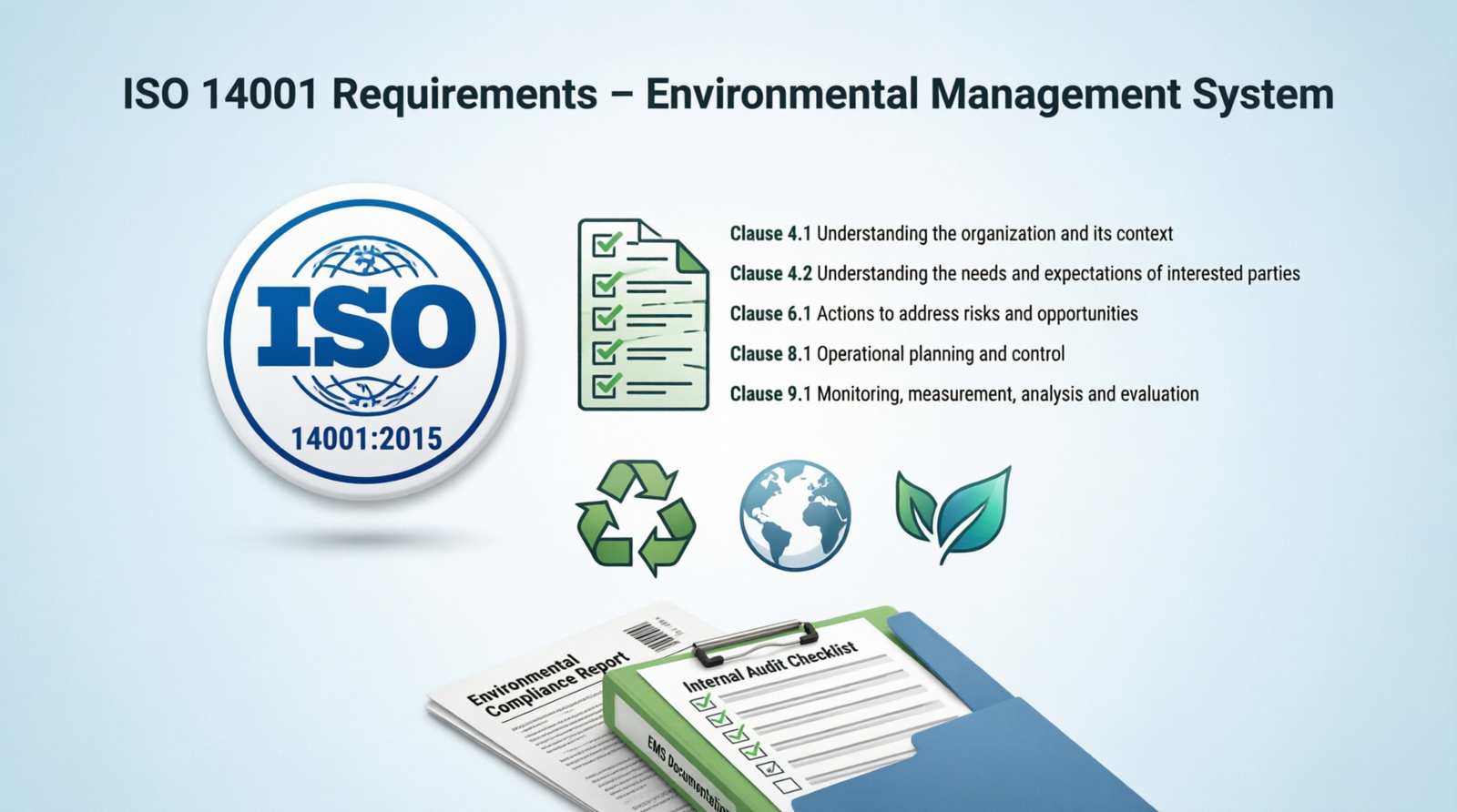
The standard is built on 10 clauses. Clauses 4 to 10 are the ones you must comply with. Here is what each one means for your business.
Clause 4: Understanding Your Organisation
What Is Required?
You must understand two things. First, the internal and external issues that affect your environmental performance. Second, the needs of interested parties — clients, regulators, local communities.
What This Looks Like in Practice
A manufacturing company in Sharjah lists these as external issues:
- UAE environmental regulations (Federal Law No. 24 of 1999)
- Dubai Municipality waste disposal rules
- Client sustainability requirements
Internal issues include energy use, water consumption, and waste volumes.
This is not a one-time exercise. You review it every year.
Clause 5: Leadership and Commitment
What Is Required?
Top management must be visibly involved. ISO 14001 does not accept a system that only exists on paper while management ignores it.
Requirements include:
- A signed environmental policy
- Clear roles and responsibilities assigned
- Management actively supporting EMS objectives
What Auditors Look For
Auditors will interview your senior team. If the CEO cannot explain the environmental policy, that is a finding. Leadership involvement must be real — not just a signature on a document.
Clause 6: Planning
This clause has three parts. All three are mandatory.
6.1 — Risks and Opportunities
You must identify environmental aspects and impacts. An aspect is what your business does. An impact is the effect on the environment.
Example:
| Aspect | Impact |
|---|---|
| Diesel generator use | Air pollution |
| Chemical storage | Soil contamination risk |
| Paper consumption | Deforestation |
| Wastewater discharge | Water pollution |
You assess which impacts are significant. Significant impacts get controls and objectives.
6.2 — Environmental Objectives
You must set measurable targets. Vague goals do not pass.
Good objective: Reduce diesel consumption by 15% before December 2025.
Bad objective: Try to use less fuel.
Each objective needs:
- A measurable target
- A responsible person
- A deadline
- A way to track progress
6.3 — Legal Compliance
You must identify every environmental law that applies to your business. In the UAE this includes:
- Federal environmental regulations
- Dubai Municipality rules
- Abu Dhabi Environment Agency requirements
- Sector-specific permits and licences
You must track these and update the list when laws change.
Related: ISO 14001 Certification Process Step by Step
Clause 7: Support
What Is Required?
Your EMS needs resources, competent people, and proper documentation to function.
This clause covers four areas:
7.1 — Resources
Assign budget, personnel, and tools to run the EMS. Auditors will check that resources are actually allocated — not just promised.
7.2 — Competence
Anyone whose work affects environmental performance must be trained and competent. Keep training records. Auditors will ask for them.
7.3 — Awareness
All staff must know:
- The environmental policy
- How their work affects the environment
- What happens if they do not follow procedures
7.4 — Communication
You must communicate about environmental matters internally and externally. Decide what you communicate, to whom, and how often. Document this decision.
7.5 — Documentation
You need documented information to prove your EMS works.
Related: ISO 14001 Documentation Requirements
Clause 8: Operations
What Is Required?
You must control the processes that create significant environmental impacts.
This includes:
- Operational controls — procedures for high-risk activities
- Emergency preparedness — what happens if a chemical spill occurs
- Contractor management — your suppliers must also meet your environmental standards
Real Example
A fit-out contractor in Dubai controls these operational risks:
- Paint and solvent storage procedures
- Waste segregation on site
- Vehicle idling policy to reduce emissions
- Subcontractor environmental briefing on day one
If your operations change, your controls must update too.
Clause 9: Performance Evaluation
What Is Required?
You must measure whether your EMS is actually working. Guessing is not acceptable.
This clause has three requirements:
9.1 — Monitoring and Measurement
Track your key environmental metrics. Common ones include:
- Energy consumption (kWh per month)
- Water usage (litres per day)
- Waste generated (tonnes per quarter)
- Carbon emissions (if applicable)
Set a frequency for each measurement. Record the results.
9.2 — Internal Audit
You must audit your EMS at planned intervals. The audit checks if the system conforms to ISO 14001 and is working effectively.
Related: ISO 14001 Internal Audit Process
Related: ISO 14001 Audit Checklist Guide
9.3 — Management Review
Senior management must formally review the EMS at least once a year. The review must be documented. Auditors will ask for the minutes.
Clause 10: Improvement
What Is Required?
When something goes wrong, you must fix it properly. ISO 14001 requires corrective action — not just a quick patch.
Steps for corrective action:
- Identify the nonconformity
- Find the root cause
- Fix the root cause — not just the symptom
- Check the fix actually worked
- Document everything
You must also look for opportunities to improve — not just react to problems.
ISO 14001 Requirements Checklist
Use this before your audit:
- Environmental policy signed by top management
- Aspects and impacts register completed
- Legal register up to date
- Environmental objectives set with targets and deadlines
- Competence and training records maintained
- Operational controls documented for significant impacts
- Emergency response procedure in place
- Internal audit completed
- Management review meeting documented
- Corrective actions closed out
If you can tick every item, you are ready for certification.
What Are the Most Common Failures?
Based on real audit findings in the UAE, these are the top reasons businesses fail or receive major nonconformities:
| Failure Area | Why It Happens |
|---|---|
| Incomplete legal register | Laws updated but register not reviewed |
| No measurable objectives | Targets set as vague statements |
| Poor training records | Training done but not documented |
| Weak emergency procedures | Procedures exist but staff unaware |
| No corrective action follow-up | Issues identified but not closed out |
Fix these before your audit.
How Do ISO 14001 Requirements Apply in the UAE?
The UAE has specific environmental regulations that interact with ISO 14001. Your legal register must include:
- UAE Federal Law No. 24 of 1999 on environment protection
- Cabinet Resolution No. 37 of 2001
- Dubai Municipality Environmental Regulations
- Abu Dhabi Environment Agency standards
- Estidama Pearl Rating System requirements (for construction)
- LEED certification alignment (for green building projects)
Businesses in free zones must also check zone-specific rules. JAFZA, DAFZA, and KIZAD each have environmental compliance requirements.
Frequently Asked Questions
What are the main ISO 14001 requirements?
ISO 14001 requires an environmental policy, aspects and impacts register, legal compliance tracking, measurable objectives, operational controls, internal audits, and management review. All requirements fall under clauses 4 to 10 of the standard.
How many clauses does ISO 14001 have?
ISO 14001 has 10 clauses. Clauses 1 to 3 are introductory. Clauses 4 to 10 are the mandatory requirements your business must meet.
What documents are required for ISO 14001?
You need an environmental policy, aspects register, legal register, objectives tracker, training records, operational procedures, internal audit report, and management review minutes.
Related: ISO 14001 Documentation Requirements
How long does it take to meet ISO 14001 requirements?
Most UAE businesses take 3 to 5 months to build and implement a compliant EMS. Smaller businesses can do it in 2 to 3 months with the right support.
Do requirements differ by industry?
The clauses are the same for all industries. But the environmental aspects, legal requirements, and operational controls will differ based on what your business does.
Related: Benefits of ISO 14001 for Businesses
Related: ISO 14001 Certification Cost in UAE
Related: ISO 14001 Certification in Dubai UAE
Main page: ISO 14001 Certification