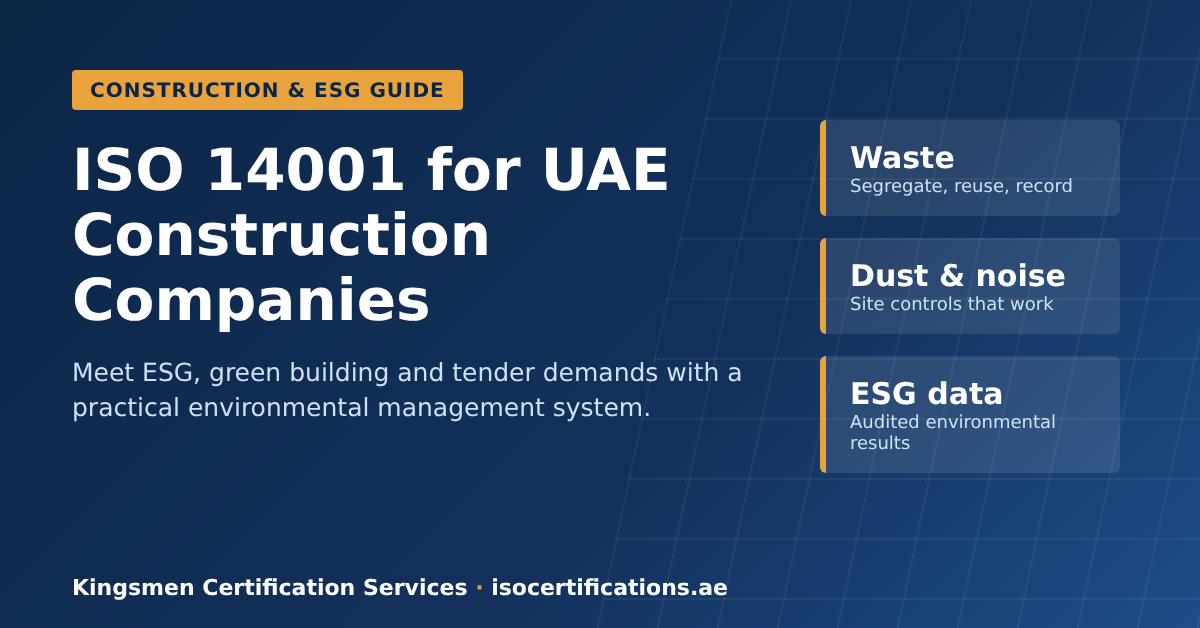
A few years ago, most construction tenders in the UAE focused on price, time and quality. Today, one more question sits on many forms. “How does your company manage its environmental impact?”
Developers, government clients and large main contractors now track dust, waste, water use and emissions on their sites. They also report on these numbers to their own boards and investors. So they want subcontractors and suppliers who can do the same.
That is where ISO 14001 comes in. This guide explains what ISO 14001 certification means for construction companies in the UAE. It also shows how the standard supports ESG goals and how to get certified without slowing your projects.
What ISO 14001 Means on a Construction Site
ISO 14001 is the international standard for an environmental management system. It does not set fixed limits for noise or dust. Instead, it gives your company a clear way to find environmental risks, control them and keep improving.
On a construction site, those risks are easy to spot. They include dust from earthworks, noise near homes, fuel and oil spills, and large volumes of waste. Water use and energy for site offices and plant add to the list too.
ISO 14001 asks you to plan for each of these. You set simple controls, train your teams and keep records. Then you check that the controls work and fix what does not. So environmental care becomes part of daily site work, not a last-minute fix before a client visit.
Why UAE Clients Now Ask for ISO 14001
Several trends push ISO 14001 up the list for UAE contractors.
National climate goals. The UAE has set out a Net Zero 2050 strategic initiative. Large developers and government entities now build these goals into their projects and supply chains.
Green building rules. Abu Dhabi uses the Estidama Pearl Rating System. Dubai has its own green building rules through Al Sa’fat. Projects under these systems need contractors who can control waste, water and materials on site.
ESG reporting. Listed developers and big investors report on environmental performance. So they ask contractors for proof of environmental control before they award work.
Tender scoring. Many prequalification forms now list ISO 14001 next to ISO 9001. Some set it as a minimum rule. Others give extra points to certified bidders.
So ISO 14001 certification in UAE has moved from a bonus to a real advantage. In some tenders, it is the line between a shortlist and a rejection.
The Business Benefits for Contractors
Many contractors start ISO 14001 for one tender. Then they see savings and fewer problems across their projects.
Lower waste costs. Better segregation and reuse of materials cut skip hire and disposal fees.
Fewer complaints and fines. Clear controls for dust, noise and spills reduce site complaints and penalty risks.
Better use of fuel and water. Simple checks on plant and site offices often reveal easy savings.
Stronger client trust. Developers prefer contractors who report clearly and handle environmental issues before they grow.
How ISO 14001 Fits With ISO 9001 and ISO 45001
Most construction clients ask for three standards together. ISO 9001 covers quality. ISO 14001 covers the environment. And ISO 45001 certification covers health and safety.
These standards share the same structure. So many contractors combine them into one integrated management system, often called a QHSE system. One set of procedures, one internal audit plan and one management review cover all three standards.
This approach saves time and cuts duplicate paperwork. It also makes life easier for site engineers. They follow one system instead of three separate manuals.
How the ISO 14001 Certification Process Works
The process follows clear stages. A good consultant keeps it practical, so your sites keep running while the system takes shape.
| Step | What happens |
|---|---|
| 1. Gap analysis | A consultant reviews your current site practices against ISO 14001 |
| 2. Aspects and impacts | Your team lists the environmental risks of each activity and rates them |
| 3. Legal register | You record the UAE environmental laws and permits that apply to your work |
| 4. Controls and training | You set simple controls for waste, dust, noise, spills and water, and train site teams |
| 5. Internal audit and review | You check the system on real sites and fix any gaps |
| 6. Certification audit | An accredited certification body audits your system in two stages |
Timelines depend on company size and the number of active sites. A small contractor with a few sites can often complete ISO 14001 in a few weeks. A larger contractor with many projects usually needs a few months.
After certification, the certificate stays valid for three years. The certification body returns each year for a surveillance audit. So your site teams need to keep the controls alive on every project.
What Auditors Look for on a UAE Site
Many contractors worry about the audit itself. In reality, auditors look for a few clear things. So it helps to know them early.
- A clean, organised site. Waste sits in marked skips, fuel sits on drip trays and spill kits are close to hand.
- Trained people. Site staff can explain the main environmental risks of their work and what to do in an emergency.
- Clear records. You can show waste transfer notes, water and fuel readings and toolbox talk records.
- Legal awareness. Your team knows which permits and local rules apply to the project.
- Action on problems. When something goes wrong, you record it, find the cause and fix it.
None of this needs heavy paperwork. It needs steady habits on every site. That is the real goal of ISO 14001 certification in UAE projects. It turns good intentions into daily practice that any client can see.
Common Mistakes Contractors Should Avoid
A few mistakes slow down ISO 14001 or weaken the result.
- Writing for the office, not the site. Procedures that site teams cannot follow will fail at audit.
- Skipping the legal register. Auditors expect you to know which UAE environmental rules apply to your work.
- Poor waste records. Waste is often the biggest risk on site. So keep clear records of how much leaves the site and where it goes.
- Treating it as a one-time task. ISO 14001 needs regular checks. A system that only wakes up before the audit will not last.
How to Choose the Right ISO 14001 Partner
The right partner understands construction sites, not just the standard. So look for ISO 14001 consultancy in UAE that keeps the system simple for site engineers and supervisors.
A good partner will:
- Visit your sites and build controls around real activities
- Help you set up a clear legal register for UAE rules
- Combine ISO 14001 with ISO 9001 and ISO 45001 where it makes sense
- Prepare your team for both audit stages
- Work only with accredited certification bodies, so clients can verify your certificate
Kingsmen Certification Services supports construction, oil and gas and manufacturing firms. The team works across Dubai, Abu Dhabi, Sharjah and the wider UAE. The team guides contractors from gap analysis to certification. You can read more about ISO 14001 certification and how Kingsmen helps companies build a practical environmental management system.
Frequently Asked Questions
Is ISO 14001 mandatory for construction companies in the UAE?
ISO 14001 is not a general legal requirement for every contractor. However, many developers, government entities and main contractors ask for it in tenders and vendor registration. So contractors who bid for large or green-rated projects often treat ISO 14001 as a must.
How long does ISO 14001 certification take in Dubai?
A small contractor with a few active sites can often complete ISO 14001 certification in Dubai within a few weeks. Larger contractors with many projects usually need a few months. The timeline also depends on how fast site teams adopt the controls. The audit date matters too.
Can we get ISO 14001, ISO 9001 and ISO 45001 together?
Yes. All three standards share the same structure, so contractors can build one integrated system for quality, environment and safety. This approach saves time, cuts duplicate paperwork and allows one combined audit. Many UAE contractors choose this route because clients often ask for all three standards in the same tender.
How does ISO 14001 support ESG reporting?
ISO 14001 helps you measure and control waste, water, energy and emissions on your projects. Those records give clear data for ESG reports. So developers and investors see real environmental results from your company. An independent audit backs every figure.
How long is an ISO 14001 certificate valid?
An ISO 14001 certificate stays valid for three years. The certification body carries out a surveillance audit every year to confirm the system still works on your sites. In the third year, a recertification audit renews it for three more years.
Build a Greener, Stronger Business
ISO 14001 helps your company win green projects, satisfy ESG-focused clients and run cleaner sites. It also cuts waste and avoids costly complaints. And it gives your site teams a simple, shared way of working on every project. Clients notice that difference during site visits, and they remember it when the next tender opens. So if your next tender asks about environmental control, start preparing now.
Talk to the Kingsmen team about ISO 14001 certification for your construction company, and request a consultation today.