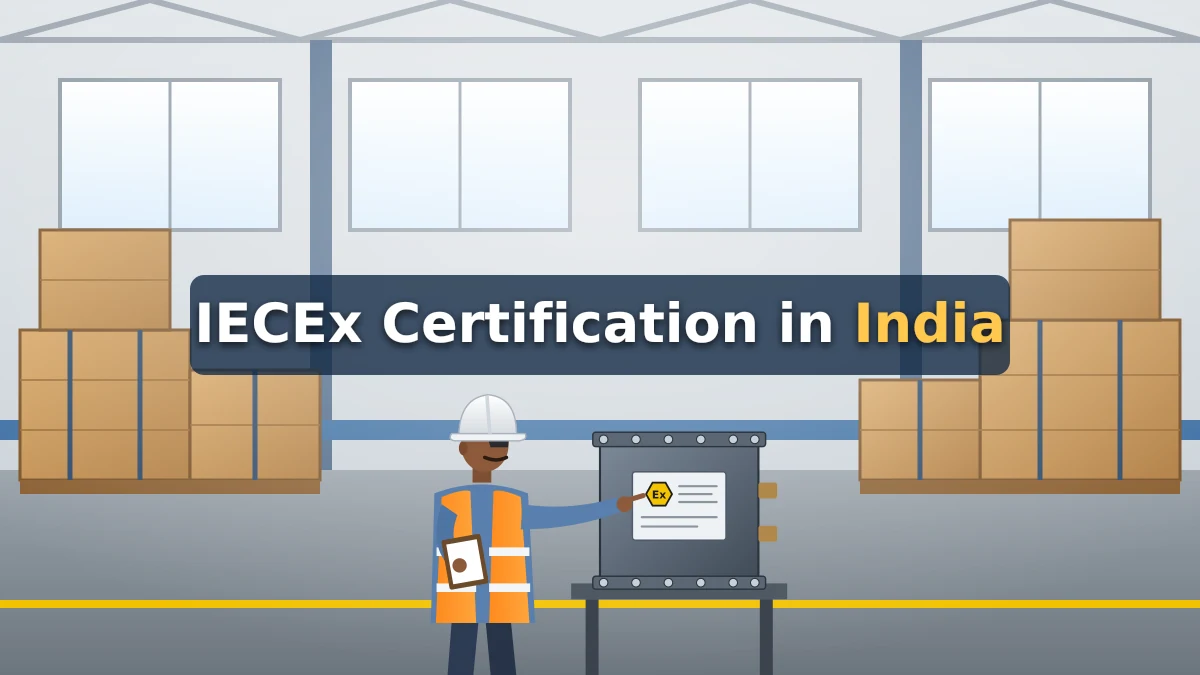
Your factory in Pune builds flameproof enclosures. A Gulf buyer loves the sample. Then the buyer asks for the IECEx certificate and the test reports.
You have local approvals. You have no IECEx file. The order waits. This post shows you how the process works in India and how to move fast.
What Is IECEx Certification in India?
IECEx certification in India proves that equipment, workshops, or people meet global safety standards for explosive atmospheres. Indian manufacturers use it to sell abroad. Engineers use it to prove skills. It follows IEC standards and carries weight in many countries.
India also has its own approvals and standards. IECEx does not replace them. It adds a global layer on top.
For local support, see our page on IECEx certification in India.
Why Do Indian Companies Need IECEx?
Indian makers now sell Ex equipment to the Gulf, Africa, Europe, and Southeast Asia. Overseas buyers want proof they can trust.
A local approval often does not satisfy a foreign client. IECEx does. One certificate speaks to buyers in many markets.
Four forces drive demand:
- Export orders. Gulf and global buyers ask for IECEx by name.
- Tender rules. Many bids list IECEx as accepted proof.
- International contractors. They carry IECEx rules from site to site.
- Skills proof. Engineers want portable, recognized credentials.
IECEx saves you from repeat testing in each country.
Who Needs IECEx Certification in India?
You need it if you make, export, install, inspect, or maintain gear for explosive atmospheres. Both companies and individual engineers qualify.
Tick any box that fits you:
- You manufacture motors, lights, panels, or enclosures for Ex zones
- You export instruments or fittings to Gulf or global buyers
- You run a workshop that repairs Ex equipment
- You inspect or maintain gear at refineries and chemical plants
- You work as an Ex engineer and plan to work abroad
- You supply parts to EPC contractors with overseas projects
A procurement manager at an Indian EPC firm once told us about a lost tender. His vendor held a strong local approval. The foreign client wanted IECEx. The vendor could not supply it in time.
Local approval alone does not travel well.
What Does IECEx Cover?
IECEx covers equipment, service facilities, and personnel. Each area has its own certificate. You may need one, two, or all three.
| Area | What It Proves | Who Needs It |
|---|---|---|
| Equipment (Ex Scheme) | The product meets IEC safety standards | Manufacturers and exporters |
| Service facilities (ExSFS) | The workshop repairs Ex gear correctly | Repair and overhaul shops |
| Personnel (CoPC) | The person has proven Ex skills | Technicians, inspectors, engineers |
Our pillar page on IECEx certification explains each scheme in plain words.
Most Indian exporters start with the equipment certificate. Many add personnel proof later.
How Do Indian Rules Fit with IECEx?
India runs its own rules for hazardous area equipment. IECEx sits beside them, not in place of them. You may need both.
Two layers usually apply:
- Indian standards and authorities. Bodies such as BIS and PESO play roles in standards and approvals. Rules change, so confirm current requirements.
- Client and export-market rules. Your buyer decides which marks they accept.
Indian standards for Ex equipment follow the IEC 60079 series closely. That helps. Your design work often carries over.
Do not assume one approval clears every market. Ask each buyer which marks they accept. Get the answer in writing.
How to Get IECEx Certification in India: Step by Step
This route fits equipment makers. Personnel routes differ, and we cover them below.
- Define your product and target zones. Decide which zones and gas groups you serve.
- Pick the protection concept. Choose Ex d, Ex e, Ex i, or another type.
- Check your design against IEC 60079 standards. Fix gaps before you apply.
- Contact an IECEx certification body. Ask about scope, fees, and timing.
- Send samples for testing. An accredited lab tests your product.
- Pass the factory audit. Assessors check your quality system.
- Receive the certificate. The body lists your product on the IECEx database.
- Keep it alive. Accept regular audits and report any design change.
Start early. Test failures cost weeks. Fix design flaws before you book lab slots.
What about personnel certification?
Engineers and technicians follow a different route. They train, then sit an assessment. A body then issues the personnel certificate.
Many Indian engineers also look at CompEx for Gulf jobs. Compare both before you pick. Our guide on CompEx vs IECEx shows how each one works.
What Affects Cost and Timeline?
Costs vary by product, lab, and scope. No single price fits every case. A simple light costs less to test than a large motor.
Five things move your bill:
- Product complexity. More parts mean more tests.
- Protection concept. Some concepts need deeper lab work.
- Test failures. Each retest adds fees and weeks.
- Document quality. Poor drawings slow the review.
- Range size. Each model variant adds work.
A clean file moves fast. A messy file stalls.
Cost-saving checklist:
- Finish your design before you apply
- Group similar models into one certificate where the body allows it
- Prepare clear drawings and parts lists
- Run internal checks before lab testing
- Ask for a written quote
- Book audit dates early
We list no fixed prices here. Fees change by body, lab, and scope.
A Real Audit Scenario for Indian Exporters
Here is a common story. It shows where files break down.
A mid-size maker in Gujarat built junction boxes. The team sent samples to a lab. The lab flagged a flameproof joint gap that sat outside the limit.
The team had to redesign one casting. That added weeks and tooling cost. The factory audit then found a second gap. The team had no written record of material checks.
The fix took two steps:
- The engineers changed the casting tolerance and retested.
- The quality team wrote a simple incoming-material check and trained the staff.
The certificate arrived later than planned. The buyer stayed, because the maker kept them updated.
Lessons you can use:
- Measure flameproof joints before you ship samples
- Keep records of every material and test check
- Tell your buyer early if the timeline slips
- Train your shop floor, not just your design team
IECEx vs ATEX vs CompEx for Indian Exporters
These names confuse many buyers. Each one does a different job.
| Feature | IECEx | ATEX | CompEx |
|---|---|---|---|
| What it covers | Equipment, services, people | Equipment (EU law) | People only |
| Reach | Global | European Union | Global, strong in UK and Gulf |
| Basis | IEC standards | EU directives | CompEx scheme rules |
| Best use for exporters | Gulf, Asia, Africa, global tenders | EU market entry | Technician skills |
IECEx and ATEX certify products. CompEx certifies workers.
Selling to Europe? You may need ATEX. Selling to the Gulf or many Asian markets? IECEx often works. Many firms hold both. For Gulf sales, see our notes on IECEx certification in UAE.
Common Mistakes Indian Companies Make
Most failures come from small, avoidable errors. Watch for these six.
- Relying on local approval alone. Foreign buyers may not accept it.
- Wrong zone or gas group. A product rated for Zone 2 cannot serve Zone 1.
- Weak records. Auditors ask for proof of every check.
- Design changes without notice. You must report changes to the body.
- Mismatched model on the nameplate. The certificate names exact models.
- No people proof. The product passes, but the installer holds no certificate.
An auditor in Chennai once found a nameplate that listed an old model code. The certificate named the new code. The team reprinted every label before shipment.
Read every nameplate against the certificate. Do it before you pack the crate.
How Do You Build Ex Skills in India?
Certificates help, but skilled people keep sites safe. Engineers need to read markings, inspect enclosures, and log findings.
Training builds that skill. It also gives you proof for client audits and overseas job applications.
Learn how zones and protection types fit together in our guide to IECEx zones and protection concepts. Then plan your learning path.
How to Choose a Provider
Pick a provider that knows Indian rules and global schemes. A weak partner wastes months.
Ask these questions:
- Does the provider explain scope in plain language?
- Does it work with accredited bodies and labs?
- Can it show past work with Indian manufacturers?
- Does it offer training for your engineers?
- Does it give written quotes and clear timelines?
Good providers answer fast and in writing. Vague answers signal trouble.
Key Takeaways
- IECEx certification in India helps exporters and engineers earn global trust.
- Local approvals and IECEx work together. One does not replace the other.
- The path runs from design check to testing, audit, certificate, and regular checks.
- Clean records and good drawings cut cost and time.
- IECEx and ATEX certify products. CompEx certifies workers.
- Always confirm which marks your buyer accepts, in writing.
Frequently Asked Questions
Is IECEx certification mandatory in India?
It depends on the product, the buyer, and the market. Indian authorities set local rules. Export buyers often ask for IECEx. Check both.
Can Indian companies get IECEx certification?
Yes. Indian manufacturers can certify products through accredited IECEx bodies and labs.
How long does IECEx certification take?
It depends on the product and test results. A clean file moves faster. Ask your body for a written timeline.
Does IECEx replace Indian approvals?
No. IECEx adds a global layer. Check which local approvals your market still needs.
Does IECEx certify people too?
Yes. The IECEx Certified Personnel Competence scheme, called CoPC, covers technicians and inspectors.
Do IECEx certificates expire?
Certificates need regular audits and updates. Always check the current status on the IECEx database.
Ready to Prepare Your Team?
Build Ex skills before your next export order. Visit Extrainings to find training that fits your product, your market, and your budget.