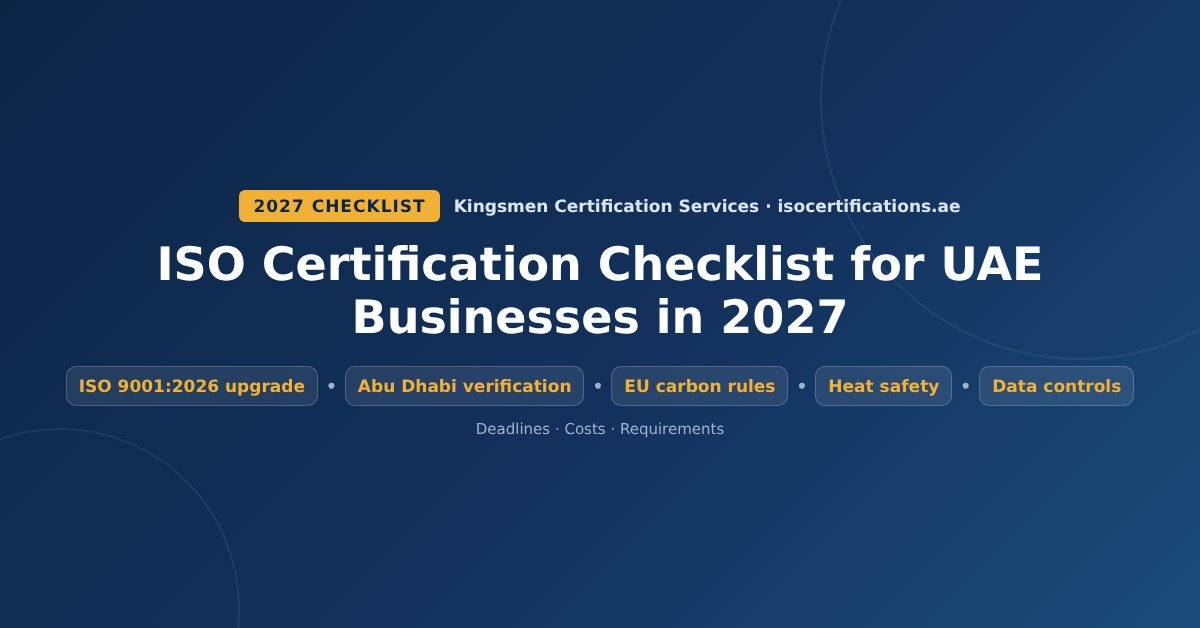
Planning ISO certification for 2027 starts with three simple questions. Which standard do your buyers want? Which deadlines apply to you? And what will the project cost in time and money? This checklist answers each one for UAE firms. It covers the main standards, the key dates and the route to a certificate.
Why UAE Buyers Want Proof in 2027
UAE buyers now want proof before they approve a supplier. New standard editions, climate reporting and data laws all land in the same window. So procurement teams add more certificate questions to their tenders. A supplier with the right certificate often clears the first screen faster than its rivals do.
Large developers, government entities and main contractors also review suppliers every year. They score delivery, quality and safety. A certificate gives them a quick, trusted signal during those reviews. It also shortens supplier audits, because the buyer can rely on an independent check.
The 2027 Deadline Calendar
Several dates in 2026 and 2027 shape ISO certification planning for UAE firms. Some come from ISO itself, while others come from local and export rules. The table below lists the dates that matter most. Use it to decide which project should start first in your business this year.
| Rule or standard | Key date | What to plan |
|---|---|---|
| ISO 9001:2026 | 2015 certificates end 30 September 2029 | Upgrade at a surveillance or renewal audit |
| ISO 14001:2026 | Transition ends in 2029 | Combine with the ISO 9001 upgrade |
| UAE climate law | Abu Dhabi verification from 2027 | Emissions data and an environmental system |
| EU carbon border rules | First declarations by 30 September 2027 | Product emissions data for EU buyers |
| India data rules | Core duties by May 2027 | Data controls for Indian clients |
| UAE midday work break | Mid-June to mid-September | Heat controls for outdoor crews |
Not every date applies to every firm. A local trading company may only need the ISO 9001 upgrade. An exporter to Europe, however, faces the carbon border rules as well. So match each row to your buyers and markets before you set a budget for ISO certification.
Core Requirements Every Standard Shares
Every management system standard shares one core structure. That means the same basic requirements apply whether you choose quality, safety or security. Once you build these parts, adding a second standard becomes much easier. The list below shows what an auditor expects to see in any system you run.
- Scope: the sites, services and products the system covers.
- Policy: a short, signed statement from top management.
- Objectives: measurable targets with monthly data.
- Risks: a register of risks and opportunities, reviewed often.
- Processes: clear steps for the work that matters most.
- Training: dated records for every person in scope.
- Internal audit: a full check of the system, with closed actions.
- Management review: signed minutes and agreed actions.
Auditors check each of these parts in every first audit. For the full list of documents and records, see this guide to ISO certification requirements.
ISO 9001: What Buyers Check
Buyers check ISO 9001 first in most UAE tenders. They want to see how you handle orders, control your work and fix complaints. With the 2026 edition now out, they may also ask about your upgrade plan. A clear transition date in your system answers that question quickly.
Auditors under the new edition still follow a job from enquiry to delivery. They sample records, interview staff and check that objectives have data behind them. Firms starting fresh should build on the 2026 text from day one. See this page on ISO 9001 certification.
ISO 14001: Proof for Climate Reporting
Climate reporting has turned ISO certification under ISO 14001 into a commercial tool. UAE firms now track emissions under the climate law, and Abu Dhabi adds third-party verification from 2027. An environmental system gives that data a home. It also shows buyers that you manage waste, energy and chemicals with care.
Exporters face one more push. Under the EU carbon border rules, importers buy certificates from February 2027. They also file the first annual declaration by 30 September 2027. So European buyers will ask UAE suppliers for reliable emissions data. Read more about ISO 14001 certification.
ISO 45001: Summer Heat and Site Risk
Site safety checks grow stricter every summer in the UAE. The midday outdoor work break runs from mid-June to mid-September. Weather experts also expect a very strong El Niño with effects into 2027. So clients want contractors who can prove control over heat stress and other site hazards.
Auditors look at risk assessments, permits to work, incident records and worker input. They also visit sites and speak with crews. A firm that logs water breaks, shade and rest times has clear proof for its ISO certification audit. Learn more about ISO 45001 certification.
ISO 27001 and ISO 20000-1: IT Tenders
IT tenders in the UAE now ask for security proof as standard. Banks, hospitals and government buyers handle sensitive data, so they check suppliers closely. ISO 27001 answers that need with 93 controls across four themes. ISO 20000-1 then covers how you deliver and support IT services.
For ISO 27001, auditors test access reviews, backups, supplier controls and the Statement of Applicability. India’s data rules also matter for firms with Indian clients, since core duties start by May 2027. See this page on ISO 27001 certification.
In an ISO certification audit for ISO 20000-1, auditors follow incidents, changes and service reports. Managed service and cloud firms often hold both certificates, since many tenders score them together. Learn more about ISO 20000 certification.
ISO 13485: Medical Device Supply
Medical device suppliers need ISO 13485 to compete for hospital and export contracts. The standard covers design, production, storage, distribution and service. The US FDA quality rule for devices now references it too. So UAE distributors and makers see it in more supplier forms each year.
Auditors check traceability, complaint handling, recalls and storage conditions. Temperature control matters a lot in UAE warehouses during summer. Keep batch records linked to each delivery, because this ISO certification depends on full traceability. For local steps, see this page on ISO 13485 certification.
HACCP and ISO 22000: Food Supply
Food buyers in the UAE ask for HACCP before they list a new supplier. Hotels, caterers and retail chains want proof that you control hazards from receipt to delivery. Many larger suppliers then add ISO 22000 for a full food safety system. Demand peaks before Ramadan and the summer season.
Auditors review the hazard analysis, critical control points, temperature logs and cleaning records. Cold chain checks matter most in hot months, when small failures grow fast. Read more about HACCP certification in the UAE.
Abu Dhabi and Dubai Buyer Needs
Each emirate brings its own buyer mix. Abu Dhabi has a large share of energy, utilities and government work. Many buyers there run deep supplier checks. Dubai leans toward trade, real estate, hospitality and technology. So the standard you start with often depends on where your main clients sit.
Abu Dhabi firms should also watch the 31 March deadline for annual emissions reports. Many plan quality, safety and environment as one project for that reason. For local support, see this page on ISO certification in Abu Dhabi.
What a Project Costs in 2027
The cost of a project depends on five main factors. These are headcount, number of sites, number of standards, current readiness and audit days. Small firms with one site sit at the low end. Groups with several sites and three standards sit higher, but a combined project still saves money.
Ask every provider for a quote that splits consultancy and audit fees. Also ask for the full three-year cost, including surveillance audits. A combined audit for several standards usually costs less than separate visits. For the main price factors, see this guide to ISO certification cost in the UAE.
Consultant or Certification Body?
Many UAE firms mix up these two roles. A consultant helps you build the system, train staff and prepare for the audit. An accredited certification body then runs the independent audit and issues the certificate. One company should not do both jobs for you, because that breaks auditor independence.
Check that the certification body holds valid accreditation. In the UAE, the Emirates International Accreditation Centre (EIAC) is the national accreditation body. Buyers often verify certificates on IAF CertSearch. So confirm the listing before you sign any ISO certification contract.
Readiness Self-Check
A short self-check shows how far you are from audit day. Answer each question below with a yes or a no. Each no marks a gap to close before you book the audit. Firms with mostly yes answers often finish one standard in about 6 to 12 weeks.
- Do you know which standard your top three buyers ask for?
- Does your scope list every site and service?
- Do you keep dated records for key processes?
- Has every staff member had a recorded briefing?
- Do you measure at least three objectives each month?
- Can top management explain the policy in plain words?
Use the answers to shape your ISO certification plan. Close the biggest gaps first, then book the internal audit and management review.
Frequently Asked Questions
Which standard should a UAE startup choose first?
Most startups choose ISO 9001 first, because tenders and supplier forms ask for it most often. IT startups often start with ISO 27001 instead. Food startups usually begin with HACCP. Check the tender forms of your target buyers first. Then pick the standard they name most, and add others as contracts grow.
How long does the process take in 2027?
Most small and mid-sized UAE firms prepare for ISO certification on one standard in about 6 to 12 weeks. Integrated projects with two or three standards take longer. The audit itself runs in two stages. Book audit dates early, since year-end and pre-Ramadan slots fill up fast.
Do I need to upgrade my ISO 9001 certificate in 2027?
Not by a set date in 2027. Certificates under the 2015 edition stay valid until 30 September 2029. However, many firms upgrade at their next surveillance or renewal audit. Doing so early avoids the rush near the deadline, when audit slots grow scarce.
Can one audit cover several standards?
Yes. ISO 9001, ISO 14001 and ISO 45001 share the same structure, so a certification body can audit them together. That means fewer audit days, one report and one set of actions. Most UAE contractors use this route to save time and money.
Do UAE buyers accept any certificate?
No. Most buyers want certificates from accredited certification bodies. In the UAE, EIAC is the national accreditation body. Many buyers also check certificates online through IAF CertSearch. So confirm the body’s accreditation before you sign, or the certificate may fail a buyer’s check.
Final Thoughts
ISO certification in 2027 rewards early planning. Match the deadline calendar to your buyers, build the shared core once and add standards as contracts grow. Then a calm audit and a trusted certificate follow naturally. Most of all, start with the buyers who matter most to your growth.
This checklist comes from the ISO advisory team at Kingsmen Certification Services. The team has supported UAE companies with ISO projects since 2014.