A client asks for your product’s environmental data. You send a brochure with sustainability claims. They come back with one question — do you have an EPD?
That moment happens daily across construction projects in the UAE, Saudi Arabia, and globally. Environmental Product Declarations are how manufacturers answer that question with verified, credible data — not marketing language.
This guide explains what an EPD is, how it works, and what your business needs to do to get one.
What Is an Environmental Product Declaration
An Environmental Product Declaration (EPD) is a standardized, third-party verified document that reports a product’s environmental impact across its full life cycle. It covers raw material extraction, manufacturing, transport, use, and end of life.
EPDs follow ISO 14025 — the international standard for Type III environmental declarations. They are based on a completed Life Cycle Assessment and verified by an independent accredited body before publication.
Three things make an EPD different from other sustainability claims:
- It is based on science — not marketing language
- It is independently verified — not self-declared
- It is publicly available — not kept internal
Architects, procurement teams, and project developers use EPDs to compare products objectively and meet green building credit requirements.
Why Businesses Need an Environmental Product Declaration
EPD certification is not just about environmental responsibility. It is a direct business tool that affects which projects your products qualify for.
Here is what drives businesses toward EPDs right now:
- LEED, BREEAM, and DGNB projects require EPDs for material credits
- Government procurement in the EU, UAE, and Saudi Arabia increasingly specifies EPD-certified products
- Export buyers in Europe and North America ask for EPDs as part of supplier qualification
- Corporate sustainability commitments push procurement teams to choose verified products over unverified ones
- Green building activity across the GCC is accelerating — and EPD requirements follow
A flooring manufacturer in the UAE lost a specification on a major Dubai mixed-use development. The project team needed EPDs for at least 20 products to earn their LEED MR credit. The manufacturer had no EPD. A competitor with one took the specification.
That is the practical cost of not having an EPD.
What Does an Environmental Product Declaration Contain
A published EPD includes specific environmental impact data covering all significant stages of the product life cycle.
| Impact Category | What It Measures |
|---|---|
| Global Warming Potential (GWP) | Carbon footprint — CO₂ equivalent emissions |
| Ozone Depletion Potential | Impact on stratospheric ozone layer |
| Acidification Potential | Emissions causing acid rain and soil acidification |
| Eutrophication Potential | Nutrient pollution affecting water and land |
| Photochemical Ozone Creation | Smog-forming emissions |
| Abiotic Resource Depletion | Consumption of non-renewable minerals and fossil fuels |
| Energy Use | Primary energy demand — renewable and non-renewable |
| Water Consumption | Fresh water use across the life cycle |
| Waste Generation | Hazardous and non-hazardous waste outputs |
Every EPD must include Global Warming Potential at minimum. Most EPDs cover all categories listed above. LEED v4 and v4.1 require coverage of specific indicators — confirm requirements with your consultant before starting.
Types of Environmental Declarations — What Makes EPD Different
ISO defines three types of environmental labels and declarations. Understanding the difference clarifies why EPDs carry more credibility than alternatives.
Type I — Eco-labels
Award schemes based on meeting predefined environmental criteria. Examples include the EU Ecolabel and Nordic Swan. Pass/fail — products either meet the criteria or do not.
Type II — Self-declared Environmental Claims
Claims made by manufacturers without independent verification. Examples include “made from recycled materials” or “carbon neutral.” No third-party check. Low credibility with sophisticated buyers.
Type III — Environmental Product Declarations
Quantified, LCA-based environmental data independently verified and publicly reported. The most transparent and credible form of environmental communication. Required by LEED, BREEAM, and major procurement policies.
EPDs are Type III declarations. That is what separates them from marketing claims — and why project teams trust them.
How an Environmental Product Declaration Is Developed
The EPD development process follows a defined sequence. Every step feeds into the next.
Step 1 — Life Cycle Assessment
Every EPD starts with an LCA. This is a systematic study of your product’s environmental impact from cradle to gate — or cradle to grave if full life cycle data is available.
The LCA follows ISO 14040 and ISO 14044. It uses recognized environmental databases — ecoinvent, GaBi, or equivalent — to model the impact of materials, energy, transport, and waste at each stage.
For manufacturers in the UAE and Saudi Arabia, the LCA uses regional energy grid data, local transport distances, and Middle East-specific material sourcing inputs. This reflects actual environmental impact — not generic global averages.
Step 2 — Product Category Rule Selection
Every EPD must follow a Product Category Rule — a standardized methodology specific to your product type. PCRs ensure EPDs across the same category are comparable.
Concrete has a PCR. Steel has a PCR. Flooring has a PCR. Using the wrong PCR invalidates the EPD for LEED and procurement purposes. Your consultant identifies the correct PCR before LCA work begins.
Step 3 — EPD Document Preparation
LCA results are compiled into an EPD document following ISO 14025 and EN 15804. The document must cover all required environmental indicators, declare the system boundary clearly, and document data quality and sources.
Step 4 — Third-Party Verification
An accredited independent verifier reviews the entire EPD — LCA methodology, data accuracy, PCR compliance, and document completeness. EPD development and verification through a recognized body is non-negotiable for LEED and procurement acceptance.
Step 5 — Registration and Publication
The verified EPD is submitted to a recognized program operator — International EPD System, UL Environment, NSF Sustainability, or BRE Global. Once published, the EPD is publicly accessible and valid for five years.
How Long Is an Environmental Product Declaration Valid
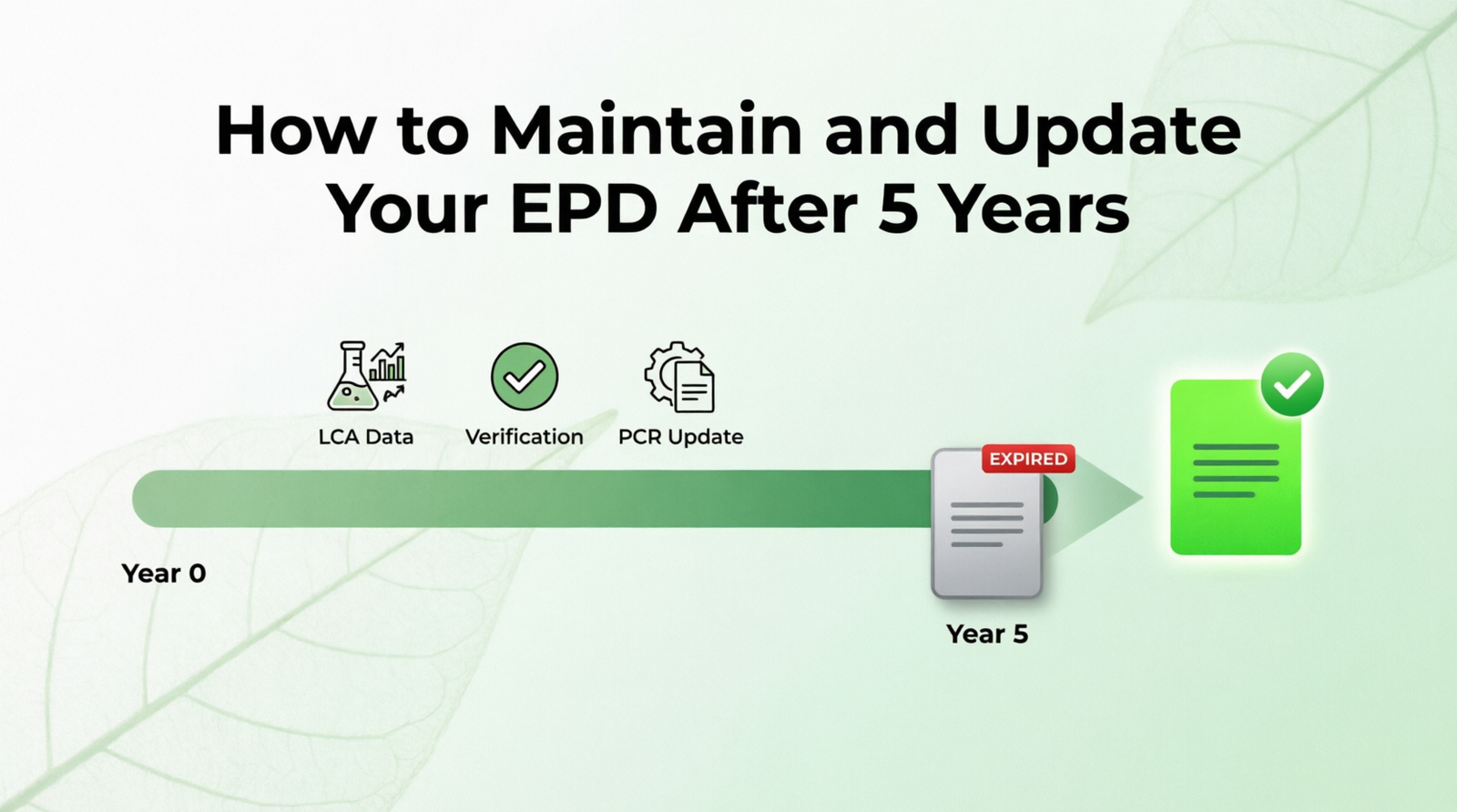
An EPD is valid for five years from the date of publication.
After five years, manufacturers must:
- Review the EPD against any changes in manufacturing processes or raw materials
- Conduct an updated LCA if significant changes have occurred
- Complete renewed third-party verification
- Re-register and re-publish the updated EPD
If your manufacturing process changes significantly before the five-year period ends — new raw material suppliers, new energy sources, production method changes — an early update is required.
Expired EPDs are not accepted by LEED project teams or procurement bodies. Plan renewal timelines proactively. Six months before expiry is the right time to start the update process.
EPD vs LCA — What Is the Difference
This is one of the most common questions manufacturers ask. The answer is straightforward.
| Feature | LCA | EPD |
|---|---|---|
| What it is | Internal scientific study | Public verified document |
| Who sees it | Internal teams, consultants | Project teams, procurement, public |
| Verification | Not required | Mandatory third-party verification |
| Format | Technical research report | Standardized declaration document |
| LEED acceptance | Not accepted alone | Accepted when verified and published |
| Purpose | Internal decision making | External transparency and compliance |
The difference between EPD and LCA is simple. An LCA produces the data. An EPD publishes that data in a verified, standardized format that project teams and procurement bodies can use.
You need both — but only the EPD qualifies for LEED credits and green procurement requirements.
Who Needs an Environmental Product Declaration
Any manufacturer whose products are specified in construction projects, green building developments, or sustainability-driven procurement processes should have an EPD.
The most relevant businesses include:
Construction material manufacturers
Concrete, cement, steel, timber, insulation, cladding, roofing — all are commonly specified in LEED projects. All benefit from EPD certification.
Interior product manufacturers
Flooring, wall coverings, ceiling systems, paints and coatings, adhesives — these products are specified in every building interior. LEED project teams actively seek EPDs for these categories.
Furniture and fitout suppliers
Commercial furniture suppliers targeting LEED-certified office and hospitality projects use EPDs to qualify under material transparency credits.
Chemical and industrial product manufacturers
Adhesives, sealants, and coatings used in construction benefit from EPDs as part of both LEED compliance and broader sustainability procurement requirements.
Manufacturers exporting to Europe or North America
EU and North American procurement policies increasingly require EPDs. Manufacturers in the UAE and Saudi Arabia targeting export markets need EPDs to compete.
EPD for Green Buildings in UAE and Saudi Arabia
Green building construction in the UAE and Saudi Arabia operates under multiple rating systems simultaneously. A single EPD can support compliance across several of them.
UAE green building standards that recognize EPDs:
- LEED v4 and v4.1
- Estidama Pearl Rating System
- Al Sa’fat — Dubai’s green building rating tool
- Emirates Green Building Council standards
Saudi Arabia green building standards that recognize EPDs:
- LEED v4 and v4.1
- GSAS — Global Sustainability Assessment System
- Saudi Green Building Forum requirements
- Vision 2030 sustainability procurement commitments
EPD for green building standards in the UAE is increasingly a procurement baseline — not just a differentiator. Manufacturers supplying to UAE projects without EPDs are already losing specifications to certified competitors.
EPD in Saudi Arabia follows the same trajectory. Vision 2030 projects include sustainability requirements that align with EPD adoption — both for local manufacturers and international suppliers entering the Saudi market.
What Businesses Ask About EPDs — Real Questions Answered
How much does an EPD cost?
Cost depends on product complexity, number of product variants, LCA data availability, and program operator registration fees. Simpler products with existing LCA data cost less. Complex multi-component products with no prior LCA cost more. Get a fixed-scope quote before starting.
How long does it take to get an EPD?
Three to six months is typical for a product-specific EPD developed from scratch. Businesses with existing LCA data or internal environmental reporting move faster. Plan your EPD development well ahead of project specification deadlines.
Can one EPD cover multiple product variants?
Yes — within limits. EPDs can cover product families if the variants share a common manufacturing process and material profile. Products with significantly different material compositions or environmental impacts require separate EPDs.
Is an EPD the same as a green certificate?
No. An EPD is a transparency document — it reports environmental impact without a pass/fail judgment. A green certificate awards recognition for meeting a performance threshold. EPDs feed into green certification systems like LEED rather than being certifications themselves.
What is the difference between EPD and PCF?
An EPD covers multiple environmental impact categories across the full life cycle. A Product Carbon Footprint focuses only on greenhouse gas emissions. EPDs are more comprehensive. Both can be developed from the same LCA study — making combined EPD and PCF development cost-efficient.
Does having an EPD mean my product is environmentally better than competitors?
No. An EPD reports your product’s environmental impact — it does not judge whether that impact is good or bad. However, LEED Option 2 rewards products that demonstrate performance better than the industry benchmark. That is where EPDs drive product improvement, not just reporting.
Can I use the same EPD for LEED and BREEAM projects?
Yes. A properly structured EPD meeting ISO 14025 qualifies for both LEED and BREEAM material credits. One EPD supports multiple green building rating systems — reducing the cost of compliance across different project types.
What happens if my product changes after the EPD is published?
Minor changes — such as small adjustments to packaging — may not require an immediate update. Significant changes — new raw material suppliers, process changes, new manufacturing locations — require an EPD update. Contact your program operator if you are unsure whether a change requires revision.
EPD Development Checklist for Manufacturers
Use this before starting the EPD process.
- Confirm which green building or procurement standard requires your EPD
- Identify the correct Product Category Rule for your product type
- Gather existing environmental data — material inputs, energy use, transport data
- Select an LCA consultant with regional experience — UAE or Saudi Arabia specific data matters
- Confirm the program operator your EPD will be registered with
- Verify the program operator is recognized by your target green building standard
- Plan your timeline — minimum 3 months before your first project specification deadline
- Budget for consulting fees, verification fees, and registration fees separately
- Plan EPD renewal 6 months before the 5-year expiry date
- Communicate your EPD availability to architects and project teams immediately after publication
Frequently Asked Questions
Does an EPD improve my product’s LEED credit contribution automatically?
Having an EPD qualifies your product for LEED MR credit Option 1. To contribute under Option 2 with a 1.5 multiplier, your EPD must demonstrate environmental performance better than the industry benchmark. That requires a product-specific EPD with optimization data — not just an industry-wide EPD.
Can a manufacturer in Saudi Arabia get an EPD without a UAE office?
Yes. EPD development is not location-dependent. Manufacturers anywhere can work with EPD consultants remotely. Regional LCA data — Saudi energy grid, local transport — is incorporated regardless of where the consultant is based.
Are EPDs required for furniture in LEED projects?
Furniture EPDs contribute to LEED MR credits in commercial interiors projects. Some LEED project types include furniture in the material scope. Check with your LEED consultant whether furniture EPDs contribute to the specific project type you are targeting.
What is a program operator and why does it matter?
A program operator is the organization that manages the EPD registration system — verifying, publishing, and maintaining EPDs in a public database. Examples include the International EPD System and UL Environment. LEED and other green building standards recognize specific program operators. Using an unrecognized operator means your EPD may not qualify.
Can EPD data be used in a company’s ESG report?
Yes. EPD data provides verified, quantified environmental performance data — exactly what ESG reporting frameworks require for product-level environmental disclosures. EPDs strengthen ESG reporting credibility significantly.
Start Your EPD Development
Environmental Product Declaration EPD development starts with one step — a scope assessment to determine what your product needs, what data you already have, and how long the process will take.
Envirolink provides end-to-end EPD development and verification for manufacturers in the UAE, Saudi Arabia, and across the GCC.
From LCA to final EPD publication, the process is managed to meet LEED, BREEAM, and regional green building requirements.
For a full EPD guide for businesses visit our resource library.
Contact the team today for a free consultation and fixed-price scope assessment.