Selling hazardous area equipment across borders is hard. Every country has its own rules, its own tests, and its own paperwork.
That’s a real problem for manufacturers. You build one product, but you need approval in a dozen markets before you can ship it.
Each delay costs money. Every extra test pushes your launch date back. Buyers move on to suppliers who can prove compliance faster.
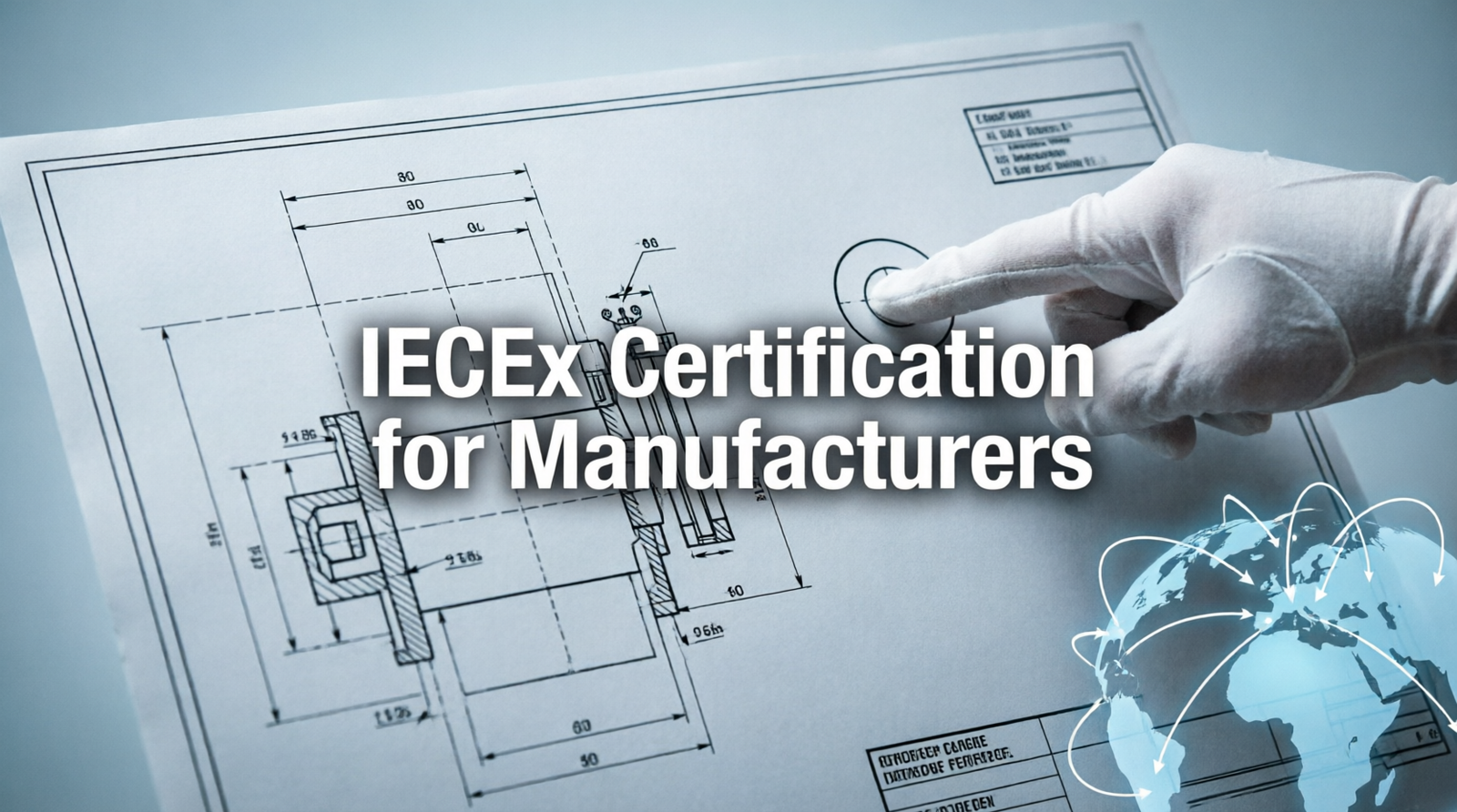
IECEx certification solves this. It gives your equipment one certificate that regulators and buyers trust worldwide. This guide breaks down what it takes to get there, from design through training.
The Imperative of IECEx for Hazardous Area Equipment
IECEx certification proves your equipment meets international safety standards for explosive atmospheres. It’s essential because it replaces dozens of national approvals with one trusted mark.
Explosive atmospheres don’t forgive design flaws. A faulty seal or a weak enclosure can spark a fire. That’s why regulators demand proof before equipment goes near flammable gas or dust.
Why safety assurance matters:
- Independent labs test your product against strict international rules
- Certification confirms your equipment won’t ignite a hazardous atmosphere
- Buyers gain confidence without running their own tests
Why international recognition matters:
IECEx works across more than 30 countries. One certificate opens doors in the Middle East, Asia-Pacific, and beyond. You skip repeat testing and repeat fees in each new market.
That matters most when you bid on international projects. Buyers often ask for proof of certification before they’ll even review your quote. A single IECEx certificate answers that question instantly.
Regulators trust the scheme too. Many national bodies accept IECEx certificates directly, with little or no extra review. That saves your team weeks of back-and-forth on every deal.
Key Stages of IECEx Equipment Certification
Manufacturers move through three main stages: design assessment, testing, and quality system audit. Each stage checks a different part of your product and process.
Stage 1: Design and development.
Build IECEx needs into your product early. Retrofitting safety features late in development costs more time and money. Your engineers should reference IECEx standards from the first sketch.
Stage 2: Testing and assessment.
An accredited test lab checks your product against the relevant standard. They test enclosures, temperature limits, and ignition protection methods. You receive an ExTR (Ex Test Report) once testing passes.
Stage 3: Quality assurance.
You need a certified quality system under IECEx QAR (Quality Assessment Report). This proves your factory keeps producing equipment that matches the tested sample, batch after batch.
| Stage | What Happens | Who’s Involved |
|---|---|---|
| Design & Development | Build safety into product specs | Your engineering team |
| Testing & Assessment | Independent lab tests the product | Accredited test laboratory |
| Quality Assurance | Factory audit confirms consistent production | Certification body auditors |
For a full walkthrough of each stage, this IECEx training guide covers what your team needs to know before you start.
Unlocking Global Markets with IECEx
IECEx certification helps you enter new markets faster and cheaper. It removes the need for separate national approvals in each country you sell to.
Without IECEx, you’d chase different certificates for the Gulf, Europe, and Asia. That means separate tests, separate fees, and separate delays. IECEx cuts that down to one process.
Reduced barriers you’ll notice:
- One certification body handles your global paperwork
- Fewer duplicate lab tests across regions
- Faster time-to-market for new products
Competitive advantage on the shelf:
Buyers in hazardous industries often shortlist only IECEx-certified suppliers. It signals your product meets a known, respected bar. That can be the deciding factor over an uncertified competitor.
Procurement teams also use certification as a shortcut. It’s faster to approve a certified supplier than to run a full technical review on an unknown one. That speed works in your favor during bidding.
A real-world example:
A mid-sized valve manufacturer in the UAE held only local approvals for years. After earning IECEx certification, they won contracts in Qatar, Saudi Arabia, and Australia within 18 months. No new local testing was needed for each deal.
Training Your Team for IECEx Compliance
Your team needs proper training to design, build, and audit equipment to IECEx standards. Without trained staff, certification slips or fails during audits.
Personnel competency isn’t optional. Engineers need to understand explosion protection concepts. Production staff need to spot deviations before they become compliance failures.
Why personnel competency matters:
Your design team should know which protection method fits your product, whether that’s flameproof, intrinsic safety, or increased safety. A wrong choice at the design stage can cost months of rework.
Why internal audits matter:
Trained staff catch problems before an external auditor does. Regular internal checks keep your quality system audit-ready all year, not just before renewal.
A trained internal auditor spots small drifts early. Maybe a supplier swapped a component. Maybe a process step got skipped on the floor. Catching that early beats explaining it to a certification body later.
To build this skill set, look into IECEx certification training built for personnel working on certified products.
Checklist: Key Training Areas for Manufacturers Seeking IECEx Certification
- Explosion protection concepts and Ex marking codes
- Design requirements for your chosen protection method
- Test lab expectations and documentation needs
- Quality management system requirements (ISO/IEC 80079-34)
- Internal audit techniques for ongoing compliance
- Change control procedures for certified products
Frequently Asked Questions
How long does IECEx certification take for a new product? Timelines vary by product complexity. Most manufacturers see three to six months from testing to final certificate.
Does IECEx certification replace ATEX approval? No. ATEX stays mandatory for EU sales. IECEx works alongside it and covers markets ATEX doesn’t reach.
What is an ExTR? An ExTR is an Ex Test Report. It documents the results of your product’s testing against IECEx standards.
Do small manufacturers need IECEx certification? If you sell hazardous area equipment internationally, yes. Size matters less than your target markets and buyer expectations.
How often does IECEx certification need renewal? Your quality system faces regular surveillance audits, and certificates need periodic review to stay valid.
Conclusion
IECEx certification turns a complex, country-by-country approval maze into one clear path. It protects your reputation, speeds up market entry, and builds buyer trust from day one.
Getting there takes the right design choices, the right testing partner, and a trained team behind the process. Skip any of those, and certification takes longer than it should.
Ready to plan your certification path? Contact our team for expert guidance on IECEx certification and training for your manufacturing business.