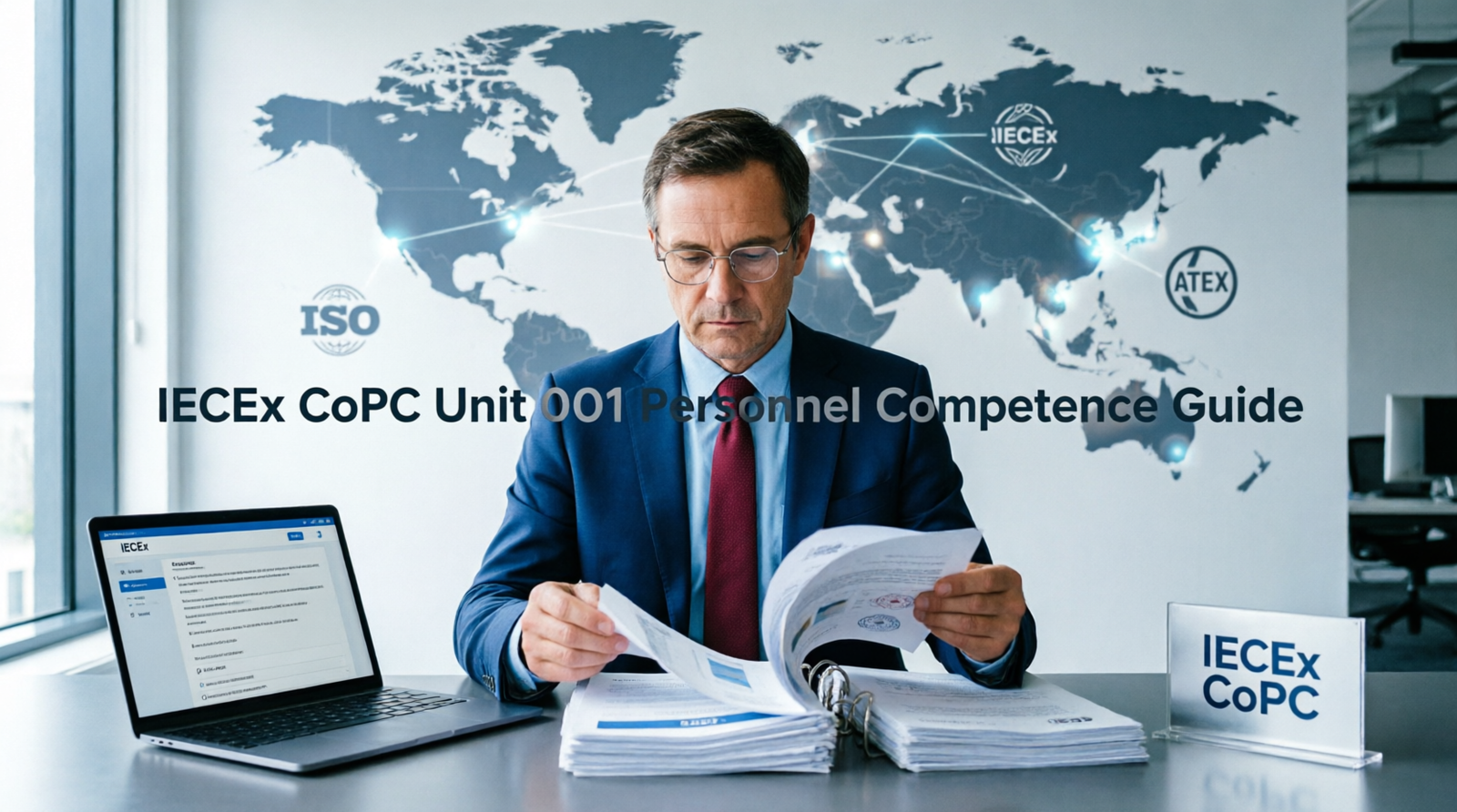
For electrical engineers and technicians pursuing careers spanning multiple international markets beyond GCC borders, IECEx Certified Personnel Competencies (CoPC) offers certification pathways providing genuine global recognition unavailable through regionally-focused alternatives. Understanding the CoPC system’s unit structure, competency requirements, assessment methodology, and practical application helps professionals evaluate whether this internationally-focused certification pathway aligns with career objectives extending beyond Middle Eastern energy markets into Asia-Pacific, European, or Americas opportunities where IECEx recognition provides critical credential portability that regional certifications cannot match.
Key Takeaways:
- IECEx CoPC structures competency through Unit 1 (core knowledge) combined with protection technique-specific units addressing equipment types like flameproof, intrinsic safety, or increased safety
- The system provides genuine global recognition across 36+ member countries spanning Asia-Pacific, Europe, Americas, and Middle East creating unmatched international career mobility
- Assessment methodology combines theoretical knowledge verification with practical competency demonstration through standardized international procedures ensuring consistent quality regardless of assessment location
- Training investment parallels CompEx costs (AED 4,500-7,500) though geographic availability remains more limited requiring careful GCC training center research
- Career value particularly benefits engineers targeting multinational contractor employment, international project rotations, or eventual relocation beyond Commonwealth-influenced markets where CompEx dominates
Understanding the IECEx CoPC System Architecture
IECEx CoPC represents the personnel competency component within the broader IECEx international certification system, which additionally covers equipment certification, service facility certification, and quality management system verification. This comprehensive architecture creates integrated certification framework where personnel, equipment, and organizational competency align under unified international standards rather than fragmented regional systems requiring separate verification approaches.
The CoPC structure organizes competency through modular units addressing different knowledge and skill domains. Unit 1 (Ex 001) establishes foundational competency applicable across all hazardous area work, covering area classification principles, equipment marking interpretation, general safety requirements, and standards framework understanding. This core unit alone doesn’t qualify for hands-on work but establishes prerequisite knowledge for specialist units addressing specific protection techniques.
Protection technique units build upon Unit 1 foundations, each addressing particular equipment protection methods requiring specialized knowledge and skills. Ex 002 addresses flameproof enclosures (Ex d), covering joint verification, enclosure integrity assessment, and flameproof-specific inspection procedures. Ex 003 covers increased safety equipment (Ex e), addressing creepage and clearance verification, termination inspection, and increased safety maintenance requirements. Ex 004 addresses intrinsically safe systems (Ex i), covering circuit verification, barrier inspection, and intrinsic safety documentation. Additional units address pressurization (Ex p), encapsulation (Ex m), and other specialized protection techniques.
Candidates select unit combinations matching their specific job requirements rather than pursuing comprehensive coverage regardless of actual need. A technician working exclusively with intrinsically safe instrumentation might pursue Unit 1 plus Ex 004 alone, while a general maintenance technician requiring broad equipment coverage might pursue Unit 1 plus Ex 002, Ex 003, and Ex 004 addressing the most common protection techniques encountered in typical facilities. Understanding IECEx certification scope helps identify appropriate unit combinations for specific career requirements.
Assessment Methodology and Competency Verification
IECEx CoPC assessment follows standardized international procedures ensuring consistent competency verification regardless of assessment location—a candidate certified in UAE receives equivalent competency verification to one certified in Australia or Malaysia, supporting the system’s core value proposition of genuine global portability. This standardization requires rigorous assessment protocols exceeding what some regional certification systems implement.
Written theoretical assessment evaluates understanding of relevant standards, safety principles, and technical requirements for selected units. Unit 1 written assessment covers fundamental concepts applicable across all specializations, while protection technique unit assessments address specific technical requirements for that protection method. Assessment format typically combines multiple-choice questions, short-answer items, and calculation problems testing both conceptual understanding and practical application capability.
Practical assessment requires demonstrated competency performing actual tasks relevant to selected units. For flameproof equipment units, this includes joint gap measurement, enclosure integrity assessment, and proper documentation of findings. For intrinsic safety units, practical assessment might include circuit verification, barrier inspection, and safety calculation demonstration. This hands-on component ensures certified individuals can actually perform required tasks rather than merely understanding concepts theoretically.
The integration between Unit 1 core knowledge and protection technique-specific units creates assessment requiring candidates demonstrate how general principles apply to specific equipment types. This differs from CompEx’s more modular approach where Ex01-Ex04 progressively builds competency through sequential stages—IECEx CoPC assessment often evaluates integrated application of core knowledge to specialized equipment within single comprehensive assessment sessions.
Assessment administration occurs through IECEx-accredited certification bodies maintaining consistent international standards. These bodies undergo periodic audits ensuring assessment quality, assessor competency, and procedural consistency across different countries and assessment centers. This international oversight provides quality assurance that purely national or regional certification systems may lack, supporting the credential’s global recognition and portability.
Career Applications for International Mobility
IECEx CoPC certification particularly benefits engineers and technicians planning careers extending beyond GCC and Commonwealth-influenced markets into regions where CompEx recognition proves limited or absent. Understanding specific career scenarios where IECEx CoPC provides distinct advantages helps evaluate whether this certification pathway aligns with individual career objectives.
Multinational Contractor Employment: Major international contractors including engineering firms based in Australia, continental Europe, or Asia-Pacific regions often maintain IECEx CoPC as their standard personnel certification requirement reflecting home market norms. Engineers seeking employment with these multinational firms, even for GCC project assignments, may find IECEx CoPC certification provides competitive advantage or explicit requirement satisfaction that CompEx alone cannot address.
International Project Rotation Programs: Large multinational operators and contractors increasingly implement global project rotation programs moving skilled personnel between operations in different countries based on project needs and career development plans. Personnel holding IECEx CoPC can participate in these rotation programs accessing assignments in Australia, Southeast Asia, or other IECEx-recognized markets without additional certification barriers that would restrict CompEx-only certified personnel to Commonwealth and Middle Eastern opportunities.
Long-Term International Career Planning: Engineers planning eventual relocation beyond GCC markets, whether for career advancement, personal circumstances, or market diversification, benefit from IECEx CoPC’s broader geographic recognition. While CompEx serves GCC careers effectively, engineers uncertain about long-term geographic career trajectory gain flexibility through IECEx CoPC investment supporting broader opportunity access.
Consulting and Advisory Services: International consulting engineers providing services across multiple countries benefit from IECEx CoPC’s universal recognition eliminating need for multiple regional certifications. This proves particularly valuable for engineers establishing international consulting practices or providing expert services to multinational clients operating across diverse regulatory jurisdictions.
Equipment Manufacturer and Technical Sales Roles: Engineers working for international equipment manufacturers or in technical sales roles requiring understanding of global certification requirements benefit from IECEx CoPC demonstrating comprehensive international standards knowledge relevant to global equipment specification and sales support activities.
Understanding CompEx certification and IECEx certification complementary relationship helps engineers evaluate whether pursuing both certifications, IECEx CoPC alone, or CompEx alone best serves their specific career trajectory and geographic ambitions.
GCC Training Availability and Access Considerations
While IECEx CoPC provides valuable international recognition, practical training availability across GCC markets remains more limited than extensive CompEx infrastructure, requiring careful research and planning for candidates pursuing this certification pathway within the region.
UAE offers the most developed IECEx CoPC training infrastructure among GCC countries, with several accredited centers in Abu Dhabi and Dubai providing regular course scheduling. However, course frequency typically proves lower than CompEx alternatives—monthly or bi-monthly scheduling compared to weekly CompEx availability at many centers. This reduced frequency requires more advance planning for candidates coordinating certification with employment or project timelines.
Saudi Arabia shows more limited IECEx CoPC training availability, with fewer accredited centers offering this certification pathway compared to extensive CompEx infrastructure throughout the Kingdom. Candidates seeking IECEx CoPC certification while based in Saudi Arabia may need to travel to UAE or other regional centers, adding logistical complexity and cost beyond pure training fees.
Qatar’s training landscape includes some IECEx CoPC availability particularly serving international contractors on North Field expansion projects, though selection remains more limited than UAE options. The concentration of international contractors in Qatar’s LNG sector creates some demand supporting IECEx CoPC training availability despite overall smaller GCC market presence compared to CompEx infrastructure.
For candidates unable to access convenient regional IECEx CoPC training, some pursue certification through periodic intensive programs offered by international training providers conducting occasional GCC sessions, or through travel to established IECEx training hubs in Singapore, Malaysia, or Australia. This travel requirement adds cost and time investment beyond pure training fees, requiring careful cost-benefit analysis comparing international travel expenses against career benefits from IECEx CoPC certification.
Some training centers offer combined CompEx and IECEx CoPC programs recognizing content overlap between systems, potentially reducing total time and cost investment for candidates pursuing both certifications compared to completely separate training programs. Understanding CompEx vs IECEx understanding the key differences helps evaluate these combined training opportunities when available.
Cost Analysis and Investment Comparison
IECEx CoPC training costs generally parallel CompEx pricing for equivalent competency levels, though specific pricing varies based on unit combinations pursued and training center location. Understanding total investment requirements helps evaluate certification value against career benefit expectations.
Unit 1 core competency training typically costs AED 2,000-3,000 as standalone component, though most candidates pursue Unit 1 combined with protection technique units rather than isolated core certification lacking practical application qualification. Protection technique units (Ex 002, Ex 003, Ex 004) each typically add AED 1,500-2,500 depending on unit complexity and training center pricing structures.
A typical technician certification combining Unit 1 with two protection technique units (perhaps Ex 002 flameproof and Ex 004 intrinsic safety, covering common equipment types) totals approximately AED 5,000-7,000, comparable to CompEx Ex01-Ex04 complete certification costs. However, technicians requiring broader equipment coverage across three or four protection techniques face higher total costs than CompEx’s fixed Ex01-Ex04 pricing structure, since additional IECEx units incur incremental costs beyond base Unit 1 plus initial specialization.
Geographic cost variations prove more pronounced for IECEx CoPC given limited GCC training availability. Candidates traveling to distant training centers face additional accommodation and transportation costs beyond base training fees, potentially adding AED 2,000-4,000 to total investment depending on travel distance and duration required. This geographic cost premium doesn’t typically affect CompEx candidates given extensive regional training infrastructure minimizing travel requirements.
Refresher and recertification costs follow similar five-year cycles as CompEx, though specific refresher scope depends on which units require renewal. Candidates should verify whether all units require simultaneous refresher or whether staggered renewal based on individual unit certification dates applies, as this affects long-term cost planning and administrative complexity compared to CompEx’s more straightforward complete Ex01-Ex04 renewal approach.
Combining IECEx CoPC with CompEx for Maximum Flexibility
Many engineers pursuing serious international career development ultimately obtain both CompEx and IECEx CoPC certifications, leveraging complementary strengths—CompEx’s extensive GCC recognition and training accessibility combined with IECEx CoPC’s broader international portability—rather than choosing exclusively between systems.
This dual certification strategy typically involves initial CompEx certification supporting immediate GCC employment given extensive regional recognition and training availability, followed by IECEx CoPC pursuit as career international ambitions develop or specific opportunities requiring this credential emerge. This staged approach spreads investment over time while building comprehensive credentials satisfying diverse employer requirements across different international markets.
The content overlap between systems, both addressing fundamental hazardous area competency principles despite different organizational structures and assessment approaches, means candidates already holding CompEx certification often complete IECEx CoPC training more efficiently than starting from scratch. Understanding gained through CompEx Ex01-Ex04 provides foundation knowledge transferable to IECEx CoPC Unit 1 and protection technique units, potentially reducing required study time despite different assessment formats.
Some training centers offer bridging programs specifically designed for CompEx-certified candidates pursuing IECEx CoPC, focusing training time on IECEx-specific requirements, documentation formats, and assessment procedures rather than repeating fundamental concepts already mastered through CompEx certification. These bridging programs typically cost less and require shorter duration than complete IECEx CoPC training from zero baseline knowledge.
For engineers uncertain about long-term international career trajectory, this dual certification approach provides maximum flexibility without requiring upfront commitment to extensive IECEx CoPC investment before career direction clarifies. Starting with CompEx for immediate GCC career support, then adding IECEx CoPC when specific international opportunities materialize or career trajectory clarifies toward global mobility, optimizes investment timing against actual career development rather than speculative upfront comprehensive certification.
Final Thoughts
IECEx CoPC certification provides valuable international recognition for electrical engineers and technicians whose career ambitions extend beyond GCC and Commonwealth-influenced markets into the broader global energy sector spanning Asia-Pacific, European, and Americas opportunities. While CompEx serves GCC-focused careers effectively given extensive regional recognition and training infrastructure, IECEx CoPC’s genuine international portability across 36+ member countries provides distinct advantages for engineers pursuing multinational contractor employment, international project rotations, or long-term career flexibility beyond regional boundaries.
The certification’s modular unit structure allows precise competency matching to specific job requirements, though this flexibility requires more careful planning than CompEx’s more straightforward Ex01-Ex04 progression. Training availability across GCC remains more limited than extensive CompEx infrastructure, requiring additional planning and potentially travel investment for candidates pursuing this certification regionally. For engineers with clear international career ambitions or specific employer requirements mandating IECEx CoPC, the investment delivers meaningful career value through genuine global mobility unavailable through regional-only certification.
For those focused primarily on GCC career development without strong international mobility requirements, CompEx alone typically provides sufficient career support without the additional complexity and potentially higher costs associated with IECEx CoPC pursuit. Understanding your specific career trajectory and target markets helps determine whether IECEx CoPC investment, CompEx alone, or strategic dual certification best serves your professional development objectives in the evolving global energy sector.
FAQs
What is IECEx CoPC certification?
IECEx CoPC (Certified Personnel Competencies) certifies individual competency for working with equipment and systems in explosive atmospheres through internationally standardized assessment, providing genuine global recognition across 36+ member countries through modular units addressing core knowledge and specific protection techniques.
Is IECEx CoPC recognized in GCC countries?
Yes, IECEx CoPC receives recognition across GCC countries with UAE showing strongest acceptance through balanced operator specifications, Qatar demonstrating growing recognition particularly among international contractors, and Saudi Arabia showing more limited but increasing acceptance alongside traditional CompEx dominance.
How much does IECEx CoPC training cost?
IECEx CoPC training costs typically range AED 5,000-7,000 for common unit combinations (Unit 1 plus two protection technique units), comparable to CompEx Ex01-Ex04 pricing, though candidates requiring broader equipment coverage across multiple protection techniques face higher costs than CompEx’s fixed pricing structure.
Should I choose CompEx or IECEx CoPC for GCC career?
For GCC-focused careers, CompEx typically provides sufficient recognition and superior training accessibility, while IECEx CoPC becomes valuable when pursuing international career mobility, multinational contractor employment, or specific employer requirements mandating this certification beyond regional GCC opportunities.
Can I combine CompEx and IECEx CoPC certifications?
Yes, many engineers pursue both certifications leveraging CompEx’s GCC recognition and IECEx CoPC’s international portability, often starting with CompEx for immediate regional career support then adding IECEx CoPC as international career ambitions develop, with some training centers offering efficient bridging programs for CompEx-certified candidates.