Here’s Blog Post 5 of 5:
Meta Title: EPD in UAE for Green Building Standards – What Manufacturers Need to Know
Meta Description: Learn how EPD certification supports UAE green building standards including LEED, Estidama, and Al Sa’fat. Full guide for manufacturers supplying UAE construction projects.
Focus Keyword: EPD in UAE for green building standards
EPD in UAE for Green Building Standards – What Manufacturers Need to Know
UAE construction projects do not just build buildings. They chase ratings. LEED. Estidama. Al Sa’fat. Every rating requires verified sustainability data from the products used.
EPD in UAE for green building standards is how manufacturers provide that data. Without it, your products do not qualify for specification on certified projects — regardless of how sustainable your manufacturing process actually is.
This guide covers every major UAE green building standard that recognizes EPDs, how each one uses them, and what manufacturers need to do to qualify.
Why UAE Green Building Standards Require EPDs
UAE’s green building agenda is one of the most active in the world. Net Zero 2050 commitments, Vision 2030 alignment, Expo legacy projects, and a construction pipeline spanning residential, commercial, hospitality, and infrastructure all operate under sustainability frameworks that include material transparency requirements.
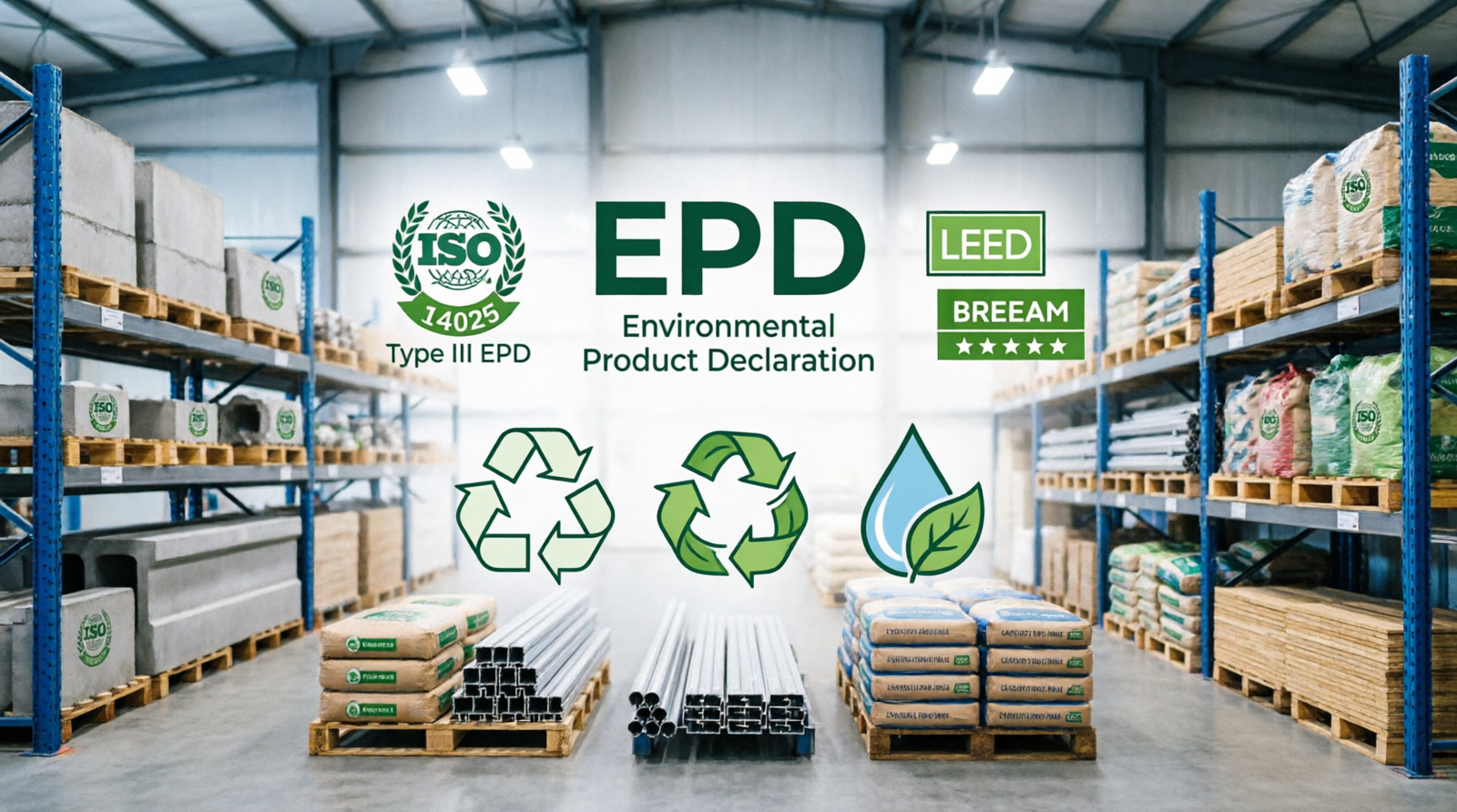
EPD certification UAE sits at the center of those requirements. Project teams pursuing green building ratings need verified environmental data from building products. EPDs provide exactly that — in a standardized, third-party verified format that rating systems accept.
Here is what drives EPD demand across UAE green building projects:
- LEED v4 and v4.1 award credits specifically for products with published EPDs
- Estidama Pearl Rating recognizes EPDs under materials and resources credits
- Al Sa’fat — Dubai’s green building evaluation tool — incorporates material transparency requirements
- Emirates Green Building Council promotes EPD adoption as part of UAE sustainability goals
- Abu Dhabi government sustainability policies increasingly specify EPD-certified materials
- Dubai Municipality green building requirements align with international material transparency standards
Manufacturers without EPDs watch competitors take their specifications. That is the direct commercial consequence of not having one.
LEED Certification and EPDs in UAE
LEED — Leadership in Energy and Environmental Design — is the most widely used green building rating system on UAE projects. Commercial towers, hotels, mixed-use developments, and government facilities across Dubai, Abu Dhabi, and the wider UAE pursue LEED certification regularly.
LEED v4 and v4.1 both include a specific credit where EPDs contribute directly.
MR Credit — Building Product Disclosure and Optimization: Environmental Product Declarations
Project teams earn one point by using products from at least 20 different manufacturers that each have a qualifying EPD.
Two options apply:
Option 1 — EPD Disclosure
Products with a publicly available EPD meeting ISO 14025 and EN 15804 each count as one product toward the 20-product threshold. Industry-wide EPDs qualify here.
Option 2 — Multi-Attribute Optimization
Products with EPDs demonstrating environmental performance better than the industry benchmark count as 1.5 products toward the threshold. Product-specific EPDs with optimization data qualify here.
For UAE manufacturers, LEED is typically the primary driver of EPD development. A product with a qualifying EPD gets specified on LEED projects. A product without one does not.
The EPD LEED certification connection is direct and commercial — not theoretical.
Estidama Pearl Rating System and EPDs
Estidama is Abu Dhabi’s green building rating system. Developed by the Abu Dhabi Urban Planning Council, it applies to residential, commercial, and mixed-use buildings across Abu Dhabi emirate.
Estidama uses a Pearl rating scale — one Pearl being the minimum for new buildings, with higher Pearl ratings reflecting stronger sustainability performance.
EPDs contribute to Estidama under its Materials and Waste category. The system rewards transparency in material selection — and EPDs provide exactly the verified environmental data that Estidama assessors require.
Key points for manufacturers supplying Estidama projects:
- Abu Dhabi’s construction pipeline includes significant government-mandated Estidama requirements
- Residential developments, public buildings, and infrastructure projects in Abu Dhabi operate under Estidama
- Manufacturers with EPDs support project teams in achieving higher Pearl ratings
- Abu Dhabi government sustainability procurement policies align with Estidama material transparency goals
For manufacturers supplying to Abu Dhabi — whether concrete, steel, insulation, flooring, or finishing products — Estidama compliance is a practical reason to develop an EPD alongside LEED qualification.
Al Sa’fat — Dubai Green Building Evaluation System and EPDs
Al Sa’fat is Dubai’s green building evaluation system, developed by Dubai Municipality. It applies to all new buildings in Dubai and evaluates sustainability performance across energy, water, indoor environment, materials, and site.
Al Sa’fat incorporates material sustainability requirements that align with international transparency standards — including recognition of EPDs for building products.
Manufacturers supplying to Dubai construction projects benefit from EPDs in two practical ways:
Direct credit contribution
Al Sa’fat assessors recognize EPD-certified products under material transparency and sustainable sourcing requirements. Products with EPDs contribute to the project’s Al Sa’fat score.
Competitive specification advantage
Dubai project teams pursuing Al Sa’fat ratings actively seek products with verified sustainability data. EPD-certified products get shortlisted. Unverified products face scrutiny.
Dubai’s construction volume is significant. Any manufacturer with regular project supply into Dubai — tiles, cladding, insulation, structural materials, fit-out products — benefits directly from Al Sa’fat-recognized EPD certification.
Emirates Green Building Council and EPDs
The Emirates Green Building Council (EmiratesGBC) is the UAE’s national green building council — a member of the World Green Building Council. It promotes sustainable construction practices across the UAE and supports alignment between UAE projects and international green building standards.
EmiratesGBC actively promotes EPD adoption as part of the UAE’s broader sustainability agenda. Its guidance aligns with both LEED and Estidama requirements — making EPDs a consistent recommendation across UAE green building contexts.
For manufacturers, EmiratesGBC recognition of EPDs means:
- EPD-certified products align with UAE national sustainability policy direction
- EmiratesGBC member developers and contractors actively seek EPD-certified suppliers
- Alignment with EmiratesGBC guidance supports qualification across multiple UAE green building systems simultaneously
A single EPD developed to ISO 14025 standards supports compliance with LEED, Estidama, Al Sa’fat, and EmiratesGBC guidance — all from one document.
UAE Green Building Standards — EPD Comparison
| Green Building Standard | Governing Body | EPD Recognition | Primary UAE Context |
|---|---|---|---|
| LEED v4 / v4.1 | USGBC | MR Credit — EPD disclosure and optimization | Commercial, hospitality, mixed-use |
| Estidama Pearl | Abu Dhabi UPC | Materials and Waste credits | Abu Dhabi residential and commercial |
| Al Sa’fat | Dubai Municipality | Material transparency requirements | All Dubai new buildings |
| BREEAM | BRE Global | Mat 01 — responsible sourcing | International developer projects in UAE |
| EmiratesGBC guidance | EmiratesGBC | Aligned with LEED and Estidama requirements | National sustainability policy |
| GSAS | Gulf Organization for Research and Development | Material credits | GCC projects — Saudi, Qatar, Kuwait |
One EPD supports all of these simultaneously. Manufacturers do not need separate EPDs for each standard. A properly structured EPD meeting ISO 14025 and EN 15804 qualifies across every system listed above.
Which UAE Manufacturers Need EPDs Most Urgently
Not every manufacturer faces equal urgency. These categories face the most immediate specification pressure.
Concrete and cement product manufacturers
Concrete is the highest-volume building material in UAE construction. LEED, Estidama, and Al Sa’fat project teams all seek EPDs for concrete products. Manufacturers without EPDs lose specifications to certified competitors on every rated project.
Steel and structural metal suppliers
Structural steel specified in LEED projects needs EPDs to contribute to MR credits. UAE steel suppliers and distributors who hold EPDs qualify for specification on certified commercial and infrastructure projects.
Insulation manufacturers
Insulation is a commonly specified EPD product category across LEED and Estidama projects. UAE-manufactured or UAE-distributed insulation products with EPDs qualify for multiple credits simultaneously.
Flooring product manufacturers
Tiles, carpet, resilient flooring, and timber flooring are all specified with EPDs on LEED commercial interiors projects across UAE office, hotel, and retail developments.
Cladding and facade manufacturers
UAE’s distinctive architecture relies heavily on cladding systems. Project teams on LEED-rated towers and mixed-use developments seek EPDs for facade and cladding products.
Paints, coatings, and adhesives suppliers
These product categories contribute to LEED MR credits and have specific EPD requirements under relevant PCRs. UAE suppliers in this category compete directly on EPD availability.
Glazing and window system manufacturers
Commercial glazing specified on LEED projects benefits from EPD certification. UAE glazing suppliers targeting developer specifications on certified projects need EPDs to qualify.
How EPDs Support UAE Net Zero 2050 Goals
The UAE committed to Net Zero by 2050. Buildings account for a significant share of national carbon emissions — both operational and embodied.
Embodied carbon — the carbon emitted during material extraction, manufacturing, and construction — is increasingly tracked on UAE projects. EPDs provide the verified embodied carbon data that whole-building carbon calculations require.
Project teams calculating embodied carbon for LEED, Estidama, or Net Zero compliance use EPD data from individual products. Without EPD data, they either use generic assumptions — which may overestimate your product’s impact — or exclude your product from consideration entirely.
Manufacturers with EPDs contribute accurate embodied carbon data to UAE’s national carbon reduction agenda. This is not just compliance — it is positioning your products as part of the solution to UAE’s Net Zero commitments.
As embodied carbon requirements tighten across UAE green building standards — which they will, following international trends — EPDs will move from optional to mandatory for most significant construction specifications.
Getting your EPD now places you ahead of that requirement.
EPD for Saudi Arabia and GCC Green Building Projects
UAE EPDs apply directly to Saudi Arabia green building projects and across the GCC. One EPD serves multiple markets simultaneously.
Saudi Arabia’s green building context includes:
- LEED v4 and v4.1 — same credit structure as UAE
- GSAS — Global Sustainability Assessment System — used across Saudi, Qatar, and Kuwait
- Saudi Green Building Forum requirements
- Vision 2030 mega-project sustainability specifications — NEOM, Red Sea Project, Diriyah Gate
Qatar, Kuwait, and Bahrain construction projects also recognize LEED and GSAS — both accepting EPDs under material credits.
For manufacturers in UAE or Saudi Arabia supplying across the GCC, one EPD covers the entire regional market. The investment in EPD development delivers returns across every certified project in every GCC country.
Practical Steps to Get EPD Certified for UAE Green Building Projects
Getting your product EPD-certified for UAE green building compliance follows a clear path.
Step 1 — Identify your target green building standards
Confirm which standards your target projects use — LEED, Estidama, Al Sa’fat, or a combination. This determines EPD requirements and the program operator you should register with.
Step 2 — Conduct a UAE-specific Life Cycle Assessment
Your LCA must use UAE energy grid data, regional transport distances, and local material sourcing inputs. Generic global averages do not reflect UAE manufacturing reality accurately.
Step 3 — Develop EPD documentation to ISO 14025 and EN 15804
The EPD document must follow the applicable Product Category Rule and cover all required environmental impact indicators for your product type.
Step 4 — Complete third-party verification
Independent verification by an accredited body is mandatory. LEED, Estidama, and Al Sa’fat all require verified EPDs — not self-declared environmental documents.
Step 5 — Register with a recognized program operator
For UAE projects, confirm the program operator is recognized by your target green building standard before registering. The International EPD System, UL Environment, and NSF Sustainability are widely accepted.
Step 6 — Communicate your EPD to UAE project teams
Publish your EPD on your website. Include it in product datasheets. Register on specification platforms used by UAE architects and consultants. Inform your sales team to lead with EPD availability in client conversations.
For a complete EPD guide for businesses covering the full process visit the Envirolink resource library.
What UAE Manufacturers Ask About EPD and Green Building Standards
Does one EPD qualify for LEED, Estidama, and Al Sa’fat simultaneously?
Yes. A properly structured EPD meeting ISO 14025 and EN 15804 qualifies across all three simultaneously. One EPD investment supports every major UAE green building rating system — no separate documents required for each standard.
How many EPDs does a LEED project in UAE typically need?
LEED MR credit Option 1 requires products from at least 20 different manufacturers with qualifying EPDs. Option 2 requires products demonstrating environmental performance better than industry benchmarks. Most LEED project teams in UAE actively seek EPD-certified products across all major material categories.
Does Estidama accept EPDs from international manufacturers?
Yes. Estidama recognizes EPDs from manufacturers anywhere — provided the EPD meets ISO 14025 requirements and is registered with a recognized program operator. International manufacturers supplying Abu Dhabi projects can use their existing EPDs for Estidama compliance.
Is BREEAM used on UAE projects and does it accept EPDs?
Yes. BREEAM is used on UAE projects — particularly by international developers and hospitality brands. BREEAM Mat 01 recognizes EPDs under responsible sourcing credits. A single EPD qualifies for both LEED and BREEAM simultaneously.
Will EPDs become mandatory for UAE construction projects?
EPDs are not currently legally mandatory in UAE. However, the direction of travel is clear. LEED, Estidama, and Al Sa’fat requirements are tightening. Embodied carbon tracking is increasing. Government sustainability procurement policies are expanding. Manufacturers who develop EPDs now avoid scrambling to comply when requirements formalize.
Can we use an EPD developed for a European market on UAE projects?
Yes — provided the EPD meets ISO 14025 and EN 15804 and is registered with a recognized program operator. However, European LCA data may not accurately reflect UAE manufacturing conditions. A UAE-specific LCA produces more accurate environmental impact figures — which may be more favorable if UAE energy and transport inputs differ from European averages.
What is the difference between EPD and HPD for UAE green building projects?
An EPD reports environmental impact — carbon, energy, water, waste. An HPD — Health Product Declaration — reports material ingredients and human health impacts. LEED awards separate credits for each. Both contribute to the MR credit category. UAE project teams pursuing high LEED scores often request both from manufacturers.
EPD UAE Green Building Checklist
Use this before starting your EPD development for UAE projects.
- Identify target UAE green building standards — LEED, Estidama, Al Sa’fat, BREEAM
- Confirm EPD requirements for each target standard
- Define product scope — single product or product family
- Confirm life cycle stages required — cradle-to-gate minimum
- Select consultant with UAE-specific LCA experience
- Identify correct Product Category Rule for your product type
- Collect UAE manufacturing data — energy, materials, water, waste, transport
- Use UAE electricity grid data and regional transport distances in LCA
- Confirm program operator recognized by target UAE green building standards
- Complete independent third-party verification
- Publish EPD and communicate to UAE specification teams immediately
- Register on UAE architect and specifier platforms — EPD Hub, Mindful Materials
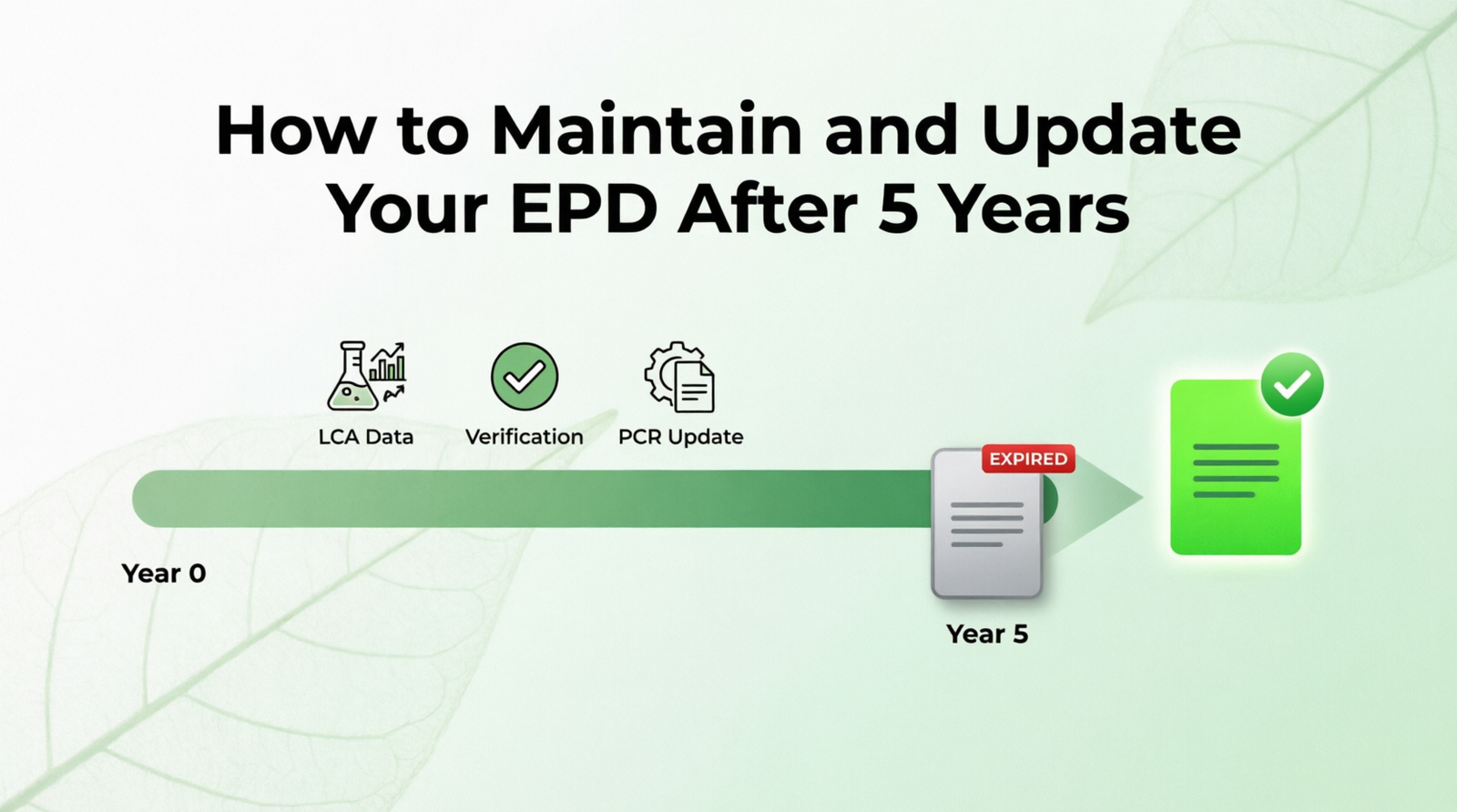
- Plan EPD renewal 6 months before 5-year expiry
Frequently Asked Questions
Does the Abu Dhabi government require EPDs on public building projects?
Abu Dhabi public building projects increasingly operate under Estidama requirements — which recognize EPDs under material credits. While EPDs are not yet individually mandated by Abu Dhabi government procurement, Estidama compliance effectively creates EPD demand on all rated projects.
Can a UAE manufacturer develop an EPD for a product manufactured outside the UAE?
Yes — provided the LCA reflects the actual manufacturing location’s data. If a UAE company manufactures products in another country and imports them, the LCA must use the manufacturing country’s energy and production data. The EPD is then valid for use on UAE projects.
How does EPD certification affect a manufacturer’s ESG reporting?
EPDs provide verified, quantified product-level environmental data — exactly what ESG frameworks require for product environmental disclosures. EPDs strengthen ESG reporting credibility and provide auditable evidence of environmental performance claims.
Are there UAE-specific EPD program operators?
Currently, most UAE manufacturers register EPDs with international program operators — the International EPD System, UL Environment, or NSF Sustainability. These are all recognized by UAE green building standards. Local GCC-specific EPD programs are developing but international program operators remain the primary route for UAE manufacturers.
What happens if a UAE project team cannot find EPDs for enough products?
Project teams may not achieve the LEED MR credit if insufficient EPD-certified products are available in their specified product categories. This creates direct commercial pressure on manufacturers — project teams actively seek and prefer EPD-certified suppliers to protect their credit count.
Get EPD Certified for UAE Green Building Projects
EPD in UAE for green building standards is a commercial necessity for manufacturers supplying to LEED, Estidama, Al Sa’fat, and BREEAM projects.
Envirolink provides complete EPD development and verification for UAE manufacturers — from LCA through publication — ensuring your EPD qualifies for every major UAE green building rating system.
Whether you are starting your first EPD or renewing an existing one, the team handles the full process with fixed pricing and UAE-specific expertise.
For a full overview of EPD importance for your business or to understand how EPD development and verification works visit the Envirolink resource library.
Contact the team today for a free consultation and fixed-price scope assessment.