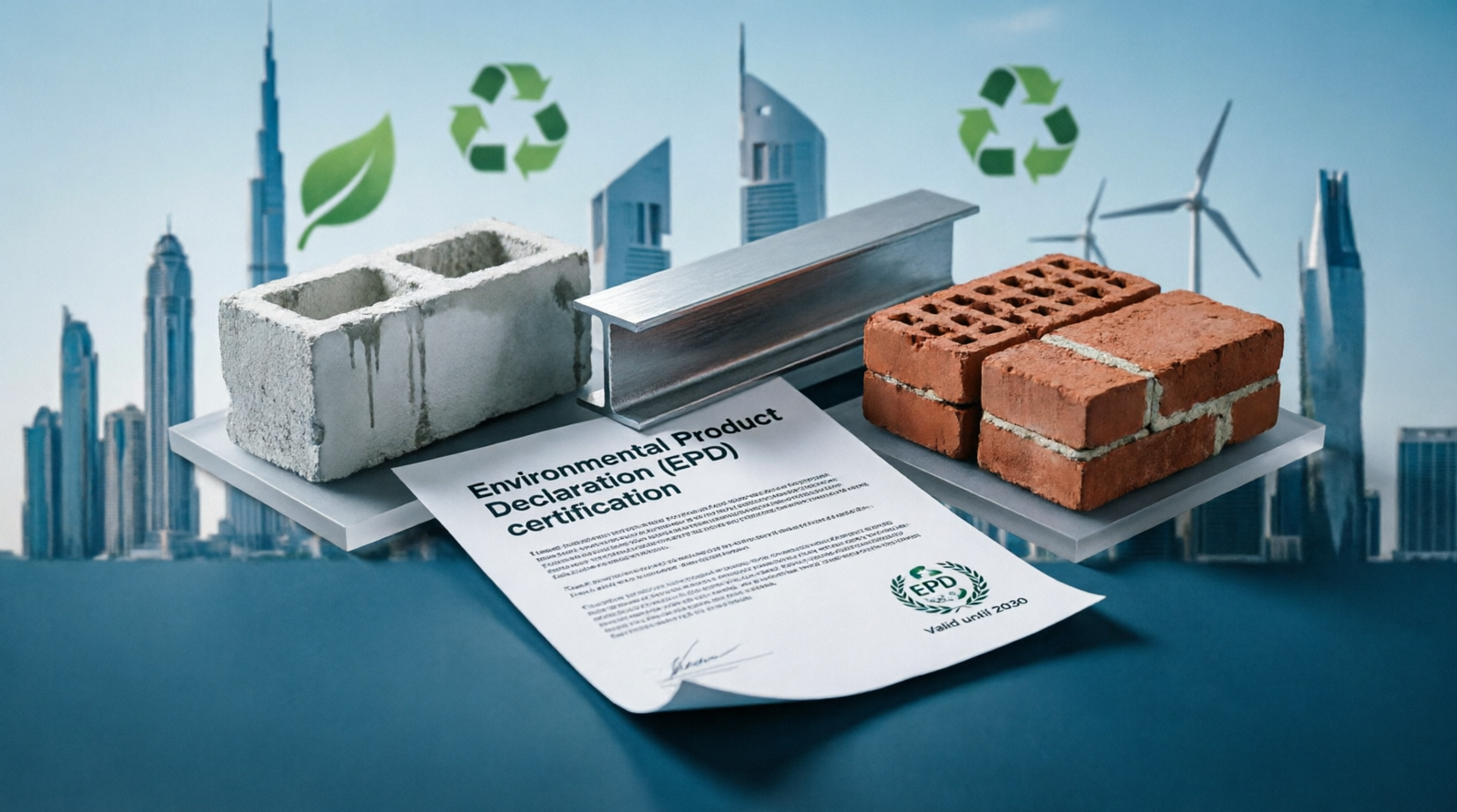
If you manufacture concrete, steel, glass, insulation, or any building material in the UAE — EPDs are no longer optional.
LEED v4, Estidama, and major infrastructure projects across Dubai and Abu Dhabi now specify EPD-compliant products. Without one, you are excluded from a growing share of the market.
This guide covers everything a UAE manufacturer needs to know — process, cost, timeline, and what actually happens on the ground.
What Is an EPD for Construction Materials?
An Environmental Product Declaration (EPD) is a verified document. It shows the environmental impact of a construction product across its full lifecycle.
It is based on a Life Cycle Assessment (LCA). It follows ISO 14025 and EN 15804. And it must be verified by an independent third party before it is published.
An EPD is not a marketing claim. It is a quantified, verified declaration — comparable across products and manufacturers.
Understand the full difference between EPD and LCA
Which Construction Materials Need an EPD?
Almost every permanently installed building product can have an EPD. In the UAE market, demand is highest for:
Structural materials:
- Ready-mix concrete
- Precast concrete elements
- Structural steel and rebar
- Aluminium sections and profiles
Envelope and finishing:
- Glass and glazing systems
- Insulation boards and batts
- Façade cladding and panels
- Ceramic and porcelain tiles
Interior and fit-out:
- Flooring systems
- Gypsum board and plaster
- Paints, coatings, and adhesives
- Raised access flooring
MEP and systems:
- Ductwork and HVAC components
- Electrical conduit and cable trays
- Plumbing pipes and fittings
If your product is specified in a LEED or Estidama project, there is a strong chance an EPD will be requested.
See the specific EPD process for flooring products
Why UAE Manufacturers Need EPDs Now
Green Building Mandates Are Expanding
Dubai and Abu Dhabi have set aggressive sustainability targets. UAE Vision 2031 and the Net Zero 2050 commitment are driving policy changes across construction procurement.
New government buildings must meet Estidama or LEED standards. That filters directly into product specifications.
Contractors Are Pushing Requirements Down the Supply Chain
Main contractors on LEED projects need EPDs to earn credits. They pass that requirement to suppliers. If you cannot provide an EPD, another manufacturer will.
Saudi Arabia and GCC Markets Are Following
Saudi Vision 2030 includes major green building commitments. NEOM, Red Sea Project, and Diriyah Gate all have sustainability requirements. EPDs are becoming standard in bid documents across the region.
Full EPD guide for UAE, Saudi Arabia, and GCC manufacturers
How EPDs Support LEED Credits for Construction Products
LEED v4 and v4.1 include the Building Product Disclosure and Optimization (BPDO) credit under Materials and Resources.
EPDs contribute directly to this credit. Here is how:
MR Credit: Environmental Product Declarations
- Products need a published, third-party verified EPD
- At least 20 qualifying products from 5 manufacturers are needed
- Products must be permanently installed in the project
- Each product with an EPD counts as one product toward the credit threshold
A concrete supplier, steel fabricator, and insulation manufacturer — each with a registered EPD — can all contribute to the same LEED project’s MR credit.
See how EPDs and LEED certification connect in detail
The EPD Process for Construction Manufacturers — Step by Step
Step 1 — Identify Your Product and PCR
A Product Category Rule (PCR) defines how the LCA must be conducted for your product type. Concrete has its own PCR. Steel has another. You must follow the correct one.
Your EPD consultant identifies the right PCR before any work begins.
Step 2 — Collect Production Data
This is where most manufacturers spend the most time. You need:
- Raw material quantities per declared unit
- Energy consumption (electricity, fuel, steam)
- Water usage
- Waste generated
- Transport distances and modes
A declared unit is the reference unit for your EPD — for example, 1 m³ of concrete or 1 tonne of steel.
Data is typically collected for a 12-month production period. The more accurate your data, the stronger your EPD.
Step 3 — Conduct the Life Cycle Assessment
A qualified LCA practitioner models your product using specialist software — SimaPro, OpenLCA, or GaBi are most common.
The LCA calculates your environmental indicators:
- GWP (carbon emissions)
- ODP (ozone depletion)
- AP (acidification)
- EP (eutrophication)
- And several more
Learn more about what LCA measures and how it differs from an EPD
Step 4 — Draft the EPD Document
The LCA outputs are formatted into an EPD document. This follows the programme operator’s template. It includes product description, system boundary, environmental indicators, and verification details.
Step 5 — Third-Party Verification
An independent verifier reviews both the LCA and the EPD document. They check:
- Accuracy of data inputs
- Correct application of the PCR
- Compliance with ISO 14025 and EN 15804
- Validity of LCA methodology
This step cannot be skipped. Without verification, the document is not a recognised EPD.
See the NSF EPD verification process
Step 6 — Register and Publish
The verified EPD is submitted to a programme operator. Common ones used in the UAE and GCC include:
- EPD International (Sweden)
- NSF International (US)
- IBU (Germany)
- The International EPD System
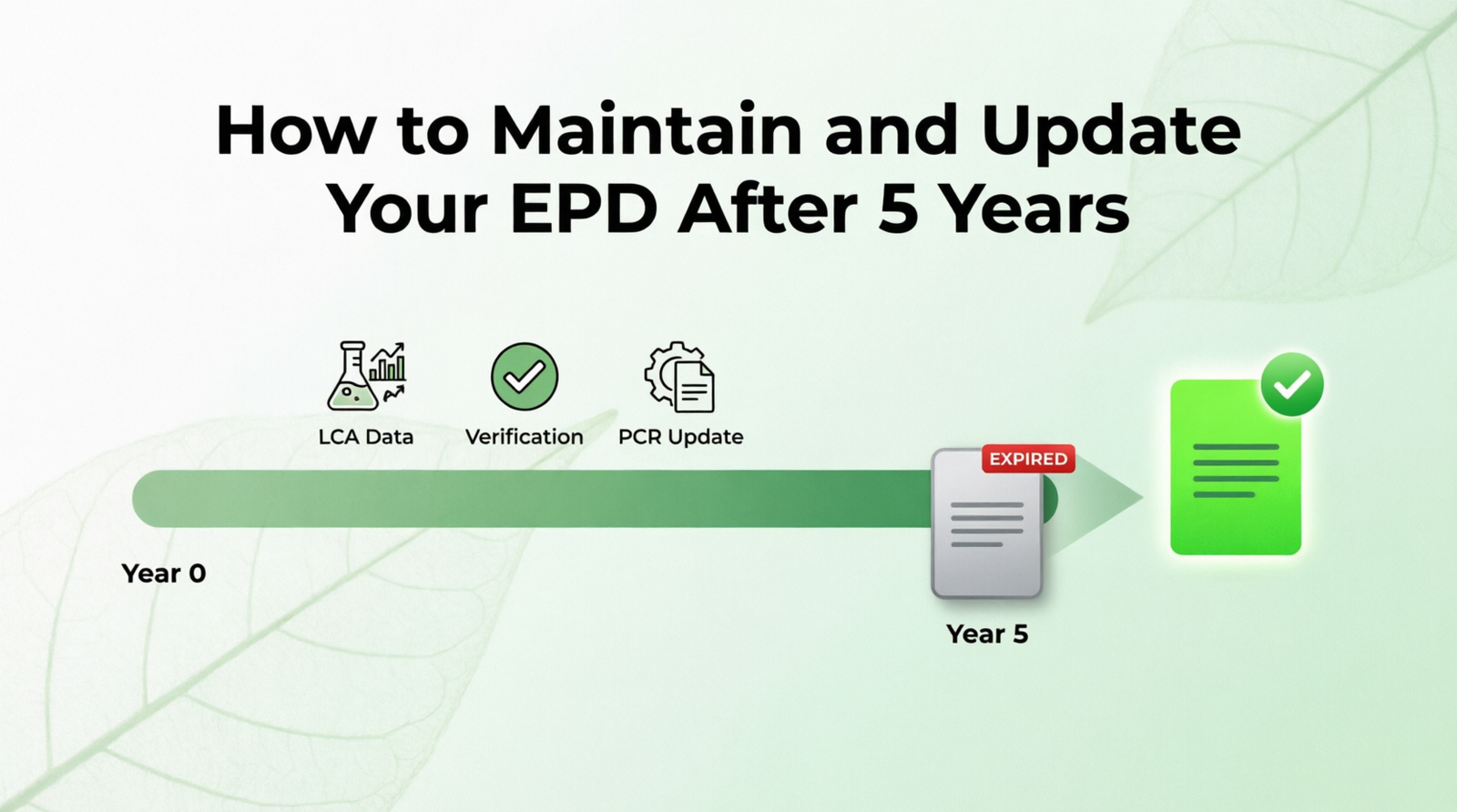
Once registered, your EPD is publicly available. It has a unique registration number and a 5-year validity period.
Timeline for UAE Construction Manufacturers
| Stage | Duration |
|---|---|
| PCR identification and scoping | 1 – 2 weeks |
| Data collection at facility | 4 – 8 weeks |
| LCA modelling | 3 – 6 weeks |
| EPD drafting | 2 – 3 weeks |
| Third-party verification | 3 – 5 weeks |
| Programme registration | 1 – 2 weeks |
| Total | 3 – 6 months |
Manufacturers with ISO 14001 systems in place move faster. Their data is already structured and traceable.
Cost Breakdown for UAE Manufacturers
| Component | Estimated Cost (USD) |
|---|---|
| LCA study | $3,000 – $8,000 |
| EPD drafting | $1,500 – $3,000 |
| Third-party verification | $1,500 – $3,500 |
| Programme registration | $500 – $1,500 |
| Total per EPD | $6,500 – $16,000 |
A concrete manufacturer with 5 product lines can reduce per-product cost by batching LCA work. One LCA framework covers multiple products — reducing overall spend significantly.
Full guide to EPD costs and process in the UAE
What Makes a Strong EPD for Construction Products
Not all EPDs carry equal weight. Here is what separates a credible EPD from a weak one:
Product-specific data — not industry averages
Project teams prefer EPDs based on actual facility data. Industry-average EPDs are valid but carry less weight in competitive specifications.
Cradle-to-gate plus modules
For most construction materials, this system boundary is standard. Ensure your EPD clearly declares which lifecycle modules are included.
Recognised programme operator
EPDs registered with EPD International, NSF, or IBU are widely accepted. Obscure or unrecognised operators may not be accepted on LEED projects.
Current and valid
An expired EPD is useless. Keep track of your 5-year renewal date.
EPD vs Green Label vs Sustainability Certificate
Manufacturers often confuse these. Here is the difference:
| Document | What It Is | Verified? | LEED Credit? |
|---|---|---|---|
| EPD | Environmental impact declaration | Yes — third party | Yes |
| Green label / eco-label | Product sustainability badge | Sometimes | Depends |
| ISO 14001 certificate | Environmental management system | Yes | No |
| Sustainability report | Company-level self-declaration | No | No |
Only a registered EPD directly supports LEED MR credits. The others serve different purposes.
See everything included in an EPD declaration
5 FAQs — EPD for Construction Materials
1. Can a UAE manufacturer register an EPD with an international programme operator?
Yes, absolutely. UAE manufacturers regularly register EPDs with EPD International, NSF, and IBU. There is no requirement to use a local programme operator. The EPD is globally valid once registered.
2. Does every product variant need its own EPD?
Not always. Similar products made from the same materials and process can sometimes be covered under one EPD with declared ranges. Your LCA practitioner will advise based on your specific product range.
3. Is an EPD mandatory to supply construction materials in the UAE?
Not yet mandatory across all projects. But it is increasingly required for LEED, Estidama, and government-tendered projects. Demand is growing fast — particularly for suppliers to large developers and main contractors.
4. How does an EPD help with UAE green building ratings beyond LEED?
Estidama Pearl Rating System in Abu Dhabi also recognises EPDs under its materials credits. As the UAE aligns with global sustainability frameworks, EPDs are becoming a baseline expectation — not just a bonus.
5. What happens if my EPD data changes after publication?
Minor production changes do not automatically invalidate an EPD. But significant changes — new raw materials, major process changes, new energy sources — may require an update or re-verification before the 5-year period ends.
Who Should Start the EPD Process First?
If you supply any of the following, prioritise your EPD now:
- Ready-mix or precast concrete
- Structural steel or rebar
- Insulation and thermal products
- Glass and curtain wall systems
- Flooring and tiling
These product categories appear in virtually every LEED and Estidama project specification. Being EPD-ready puts you ahead of competitors still waiting.