An Environmental Product Declaration (EPD) is a verified document. It shows the environmental impact of a product across its full lifecycle. Think of it as a nutrition label — but for construction materials and manufactured goods.
EPDs follow ISO 14025. They are third-party verified. And they are increasingly required for green building certifications like LEED and Estidama.
What Is an EPD, Exactly?
An EPD is a standardised report. It quantifies how much carbon, water, and energy a product uses — from raw material to disposal.
It is based on a Life Cycle Assessment (LCA). The LCA calculates environmental data. The EPD publishes that data in a verified, comparable format.
Key facts:
- Governed by ISO 14025 and EN 15804
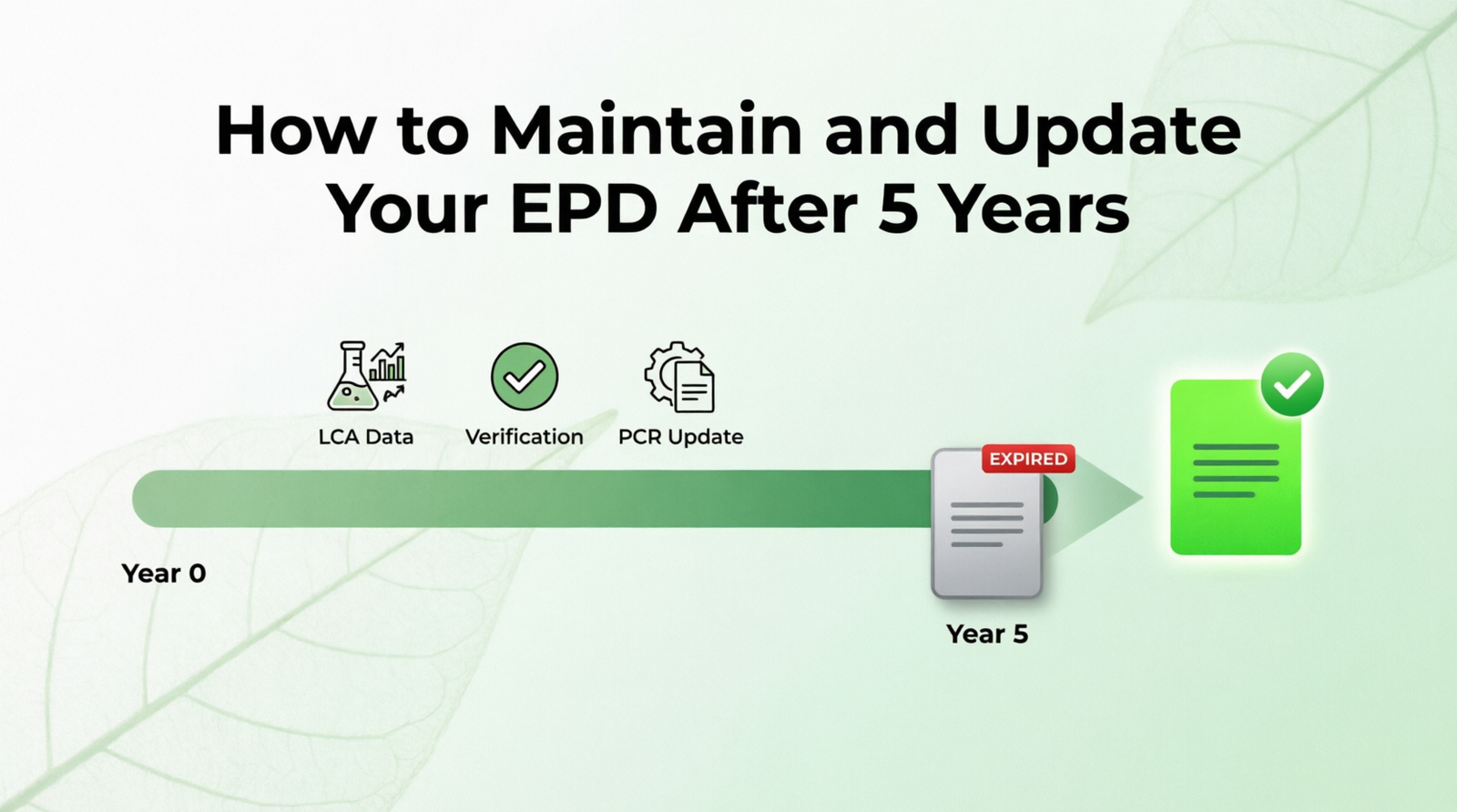
- Valid for 5 years from date of issue
- Must be verified by an independent third party
- Published on a recognised EPD programme operator platform
If a client or project asks for an EPD, they want proof — not a claim.
Why Do Businesses Need an EPD?
1. Green Building Projects Require Them
LEED v4 and v4.1 award credits for EPD-backed products. Estidama in Abu Dhabi does the same. If your product is not EPD-verified, it may not qualify for these projects.
A concrete block supplier in Dubai without an EPD loses bids. A supplier with one wins them.
2. Government Procurement Is Changing
UAE and Saudi Arabia are tightening sustainability requirements. Public infrastructure projects increasingly specify EPD-compliant materials. This is not a future trend — it is happening now.
3. Export Markets Demand Them
Europe, the US, and Australia require EPDs for many building products. If you export or plan to, an EPD removes a major barrier.
4. It Builds Credibility
An EPD is third-party verified. It is not a marketing claim. Architects, consultants, and procurement teams trust it. That trust translates into specifications and orders.
What Products Can Get an EPD?
Almost any product with measurable environmental impact can get an EPD.
Common product categories:
- Concrete and cement
- Steel and aluminium
- Glass and insulation
- Flooring and tiles
- Paints and coatings
- Façade systems
- MEP equipment
EPD for construction materials — see the full product guide
How Does the EPD Process Work?
Step 1 — Choose a Product Category Rule (PCR)
A PCR is a rulebook. It defines how the LCA must be done for your product type. You must follow the correct PCR for your category.
Step 2 — Conduct a Life Cycle Assessment (LCA)
A qualified LCA practitioner collects data. They model your product’s environmental impact from cradle to gate — or cradle to grave.
Learn more about EPD vs LCA differences
Step 3 — Draft the EPD Document
The LCA data is formatted into an EPD. It follows the programme operator’s template.
Step 4 — Third-Party Verification
An independent verifier reviews the LCA and EPD. They check accuracy and compliance with ISO 14025.
Step 5 — Register and Publish
The verified EPD is submitted to a programme operator — such as NSF, IBU, or EPD International. It is then published and publicly available.
See the NSF EPD development process
How Long Does It Take?
Most EPD projects take 3 to 6 months. The timeline depends on:
- Data availability at your facility
- Product complexity
- Verifier and programme operator schedules
A single-product EPD is faster. A manufacturer with 5 product lines needs more time for data collection and LCA modelling.
What Does an EPD Cost?
Costs vary. Here is a realistic range for UAE and GCC manufacturers:
| Component | Estimated Cost (USD) |
|---|---|
| LCA study | $3,000 – $8,000 |
| EPD drafting | $1,500 – $3,000 |
| Third-party verification | $1,500 – $3,500 |
| Programme registration fee | $500 – $1,500 |
| Total | $6,500 – $16,000 |
Multi-product EPDs cost more upfront — but the per-product cost drops significantly.
Full guide to getting an EPD in the UAE
EPD and LEED Certification — How They Connect
LEED v4 and v4.1 include a credit called Building Product Disclosure and Optimization (BPDO). EPDs are a direct path to earning this credit.
Here is how it works:
- Each qualifying EPD contributes toward the LEED MR credit
- Products need to be permanently installed in the project
- At least 20 products from 5 manufacturers are typically needed
See how EPDs connect to LEED certification
What Information Does an EPD Contain?
A published EPD includes:
- Product description — what it is, how it is made
- Declared unit — the unit of measurement (e.g., 1 tonne of concrete)
- System boundary — which lifecycle stages are included
- Environmental indicators — GWP, ODP, AP, EP, POCP, ADPE, ADPF
- LCA methodology — software and database used
- Verification statement — verifier name and date
- Validity period — 5 years from registration
GWP (Global Warming Potential) is the most referenced indicator. It measures carbon dioxide equivalent (CO₂e) emissions per declared unit.
EPD for Specific Product Types
Different products have different PCRs and benchmarks.
Flooring products:
EPDs for flooring must follow EN 15804 or the relevant ISO-aligned PCR. They typically cover cradle-to-gate plus installation.
EPD for flooring — what manufacturers need to know
Construction materials:
Concrete, steel, and insulation have well-established PCRs. Data collection is usually straightforward for manufacturers with ISO 14001 systems in place.
Common Questions From Manufacturers
Do I need a separate EPD for each product?
Not always. A product-specific EPD covers one product. But programme operators also allow industry-average EPDs and facility-specific EPDs across similar product lines.
Can a small manufacturer get an EPD?
Yes. Size does not disqualify you. What matters is having reliable production data and the budget for an LCA study.
Is an EPD the same as ISO 14001?
No. ISO 14001 is an environmental management system. An EPD is a product-level declaration. They serve different purposes.
Does an EPD expire?
Yes. EPDs are valid for 5 years. After that, you must update the LCA data and re-verify.
Who Verifies EPDs in the UAE and GCC?
Verification must be done by an approved third party. Some programme operators have their own verifiers. Others accept independent, qualified LCA verifiers.
In the UAE and GCC, manufacturers typically work with:
- International programme operators (EPD International, NSF, IBU)
- Local sustainability consultants who manage the full process
EPD guide for manufacturers in UAE, Saudi Arabia, and GCC
Is an EPD Worth It for Your Business?
Ask yourself three questions:
- Do your clients or projects require LEED, Estidama, or green building credits?
- Do you export to markets that specify EPD-compliant products?
- Do you want verified sustainability claims — not just marketing language?
If the answer to any of these is yes, an EPD is worth the investment.
A steel fabricator in Sharjah recently completed an EPD for two product lines. Within six months, they were specified on two major infrastructure projects in Saudi Arabia that had previously excluded them.
That is the business case.
Ready to Start?
Understand why EPD matters for your business
Read the full EPD guide for businesses
Getting an EPD is a process. But it is a clear, structured one. With the right support, most manufacturers complete it within 4 months.
Start with your product data. That is where every successful EPD begins.