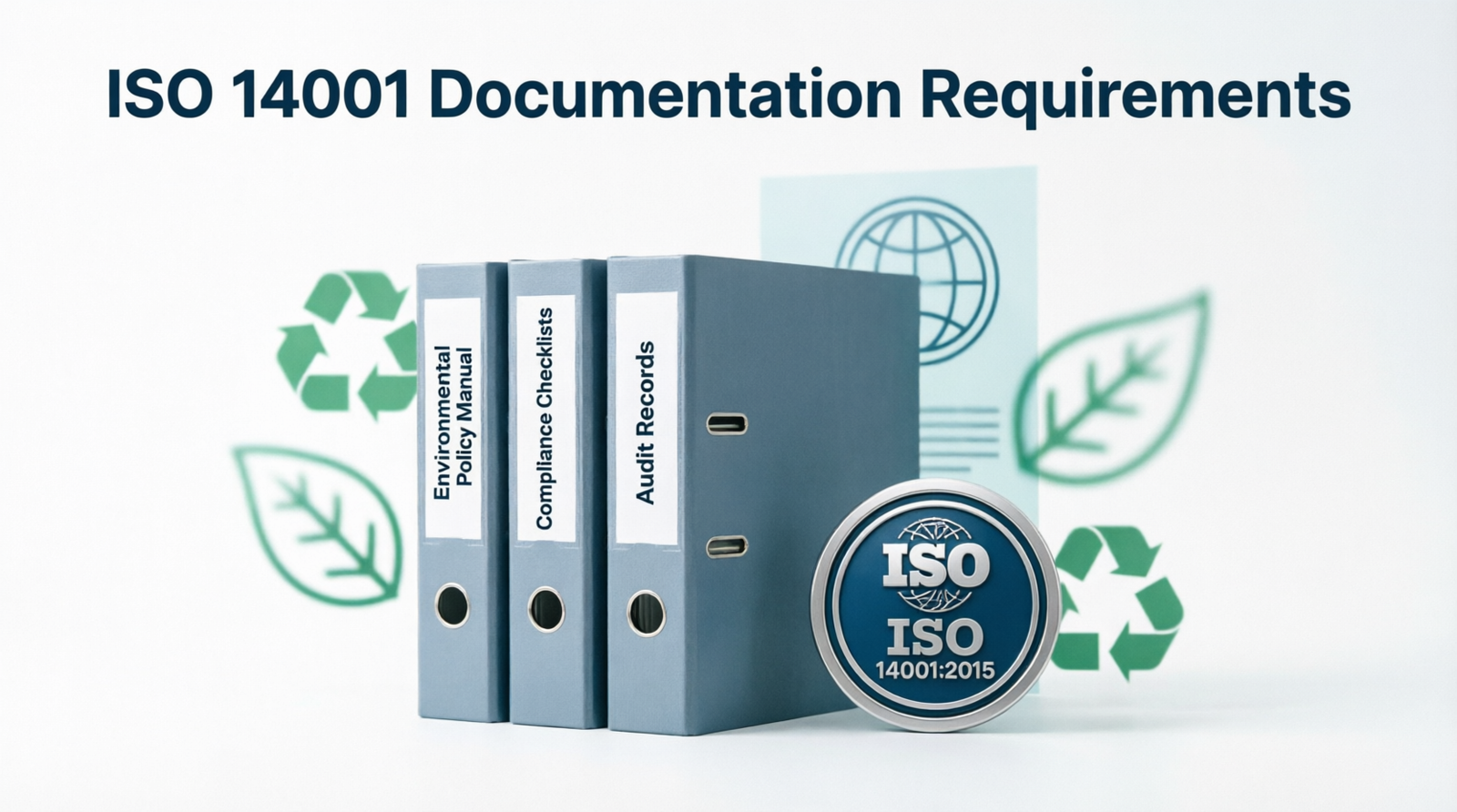
Most businesses overcomplicate ISO 14001 documentation. They create hundreds of pages nobody reads. The standard does not ask for that. It asks for the right documents — maintained properly and used in real operations.
Here is exactly what you need.
What Does ISO 14001 Say About Documentation?
ISO 14001 uses the term “documented information.” This covers both documents (procedures, policies) and records (evidence that things were done).
You need two types:
- Documents you maintain — policies, procedures, registers
- Records you retain — audit reports, training logs, meeting minutes
The standard does not prescribe a specific format. A spreadsheet, a PDF, or a simple Word file all work. What matters is that documents are controlled, current, and accessible.
Mandatory Documents Required by ISO 14001
These are not optional. Without them, you will receive a major nonconformity in your audit.
1. Environmental Policy
A short, signed statement from top management. It must commit to:
- Protecting the environment
- Meeting legal obligations
- Continual improvement
Keep it to one page. Make it visible — post it in your office, include it in staff inductions.
2. Scope of the EMS
A written statement defining what your EMS covers. Be specific.
Example: “This EMS applies to all operations at our Dubai production facility, including manufacturing, warehousing, and on-site maintenance.”
If your scope is vague, auditors will question it immediately.
3. Environmental Aspects and Impacts Register
This is your most important document. It lists everything your business does that affects the environment — and how significant that impact is.
A basic register looks like this:
| Activity | Aspect | Impact | Significance |
|---|---|---|---|
| Generator use | Emissions | Air pollution | High |
| Chemical storage | Spillage risk | Soil contamination | High |
| Office operations | Paper use | Resource depletion | Low |
| Vehicle fleet | Fuel consumption | Carbon emissions | Medium |
Review this register at least once a year. Update it when operations change.
4. Legal and Other Requirements Register
List every environmental law, regulation, and permit that applies to your business. In the UAE this includes:
- Federal Law No. 24 of 1999
- Dubai Municipality waste regulations
- Abu Dhabi Environment Agency permits
- Free zone specific requirements
- Client contractual environmental obligations
Update this register when laws change. Auditors check the date of your last review.
5. Environmental Objectives and Targets
Document your environmental goals with measurable targets.
Each objective must show:
- What you want to achieve
- How you will measure it
- Who is responsible
- The deadline
Example entry:
| Objective | Target | Owner | Deadline |
|---|---|---|---|
| Reduce water consumption | 20% reduction vs 2024 baseline | Facilities Manager | December 2025 |
| Decrease landfill waste | 30% reduction | Operations Manager | June 2025 |
Vague objectives fail audits. Numbers and deadlines are mandatory.
Related: What Are ISO 14001 Requirements
Mandatory Records Required by ISO 14001
Records are the evidence that your EMS is working. Without records, you cannot prove compliance.
6. Competence and Training Records
For every employee whose work affects environmental performance, you need:
- Job role and environmental responsibilities
- Training completed
- Date of training
- Evidence of competence (test results, sign-off sheets)
A simple spreadsheet works. Update it every time training happens.
7. Monitoring and Measurement Records
You must track your key environmental metrics regularly. Common records include:
- Monthly energy consumption logs
- Water meter readings
- Waste disposal records and manifests
- Vehicle fuel consumption logs
- Chemical usage records
Keep at least 12 months of data before your certification audit. Auditors want to see trends, not just one month of numbers.
8. Legal Compliance Evaluation Records
Once a year at minimum, you must evaluate whether you are actually complying with your legal requirements. Document this evaluation.
It does not need to be complex. A table showing each legal requirement and your compliance status is sufficient.
9. Internal Audit Records
You must document:
- Audit plan and schedule
- Audit findings (conformities and nonconformities)
- Corrective actions raised
- Closure of corrective actions
Related: ISO 14001 Internal Audit Process
Related: ISO 14001 Audit Checklist Guide
10. Management Review Minutes
Document every management review meeting. Minutes must show:
- Date and attendees
- Topics discussed
- Decisions made
- Actions assigned with deadlines
One management review per year is the minimum. Most auditors expect two.
11. Nonconformity and Corrective Action Records
When something goes wrong — a spill, a missed target, a failed procedure — document it.
Each record must show:
- What happened
- Root cause identified
- Action taken
- Verification that the action worked
Related: How to Maintain ISO 14001 Certification
12. Emergency Preparedness and Response Records
Document your emergency scenarios, response procedures, and any drills conducted.
For UAE businesses, common scenarios include:
- Chemical spill on site
- Fire near hazardous materials
- Fuel leak from vehicles or generators
- Wastewater overflow
Conduct at least one drill per year. Record the date, scenario tested, and any improvements made.
How to Control Your Documents
ISO 14001 requires your documented information to be controlled. This means:
- Documents have version numbers and dates
- Outdated versions are removed or clearly marked
- Documents are accessible to people who need them
- Documents are protected from accidental changes or deletion
A simple document control register tracks:
| Document | Version | Last Reviewed | Owner |
|---|---|---|---|
| Environmental Policy | v3 | January 2025 | CEO |
| Aspects Register | v7 | March 2025 | EMS Manager |
| Legal Register | v5 | February 2025 | Compliance Officer |
You do not need expensive software. A shared folder with clear naming conventions works fine for most small and medium businesses.
How Much Documentation Is Enough?
This is the most common question. The answer is simple.
Write what you actually do. Not what you think you should do.
A procedure nobody follows is worse than no procedure. Auditors do not count pages. They check if your documents reflect reality.
A medium-sized business in Dubai typically needs:
- 1 environmental policy
- 1 scope statement
- 4 to 6 core procedures
- 5 to 8 active registers and logs
- Records updated regularly
That is it. Keep it lean and keep it real.
Common Documentation Mistakes to Avoid
These mistakes appear in UAE audits regularly:
| Mistake | Impact |
|---|---|
| Aspects register never updated | Major nonconformity |
| Legal register out of date | Major nonconformity |
| Training records incomplete | Minor nonconformity |
| Objectives with no measurable targets | Major nonconformity |
| Corrective actions not closed | Minor nonconformity |
| Emergency drills not recorded | Minor nonconformity |
Fix these before your audit — not during it.
ISO 14001 Documentation Checklist
Use this to confirm you are ready:
- Environmental policy signed and communicated
- EMS scope clearly defined
- Aspects and impacts register complete and current
- Legal register reviewed within the last 12 months
- Objectives documented with targets, owners, and deadlines
- Training records maintained for all relevant staff
- Monitoring data collected for at least 3 months
- Legal compliance evaluation completed
- Internal audit report finalised
- Management review minutes documented
- Corrective actions recorded and closed
- Emergency response procedures and drill records in place
Frequently Asked Questions
What documents are mandatory for ISO 14001?
The mandatory documents are: environmental policy, EMS scope, aspects and impacts register, legal register, environmental objectives, competence records, monitoring data, compliance evaluation, internal audit records, management review minutes, and corrective action records.
Do I need a procedures manual for ISO 14001?
Not necessarily. ISO 14001 does not require a formal manual. You need documented procedures only where their absence could lead to environmental harm or nonconformity.
How long must I keep ISO 14001 records?
The standard does not specify a retention period. Most UAE businesses keep records for a minimum of 3 years — covering one full certification cycle.
Can I store ISO 14001 documents digitally?
Yes. Digital storage is fully acceptable. Use a shared drive with access controls and version tracking.
How often should I update my documentation?
Review your aspects register and legal register at least once a year. Update them immediately when your operations or applicable laws change.
Related: ISO 14001 Certification Process Step by Step
Related: ISO 14001 Certification Cost in UAE
Related: Benefits of ISO 14001 for Businesses
Related: ISO 14001 Certification in Dubai UAE
Main page: ISO 14001 Certification