UAE construction projects are moving fast. LEED targets are set. Sustainability procurement requirements are tightening.
And manufacturers keep asking the same question — how do we actually get an EPD?
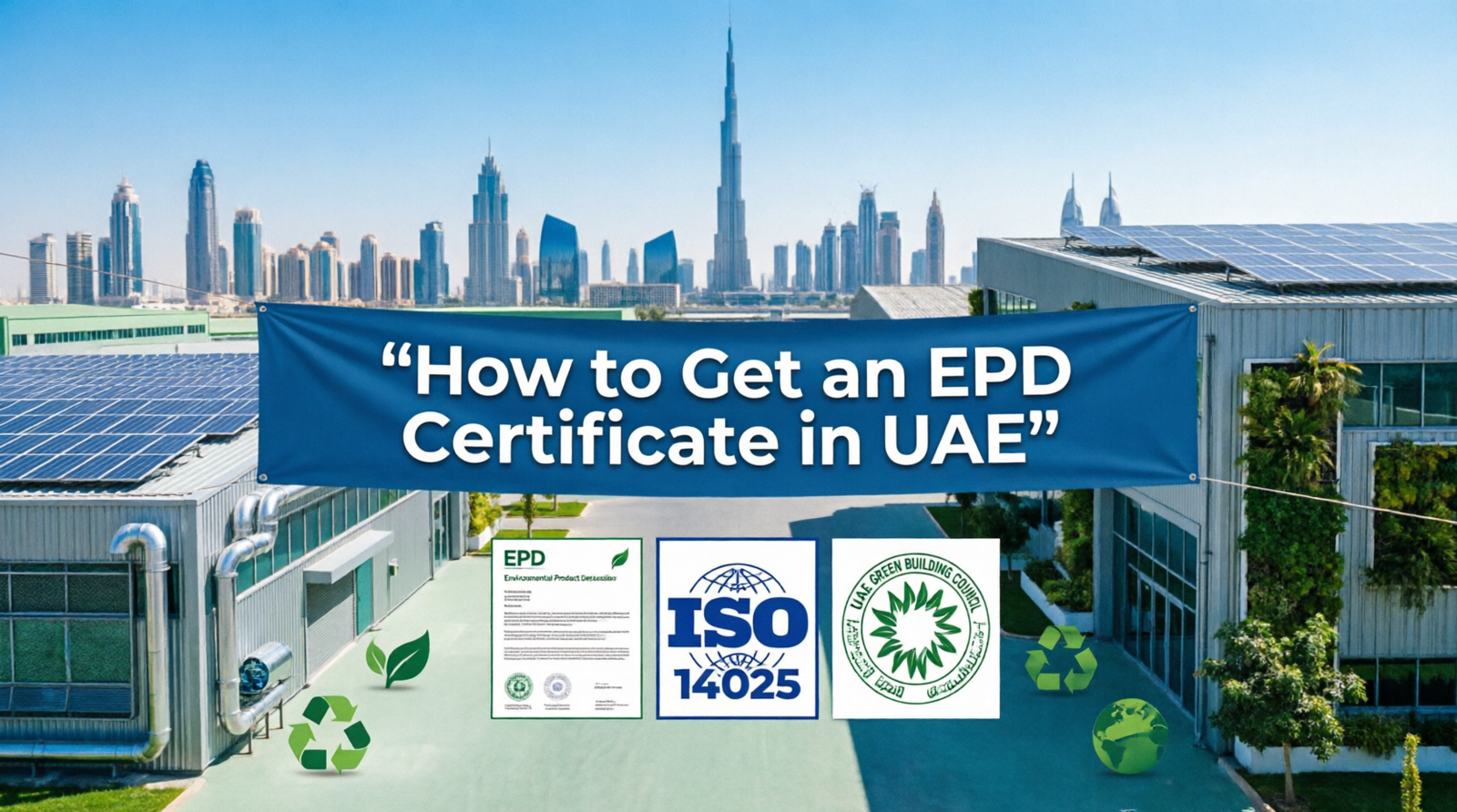
This guide answers that directly. No theory. No filler. Just the exact process for getting an EPD certificate in UAE — from the first step to a published, LEED-ready declaration.
What Getting an EPD in UAE Actually Involves
Getting an Environmental Product Declaration in UAE means completing a structured process that produces a verified, publicly registered document reporting your product’s environmental impact.
It is not a single application. It is a process with defined stages — each building on the last.
The full process covers:
- Conducting a Life Cycle Assessment specific to your product and UAE manufacturing context
- Selecting the correct Product Category Rule
- Developing the EPD document to ISO 14025 and EN 15804 standards
- Completing independent third-party verification
- Registering and publishing the EPD with a recognized program operator
Each stage has technical requirements. Getting any stage wrong delays the entire process — or produces an EPD that does not qualify for LEED or UAE green building standards.
Why UAE Manufacturers Need an EPD Now
EPD certification UAE demand is not coming — it is already here.
UAE green building activity operates across multiple rating systems simultaneously. LEED, Estidama Pearl, Al Sa’fat, and Emirates Green Building Council standards all recognize EPDs for material credits. Projects pursuing these ratings actively seek EPD-certified products during specification.
Here is what drives urgency for UAE manufacturers:
- LEED MR credits require products with verified EPDs — no EPD means no specification
- Estidama Pearl Rating System rewards EPD-certified materials in building assessments
- Al Sa’fat — Dubai’s green building tool — incorporates material transparency requirements where EPDs apply
- Government procurement policies in Abu Dhabi and Dubai increasingly specify sustainability credentials including EPDs
- Export buyers in Europe and the UK require EPDs as standard supplier documentation
A UAE insulation manufacturer completed their EPD after losing two project specifications in six months. Both project teams confirmed the same reason — no EPD meant the product could not contribute to their LEED MR credit count. The EPD was completed. The next specification cycle included them. That is a direct, measurable return.
Step-by-Step Process to Get an EPD Certificate in UAE
Step 1 — Define Your Product Scope
Before any technical work begins, define exactly what product or product family the EPD will cover.
Key decisions at this stage:
- Single product or product family — can multiple variants be covered under one EPD?
- Which manufacturing site or sites are included in the scope
- Which life cycle stages will be covered — cradle-to-gate is the minimum for most LEED applications
- Which markets and green building standards the EPD needs to qualify for
Getting scope right at the start prevents costly revisions later. A consultant experienced in EPD in UAE helps you define a scope that is practical, credible, and meets the requirements of your target projects.
Step 2 — Identify the Correct Product Category Rule
Every EPD must follow a Product Category Rule (PCR) — a standardized methodology for your specific product type.
PCRs define:
- Which life cycle stages must be included
- Which environmental impact categories must be reported
- How to handle multi-output manufacturing processes
- What data quality requirements apply
Examples of PCRs relevant to UAE manufacturers:
- PCR for concrete and cement products
- PCR for steel and structural metals
- PCR for insulation materials
- PCR for flooring products
- PCR for paints, coatings, and adhesives
- PCR for glazing and window systems
Using the wrong PCR produces an EPD that cannot be compared with competitor products — and may not qualify for LEED or green building credits. Your consultant identifies and confirms the correct PCR before LCA work begins.
Step 3 — Conduct the Life Cycle Assessment
The LCA is the technical foundation of every EPD. It measures environmental impact across all included life cycle stages.
For UAE manufacturers, the LCA uses:
- UAE electricity grid data — the UAE energy mix directly affects manufacturing stage carbon and energy impact figures
- Regional transport distances — from raw material sourcing locations to your facility, and from your facility to typical project sites
- Local raw material inputs — where materials are sourced from affects environmental impact calculations significantly
- UAE-specific waste management data — end-of-life assumptions reflect actual UAE disposal and recycling infrastructure
This is why working with consultants who understand the UAE context matters. Generic global LCA data produces less accurate EPDs — and sophisticated LEED project teams notice.
LCA methodology follows ISO 14040 and ISO 14044. Recognized databases — ecoinvent, GaBi, or equivalent — are used to model background system data. Your consultant collects foreground data — your actual production inputs and outputs — directly from your facility.
Data collection from your team typically involves:
- Annual material consumption data by input type
- Energy consumption — electricity, gas, fuel — per unit of production
- Water consumption per unit of production
- Waste generation data — type and quantity
- Packaging material data
- Transport information — distances and modes from key suppliers and to key markets
Step 4 — Develop the EPD Document
LCA results are compiled into an EPD document. The document structure follows ISO 14025 and EN 15804 requirements.
A complete EPD document includes:
- Product description and technical specifications
- System boundary declaration — what life cycle stages are included and excluded
- Environmental impact results for all required indicators
- Declared unit — the functional unit to which all results are referenced
- Data quality assessment
- References to LCA study and PCR
- Verification statement
The document must be specific to your product — not a modified template. Auditors and project teams identify generic documentation immediately. LEED verification reviewers reject EPDs with inconsistent or implausible data.
Step 5 — Complete Third-Party Verification
EPD verification is mandatory. An accredited independent verifier reviews:
- LCA methodology and data quality
- Compliance with the applicable PCR
- Compliance with ISO 14025 and EN 15804
- Accuracy and consistency of environmental impact results
- Completeness of the EPD document
The verifier issues a verification statement confirming the EPD meets requirements. Without this statement, the EPD cannot be registered or used for LEED compliance.
Verification is conducted by organizations accredited to perform EPD reviews — separate from your EPD consultant. Independence is a requirement. Your consultant cannot verify their own work.
Step 6 — Register With a Program Operator
The verified EPD is submitted to a program operator — the organization that manages the public EPD database.
Program operators recognized by LEED and international green building standards include:
- The International EPD System
- UL Environment
- NSF Sustainability
- BRE Global
- Institut Bauen und Umwelt (IBU)
Registration involves submitting the verified EPD document, paying registration fees, and completing the program operator’s submission requirements. Once accepted, the EPD is published in the program operator’s public database with a unique EPD number.
For UAE manufacturers targeting LEED projects, confirm your chosen program operator is recognized under the applicable LEED credit before registering. Not all program operators are accepted by all rating systems.
Step 7 — Publish and Communicate Your EPD
Publication is not the end. It is the point where your EPD starts delivering value.
Actions to take immediately after publication:
- Add the EPD to your product datasheets and technical documentation
- Publish the EPD link on your website — product pages and sustainability section
- Register on EPD databases used by architects and specifiers — EPD Hub, Mindful Materials, and equivalent platforms
- Include EPD documentation in tender submissions and client sustainability questionnaires
- Inform your sales and specification teams — they need to communicate EPD availability actively
Manufacturers who complete EPDs but fail to communicate their availability miss the commercial benefit. Architects and project teams cannot specify your product if they do not know the EPD exists.
How Long Does EPD Certification Take in UAE
Timeline depends on product complexity and data availability.
| Stage | Typical Duration |
|---|---|
| Scope definition and PCR identification | 1 to 2 weeks |
| Data collection from manufacturer | 2 to 4 weeks |
| LCA study completion | 4 to 8 weeks |
| EPD document preparation | 2 to 3 weeks |
| Third-party verification | 3 to 6 weeks |
| Program operator registration and publication | 2 to 4 weeks |
| Total typical timeline | 3 to 6 months |
Factors that extend the timeline:
- Incomplete or difficult-to-obtain manufacturing data
- Complex multi-component products requiring extensive LCA modelling
- Products with no existing PCR — requiring PCR development before EPD work begins
- Verification queries requiring LCA revisions
- Program operator backlog during peak submission periods
Plan your EPD development at least six months before your first critical project specification deadline. Rushing any stage produces errors that extend the overall process.
How Much Does an EPD Cost in UAE
EPD cost in UAE has three separate components. Understand all three before budgeting.
LCA and EPD consulting fees
This covers gap analysis, data collection support, LCA modelling, EPD document preparation, and verification support. This is typically the largest cost component. Complexity drives cost — a simple single-material product costs less than a multi-component manufactured product with a complex supply chain.
Third-party verification fees
Paid directly to the independent verification body. Fees depend on product complexity and the verifier’s assessment scope. This is separate from consulting fees.
Program operator registration fees
Paid to the program operator for EPD registration, publication, and database maintenance. Annual maintenance fees apply for the five-year validity period.
Always request a fixed-price quote covering all three components before committing. Reputable consultants provide a clear scope and total cost upfront — no hidden charges midway through the process.
UAE Green Building Standards That Recognize EPDs
A single EPD developed to ISO 14025 standards supports compliance across multiple UAE green building rating systems simultaneously.
LEED v4 and v4.1
EPDs contribute to the MR Credit — Building Product Disclosure and Optimization. Products with qualifying EPDs count toward the 20-product threshold for one LEED point.
Estidama Pearl Rating System
Abu Dhabi’s green building standard recognizes EPDs under its materials and resources credits. Manufacturers supplying to Abu Dhabi projects benefit directly from EPD certification.
Al Sa’fat — Dubai Green Building Evaluation System
Dubai’s sustainability framework incorporates material transparency requirements. EPDs support compliance with Al Sa’fat material credits for projects in Dubai.
Emirates Green Building Council
EGBC actively promotes EPD adoption as part of the UAE’s broader sustainability agenda. EPD-certified products align with EGBC’s material transparency objectives.
For a full overview of how EPDs apply to UAE green building standards visit the Envirolink resource library.
EPD vs Other UAE Sustainability Certifications
Manufacturers sometimes ask whether EPDs overlap with other sustainability certifications they already hold.
| Certification | What It Covers | Relationship to EPD |
|---|---|---|
| EPD | Product environmental impact — full LCA | Standalone product declaration |
| HPD | Product ingredient transparency — human health | Complements EPD for LEED MR credits |
| ISO 14001 | Company environmental management system | Does not replace EPD — different scope |
| Carbon Footprint Certificate | Product carbon emissions only | Narrower than EPD — not a substitute |
| Recycled Content Certification | Recycled material percentage | Separate LEED credit — complements EPD |
EPDs are product-specific documents. Company-level certifications like ISO 14001 do not substitute for EPDs. Project teams and procurement bodies require product-level verified data — which only an EPD provides.
Common Questions UAE Manufacturers Ask About EPDs
Do we need a separate EPD for each product we manufacture?
Not necessarily. Products sharing the same manufacturing process and similar material composition can be covered under one EPD as a product family. Products with significantly different materials or processes require separate EPDs. Your consultant defines the most cost-efficient grouping during scope definition.
Can we start an EPD if we do not have existing environmental data?
Yes. Data collection is part of the EPD process. Your consultant guides you through what data is needed and how to collect it from your production records. Most manufacturers have more relevant data than they realize — it just needs to be organized correctly.
Is an EPD from another country valid for UAE projects?
Yes — if the EPD meets ISO 14025 requirements and is registered with a recognized program operator. However, EPDs developed with UAE-specific LCA data are more accurate and may produce lower environmental impact figures if UAE energy and transport conditions are favorable.
What if our manufacturing process changes after the EPD is published?
Minor changes may not require immediate revision. Significant changes — new suppliers, new energy sources, process modifications — require an EPD update. Contact your program operator if you are uncertain whether a change triggers a revision requirement.
Can an EPD be used in Saudi Arabia projects as well?
Yes. An EPD developed for UAE projects applies equally to Saudi Arabia green building and LEED projects. One EPD serves both markets — and most export markets globally.
EPD Certificate UAE — Process Checklist
Use this before starting your EPD development.
- Identify which UAE green building standard or procurement policy requires your EPD
- Define product scope — single product or product family
- Confirm life cycle stages to be covered — cradle-to-gate minimum
- Select consultant with UAE-specific LCA experience
- Identify correct Product Category Rule for your product type
- Prepare manufacturing data — materials, energy, water, waste, transport
- Confirm program operator recognized by your target green building standard
- Budget for consulting, verification, and registration fees separately
- Plan timeline — minimum 4 months before first project specification deadline
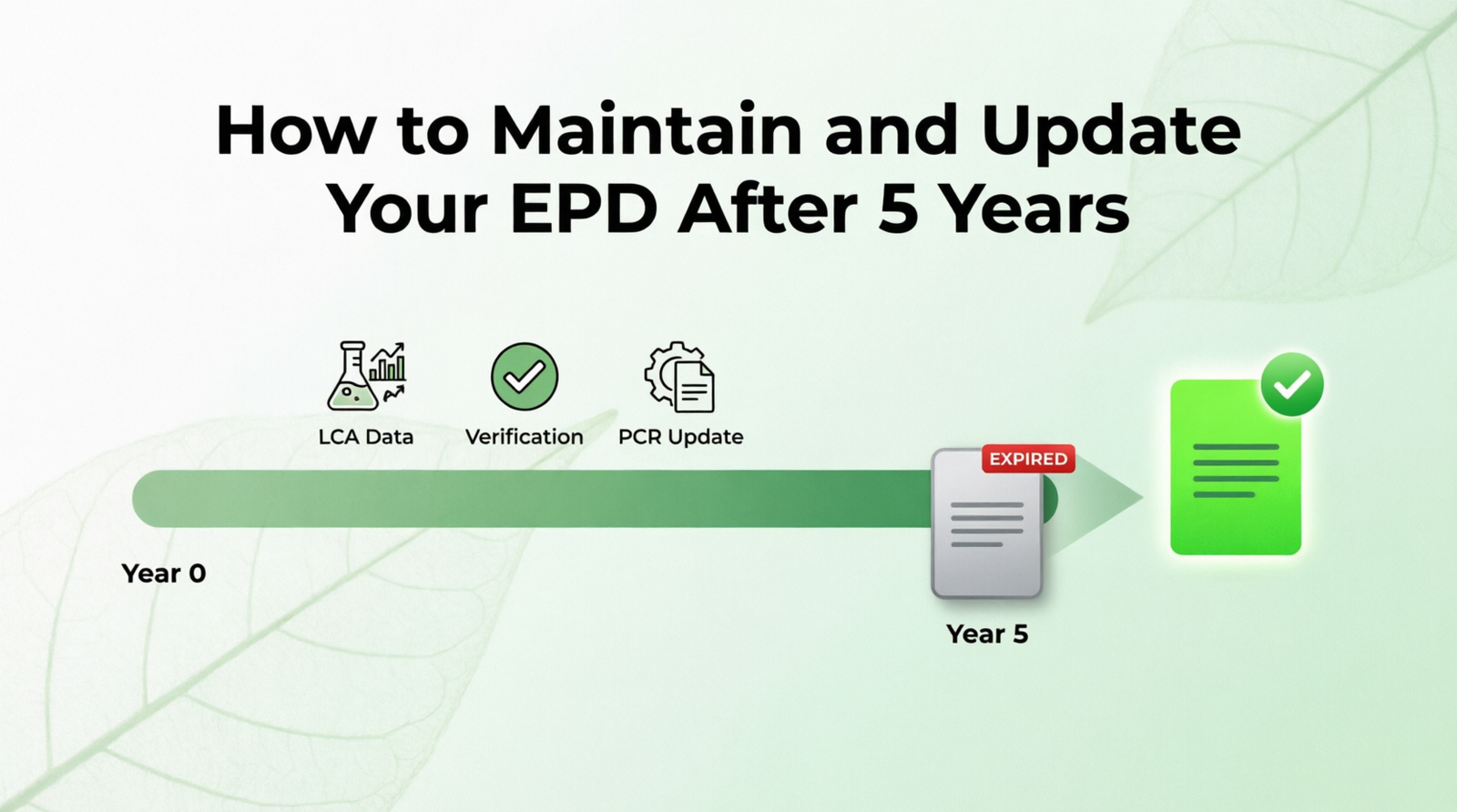
- Plan EPD renewal 6 months before 5-year expiry date
- Communicate published EPD to specification teams and clients immediately
Frequently Asked Questions
Does Envirolink handle the full EPD process in UAE?
Yes. Envirolink manages end-to-end EPD development — from scope definition and LCA through verification, registration, and publication. Manufacturers do not need to manage multiple parties separately.
Is an EPD required for all LEED project materials in UAE?
No. LEED requires a threshold of products with EPDs — not every product in the building. However, the more EPD-certified products a project uses, the easier it is to earn the MR credit. Manufacturers with EPDs get specified. Those without get replaced.
Can we get an EPD for a product we import and resell in UAE?
EPDs are typically issued to the manufacturer of the product — not the importer. If you import products, the manufacturer must develop the EPD. You can encourage your suppliers to obtain EPDs and use their published EPDs in your project submissions.
What is the difference between a product-specific EPD and an industry-wide EPD?
A product-specific EPD reflects the actual environmental impact of your specific product. An industry-wide EPD uses average data for a product category. Product-specific EPDs are more accurate and qualify for LEED Option 2 with a 1.5 credit multiplier. Industry-wide EPDs qualify for Option 1 only.
Does getting an EPD mean our product is environmentally certified?
An EPD is a transparency declaration — not a performance certification. It reports your product’s environmental impact without judging whether that impact is good or bad. However, developing an EPD often reveals improvement opportunities that manufacturers use to genuinely reduce environmental impact.
Get Your EPD Certificate in UAE
EPD certification in UAE starts with one conversation — a scope assessment to define your product, your target markets, and the fastest path to a published, LEED-ready declaration.
Envirolink provides complete EPD development and verification support for UAE manufacturers across all product categories and green building standards.
From LCA to EPD publication, the process is managed to meet LEED, Estidama, Al Sa’fat, and international procurement requirements.
Contact the team today for a free scope assessment and fixed-price quote.