Introduction
The UAE’s energy and industrial sectors are growing at an unprecedented pace. From ADNOC’s multi-billion dollar upstream expansions to ENEC’s Barakah nuclear power plant operations, one thing is becoming increasingly clear — working in hazardous areas without verified competency is no longer acceptable.
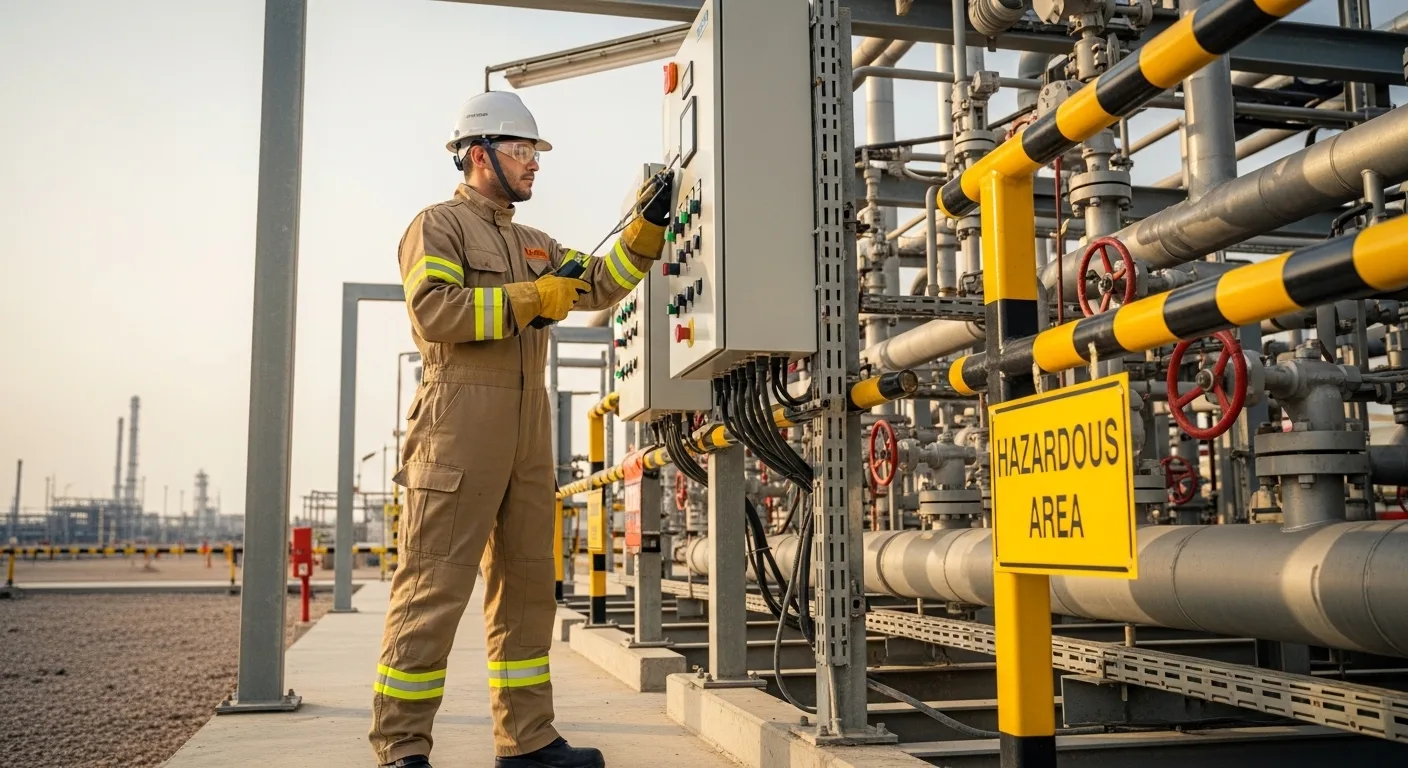
Explosive atmospheres exist wherever flammable gases, vapours, or combustible dusts are present. A single mistake in these environments — a wrongly selected cable gland, a missed inspection point, an incorrectly installed Ex-rated luminaire — can trigger catastrophic consequences. Lives, assets, and project timelines are all at stake.
This is precisely why CompEx certification in UAE has moved from a “preferred” credential to a near-mandatory requirement on major oil, gas, and energy projects across the Emirates. Whether you are an electrical engineer targeting ADNOC projects in Abu Dhabi, an instrumentation technician preparing for offshore work, or a supervisor managing hazardous area teams — CompEx is the qualification that opens doors, earns trust, and proves your competence.
This ultimate guide covers everything you need to know about CompEx certification in 2026, including modules, costs, the training process, career benefits, and how to choose the right training centre in UAE.
What Is CompEx Certification?
CompEx stands for Competency in Explosive Atmospheres. It is an internationally recognised certification scheme that validates whether a professional has the knowledge and practical skills required to safely work with electrical and mechanical equipment in potentially explosive environments.
Originally developed in the United Kingdom under the auspices of the Engineering Training Council, CompEx is now accepted globally as the benchmark standard for hazardous area competency. It is built upon the IEC 60079 series of international standards, which govern the design, installation, inspection, and maintenance of Ex-rated apparatus worldwide.
Unlike many safety certifications that focus purely on theoretical knowledge, CompEx uniquely combines classroom instruction with observed practical assessments. Candidates must demonstrate real-world competency — not just pass a written exam.
Who needs CompEx certification?
- Electrical engineers installing equipment in Zone 0, Zone 1, and Zone 2 classified areas
- Instrument engineers working with Ex-rated transmitters, analysers, and control systems
- Technicians performing inspection and maintenance of hazardous area equipment
- Supervisors responsible for authorising hazardous area work
- EHS professionals auditing Ex installations
- Project engineers overseeing hazardous area construction and commissioning
If your work involves explosive atmosphere zones in any capacity, CompEx training is the recognised path to demonstrating your competency to employers, clients, and regulators.
CompEx Modules Explained (Ex01–Ex04 and Beyond)
CompEx is structured into discrete units, each targeting a specific scope of hazardous area work. Understanding these modules helps you identify exactly which certification you need for your role.
Ex01 — Wiring Systems in Explosive Atmospheres This unit covers the selection and installation of cables, conduit systems, and wiring methods appropriate for use in hazardous areas. It addresses cable gland selection, armoured cable installation, and barrier and sealing requirements. Both theoretical knowledge and practical installation exercises are assessed.
Ex02 — Electrical Apparatus Installation Ex02 focuses on the physical installation of Ex-rated electrical equipment — motors, junction boxes, luminaires, switchgear, and control panels. Candidates must demonstrate correct equipment selection based on zone classification, temperature class, and gas group requirements.
Ex03 — Inspection of Ex Electrical Equipment This unit trains candidates to conduct initial and periodic visual, close, and detailed inspections of installed Ex equipment in accordance with IEC 60079-17. The practical assessment requires candidates to identify installed defects on a purpose-built training rig.
Ex04 — Maintenance of Ex Electrical Equipment Ex04 covers the safe maintenance, repair, and overhaul of hazardous area electrical equipment. Candidates learn how to dismantle, inspect, and reassemble Ex components without compromising their explosion protection integrity.
Ex05–Ex06 cover initial verification and periodic inspection of complete Ex electrical installations. Ex07–Ex08 address instrumentation — the installation, inspection, and maintenance of Ex-rated instruments and control equipment. Ex11–Ex12 cover mechanical Ex equipment installation and maintenance.
Training programs typically combine three to five days of structured classroom learning with hands-on practical sessions using genuine Ex-rated equipment. Passing both the written examination and the practical assessment is required for certification. For a full breakdown, refer to the CompEx certification training guide published by Extrainings.
Why CompEx Certification Is Important in UAE in 2026
The demand for CompEx-certified professionals in the UAE has never been stronger. Several converging factors are driving this:
ADNOC Projects Abu Dhabi National Oil Company continues to execute one of the world’s largest upstream and downstream expansion programmes. Projects including offshore field developments, refinery upgrades, and new gas processing facilities all involve extensive Zone 1 and Zone 2 classified areas. ADNOC’s technical personnel specifications and those of its EPC contractors — including Wood, Petrofac, Technip Energies, and McDermott — routinely list CompEx as a required competency for electrical and instrumentation roles. For details specific to Abu Dhabi, explore CompEx certification in UAE and the Abu Dhabi CompEx certification centre.
ENEC and the Nuclear Sector The Emirates Nuclear Energy Corporation operates the Barakah Nuclear Power Plant — the Arab world’s first operational nuclear facility. While nuclear environments have their own regulatory framework, many of the auxiliary systems, backup power infrastructure, and support facilities at Barakah involve hazardous area classifications. ENEC’s supply chain partners and maintenance contractors increasingly specify CompEx as a baseline competency requirement.
EPC Contractor Requirements Large international EPC contractors operating across the UAE use global competency frameworks. CompEx fits directly into these frameworks and is the credential they recognise when verifying hazardous area competency during personnel mobilisation. Without it, engineers may be refused site access on projects where CompEx is mandated — regardless of their years of experience.
Site Access and Project Eligibility On many UAE oil and gas projects, CompEx certification is checked during the personnel qualification process before site badges are issued. Holding a valid, verifiable CompEx certificate removes this barrier entirely and can mean the difference between winning a contract role and being rejected at the mobilisation stage.
Who Should Take CompEx Training?
CompEx training in UAE is relevant to a broad range of technical professionals:
- Electrical Engineers — Those involved in design review, installation supervision, commissioning, and inspection of Ex electrical systems
- Instrumentation and Control Engineers — Professionals working on Ex-rated transmitters, analysers, field instruments, and control loops in hazardous areas
- Electrical Technicians — Trade-qualified technicians performing hands-on installation, inspection, and maintenance work in Zone 0, 1, and 2 environments
- Maintenance Supervisors — Those responsible for authorising and overseeing Ex maintenance work on rotating shifts
- EHS Professionals — Safety officers conducting hazardous area audits who need to understand Ex equipment integrity standards
- Mechanical Engineers — Those working with Ex-rated mechanical equipment (pump seals, ventilation, fans) may benefit from Ex11–Ex12 units
Whether you are a senior engineer or a newly qualified technician, CompEx courses in GCC are available at various levels to match your experience and role requirements.
CompEx Certification Cost in UAE
Understanding CompEx certification cost is important before committing to a programme. Costs vary depending on several factors:
Factors That Affect CompEx Certification Cost in UAE:
- Number of units selected — Taking Ex01–Ex04 as a combined package costs more than a single unit but offers significantly better value per unit
- Training provider — Approved providers set their own pricing. Quality of instruction, equipment, and facilities justifies cost differences
- Delivery format — Open-enrollment public courses are typically priced per delegate; in-company corporate training for teams of 5+ usually attracts group discounts
- Location — Training centres in Abu Dhabi and Dubai have slightly different cost structures reflecting their respective operating environments
General Cost Range: While exact pricing should always be confirmed directly with your chosen provider, CompEx programmes in the UAE typically range from AED 4,000 to AED 9,000 or more per delegate for combined unit packages, depending on scope and duration. This cost usually includes all course materials, examination fees, practical assessment fees, and certification registration.
UAE vs Qatar Cost Comparison: CompEx certification cost in Qatar is broadly comparable to UAE pricing, though project-demand cycles and the concentration of LNG-related training requirements in Doha can occasionally influence availability and scheduling. For a detailed comparison of training fees across both markets, visit the CompEx certification UAE/Qatar training fees page.
Many professionals in the Gulf find that their employer funds CompEx training in full, particularly when the certification is a project requirement. It is always worth raising this with your company’s training or HSE department before self-funding.
CompEx Training Process: Step by Step
Here is exactly what the journey from enrolment to certification looks like:
Step 1 — Choose an Approved Training Provider Select an accredited CompEx training centre in UAE with verified approval status. Ensure the centre has proper practical training rigs with genuine Ex-rated equipment and experienced instructors.
Step 2 — Identify Your Required Units Based on your job role and the type of hazardous area work you perform, determine which CompEx units (Ex01–Ex04, Ex07–Ex08, or others) apply to you. Your training provider can advise on the right combination.
Step 3 — Attend the Training Programme Training typically spans three to five days per module combination. This includes classroom-based theory sessions covering IEC 60079 standards, protection concepts, zone classification, and documentation, followed by practical workshop sessions.
Step 4 — Sit the Written Examination At the end of the theory component, candidates complete a written examination. This covers knowledge of Ex protection principles, equipment selection, inspection criteria, and standards requirements.
Step 5 — Complete the Practical Assessment A certified CompEx assessor observes each candidate performing designated practical tasks — such as inspecting an Ex installation on a training rig and identifying defects. This is the component that makes CompEx a true competency certification.
Step 6 — Receive Your Certificate Successful candidates receive their CompEx certificate and are registered on the official CompEx online verification database. Employers globally can verify your certification status in real time.
For a comprehensive walkthrough, the CompEx exam in GCC guide is a valuable resource.
Certificate validity: 5 years from the date of successful assessment.
CompEx Certification vs IECEx: Key Differences
A common question among engineers in the UAE is whether to pursue CompEx or IECEx certification. While both relate to explosive atmosphere competency, they serve different purposes.
| CompEx | IECEx | |
|---|---|---|
| Scope | Personnel competency assessment | Equipment certification + personnel scheme |
| Origin | UK (global recognition) | International Electrotechnical Commission |
| Focus | Installation, inspection, maintenance skills | Broader competency including design |
| Practical assessment | Mandatory | Mandatory |
| GCC recognition | Very high — preferred by EPC contractors | Growing but less widespread in Gulf |
| Typical use case | Site-based engineers and technicians | Senior engineers, certification bodies |
In most UAE and Qatar project environments, CompEx is the more practical and immediately recognised credential for site-based engineering and technical roles. IECEx CoPC (Certificate of Personnel Competence) is valued for higher-level roles and design-focused positions. Many senior professionals hold both.
For a detailed side-by-side analysis, read the CompEx vs IECEx differences guide.
Career Benefits of CompEx Certification
The career return on CompEx investment is substantial and measurable:
Salary Premium CompEx-certified electrical engineers in the UAE and Qatar regularly earn 10–20% more than uncertified peers in equivalent roles. On major oil and gas projects where Ex competency is scarce, certified professionals command premium day rates.
Expanded Job Opportunities in GCC CompEx opens access to roles that are explicitly closed to uncertified candidates. ADNOC, QatarEnergy, and their EPC partners frequently filter CVs at the screening stage based on CompEx status. Certification removes this filter entirely and puts you in a much smaller, more competitive pool of qualified candidates.
Project Eligibility Many major GCC projects require CompEx as a condition of personnel mobilisation approval. Without it, even experienced engineers can be rejected at the gate. With it, you are immediately deployable to the Gulf’s highest-value projects.
Professional Credibility CompEx is verifiable by any employer worldwide via the online database. It signals a verified, assessed level of competency — not just claimed experience. This builds credibility with clients, supervisors, and project management teams.
For a full analysis of career progression pathways, read the CompEx certification career scope and benefits guide.
How to Choose the Right CompEx Training Centre in UAE
Not all training centres are equal. When evaluating options for CompEx training in UAE, apply these criteria:
Accreditation Status The training centre must be an officially approved CompEx training and assessment centre. Ask for their approval documentation and verify it independently.
Practical Lab Facilities CompEx requires hands-on training with real Ex-rated equipment — junction boxes, cable glands, motors, instruments. Visit the facility or ask for photos. A centre without a proper practical training rig cannot deliver assessment-standard training.
Trainer Experience Instructors should have real field experience in hazardous area environments — not just academic knowledge of the standards. Ask about your trainer’s industry background before enrolling.
First-Attempt Pass Rates A quality provider should be able to share pass rate data. Consistently high first-attempt pass rates indicate effective teaching, not easy assessments.
Flexibility and Scheduling Providers offering multiple course dates per year, corporate group bookings, and the option for on-site delivery serve the Gulf market’s project-driven scheduling demands far better than those with rigid fixed calendars.
CompEx Certification Renewal
CompEx certificates are valid for five years from the date of successful assessment. As expiry approaches, certified professionals must complete a refresher programme — often referred to as the RPP (Refresher/Re-assessment Programme) — and undergo re-assessment to renew their certification.
Given how frequently UAE project contracts specify CompEx, allowing your certificate to lapse creates unnecessary career risk. Setting a renewal reminder at the four-year mark gives you ample time to schedule refresher training without a gap in certification status.
For everything you need to know about timing and the renewal process, visit the CompEx certification renewal guide.
Conclusion: Your Next Step Toward CompEx Certification in UAE
The UAE’s energy sector is operating at a scale and pace that demands verified, proven competency — not just years of experience. As ADNOC’s expansion programmes advance and ENEC’s operations mature, the demand for CompEx-certified electrical engineers, instrumentation professionals, and technicians will only intensify through 2026 and beyond.
CompEx certification in UAE is not just a career investment — it is increasingly a baseline requirement for accessing the Gulf’s most rewarding and highest-paying project roles. The combination of internationally recognised standards, practical assessment rigour, and employer-verified credibility makes it the single most impactful credential an electrical or instrumentation professional can hold in this market.
Extrainings is a trusted, approved CompEx training provider serving UAE and Qatar, with experienced instructors, fully equipped practical training facilities, and a track record of preparing Gulf-based professionals for successful certification.
Ready to take the next step? Contact Extrainings today to discuss your CompEx training requirements, confirm your required units, and book your place on the next available course in UAE.
👉 View CompEx training programmes at Extrainings
Frequently Asked Questions (FAQs)
Q1: What is CompEx certification and who needs it in UAE? CompEx certification validates that a professional has the knowledge and practical skills to work safely in potentially explosive atmospheres. In UAE, it is required or strongly preferred for electrical engineers, instrumentation technicians, and maintenance professionals working on ADNOC projects, EPC contractor sites, and energy facilities operating in classified hazardous zones.
Q2: How much does CompEx certification cost in UAE? CompEx certification cost in UAE typically ranges from AED 4,000 to AED 9,000 or more per delegate, depending on the number of units selected, the training provider, and whether it is open-enrollment or corporate group training. The fee generally includes all course materials, examination, practical assessment, and certificate registration. For accurate pricing, contact Extrainings directly or visit the training fees page.
Q3: How long is CompEx certification valid? CompEx certification is valid for five years from the date of your successful assessment. After five years, you must complete a refresher programme and re-assessment to renew your certification and remain eligible for UAE and GCC project roles.
Q4: Am I eligible for CompEx training if I am not a qualified electrician? CompEx is a competency assessment scheme, not a trade training programme. Most providers recommend candidates have a recognised electrical, instrumentation, or mechanical trade qualification and a minimum of two years of relevant industry experience. However, eligibility can vary by unit — speak to Extrainings’ training advisors to confirm your suitability before enrolling.
Q5: Is CompEx accepted in Qatar as well as UAE? Yes. CompEx certification is recognised and widely accepted across the GCC, including Qatar. QatarEnergy’s EPC contractors and Ras Laffan Industrial City operators accept CompEx as the verified hazardous area competency credential for electrical and instrumentation roles. The same certificate earned in UAE is valid for Qatar projects and vice versa.
Q6: What is the difference between CompEx and IECEx certification? CompEx focuses specifically on personnel competency for installation, inspection, and maintenance tasks in explosive atmosphere environments. IECEx CoPC (Certificate of Personnel Competence) covers a broader scope including equipment design and is issued directly under the International Electrotechnical Commission framework. For site-based engineers and technicians in UAE, CompEx is the more widely recognised and immediately applicable credential. Read the CompEx vs IECEx guide for a full comparison.
Q7: Can my employer fund my CompEx training in UAE? Yes — many employers in the UAE’s oil, gas, and energy sectors fund CompEx training for their technical personnel, particularly when it is a project or contract requirement. If your role involves hazardous area work, it is worth discussing with your company’s training or HSE department. Extrainings also offers corporate group training packages at competitive rates for companies enrolling multiple employees.
Published by Extrainings | Approved CompEx Training Provider — UAE & Qatar For course bookings and enquiries: extrainings.com