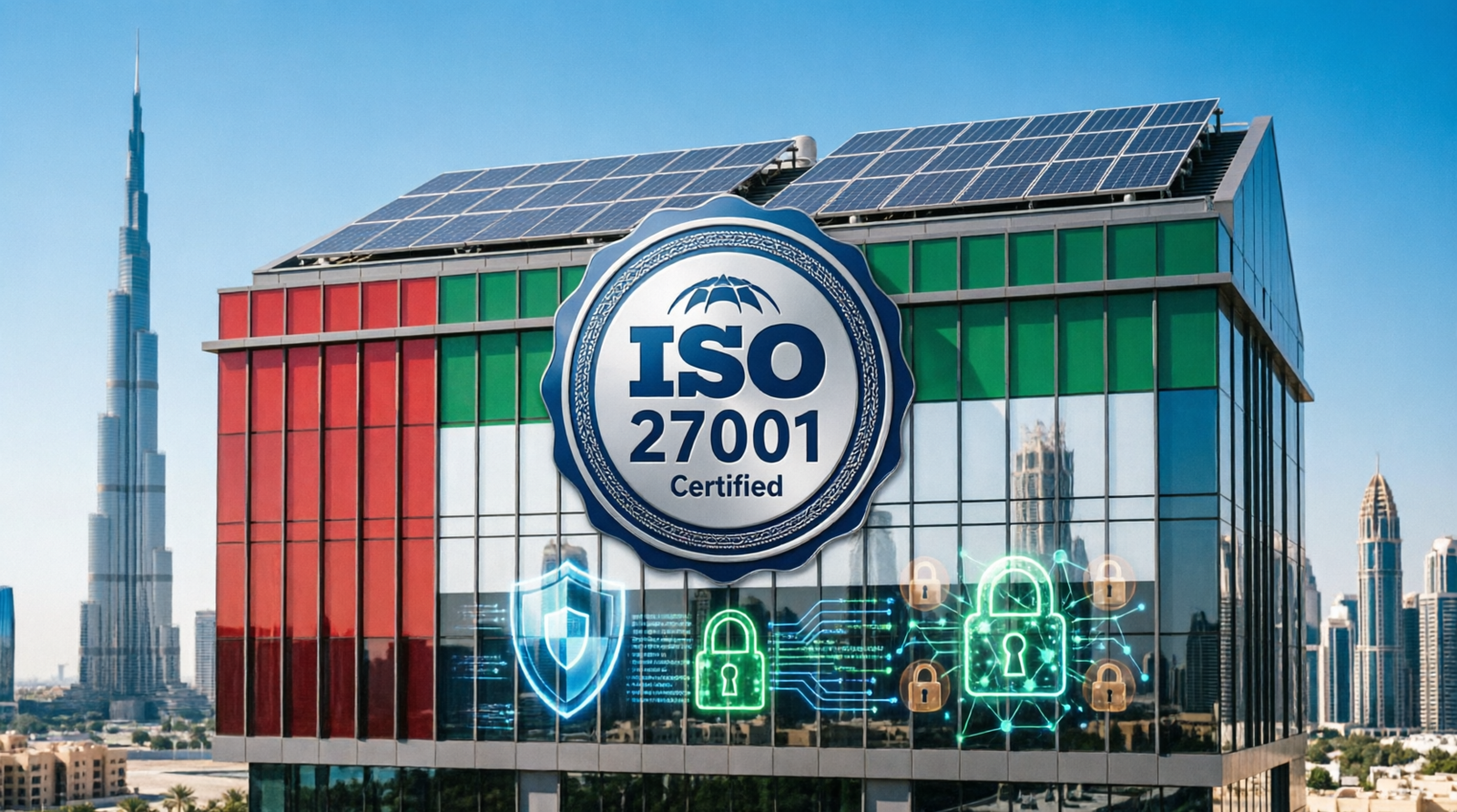
ISO 27001 certification in UAE helps businesses protect sensitive data through a structured security management system. It’s the global standard for information security management. Companies handling client data, financial records, or cloud services need this certification most.
If you’re searching for ISO 27001 certification cost in UAE or wondering how it applies to your industry, this guide breaks it down step by step.
UAE clients and regulators increasingly expect proof of data protection. ISO 27001 gives you that proof through an internationally recognized framework.
What Is ISO 27001 Certification?
ISO 27001 is the international standard for information security management systems, often shortened to ISMS. It helps businesses protect data from breaches, leaks, and unauthorized access.
The standard helps companies:
- Identify information security risks across operations
- Protect customer and company data from breaches
- Meet client and regulatory data protection expectations
- Build a culture where security is part of daily work
A certified business shows it actively manages information risk, not just reacts after an incident.
Why UAE Businesses Need ISO 27001 Certification
The UAE has pushed strict data protection rules across sectors, especially in finance, healthcare, and technology. ISO 27001 helps businesses align with these expectations.
Client Trust and Contract Requirements
Many corporate clients, especially in banking, government, and IT services, require ISO 27001 certified vendors before sharing sensitive data or signing contracts.
Reduced Breach Risk
A structured ISMS identifies vulnerabilities before they become incidents. This means fewer data breaches and less downtime from security events.
Regulatory Alignment
UAE data protection regulations expect businesses to handle personal and financial data responsibly. ISO 27001 provides a framework that supports compliance.
Competitive Advantage
When competing for IT, finance, or outsourcing contracts, certified businesses stand out from competitors without formal security systems.
Easier Integration with Other Standards
ISO 27001 pairs naturally with ISO 9001 for quality and ISO 22301 for business continuity, allowing businesses to build a broader risk management framework.
ISO 27001 Certification Process in UAE
The certification process follows a clear path. Here’s how it works.
Step 1: Initial Security Assessment
A consultant reviews your current data handling practices. They identify where sensitive information is stored, processed, and shared.
Step 2: Risk Assessment
Every information asset gets reviewed for security risks. This includes servers, employee devices, cloud storage, and third-party access.
Step 3: Documentation Development
You’ll create a security policy, access control procedures, incident response plans, and risk treatment records. These must reflect your actual systems and workflows.
Step 4: Staff Training
Employees learn security practices like password management, phishing awareness, and data handling rules.
Step 5: Implementation Period
Run the new security controls for a few weeks. This generates records that prove the system works in daily operations.
Step 6: Internal Audit
Before the external audit, your team checks compliance internally. This catches gaps early and saves time later.
Step 7: Certification Audit
An accredited certification body audits your systems. They review documents, test controls, and interview staff about security procedures.
Step 8: Certificate Issuance
Once you pass, you receive your ISO 27001 certificate, valid for three years with annual surveillance audits.
ISO 27001 Certification Cost in UAE
Cost depends on several factors specific to your operations.
Key cost factors include:
- Number of employees and IT systems involved
- Complexity of data flows (cloud services, third-party integrations)
- Current state of existing security controls
- Whether external consultants are needed
- Certification body audit fees
Businesses with complex IT environments, multiple cloud providers, or remote teams typically need more preparation time than businesses with simple, on-premise systems. Always request a detailed quote separating consultant fees from certification body charges.
Industries That Benefit Most from ISO 27001 in UAE
While any business handling data can pursue certification, some sectors see faster returns due to higher data sensitivity.
IT and Technology Companies
Software providers, IT service companies, and managed service providers handle large volumes of client data. Certification reassures clients about data handling practices.
Financial Services
Banks, insurance companies, and fintech firms face strict data protection expectations from regulators and clients alike.
Healthcare and Medical Device Companies
Patient data requires careful handling. See our ISO certification for medical devices guide for related sector requirements.
Cloud Service Providers
Businesses storing client data in the cloud should also consider ISO 27018 certification, which focuses specifically on protecting personal data in cloud environments.
Education Sector
Schools and training centers handle student records and payment data. Check ISO certification for the education sector for related requirements.
ISO 27001 vs Related Standards: Quick Comparison
Many UAE businesses pursue more than one standard together. Here’s how ISO 27001 fits.
| Standard | Focus Area | Common Pairing |
|---|---|---|
| ISO 27001 | Information security management | IT, finance, healthcare |
| ISO 27018 | Cloud data privacy | Cloud service providers |
| ISO 9001 | Quality management | Almost any business |
| ISO 22000 | Food safety management | Food and hospitality |
Businesses handling both quality processes and sensitive data often pair ISO 27001 with ISO 9001 certification for a combined audit approach. For a full breakdown of available standards, see our ISO certification in UAE overview.
Common Mistakes Businesses Make with ISO 27001
Avoid these pitfalls to keep your certification process smooth.
Mistake 1: Focusing Only on IT Systems
Information security covers more than servers and software. Physical access, paper records, and employee behavior all count.
Mistake 2: Writing Policies Without Technical Input
Procedures written without IT team input often miss practical realities, like how data actually flows between systems and third parties.
Mistake 3: Ignoring Third-Party Risk
If vendors or contractors access your systems, their security practices affect your certification. Include them in your risk assessments.
Mistake 4: Treating Certification as a One-Time Project
Information security requires ongoing monitoring. Surveillance audits check whether controls continue working after the initial certificate.
Mistake 5: Choosing an Unaccredited Certification Body
Always confirm accreditation. Corporate clients and tenders across the UAE may reject certificates from unaccredited bodies.
Real Example: A UAE IT Services Company
An IT services company in the UAE kept losing enterprise clients during procurement reviews. Their security practices were reasonable, but undocumented and inconsistent across teams.
After implementing ISO 27001, they introduced formal access controls, encrypted client data storage, and a clear incident response plan. Within a few months, they passed security reviews for two new enterprise clients that had previously rejected their proposals.
Their internal team also reported faster onboarding for new staff, since security procedures were now written down and consistently applied.
ISO 27001 Across the UAE
ISO 27001 requirements apply consistently across the UAE, though specific sectors like finance and healthcare may face additional regulatory expectations. If your operations span multiple locations, check our emirate-specific guides for broader context:
- ISO certification in Dubai
- ISO certification in Sharjah
- ISO certification in Ajman
- ISO certification in Ras Al Khaimah
For a complete overview of ISO standards and the certification process across the country, visit our main ISO certification in UAE guide.
Frequently Asked Questions
How long does ISO 27001 certification take in UAE?
Most businesses complete certification in 8 to 12 weeks, depending on the complexity of IT systems and number of locations.
Is ISO 27001 mandatory for UAE businesses?
It’s not a blanket legal requirement. However, many enterprise clients, especially in finance and government sectors, require certified vendors.
Can ISO 27001 be combined with other certifications?
Yes. Many businesses combine ISO 27001 with ISO 9001 or ISO 27018 through an integrated approach, reducing audit costs and time.
What does the risk assessment involve?
It involves identifying information assets, evaluating threats and vulnerabilities, and deciding how each risk will be treated, reduced, or accepted.
Do small businesses need ISO 27001?
Smaller businesses handling limited data may not need it urgently. However, any business storing client information, financial records, or operating in the cloud benefits from the structure it provides.
Choosing an ISO 27001 Consultant in UAE
Look for these qualities when selecting a consultant for information security certification.
- Experience with your specific industry’s data handling practices
- Technical knowledge of cloud, network, and access control systems
- Clear, written pricing without hidden costs
- Support for integrating ISO 27001 with other standards
- Ongoing assistance for surveillance audits and incident response planning
A strong consultant builds a security system your team can maintain daily, not just a file of documents for audit day.
Final Thoughts
ISO 27001 certification in UAE reduces data breach risk, builds client trust, and opens doors to contracts that require certified vendors. The process takes weeks, not months, and works best when security practices become part of daily operations, not just a compliance exercise.
For a broader view of ISO standards available across the country, explore our complete ISO certification in UAE guide.
Visit Global Certification Services to discuss your certification needs and get a tailored quote.