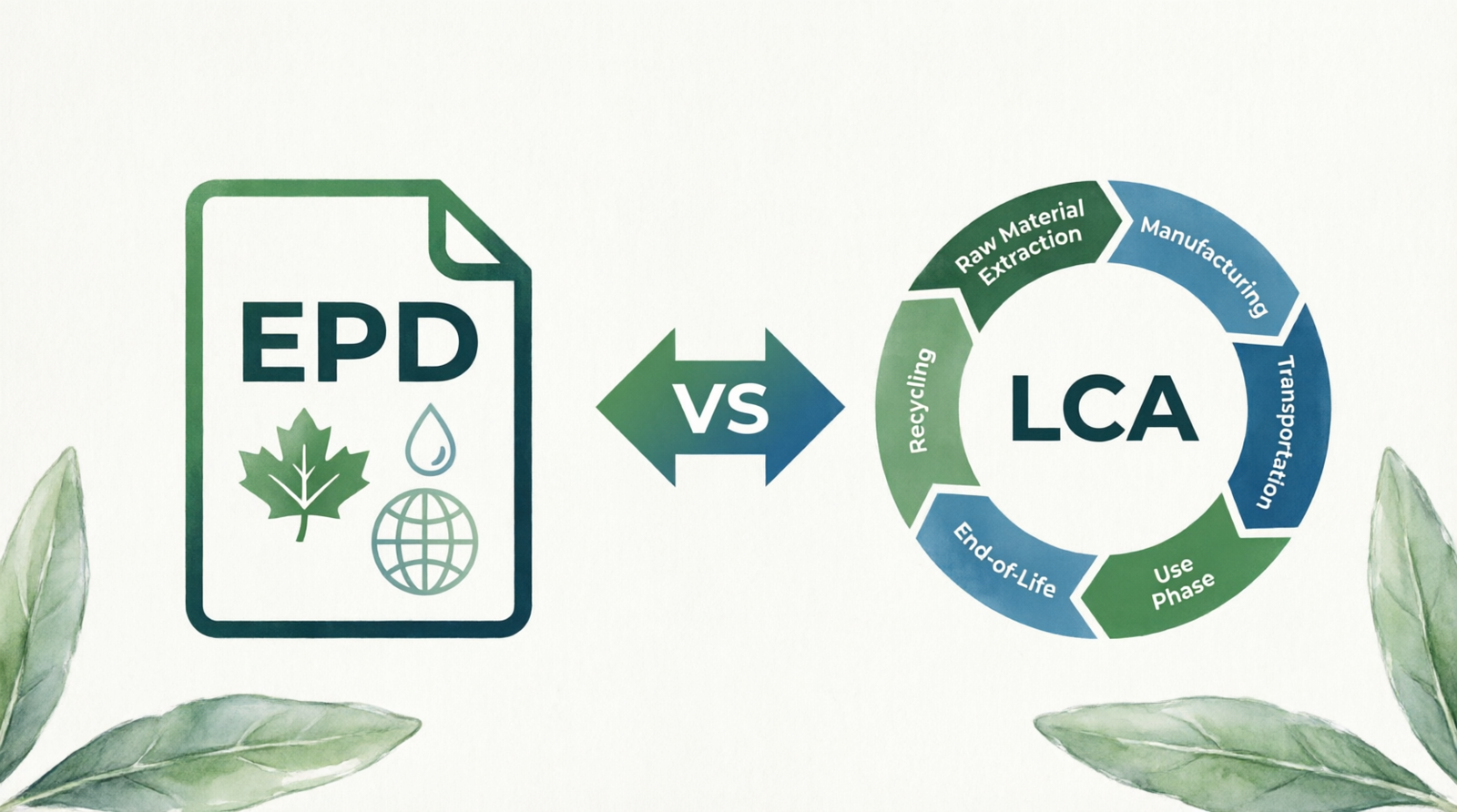
An LCA measures environmental impact. An EPD publishes it.
That is the core difference. But the two are deeply connected. You cannot have a credible EPD without a completed LCA. And an LCA alone does not give you a verified, market-ready declaration.
Here is exactly how they differ — and why both matter for your business.
What Is an LCA?
A Life Cycle Assessment (LCA) is a technical study. It calculates the environmental impact of a product across its entire life — from raw material extraction to disposal.
LCA follows ISO 14040 and ISO 14044. It covers:
- Raw material sourcing
- Manufacturing and processing
- Transport and distribution
- Product use and maintenance
- End-of-life disposal or recycling
The output is a set of environmental indicators. These include carbon emissions, water use, energy consumption, and more.
An LCA is an internal technical document. It is not automatically verified or publicly available.
What Is an EPD?
An Environmental Product Declaration (EPD) is a verified, published document. It takes the data from an LCA and presents it in a standardised, third-party verified format.
EPDs follow ISO 14025. They are registered with a programme operator — such as EPD International, NSF, or IBU. Once published, they are publicly accessible.
Learn what an EPD is and why it matters
An EPD is the document your clients, architects, and project teams actually ask for. The LCA is the study that makes the EPD possible.
EPD vs LCA: Side-by-Side Comparison
| Feature | LCA | EPD |
|---|---|---|
| What it is | Environmental impact study | Verified public declaration |
| Standard | ISO 14040 / ISO 14044 | ISO 14025 / EN 15804 |
| Third-party verified | Not required | Mandatory |
| Publicly available | No | Yes |
| Used for | Internal analysis, EPD input | LEED, Estidama, procurement |
| Validity period | No expiry | 5 years |
| Output | Technical report | Standardised declaration document |
Why the Difference Matters for Manufacturers
A manufacturer once said: “We did an LCA two years ago. Isn’t that enough?”
It is not.
An LCA gives you data. An EPD gives you credibility. Project teams and procurement officers cannot use an internal LCA report to earn LEED credits. They need a registered, verified EPD.
Here is a practical example. A paint manufacturer in Dubai completes an LCA for their product line. The study shows low carbon emissions. But without an EPD, no LEED project can count that product toward their MR credit. The LCA data stays locked in a PDF on someone’s hard drive.
Turn it into an EPD — and that same data earns you project specifications across the UAE and Saudi Arabia.
See how EPDs connect directly to LEED certification
Can You Have an LCA Without an EPD?
Yes. Many companies conduct LCAs for internal purposes — carbon footprint tracking, product improvement, supplier benchmarking.
That is completely valid. But it does not replace an EPD for external use.
Reasons to do an LCA without an EPD:
- Internal sustainability reporting
- Identifying high-impact stages in your supply chain
- Preparing for future EPD development
- Meeting corporate ESG targets
When you need to go further and get an EPD:
- Supplying to LEED or Estidama projects
- Responding to green procurement tenders
- Exporting to Europe, the US, or Australia
- Making verified environmental claims publicly
Can You Have an EPD Without an LCA?
No. An EPD always requires a completed LCA as its foundation.
The LCA provides the data. The EPD formats, verifies, and publishes it. One cannot exist without the other.
This is why the EPD process always begins with LCA data collection. That is usually the longest and most intensive part of the project.
Understand the full EPD development and verification process
What Does an LCA Actually Measure?
An LCA measures impact across several environmental categories. These are called impact indicators.
Common LCA indicators:
- GWP — Global Warming Potential (carbon emissions, CO₂e)
- ODP — Ozone Depletion Potential
- AP — Acidification Potential
- EP — Eutrophication Potential
- POCP — Photochemical Ozone Creation Potential
- ADPE — Abiotic Depletion of Elements
- ADPF — Abiotic Depletion of Fossil Fuels
GWP is the most referenced. It directly reflects your product’s carbon footprint.
What System Boundary Does Each Use?
System boundary defines which stages of the lifecycle are included in the study.
Common system boundaries:
- Cradle to gate — raw material extraction to factory gate
- Cradle to grave — full lifecycle including use and disposal
- Cradle to cradle — includes recycling and recovery
Most EPDs for construction products use cradle to gate with additional modules. The chosen boundary must match the Product Category Rule (PCR) for your product type.
See how this applies to construction materials specifically
How Long Does Each Take?
| Stage | Typical Duration |
|---|---|
| LCA data collection | 4 – 8 weeks |
| LCA modelling and report | 4 – 8 weeks |
| EPD drafting | 2 – 4 weeks |
| Third-party verification | 3 – 6 weeks |
| Programme registration | 1 – 3 weeks |
| Total (EPD) | 3 – 6 months |
The LCA stage is usually the bottleneck. Manufacturers with strong data systems move faster. Those without structured production data take longer.
What Does Each Cost?
The LCA is the largest cost in the EPD process. Here is a realistic breakdown:
| Component | Estimated Cost (USD) |
|---|---|
| LCA study | $3,000 – $8,000 |
| EPD drafting | $1,500 – $3,000 |
| Third-party verification | $1,500 – $3,500 |
| Programme registration | $500 – $1,500 |
If you already have a completed LCA, your EPD cost drops significantly. The LCA does not need to be redone — it just needs to be current and aligned with the relevant PCR.
Full cost breakdown for EPD in the UAE
LCA Types Used in EPDs
Not all LCAs are the same. EPDs can be based on different LCA types:
Product-specific LCA
Uses actual production data from your facility. Most accurate. Required for product-specific EPDs.
Industry-average LCA
Based on sector-wide data. Used for industry-average EPDs. Less precise but faster and cheaper.
Facility-specific LCA
Uses data from a specific manufacturing site. Useful when one site produces multiple product lines.
For manufacturers in the UAE and GCC, a product-specific EPD based on a facility-specific LCA is usually the best route. It gives you verified, accurate data — and the strongest market position.
Read the full EPD guide for UAE and GCC manufacturers
Which Do You Actually Need?
Here is a simple decision framework:
You need an LCA if:
- You want to understand your product’s environmental footprint
- You are preparing for ESG reporting
- You plan to develop an EPD in the future
You need an EPD if:
- Your clients require it for LEED or Estidama projects
- You are bidding on government or infrastructure tenders
- You export to markets that mandate environmental declarations
- You want a verified, public sustainability claim
You need both if:
- You want the full picture — internal insight and external credibility
Most serious manufacturers in construction and building materials need both. The LCA gives you internal understanding. The EPD gives you market access.
A Real-World Scenario
A flooring manufacturer in Sharjah wanted to supply a major hospitality project in Abu Dhabi. The project was targeting LEED Gold. The specification called for EPD-compliant products.
The manufacturer had conducted an internal sustainability review two years earlier. But it was not a formal LCA. And there was no EPD.
They had three options:
- Lose the bid
- Rush an LCA and hope for a shortcut
- Engage a consultant, complete the LCA properly, and develop the EPD
They chose option three. The process took four months. They missed that project. But they won the next two — because the EPD was now registered and ready.
See how EPD works for flooring manufacturers
Common Misconceptions
“Our sustainability report is the same as an LCA.”
No. A sustainability report is self-declared. An LCA follows ISO methodology and quantifies specific environmental indicators.
“An LCA is enough for LEED.”
No. LEED requires a registered, third-party verified EPD — not an internal LCA report.
“EPDs are only for large companies.”
Wrong. Small and mid-size manufacturers across the GCC are completing EPDs. Size is not the barrier — data availability is.
“Once we have an EPD, we never need to redo the LCA.”
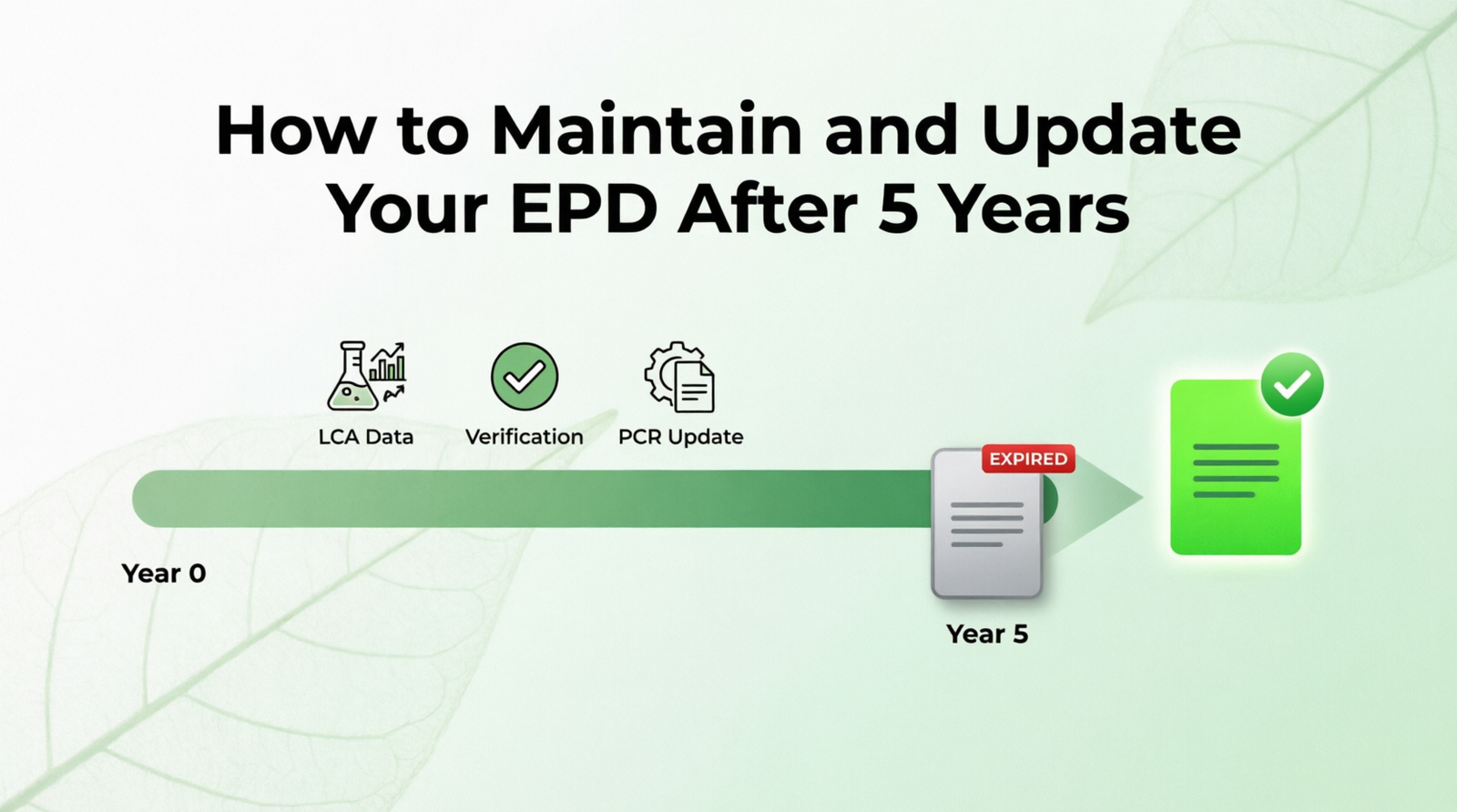
Incorrect. EPDs are valid for 5 years. After that, the LCA data must be updated and the EPD re-verified.
The Bottom Line
LCA and EPD are not competitors. They are sequential steps in the same process.
Start with the LCA. Build on it with an EPD. The EPD is what opens doors — to projects, markets, and procurement lists that your competitors without one simply cannot access.