Introduction
You work near flammable gas, vapour, or combustible dust. One wrong spark ends a career — or a life.
That is why global operators no longer accept “experience” alone. They want proof.
IECEx Certification is that proof. It is the internationally recognized system that confirms equipment and personnel meet strict safety standards for hazardous areas.
If you are an engineer, technician, or safety officer working in oil and gas, petrochemicals, or manufacturing, this guide explains exactly what IECEx Certification means, who needs it, how the process works, and how to get started with proper IECEx Training.
What Is IECEx Certification?
IECEx Certification is a global scheme, managed by the International Electrotechnical Commission, that certifies equipment and personnel for safe use in explosive atmospheres. It confirms compliance with IEC 60079 standards, covering electrical equipment, installation practices, and individual competence in hazardous locations.
The IECEx System has three main certification schemes:
- Equipment Certification (IECEx 02): Confirms Ex-rated equipment is safe for use in hazardous areas.
- Certified Facilities Scheme: Confirms a repair or manufacturing facility follows approved quality processes.
- Certification of Personnel Competence, or CoPC (IECEx 05): Confirms an individual has the knowledge and practical skill to work safely with Ex equipment.
This guide focuses mainly on personnel certification, since that is what most engineers and technicians need before they can legally work on hazardous sites.
The scheme was created because national certifications did not always transfer between countries. A technician certified in one country often had to repeat testing elsewhere. IECEx solved this by creating one accepted standard, recognized in more than 30 countries.
Why IECEx Certification Is Important
IECEx Certification matters because it reduces the risk of explosions caused by faulty equipment or under-qualified personnel. It gives employers, regulators, and insurers a documented, third-party guarantee that a person or product meets international safety requirements — not just a company’s internal training record.
A few reasons this certification carries real weight on site:
- It is independently verified. Only approved IECEx Certification Bodies (ExCBs) can issue certificates, and only after a formal assessment.
- It standardizes competence globally. A certified person in Dubai meets the same bar as one certified in Houston or Perth.
- It supports legal and contractual compliance. Many operators, including major GCC energy companies, now write IECEx requirements directly into contractor safety policies.
- It reduces insurance and audit friction. Auditors accept IECEx credentials as evidence of due diligence.
Training alone is not enough. As the IECEx Secretariat notes, completing a training course does not guarantee competence — only a passed assessment against IECEx OD 503 does. This is why structured IECEx Training followed by formal assessment is the path that actually counts toward certification.
Who Needs IECEx Certification?
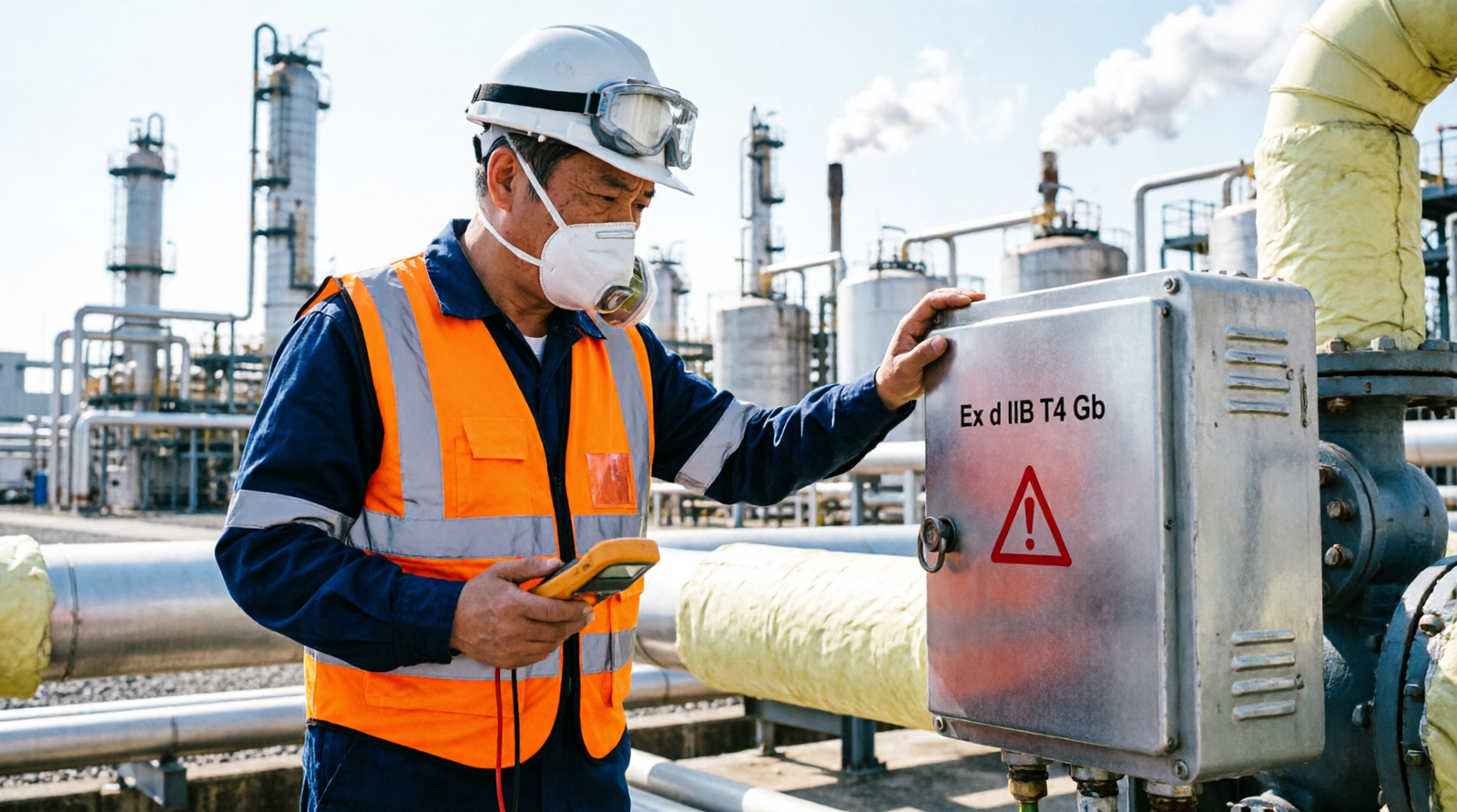
Anyone who designs, installs, inspects, maintains, or repairs electrical equipment in explosive atmospheres typically needs IECEx Certification. This includes electrical engineers, instrumentation technicians, maintenance staff, inspectors, and safety officers working in classified hazardous zones.
Roles that commonly require it:
- Electrical and instrumentation engineers
- Maintenance and repair technicians
- Hazardous area inspectors and auditors
- Design engineers specifying Ex equipment
- HSE and safety officers overseeing Ex-rated sites
- Contractors bidding on hazardous-area projects
Industries where this certification is now close to mandatory:
- Oil and gas — onshore and offshore production, refining
- Petrochemical plants — processing, storage, pipeline operations
- Manufacturing facilities — anywhere flammable dust or vapour is present
- Electrical engineering and EPC contractors — design and installation firms
- Mining operations — coal and other combustible-dust environments
This is especially relevant across the UAE, Saudi Arabia, Qatar, and the wider GCC, where national operators such as ADNOC, Saudi Aramco, and QatarEnergy increasingly reference IECEx competence requirements in contractor safety systems. The same pattern holds in Singapore, a major refining and petrochemical hub where IECEx-certified personnel are standard on hazardous-area projects.
IECEx Certification Process: Step-by-Step
The IECEx certification process involves choosing the right competence unit, completing preparatory training, undergoing assessment by an approved Certification Body, and receiving a certificate published on the IECEx online register. The full process typically takes a few weeks, depending on the units selected.
Here is how it works in practice:
- Identify the right Unit of Competence. IECEx CoPC covers work functions such as installation, inspection, maintenance, and design — you choose the unit that matches your role.
- Complete preparatory IECEx Training. A Recognized Training Provider (RTP) delivers a course covering IEC 60079 standards, equipment protection concepts, and site practices.
- Apply through an approved ExCB. You submit an application and evidence of relevant work experience — most units require around three years in hazardous areas.
- Sit the theoretical exam. A written assessment tests your knowledge of standards and protection principles.
- Complete the practical assessment. You demonstrate hands-on competence, often at the Certification Body’s assessment centre.
- Receive your Personnel Competence Assessment Report (PCAR). The ExCB confirms you passed both components.
- Get certified and published. Your Certificate of Personnel Competence is issued and listed on the public IECEx online register for verification.
Checklist: Are You Ready to Apply?
- You have identified the correct competence unit for your role
- You have at least 3 years of relevant hazardous area experience (unit-dependent)
- You have completed structured IECEx Training with an approved provider
- You have your CV and experience evidence ready for the application
- You have selected an approved IECEx Certification Body (ExCB)
- You have budgeted for exam and assessment fees
IECEx Training Requirements
IECEx does not formally require training before certification, but nearly every candidate needs it in practice, since the theoretical and practical exams are demanding. Recognized Training Providers prepare candidates for both the knowledge exam and the hands-on assessment.
A solid IECEx Training course typically covers:
- Fundamentals of explosive atmospheres and ignition risk
- Equipment protection concepts (flameproof, intrinsic safety, increased safety, and others)
- Zone classification under IEC 60079-10
- Installation requirements under IEC 60079-14
- Inspection and maintenance requirements under IEC 60079-17
- Repair and overhaul principles under IEC 60079-19
Most candidates start with the foundational unit before moving into role-specific units for installation, inspection, maintenance, or design work.
IECEx CoPC Certification Explained
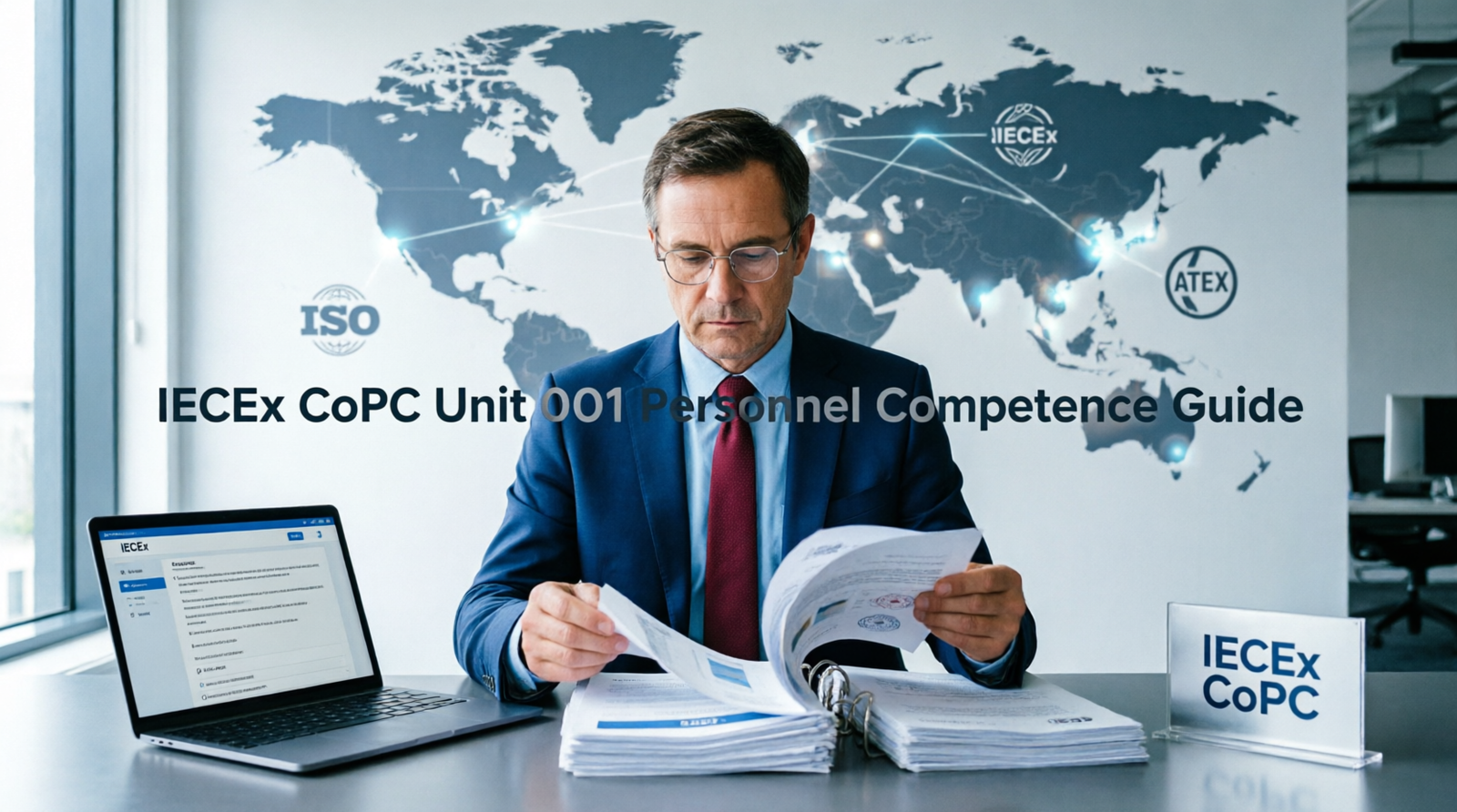
IECEx CoPC, or Certificate of Personnel Competence, is the personnel branch of the IECEx System that certifies an individual’s competence to work safely in hazardous areas. It is issued only by approved Certification Bodies after both a written exam and a practical assessment are successfully completed.
Key facts about CoPC:
- It uses a modular unit system — you certify only in the units relevant to your job, from basic site awareness through to design and repair.
- Certificates are typically valid for five years, after which re-assessment is required.
- Every certificate is published on the public IECEx register, so employers can verify it instantly.
- It is internationally portable — a CoPC earned in one IECEx member country is recognized in all others.
CoPC is often compared with regional schemes like CompEx. The core difference is scope: CompEx is widely used in specific markets and leans practical, while IECEx CoPC is globally recognized, standards-driven, and built for professionals working across borders.
Benefits of IECEx Certification
- Global career mobility — one credential accepted across 30+ countries
- Higher employability — many GCC and international operators shortlist certified candidates first
- Reduced site risk — certified personnel are demonstrably competent to handle Ex equipment
- Stronger audit and compliance position for both individuals and employers
- Public verifiability — certificates can be checked instantly on the IECEx register, building trust with clients and regulators
IECEx Certification vs Other Explosion Protection Certifications
| Feature | IECEx | ATEX | CompEx |
|---|---|---|---|
| Governing body | IEC (international) | European Union | National (varies by region) |
| Geographic recognition | 30+ countries globally | EU/EEA primarily | Mainly UK and select markets |
| Covers equipment | Yes | Yes | No (personnel-focused) |
| Covers personnel (CoPC) | Yes | No formal scheme | Yes |
| Validity period | 5 years (personnel) | Ongoing, product-based | 3 years (personnel) |
| Best suited for | International, multi-region careers and projects | EU market equipment compliance | UK-centric hazardous area roles |
For engineers targeting GCC, Asian, or global projects, IECEx Certification generally offers the broadest recognition.
Common IECEx Certification Mistakes
- Skipping proper training and going straight to the exam. Passing rates drop sharply without structured preparation.
- Choosing the wrong competence unit. Applying for a unit that doesn’t match your actual job function wastes time and money.
- Underestimating the practical assessment. Candidates often prepare only for theory and struggle with hands-on evaluation.
- Letting certification lapse. Missing the five-year renewal window means starting the assessment process again.
- Assuming a training certificate equals IECEx certification. A Record of Training from an RTP is not a CoPC — only an ExCB can issue that.
Expert Tip
Work with a Recognized Training Provider that also gives you exposure to real assessment-style questions and practical scenarios. Candidates who train on realistic equipment setups consistently perform better in the ExCB’s practical evaluation than those trained on theory alone.
How Extrainings Helps Professionals
Extrainings works with engineers, technicians, and safety teams across the UAE, Saudi Arabia, and the wider GCC to prepare for IECEx assessments the right way — with instructors who understand both the standards and the realities of hazardous-area work on site.
Our team structures training around the specific units you need, whether that’s installation, inspection, maintenance, or design, so you walk into your assessment prepared rather than guessing.
Explore our IECEx Certification services or start with our detailed IECEx Training guide to map out the right path for your role.
Frequently Asked Questions
What is IECEx Certification?
IECEx Certification is an international scheme confirming that equipment or personnel meet IEC 60079 safety standards for explosive atmospheres. It covers equipment approval, facility certification, and personnel competence, and is recognized in over 30 countries worldwide.
How do I get IECEx Certification?
Choose the competence unit matching your role, complete preparatory training with a Recognized Training Provider, then apply through an approved Certification Body for the theoretical and practical assessment. Certification is issued once both are passed.
How long does IECEx Certification take?
The timeline varies by unit and provider, but most candidates complete training and assessment within a few weeks. The bottleneck is usually scheduling the practical assessment with an approved Certification Body.
How much does IECEx Certification cost?
Costs vary by competence level, unit combination, and country, generally ranging from a few thousand dirhams to over ten thousand depending on scope. Training, exam, and assessment fees are typically charged separately.
How long is an IECEx CoPC valid?
An IECEx Certificate of Personnel Competence is valid for five years. After that, certified individuals must complete a re-assessment, including updated practical and theoretical testing, to renew their credential.
Is IECEx Certification mandatory in the UAE and Saudi Arabia?
It is not a single national legal mandate, but major operators like ADNOC and Saudi Aramco increasingly require or strongly prefer IECEx-certified personnel in contractor safety systems for hazardous-area work.
What is the difference between IECEx CoPC and CompEx?
IECEx CoPC is globally recognized across 30+ countries with a five-year validity, while CompEx is more regionally focused, often UK-centric, with a three-year validity. IECEx suits professionals working on international projects.
Ready to Get IECEx Certified?
Working in hazardous areas without proper certification puts your safety, your team, and your career at risk.
Get started with structured, expert-led IECEx Training or explore full IECEx Certification services with ExTrainings today.