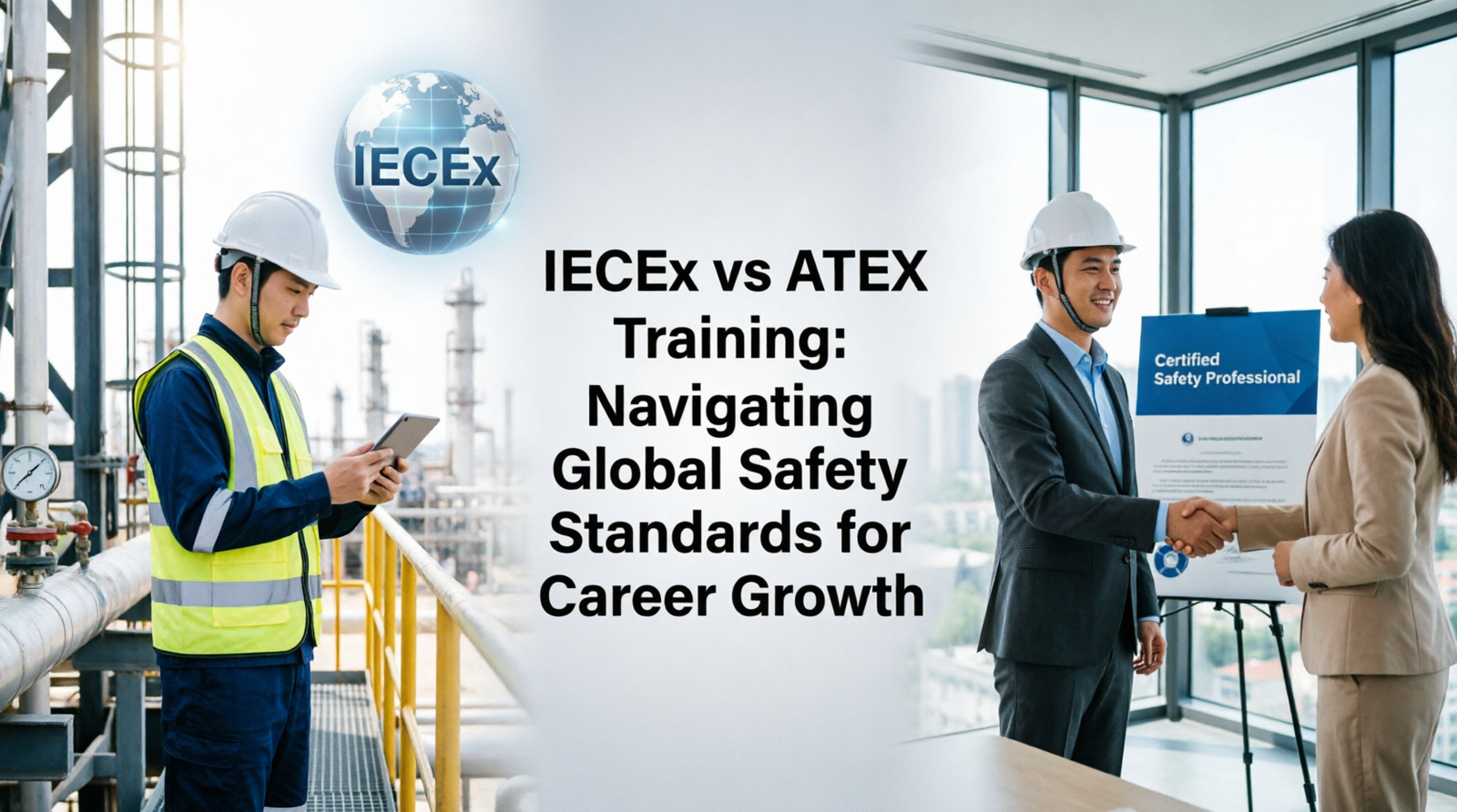
Hazardous industries carry real risk. One spark near flammable gas can cause a disaster. That’s why safety certifications matter so much for your team.
If you work in oil and gas, mining, or chemical plants, you’ve likely heard two terms: IECEx and ATEX. Both protect workers. Both prove your skills. But they work differently.
Understanding the difference helps you pick the right training path. It also opens doors to better jobs and safer worksites.
What is IECEx Certification?
IECEx certification proves you meet international standards for working in explosive atmospheres. It covers equipment, personnel, and workplace safety across the globe.
The IECEx Scheme comes from the International Electrotechnical Commission. It sets one standard that works in over 30 countries. This means your certification travels with you.
Employers trust IECEx because it removes guesswork. A certified technician in Dubai meets the same bar as one in Perth or Houston.
Why IECEx matters for safety:
- It confirms you understand explosion protection methods
- It proves you can install and maintain hazardous area equipment safely
- It reduces the risk of costly incidents on site
- It gives employers confidence without extra local checks
For a closer look at what this certification involves, explore IECEx certification training and see how it fits your role.
What is ATEX Certification?
ATEX certification meets European Union rules for equipment and workplaces with explosion risk. It applies mainly within EU member states.
ATEX comes from two EU directives. One covers equipment makers. The other covers how employers protect workers on site. Together, they set the legal baseline across Europe.
If your work stays inside the EU, ATEX may be all you need. But it doesn’t automatically transfer outside Europe.
Key differences from IECEx:
- ATEX is a legal requirement inside the EU, not a voluntary scheme
- It focuses on equipment marking (the “Ex” symbol) and workplace zoning
- Recognition outside Europe is limited compared to IECEx
IECEx vs ATEX: Key Differences for Professionals
Both schemes aim to prevent explosions in hazardous areas. But they differ in reach, legal weight, and who accepts them.
| Criteria | IECEx | ATEX |
|---|---|---|
| Scope | Global | European Union |
| Legal basis | Voluntary international scheme | EU law (mandatory) |
| Governing body | IEC (International Electrotechnical Commission) | European Commission |
| Recognition | 30+ countries | EU member states, some recognition elsewhere |
| Best suited for | Professionals working across borders | Professionals working only within the EU |
Why IECEx offers broader career options:
IECEx certification travels well. If you plan to work in the Middle East, Asia, Australia, or the Americas, employers there recognize IECEx. This gives you more job options without repeating training in each country.
How each affects compliance:
Your equipment and your team both need to match local rules. A plant in the EU may need ATEX-marked gear. A global contractor may need staff who hold IECEx certificates to bid on international projects.
Why Choose IECEx Training for Your Career?
IECEx training boosts your job options and your pay. It signals to employers that you meet a trusted global standard, wherever the project is based.
Hazardous industries need skilled people. Oil and gas, mining, and chemical plants all run in multiple countries. Companies want staff who can move between sites without new certification each time.
Career benefits you gain:
- Higher earning potential in specialist roles
- Access to international job postings
- Fewer barriers when switching employers or countries
- Stronger standing during safety audits and inspections
Industries actively hiring IECEx-certified staff:
- Oil and gas exploration and production
- Mining and mineral processing
- Chemical and petrochemical plants
- Marine and offshore energy
- Power generation
Checklist: Steps to Advance Your Career with IECEx Training
- Confirm your current role needs hazardous area competency
- Choose an accredited IECEx training provider
- Complete the required unit(s) of competency
- Pass the practical and written assessment
- Apply for your IECEx Certificate of Personnel Competence (CoPC)
- Keep your certificate active through renewal training
Want guidance on which path fits your role? Browse this IECEx training guide for a full breakdown of courses and units.
Practical Steps to Get IECEx Certified
You get IECEx certified by completing accredited training, passing an assessment, and applying for your Certificate of Personnel Competence. The full process usually takes a few days to a few weeks.
Step 1: Pick an accredited provider. Not all training counts. Your provider must be IECEx-accredited, or your certificate won’t hold weight.
Step 2: Complete your training units. Courses cover topics like equipment inspection, installation, and maintenance in explosive atmospheres.
Step 3: Sit your assessment. Expect both a written exam and a practical skills check. Assessors confirm you can apply the theory on real equipment.
Step 4: Apply for your CoPC. Once you pass, you submit your results to receive your official IECEx certificate.
Step 5: Renew on schedule. Certificates need periodic renewal to stay valid, so keep track of your expiry date.
Conclusion
IECEx and ATEX both protect workers in hazardous areas. But IECEx gives you a passport that works across borders, while ATEX stays tied to the EU.
If you want to grow your career beyond one region, IECEx training gives you an edge. It’s recognized, respected, and in demand across major industries.
Ready to take the next step? Contact our team to find the right IECEx training program for your career goals.