Why Understanding the EPD Certification Process Matters
Many businesses want environmental product declarations but do not start because the process feels unclear. That uncertainty costs them time, market access, and competitive advantage.
The truth is simple: the EPD certification process follows a defined, repeatable sequence. Once you understand each step, the path becomes manageable — even straightforward.
This guide walks you through every stage. No jargon without explanation. No steps skipped.
Short Answer: The EPD certification process involves five core steps — defining scope and selecting a PCR, conducting a Life Cycle Assessment (LCA), drafting the EPD document, completing independent third-party verification, and registering with a program operator. The full process typically takes three to six months from data collection to publication.
What Are Environmental Product Declarations?
Before diving into the process, let us be precise about what you are certifying.
Environmental product declarations are standardised, third-party verified documents that quantify the environmental impact of a product across its life cycle. They follow ISO 14025 and are built on a Life Cycle Assessment (LCA) conducted according to ISO 14040 and ISO 14044.
They are not self-declarations. They are not estimates. They are independently verified, publicly published data reports.
Every EPD covers specific environmental indicators — including Global Warming Potential (GWP), acidification, eutrophication, ozone depletion, and resource depletion — for a defined product across defined life cycle stages.
How Long Does EPD Certification Take?
This is the first question most businesses ask. The honest answer is three to six months for most products.
Here is what drives the timeline:
| Factor | Faster | Slower |
|---|---|---|
| Data availability | 12 months of clean records ready | Records incomplete or scattered |
| Product complexity | Single, simple product | Multi-component or bespoke product |
| PCR availability | Established PCR exists | New PCR development needed |
| Verification schedule | Verifier available quickly | Queue at third-party body |
| Program operator | Fast registration process | Backlog at operator |
Businesses that prepare their production data in advance — before formally starting the EPD process — consistently complete certification faster. Preparation is not a separate phase. It is the most valuable phase.
Step 1: Define Scope and Functional Unit
Every EPD starts with a precise definition of what is being declared.
What Is the Product?
Be specific. A ready-mix concrete C30 grade and a C40 grade are different products with different environmental profiles. A wall panel and a floor panel follow different system boundaries. Precision at this stage prevents rework later.
What Is the Functional Unit?
The functional unit is the reference basis for all calculations. It allows fair comparison between different products performing the same function. Examples include:
- 1 cubic metre of ready-mix concrete with defined compressive strength
- 1 square metre of insulation at defined thermal resistance
- 1 kg of adhesive with defined bonding strength
Everything in the LCA is calculated per functional unit. Getting this right is critical.
What Life Cycle Stages Are Included?
Environmental product declarations can cover:
- Cradle to gate (A1-A3): Raw material extraction through manufacturing
- Cradle to gate with options (A1-A3 with selected downstream modules)
- Cradle to grave (A1-C4): Full life cycle including end-of-life
- Cradle to cradle: Including material recovery and recycling benefits
The declared system boundary must match the requirements of your target PCR document.
Step 2: Identify and Apply the Correct PCR
Product Category Rules (PCR) are the rulebooks for specific product categories. They define how the LCA must be conducted, which impact categories must be reported, what data quality requirements apply, and how results must be presented.
Using the wrong PCR — or no PCR — produces an invalid EPD. Your verifier will reject it.
How to Find the Right PCR
PCR documents are published by program operators. Search the databases of:
- EPD International (epd-international.org)
- IBU — Institut Bauen und Umwelt (ibu-epd.com)
- The International EPD System
- UL Environment
If no PCR exists for your product category, you may need to participate in developing one. Your LCA consultant advises on this early.
PCR Compliance Is Non-Negotiable
Your entire LCA study must comply with the selected PCR. The verifier checks this explicitly. Non-compliance is the most common reason EPD submissions require revision before approval.
Step 3: Conduct the Life Cycle Assessment
The LCA is the technical core of the EPD certification process. It generates all the quantified environmental data that appears in the final declaration.
Collect Primary Data
Primary data comes directly from your production facility. This is the most credible form of data for LCA purposes. Collect:
- Raw material quantities and sourcing locations
- Energy consumption by type (electricity, gas, diesel)
- Water inputs and outputs
- Waste quantities and disposal routes
- Transport distances and modes for incoming materials
Twelve months of production data is the standard minimum period. This accounts for seasonal variation and provides a representative average.
Supplement With Secondary Data
Where primary data is unavailable — particularly for upstream processes like raw material extraction at supplier sites — practitioners use background datasets. Common datasets include:
- Ecoinvent (most widely used globally)
- GaBi databases
- National LCI databases where available
Your consultant selects the most geographically appropriate datasets and documents all selections transparently.
Model the Life Cycle
Using specialist LCA software — SimaPro, openLCA, or GaBi — the consultant models the full system. Every input and output is connected. Every impact category is calculated per functional unit.
This is where the numbers emerge: GWP figures, energy demand, water depletion, toxicity indicators, and all other declared categories.
Quality Check the Model
Before moving to the EPD drafting stage, the LCA model is internally reviewed. Sensitivity analysis checks whether key assumptions significantly change the result. Completeness checks confirm no major flows are missing.
Step 4: Draft the EPD Document
The LCA results feed directly into the EPD document. But the document is not just a data table. It must meet specific formatting, disclosure, and transparency requirements set by the program operator and PCR.
Mandatory Content in Every EPD
Every environmental product declaration must include:
- Product description and intended application
- Declared unit and system boundary
- Description of the LCA methodology
- Environmental performance data for all mandatory impact categories
- Data quality statement
- Reference to the applicable PCR
- Information about the program operator and verifier
- Validity period and registration number
Missing any mandatory element is grounds for rejection during verification.
Scenario Descriptions
For life cycle stages beyond A1-A3, the EPD must include scenario descriptions. These explain the assumptions used — default transport distance to site, assumed service life, end-of-life scenario assumptions. Transparent scenario descriptions are essential for credibility.
Step 5: Independent Third-Party Verification
This is the step that separates environmental product declarations from marketing claims. No EPD is valid without passing independent verification.
Who Verifies EPD Reports?
Verifiers are accredited by program operators. They must be independent — no financial or organisational connection to the company whose EPD they are reviewing. They must have demonstrated competence in LCA methodology and the relevant PCR.
Finding a qualified verifier is not optional. The program operator maintains a list of approved verifiers for each product category.
What Does the Verifier Check?
The verifier conducts a structured review covering:
- Compliance of the LCA with ISO 14040/14044
- Compliance with the declared PCR
- Accuracy of calculations and data sources
- Completeness of the EPD document
- Consistency between the LCA study and the EPD
- Appropriateness of the functional unit and system boundary
Verification Outcomes
The verifier issues one of three outcomes:
- Approved: EPD proceeds to registration
- Approved with minor corrections: Small adjustments required before registration
- Not approved: Significant issues require LCA revision and re-submission
Most well-prepared EPD submissions require only minor corrections or pass outright. Poorly prepared submissions with incomplete data or PCR non-compliance face full revision cycles.
Step 6: Register With a Program Operator
Once the verifier approves, the EPD is submitted to the program operator for registration.
What Happens at Registration?
The program operator:
- Assigns a unique EPD registration number
- Reviews the document for format compliance
- Publishes the EPD in their public database
- Issues the official EPD certificate
The registration fee varies by operator and product category. Most operators publish their fee structures publicly.
Program Operators Accepted in UAE Projects
For UAE-based businesses, the most commonly accepted program operators include:
- EPD International (The International EPD System)
- IBU — Institut Bauen und Umwelt
- UL Environment (previously UL EHS Sustainability)
- BREEAM-linked program operators for UK/Gulf projects
Your target market determines which operator best serves your needs. A consultant familiar with EPD certification in UAE advises on the most strategically appropriate choice.
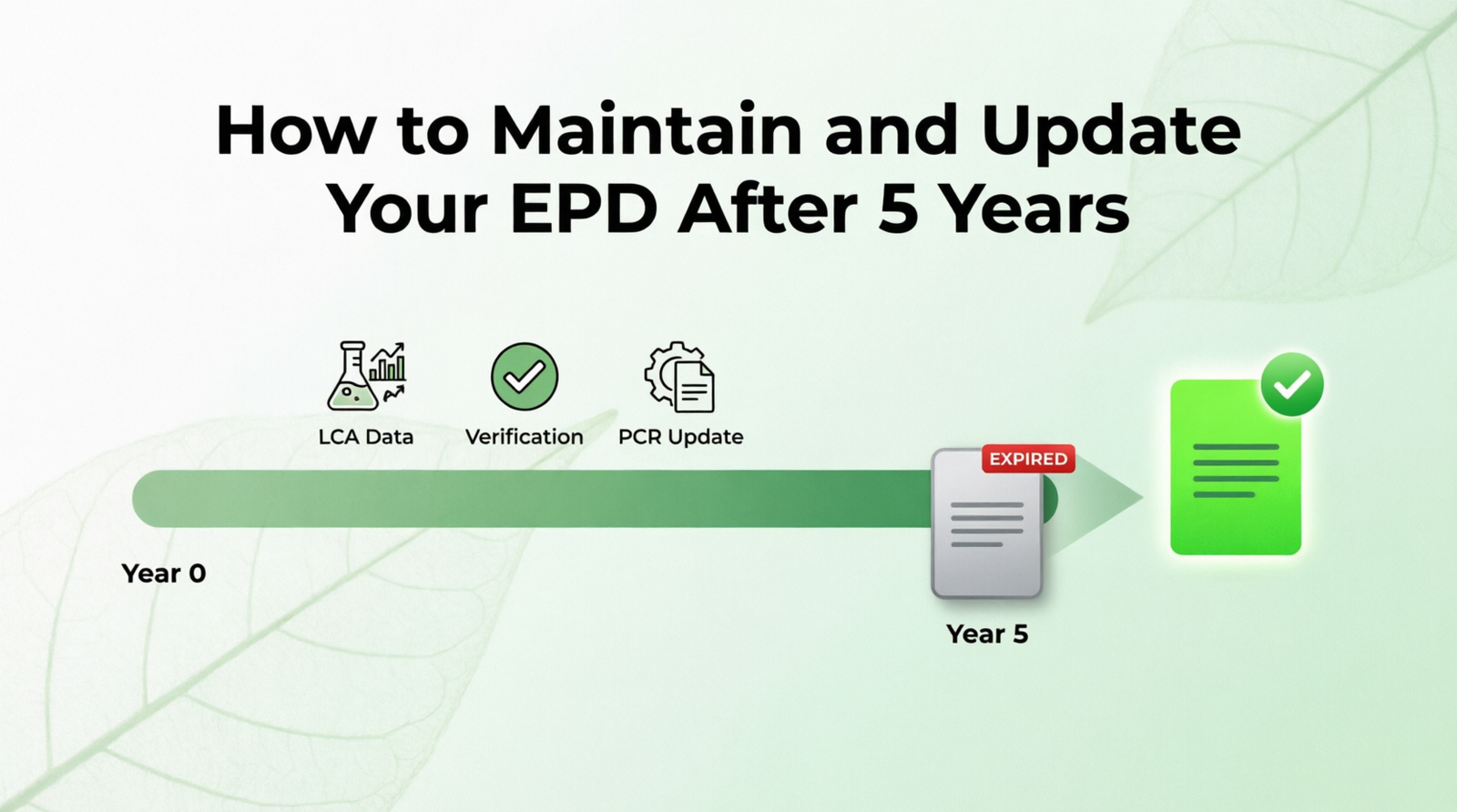
Step 7: Maintain and Renew Your EPD
An EPD is valid for five years from the date of registration. But validity is conditional.
When Must You Update Your EPD?
You must update or withdraw your EPD if:
- Your product formulation changes significantly
- Your production process changes in ways that affect environmental impact
- Your key material suppliers change
- The applicable PCR is revised and requires updated declarations
Proactive monitoring ensures your EPD remains accurate and credible throughout its validity period.
Renewal Process
Renewal follows the same process as initial certification. However, businesses with existing production data systems and an established LCA model renew significantly faster and at lower cost than first-time certification.
How Is LCA Used in EPD: The Connection Explained
Many businesses understand EPD as a document. Fewer understand that the LCA is the engine that makes it credible.
Without a rigorous LCA, the EPD is just a template with numbers inserted. The LCA methodology — ISO 14040/14044 — ensures:
- Consistent treatment of all inputs and outputs
- Transparent data sourcing and quality assessment
- Reproducible results that a verifier can independently check
- Comparable results across products in the same category
This is why environmental product declarations carry weight with sophisticated buyers. The LCA behind them is rigorous science — not marketing estimation.
Common Mistakes in the EPD Certification Process
Starting Without the Right PCR
Some businesses commission an LCA before confirming the applicable PCR. If the PCR requires data or scope that the LCA did not collect, the entire study may need revision. Confirm the PCR first.
Using Industry Average Data Instead of Primary Data
Industry averages are acceptable where primary data is genuinely unavailable. But using averages for your own manufacturing process — when you have access to actual production records — weakens your EPD and reduces its value in competitive tender situations.
Underestimating the Verification Timeline
Verifiers operate on their own schedules. Build verification time into your project plan. Assuming verification takes two weeks when it typically takes four to eight weeks creates avoidable delays.
Not Aligning With Target Market Requirements
An EPD registered with one program operator may not be accepted by all buyers. Confirm which program operators your target clients and projects accept before selecting yours.
Frequently Asked Questions: EPD Certification Process
What are the steps for EPD certification?
Define scope, select PCR, conduct LCA, draft the EPD, complete third-party verification, and register with a program operator.
How is LCA used in EPD?
LCA provides quantified environmental impact data across the product life cycle — it is the technical foundation of every EPD.
Who verifies EPD reports?
An independent, accredited third-party verifier approved by the program operator reviews and approves all EPD submissions.
How long does EPD certification take?
Typically three to six months depending on data readiness, product complexity, and verifier availability.
What is a PCR in EPD?
PCR stands for Product Category Rules — the rulebook that defines how the LCA must be conducted for a specific product category.
How long is an EPD valid?
Environmental product declarations are valid for five years from the date of registration with the program operator.
Can I use one EPD for multiple products?
Yes, a range EPD can cover multiple products within one declaration — subject to PCR rules for that product category.
Final Word
The EPD certification process is structured, verifiable, and repeatable. Businesses that approach it with proper preparation — clean data, the right consultant, and a clear understanding of their target market requirements — move through it efficiently and emerge with a document that carries genuine commercial weight.
Environmental product declarations are not paperwork for its own sake. They are the verified evidence base that wins specifications, earns green building credits, and opens export markets that remain closed to competitors without them.
Start with step one. The rest follows.