Are you a medical device manufacturer struggling to access regulated markets in Europe, the US, or Canada? Is your quality management system falling short of what healthcare buyers and regulatory bodies expect? ISO 13485 Certification is the globally recognised solution — and without it, your path into the medical device market is blocked before it begins.
This guide explains exactly what ISO 13485 is, who needs it, what the requirements involve, how the certification process works, and how expert support can get you there faster.
What Is ISO 13485 Certification?
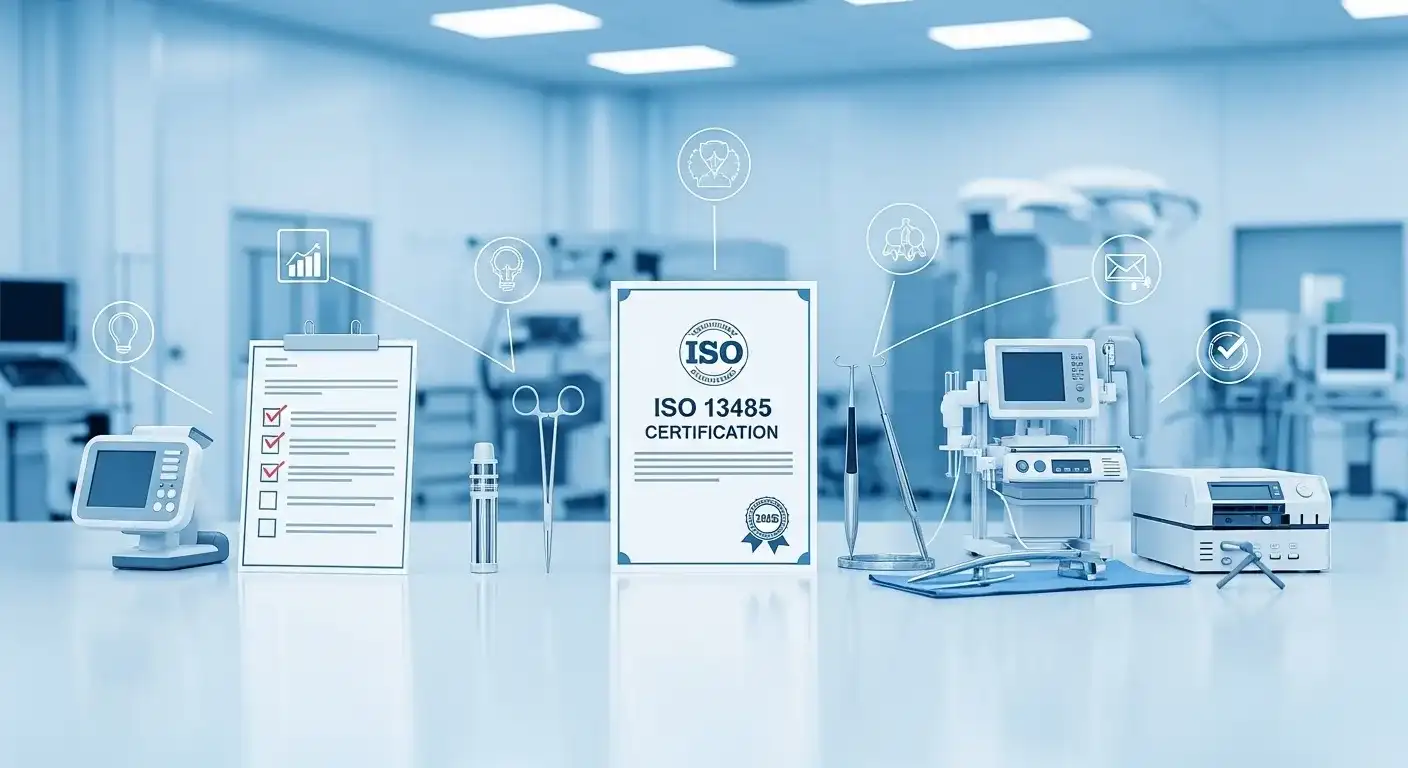
ISO 13485 is an internationally recognised standard that defines the requirements for a Quality Management System (QMS) specifically designed for the medical device industry. Unlike general quality standards, ISO 13485 is purpose-built around the unique regulatory, safety, and traceability demands of medical device design, manufacture, and distribution.
ISO 13485 Certification demonstrates that your organisation consistently meets both regulatory requirements and customer expectations for product safety and performance across the entire medical device lifecycle — from design and development through production, servicing, and post-market activities.
Short Answer: ISO 13485 Certification is a globally recognised quality management standard for medical device organisations. It covers the full device lifecycle including design, manufacturing, risk management, traceability, and post-market surveillance — and is required for regulatory approval in the EU, Canada, Japan, and many other markets.
Why ISO 13485 Certification Matters in 2025
The medical device industry is one of the most heavily regulated sectors in the world — and that regulation is tightening. In 2025, regulatory authorities across major markets have raised the bar for what constitutes an acceptable quality management system.
Here is the reality that medical device companies face without ISO 13485 Certification:
- The EU Medical Device Regulation (MDR) and In Vitro Diagnostic Regulation (IVDR) require manufacturers to demonstrate robust QMS compliance as a condition of CE marking
- The FDA’s 21 CFR Part 820 Quality System Regulation aligns closely with ISO 13485, making certification a practical necessity for US market access
- Health Canada mandates ISO 13485 Certification as a core licensing requirement for medical device manufacturers
- Major hospital procurement teams, distributors, and group purchasing organisations will not engage with uncertified suppliers regardless of product quality
- Contract manufacturers and component suppliers without certification are routinely excluded from the supply chains of certified OEMs
Without ISO 13485, your organisation is invisible to the most valuable customers in the healthcare market.
Who Needs ISO 13485 Certification?
ISO 13485 is not limited to device manufacturers alone. It applies to every organisation with a role in the medical device supply chain — and the scope is broader than most companies initially realise.
Medical Device Manufacturers designing and producing any class of device — from disposable instruments to implantable components — must hold ISO 13485 Certification to access regulated markets and satisfy distributor requirements.
Contract Manufacturers and OEM Suppliers producing components, sub-assemblies, or finished devices on behalf of brand owners are increasingly required by their clients to be ISO 13485 certified as a contractual prerequisite.
Sterilisation Service Providers processing medical devices for manufacturers must demonstrate QMS compliance that meets ISO 13485 requirements, as sterilisation is a critical and validated production process.
Medical Device Software Developers building software that qualifies as a medical device or software-as-a-medical-device (SaMD) must implement ISO 13485-compliant processes for design control, validation, and post-market monitoring.
Packaging Suppliers providing sterile barrier systems or device packaging must demonstrate traceability, process validation, and quality controls consistent with ISO 13485.
Importers and Distributors operating in regulated markets are increasingly required to maintain their own ISO 13485 certification as regulators extend quality obligations across the full supply chain.
If your business touches a medical device at any stage of its lifecycle, ISO 13485 is relevant to your operations.
ISO 13485 Certification Requirements You Must Understand
To achieve ISO 13485 Certification, your organisation must implement and maintain a documented QMS that satisfies the standard’s core clauses. These are not abstract principles — they translate directly into operational processes, documentation, and records that auditors will evaluate.
Documented Quality Management System — Establish a comprehensive QMS that covers all processes affecting product quality and safety, with clear documentation, version control, and record retention policies throughout.
Risk Management Integration — Implement risk management practices aligned with ISO 14971 across design, production, and post-market activities. Risk must be identified, evaluated, controlled, and monitored systematically.
Design and Development Controls — Maintain documented procedures for design input, design output, design verification, design validation, and design transfer — with complete traceability from requirement to finished device.
Traceability Systems — Ensure full traceability of raw materials, components, subassemblies, and finished devices — enabling precise identification and recall of any affected product in the event of a non-conformance.
Process Validation — Validate all manufacturing processes where output cannot be fully verified by subsequent inspection — including sterilisation, cleanroom operations, and software systems.
Supplier and Outsourced Process Control — Evaluate, approve, and monitor all suppliers and outsourced service providers who impact product quality, with documented qualification criteria and ongoing performance records.
Complaint Handling and Post-Market Surveillance — Implement formal procedures for receiving, investigating, and resolving customer complaints, adverse events, and field safety corrective actions in alignment with regulatory reporting requirements.
Internal Audits and Management Reviews — Conduct regular internal audits of the QMS and hold documented management reviews where leadership evaluates performance data and approves improvement actions.
Corrective and Preventive Action (CAPA) — Maintain a structured system for identifying the root causes of non-conformances and implementing corrective actions that prevent recurrence.
These requirements combine to create a QMS that is not simply compliant on paper but genuinely capable of producing safe, effective medical devices consistently.
How to Get ISO 13485 Certified: Step-by-Step Process
Step 1 — Gap Assessment
Evaluate your existing processes, documentation, and quality controls against ISO 13485 requirements. This identifies precisely what is already in place, what needs to be developed, and where the highest-risk gaps exist before work begins.
Step 2 — QMS Documentation Development
Prepare all required documentation including the Quality Manual, Standard Operating Procedures (SOPs), work instructions, risk management files, validation protocols, and controlled forms. Every document must meet the standard’s strict version control and approval requirements.
Step 3 — Risk Management Implementation
Establish a risk management process aligned with ISO 14971 that covers design risk, process risk, and post-market risk monitoring. This is one of the most scrutinised areas during certification audits and must be genuinely embedded — not retrospectively created.
Step 4 — QMS Rollout Across Departments
Deploy all new procedures, systems, and controls across relevant functions — including design, production, quality assurance, procurement, and customer service. This phase includes staff training, data capture system setup, and validation of critical processes.
Step 5 — Internal Audit
Conduct a full internal audit of the implemented QMS. Document all findings, raise non-conformances, and implement corrective actions before scheduling the external certification audit.
Step 6 — Management Review
Leadership formally reviews QMS performance data, audit findings, customer feedback, and regulatory updates — and approves all actions required before certification.
Step 7 — Stage 1 Certification Audit
The accredited certification body reviews your QMS documentation, policies, and procedures to confirm that the system is adequately designed and ready for a full on-site assessment.
Step 8 — Stage 2 Certification Audit
Auditors conduct a thorough on-site or remote audit to verify that the QMS is fully implemented, consistently followed, and producing the intended quality outcomes across all relevant processes.
Step 9 — Certification Awarded and Maintained
Upon successful completion, your ISO 13485 certificate is issued. It is valid for three years with annual surveillance audits required to confirm continued compliance and ongoing improvement.
Key Benefits of ISO 13485 Certification for Medical Device Organisations
Global Regulatory Market Access — ISO 13485 Certification is a prerequisite for CE marking under EU MDR, Health Canada licensing, and is closely aligned with FDA 21 CFR Part 820 — opening access to the world’s largest regulated medical device markets simultaneously.
Increased Customer and Distributor Trust — Hospitals, group purchasing organisations, and international distributors prioritise certified suppliers. Certification removes procurement barriers that uncertified competitors cannot overcome regardless of their product quality.
Reduced Product Failures and Recalls — Standardised design controls, process validation, and complaint management significantly reduce the risk of device failures, non-conformances, and the catastrophic costs of a product recall.
Structured Risk Management Across the Device Lifecycle — A formal risk-based approach means potential safety issues are identified and resolved during design and production — not after devices reach patients.
Stronger Supplier Relationships — Certified organisations are preferred partners for OEMs and prime contractors who are themselves required to ensure their supply chain meets ISO 13485 standards.
Operational Efficiency and Waste Reduction — Documented procedures, process validation, and internal audit cycles reduce inefficiencies, rework, and the cost of poor quality across manufacturing operations.
Brand Credibility in a Safety-Critical Industry — In the medical device sector, your quality credentials are as important as your product features. Certification is visible, verifiable proof that safety and quality are embedded into your operations.
Foundation for Regulatory Submissions — A certified QMS produces the technical documentation, design history files, and quality records that regulatory submissions — including 510(k), CE Technical Files, and Health Canada applications — require.
ISO 13485 vs ISO 9001: Key Differences Every Medical Device Company Must Know
A frequent question from companies already holding ISO 9001 Certification is whether it is sufficient for medical device operations. The answer is no — and the differences are significant.
Regulatory Focus — ISO 9001 is a general quality management standard applicable to any industry. ISO 13485 is specifically designed to meet the statutory and regulatory requirements of the medical device sector, incorporating clauses that have no equivalent in ISO 9001.
Risk Management Requirements — ISO 13485 requires a systematic approach to risk management aligned with ISO 14971 throughout the entire device lifecycle. ISO 9001’s risk treatment is far less prescriptive and does not satisfy medical device regulatory expectations.
Design and Development Controls — ISO 13485 mandates detailed design control procedures including design input, output, verification, validation, and transfer documentation. ISO 9001 allows organisations to exclude design controls if they do not perform design activities — an exclusion not permitted under ISO 13485.
Process Validation — ISO 13485 requires validation of all processes where output cannot be verified by downstream inspection — a mandatory requirement that applies specifically to medical device manufacturing processes.
Post-Market Surveillance — ISO 13485 includes requirements for ongoing post-market monitoring, complaint handling, and regulatory reporting. ISO 9001 has no equivalent requirement for post-delivery surveillance at this level.
Document and Record Control Stringency — ISO 13485 imposes stricter requirements on document control, record retention periods, and the traceability of changes — reflecting the legal and liability context of medical device regulation.
For any organisation operating in the medical device sector, ISO 13485 Certification is the required standard. ISO 9001 alone is not an acceptable substitute for regulatory or customer purposes.
ISO 13485 and Other Regulatory Frameworks: How They Work Together
ISO 13485 and EU MDR — The EU Medical Device Regulation requires manufacturers to have a QMS that meets the requirements of Annex IX. ISO 13485 Certification is the most widely accepted method of demonstrating QMS compliance under MDR, though certification alone does not constitute MDR compliance in its entirety.
ISO 13485 and FDA 21 CFR Part 820 — The FDA’s Quality System Regulation has historically aligned closely with ISO 13485. The FDA’s updated Quality Management System Regulation (QMSR), effective from February 2026, formally incorporates ISO 13485:2016 — making certification directly relevant to FDA compliance for the first time.
ISO 13485 and MDSAP — The Medical Device Single Audit Program allows a single audit to satisfy regulatory requirements in Australia, Brazil, Canada, Japan, and the United States simultaneously. ISO 13485 is the foundation of MDSAP audits, making it a gateway to five major regulatory markets through a single certification process.
ISO 13485 and ISO 14971 — ISO 14971 is the dedicated risk management standard for medical devices and is referenced throughout ISO 13485. Implementing both together ensures your risk management processes satisfy certification and regulatory auditors across all major markets.
How Global ISO Certifications Supports Your ISO 13485 Journey
Global ISO Certifications provides end-to-end ISO 13485 Certification support for medical device manufacturers, suppliers, and service providers worldwide — whether you are pursuing your first certification or upgrading an existing QMS to meet new regulatory demands.
The support process covers gap analysis and readiness assessment, full QMS documentation development including quality manuals, SOPs, and risk management files, process validation planning, internal auditor training, mock audit preparation, certification body selection and coordination, and post-certification surveillance support.
All services are available remotely, making expert support accessible for organisations across any geography. Contact Global ISO Certifications to start with a free consultation and receive a tailored certification roadmap for your organisation.
Frequently Asked Questions About ISO 13485 Certification
Is ISO 13485 Certification mandatory for medical device companies?
In many markets, yes. It is a prerequisite for CE marking under EU MDR, a core requirement for Health Canada licensing, and is now directly referenced in the FDA’s updated QMSR. Any company selling medical devices in regulated markets effectively requires it.
How long does ISO 13485 Certification take?
Most organisations complete the process in three to six months. Companies with an existing documented QMS and prior audit experience may move faster, while those building their system from scratch typically require the full timeline.
What is the difference between ISO 13485 and ISO 9001?
ISO 9001 Certification is a general quality management standard for any industry. ISO 13485 is specifically designed for medical device organisations and includes mandatory requirements for risk management, design controls, process validation, traceability, and post-market surveillance that ISO 9001 does not contain.
Can small medical device startups get ISO 13485 certified?
Yes. ISO 13485 is fully scalable to organisations of any size. Many startups pursue certification early specifically because it is required to access distribution channels and attract investment from healthcare-focused partners.
Does ISO 13485 Certification cover software as a medical device (SaMD)?
Yes. ISO 13485 applies to organisations developing software that qualifies as a medical device or that forms part of a medical device, including design control, validation, and post-market monitoring requirements for software.
How does ISO 13485 relate to ISO 22000 or other sector standards?
ISO 13485 sits within a family of sector-specific management system standards. Organisations with both healthcare and food safety operations sometimes implement ISO 22000 Certification alongside ISO 13485 — using the compatible High Level Structure to integrate both systems efficiently.
What happens during a surveillance audit?
Annual surveillance audits conducted by the certification body verify that your QMS remains compliant, that corrective actions from previous audits have been implemented, and that your organisation is continuing to improve. Surveillance audits are shorter than the initial certification audit but require ongoing documentation and records to be current.
Is ISO 13485 Certification the Right Step for Your Medical Device Business?
If your organisation manufactures, supplies, or services medical devices — and you are serious about accessing regulated markets, winning healthcare contracts, and building a quality reputation that survives regulatory scrutiny — ISO 13485 Certification is not optional. It is the foundation on which compliant, competitive medical device businesses are built.
The organisations that invest in certification today are the ones that will hold long-term supply agreements, pass regulatory audits, and scale into new markets tomorrow.
Get in touch with Global ISO Certifications today to begin your ISO 13485 journey with experienced consultants, a structured process, and full remote support available worldwide.