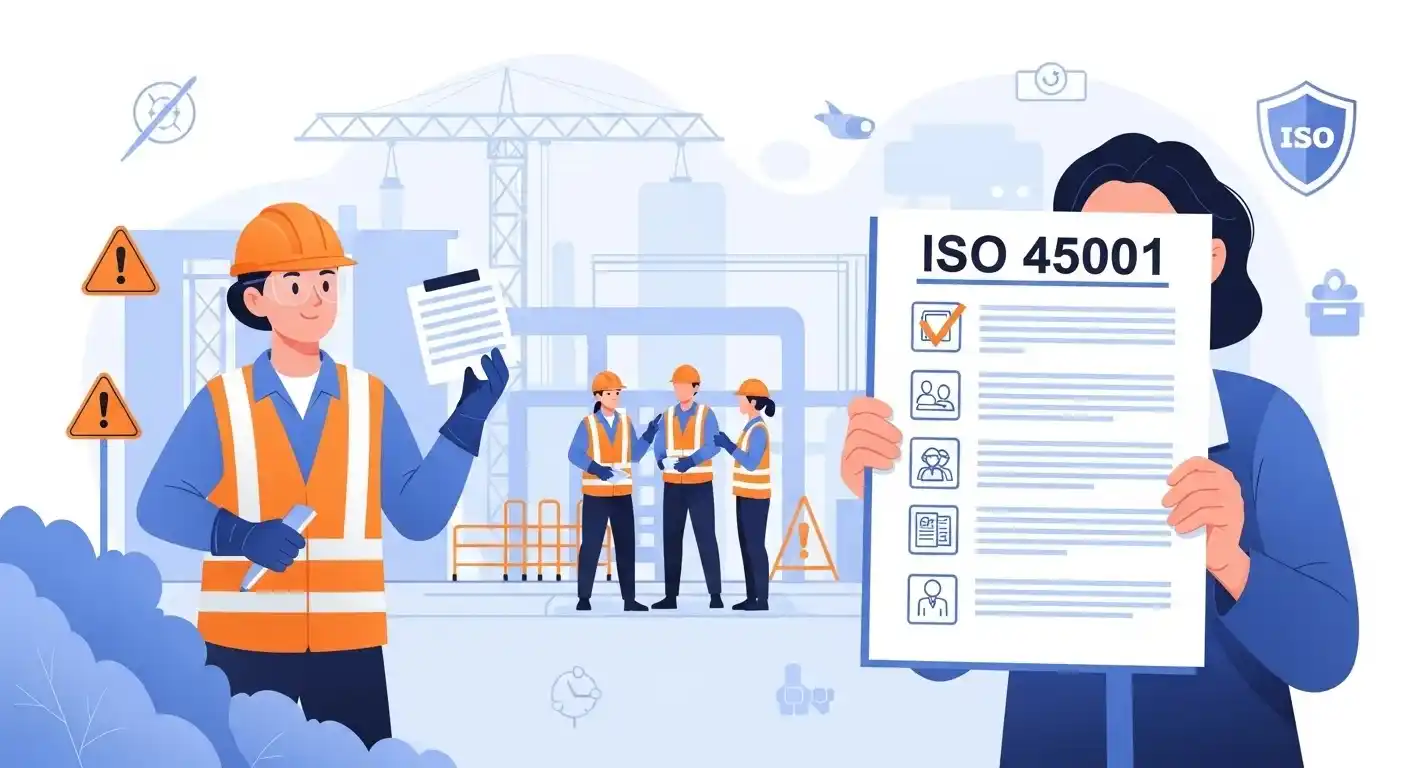
ISO 45001 certification is an international standard for Occupational Health and Safety Management Systems (OHSMS) that helps organizations reduce workplace injuries, improve employee safety, and demonstrate commitment to worker wellbeing. Published in March 2018, it replaced the former OHSAS 18001 standard and provides a framework for managing occupational health and safety risks systematically.
Workplace accidents cost businesses billions annually in lost productivity, medical expenses, and legal liabilities. According to the International Labour Organization (ILO), approximately 2.3 million workers die each year from work-related accidents and diseases, with an additional 340 million occupational accidents occurring globally.
Organizations struggle with fragmented safety approaches, inconsistent risk management, and compliance challenges across multiple locations. ISO 45001 addresses these pain points by providing a unified framework that integrates safety management into overall business operations.
This comprehensive guide explains everything you need to know about ISO 45001 certification, from understanding the requirements to implementing the standard and achieving certification. Whether you’re a safety manager, business owner, or compliance officer, you’ll find actionable insights to improve workplace safety in your organization.
What is ISO 45001 Certification?
ISO 45001 is an internationally recognized standard developed by the International Organization for Standardization (ISO). It specifies requirements for an occupational health and safety management system that enables organizations to proactively improve their OH&S performance.
The standard applies to organizations of all sizes and industries, from small businesses to multinational corporations. It provides a systematic approach to identifying hazards, assessing risks, and implementing controls to prevent work-related injuries and ill health.
Unlike previous safety standards that focused primarily on hazard management, ISO 45001 emphasizes leadership involvement, worker participation, and continuous improvement. This holistic approach ensures safety becomes embedded in organizational culture rather than existing as a separate compliance exercise.
Why Was ISO 45001 Developed?
Before ISO 45001, organizations used various national and regional standards like OHSAS 18001, creating challenges for multinational companies operating across different jurisdictions. The lack of a unified international standard meant duplicated efforts and inconsistent safety practices.
ISO 45001 was developed through collaboration among occupational health and safety experts from over 70 countries. The standard incorporates best practices from existing frameworks while introducing new requirements aligned with modern workplace challenges.
The development process considered diverse working environments, from construction sites to office buildings, ensuring applicability across all sectors. This universal approach makes ISO 45001 the most comprehensive occupational health and safety standard available today.
How Does ISO 45001 Differ from OHSAS 18001?
Organizations familiar with OHSAS 18001 will notice several significant differences in ISO 45001. The new standard adopts the High-Level Structure (HLS) used by other ISO management system standards, making integration with ISO 9001 and ISO 14001 easier.
ISO 45001 places greater emphasis on organizational context, requiring companies to understand both internal and external issues affecting their OH&S management system. Leadership involvement receives more focus, with top management explicitly responsible for OH&S performance rather than delegating to safety officers.
Worker participation expanded significantly, requiring organizations to establish processes for worker consultation at all levels. Risk management becomes more proactive, addressing both opportunities and risks rather than focusing solely on hazard prevention.
Why Do Organizations Need ISO 45001 Certification?
Organizations pursue ISO 45001 certification for compelling business, legal, and ethical reasons. Understanding these drivers helps justify the investment required for implementation and certification.
Workplace safety directly impacts employee morale, productivity, and retention. Companies with strong safety records experience lower turnover rates as employees feel valued and protected. This positive workplace culture attracts top talent in competitive labor markets.
What Are the Business Benefits?
Certified organizations typically see reduced accident rates, leading to lower insurance premiums and workers’ compensation costs. The systematic approach to risk management prevents incidents before they occur, saving substantial expenses associated with workplace injuries.
Improved safety performance enhances corporate reputation, making companies more attractive to clients, investors, and business partners. Many large organizations now require suppliers to hold ISO 45001 certification as a condition of doing business.
Operational efficiency improves as fewer disruptions occur from accidents and injuries. Employees work more confidently in safe environments, leading to higher productivity and better quality output. Reduced absenteeism from work-related illness further contributes to operational consistency.
How Does Certification Help with Legal Compliance?
While ISO 45001 doesn’t replace legal requirements, it provides a framework ensuring organizations systematically identify and comply with applicable OH&S legislation. The standard requires maintaining a register of legal obligations and monitoring compliance continuously.
Demonstrating ISO 45001 certification shows regulatory authorities that organizations take safety seriously and have robust systems in place. This proactive approach can favorably influence regulatory inspections and reduce the likelihood of penalties for non-compliance.
In litigation situations, certified organizations can demonstrate they implemented internationally recognized best practices to protect workers. This evidence may mitigate liability and demonstrate due diligence in safety management.
What Are the Key Requirements of ISO 45001?
ISO 45001 follows the High-Level Structure common to ISO management system standards, consisting of ten clauses. Understanding these requirements helps organizations plan their implementation effectively.
The standard uses Plan-Do-Check-Act (PDCA) methodology, creating a continuous improvement cycle. Organizations plan their OH&S management system, implement it, monitor performance, and take actions to improve continuously.
What Does Context of the Organization Mean?
Clause 4 requires organizations to understand their context—both internal and external factors affecting their ability to achieve OH&S objectives. Internal factors include organizational culture, resources, and processes, while external factors encompass legal requirements, stakeholder expectations, and industry trends.
Organizations must identify interested parties relevant to their OH&S management system and understand their needs and expectations. Interested parties typically include workers, contractors, regulatory authorities, customers, and local communities.
The scope of the OH&S management system must be clearly defined, considering the context, interested parties, and work-related activities. This scope determines which activities, products, and services fall under the management system.
How Important is Leadership and Worker Participation?
Clause 5 emphasizes top management’s role in providing leadership and commitment to the OH&S management system. Management must establish an OH&S policy, assign responsibilities, allocate resources, and actively promote a safety culture.
Worker participation requirements extend beyond simple consultation, requiring organizations to establish processes for workers to participate in developing, planning, implementing, and improving the system. Workers must be able to report hazards, investigate incidents, and contribute to decision-making.
Organizations must remove or minimize barriers to participation, such as language differences, literacy levels, or shift patterns. Providing training, time, and resources for participation demonstrates genuine commitment to worker involvement.
What Planning Elements Are Required?
Clause 6 addresses planning, requiring organizations to identify risks and opportunities related to their OH&S management system. This risk assessment process differs from operational hazard identification, focusing on factors that could prevent achieving system objectives.
Organizations must establish processes for hazard identification that are ongoing and proactive rather than reactive. These processes should consider routine and non-routine activities, human factors, infrastructure, and potential emergency situations.
OH&S objectives must be established at relevant functions and levels, aligned with the policy, and consistent with legal requirements. Objectives should be measurable, monitored, communicated, and updated as appropriate.
How Much Does ISO 45001 Certification Cost?
Understanding certification costs helps organizations budget appropriately and plan their implementation timeline. Costs vary significantly based on organization size, complexity, and current safety management maturity.
Total investment includes consultant fees, training costs, internal resources, certification body charges, and ongoing maintenance expenses. Breaking down these components provides clarity for financial planning.
What Are the Main Cost Components?
Consultant fees typically range from $5,000 to $50,000 depending on organization size and consultant scope. Small businesses might spend $5,000-15,000 for basic implementation support, while large multinational companies could invest $30,000-50,000+ for comprehensive guidance.
Training expenses cover both awareness training for all employees and specialized training for auditors and safety personnel. Budget $500-2,000 per person for internal auditor training and $200-500 per employee for general awareness programs.
Certification body fees depend on organization size, number of sites, and employee count. Small organizations (under 50 employees) typically pay $3,000-8,000 for initial certification, medium organizations (50-250 employees) pay $8,000-15,000, and large organizations (250+ employees) pay $15,000-30,000+.
What Ongoing Costs Should You Expect?
Annual surveillance audits maintain certification validity, costing approximately 30-40% of initial certification fees. For an organization that paid $10,000 initially, expect annual surveillance costs around $3,000-4,000.
Recertification every three years typically costs 60-70% of initial certification fees. Organizations also invest in continuous improvement activities, procedure updates, and refresher training, adding $2,000-10,000 annually depending on size.
While these costs seem substantial, the return on investment through reduced accidents, lower insurance premiums, and improved productivity typically justifies the expenditure. Most organizations recover their certification investment within 1-2 years through tangible savings.
How Do You Implement ISO 45001?
Successful implementation requires careful planning, adequate resources, and strong leadership commitment. Following a structured approach increases the likelihood of successful certification on the first attempt.
The implementation timeline typically spans 6-18 months depending on organization size, existing safety systems, and resource availability. Smaller organizations with basic safety programs might achieve certification in 6-9 months, while large complex organizations may require 12-18 months.
What Are the Implementation Steps?
Step 1: Gain Leadership Commitment – Secure executive support by presenting business case, expected benefits, and resource requirements. Leadership buy-in is critical for successful implementation.
Step 2: Conduct Gap Analysis – Assess current OH&S practices against ISO 45001 requirements to identify gaps. This analysis provides a roadmap for implementation and helps estimate required effort.
Step 3: Develop Implementation Plan – Create detailed project plan with timelines, responsibilities, and milestones. Assign a project manager to coordinate activities and report progress to leadership.
Step 4: Establish OH&S Policy – Develop policy statement reflecting organizational commitment to worker safety, legal compliance, and continuous improvement. Ensure policy is appropriate to the organization’s context and communicated to all workers.
Step 5: Identify Hazards and Assess Risks – Establish systematic processes for identifying workplace hazards and assessing associated risks. Involve workers in this process to capture practical insights.
Step 6: Implement Controls – Develop and implement controls to eliminate or minimize identified risks following the hierarchy of controls. Document procedures for high-risk activities.
Step 7: Train Personnel – Provide awareness training to all employees and specialized training to those with specific OH&S responsibilities. Ensure training is documented and competence verified.
Step 8: Conduct Internal Audits – Perform internal audits to verify system effectiveness and identify areas for improvement before the certification audit. Address any non-conformities discovered.
Step 9: Management Review – Conduct management review to evaluate system performance, review audit findings, and identify improvement opportunities. Demonstrate leadership engagement in the process.
Step 10: Certification Audit – Engage an accredited certification body to conduct external audit. The audit typically occurs in two stages: document review followed by on-site implementation verification.
What Common Challenges Should You Anticipate?
Organizations frequently underestimate the cultural change required for effective OH&S management. Moving from compliance-driven safety to a prevention-focused culture takes time and consistent leadership.
Worker participation can be challenging in organizations with traditional hierarchical structures. Creating genuine consultation processes where workers feel comfortable raising concerns requires cultural shift and trust building.
Resource constraints often slow implementation, particularly in smaller organizations. Balancing daily operations with implementation activities requires careful planning and realistic timelines.
How Do You Maintain ISO 45001 Certification?
Achieving certification is just the beginning; maintaining it requires ongoing commitment and continuous improvement. Understanding maintenance requirements prevents certificate suspension or withdrawal.
The certification cycle spans three years, with annual surveillance audits verifying continued compliance. Organizations must demonstrate active management system operation, not just documentation maintenance.
What Do Surveillance Audits Involve?
Annual surveillance audits examine specific areas of the management system rather than conducting complete reviews. Auditors verify that documented procedures are being followed, non-conformities from previous audits have been addressed, and continuous improvement is occurring.
Organizations should maintain comprehensive records of incidents, hazard reports, training completion, and corrective actions. These records provide evidence of system operation and continuous improvement.
Management review meetings should occur at planned intervals, typically quarterly or semi-annually. These reviews demonstrate leadership engagement and provide opportunities to address system performance.
How Do You Demonstrate Continuous Improvement?
Continuous improvement extends beyond fixing non-conformities; it involves proactively seeking opportunities to enhance OH&S performance. Organizations should establish key performance indicators measuring both leading indicators (proactive measures) and lagging indicators (reactive measures).
Leading indicators might include near-miss reports, safety observation submissions, or training completion rates. Lagging indicators include injury rates, lost time incidents, or workers’ compensation claims. Balanced measurement provides comprehensive performance insight.
Regular data analysis identifies trends and opportunities for improvement. Acting on this analysis through targeted initiatives demonstrates commitment to continuous enhancement of worker safety.
Frequently Asked Questions
Is ISO 45001 Certification Mandatory?
ISO 45001 certification is voluntary in most jurisdictions; however, some industries or clients may require it contractually. While not legally mandated, certification demonstrates compliance with occupational health and safety best practices.
How Long Does Certification Take?
Implementation typically takes 6-18 months depending on organization size and existing systems. The certification audit process itself usually requires 1-2 weeks from initial document review to final certification decision.
Can Small Businesses Get Certified?
Yes, ISO 45001 is scalable to organizations of all sizes. Small businesses can implement simplified systems appropriate to their risk levels while still meeting standard requirements. Many certification bodies offer tailored approaches for smaller organizations.
What is the Difference Between ISO 45001 and ISO 9001?
ISO 9001 focuses on quality management, while ISO 45001 addresses occupational health and safety. Both use the same High-Level Structure, making integrated implementation easier for organizations pursuing multiple certifications.
Do We Need a Consultant?
While not mandatory, consultants significantly accelerate implementation and increase first-time certification success rates. Organizations with internal expertise may implement independently, but most benefit from external guidance, particularly during initial implementation.
How Often Must We Recertify?
Certification is valid for three years, subject to successful annual surveillance audits. At the end of the three-year cycle, organizations undergo recertification audit to renew their certificate for another three years.
Ready to improve workplace safety and achieve ISO 45001 certification? Contact Global ISO Certificates today for expert guidance on implementing and certifying your occupational health and safety management system. Our experienced consultants help organizations of all sizes achieve certification efficiently.