Quick Summary: ISO 9001 focuses on Quality Management Systems while ISO 14001 addresses Environmental Management Systems. Both are globally recognised, voluntary, and highly valuable — but the right choice depends on your business goals, industry, and stakeholder requirements. This guide helps you choose — or make the case for implementing both.
When businesses explore ISO certification for the first time, two standards come up repeatedly: ISO 9001 and ISO 14001. While each addresses a different management discipline, they share a common structure and are designed to complement each other.
Understanding what each standard covers — and what it can do for your business — is the first step toward making the right certification decision for 2026 and beyond.
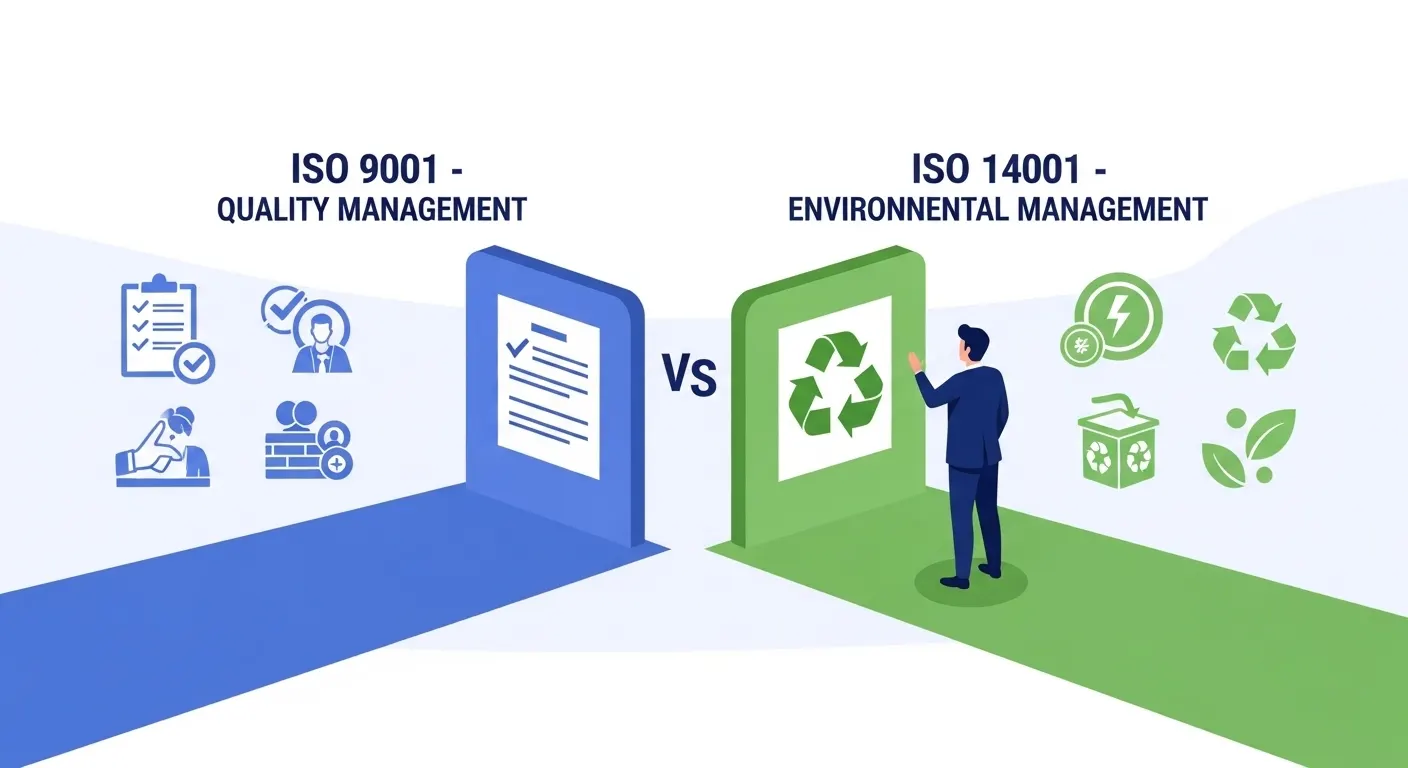
ISO 9001 and ISO 14001 at a Glance
ISO 9001: Quality Management
- Ensures consistent product/service quality
- Focuses on customer satisfaction
- Manages operational processes
- Drives continual improvement
- Applicable to all industries
- Over 1 million certified organisations globally
ISO 14001: Environmental Management
- Manages environmental impacts and risks
- Ensures environmental legal compliance
- Reduces waste, energy, and emissions
- Supports sustainability reporting
- Applicable to all sectors and sizes
- Over 300,000 certified organisations globally
Key Differences Between ISO 9001 and ISO 14001
| Feature | ISO 9001 | ISO 14001 |
|---|---|---|
| Primary Focus | Product/service quality | Environmental performance |
| Core Concept | Customer satisfaction & QMS | Environmental aspects & EMS |
| Key Output | Quality Manual, process docs | Environmental Policy, aspects register |
| Legal Compliance | General regulatory compliance | Specific environmental legislation |
| Common Users | Manufacturing, construction, logistics, services | Construction, energy, manufacturing, facilities |
| Main Driver | Customer requirements, tenders | Regulatory demand, sustainability goals, tenders |
What ISO 9001 Certification Delivers
ISO 9001 is the world’s most recognised quality certification. It provides a structured framework for managing how your organisation delivers products and services — consistently, efficiently, and to customer expectations.
Key outcomes include reduced defects and rework, stronger supplier relationships, improved process documentation, and a clear pathway for staff accountability and training. For organisations looking to grow, ISO 9001 is often the entry point into regulated supply chains and government procurement.
Sector guides worth reading:
- ISO 9001 benefits for construction companies — managing project quality, subcontractors, and inspections
- ISO 9001 for logistics companies in UAE — meeting client and customs requirements
- ISO 9001 for startups — get certified fast in 2026
What ISO 14001 Certification Delivers
ISO 14001 is the global benchmark for environmental responsibility. It gives your organisation a systematic approach to identifying how your activities affect the environment — and implementing controls to reduce negative impacts, prevent pollution, and meet all applicable legal obligations.
Beyond compliance, ISO 14001 delivers direct cost savings through more efficient use of energy, water, and raw materials. It also strengthens your ESG profile — increasingly important for investors, insurers, and large corporate clients.
Detailed resources to explore:
- ISO 14001 certification process — step by step
- ISO 14001 requirements explained
- ISO 14001 documentation requirements
- ISO 14001 certification cost in UAE
The Case for Integrating Both Standards
Integrated Management System (IMS)
Because ISO 9001 and ISO 14001 share the same Annex SL high-level structure, they integrate seamlessly into a single Integrated Management System (IMS). Running a combined QMS+EMS means:
- One set of internal audits covering both standards
- Shared management review process
- Consolidated documentation and record-keeping
- Lower overall certification and maintenance costs
- Simplified staff training and awareness programmes
Many businesses find that implementing both standards simultaneously is more cost-effective than sequential implementation, with minimal additional effort required for the second standard.
Which Certification Should You Pursue First?
Choose ISO 9001 first if:
Your immediate priority is winning contracts, improving service delivery, or meeting customer quality requirements. ISO 9001 has the broadest market recognition and is the most commonly required standard in procurement and tendering processes.
Choose ISO 14001 first if:
Your business has significant environmental impacts, operates in a regulated sector, needs to demonstrate sustainability credentials to clients or investors, or is responding to specific regulatory or tender requirements for environmental management.
Implement both simultaneously if:
You want to maximise value, reduce total implementation cost, and position your business for the broadest range of market opportunities. The shared Annex SL structure makes dual implementation highly practical.
Maintaining Your Certification — Long Term
Both standards require ongoing commitment through surveillance audits and continual improvement. Our dedicated maintenance guides cover everything you need to sustain certification over the long term:
- How to maintain ISO 9001 certification
- How to maintain ISO 14001 certification
- ISO 14001 audit checklist guide
- ISO 14001 internal audit process
Get Expert Guidance on Your Certification Strategy
Global ISO Certificates works with businesses across the UAE and internationally to design and implement ISO certification strategies tailored to their goals, timelines, and budgets. Whether you need ISO 9001, ISO 14001, or an integrated management system, our team has the expertise to guide you efficiently from planning to certification.
Ready to get certified? Explore your options:
ISO 9001 Certification →
ISO 14001 Certification →
All ISO Services →