Two terms come up in every sustainability conversation about building products. EPD. LCA. Most people use them interchangeably. They are not the same thing.
Understanding the difference between EPD and LCA matters practically — because one qualifies your product for LEED credits and green procurement. The other does not. Knowing which is which saves time, money, and failed specification attempts.
This guide explains both clearly — what each one is, how they relate, and what manufacturers in UAE and Saudi Arabia need to know before starting either process.
What Is a Life Cycle Assessment
A Life Cycle Assessment (LCA) is a scientific study that measures the environmental impact of a product across its entire life cycle — from raw material extraction through manufacturing, transport, use, and end of life.
LCA follows ISO 14040 and ISO 14044. It uses recognized environmental databases to model background system data — energy grids, transport modes, material production impacts. Your consultant collects foreground data — your actual production inputs and outputs — directly from your facility.
An LCA produces quantified environmental impact results across multiple categories:
- Global Warming Potential — carbon footprint
- Energy consumption — renewable and non-renewable
- Water use — fresh water across all stages
- Resource depletion — raw materials and fossil fuels
- Emissions to air, water, and soil
- Waste generation — hazardous and non-hazardous
LCA is an internal technical study. It is typically confidential. It is not independently verified by default. And it is not publicly registered or published.
That last point matters. An LCA alone does not satisfy LEED requirements. It does not satisfy green procurement requirements. It does not give project teams the verified, comparable data they need for credit documentation.
What Is an Environmental Product Declaration
An Environmental Product Declaration (EPD) is a standardized, publicly available document that communicates LCA results in a verified, comparable format.
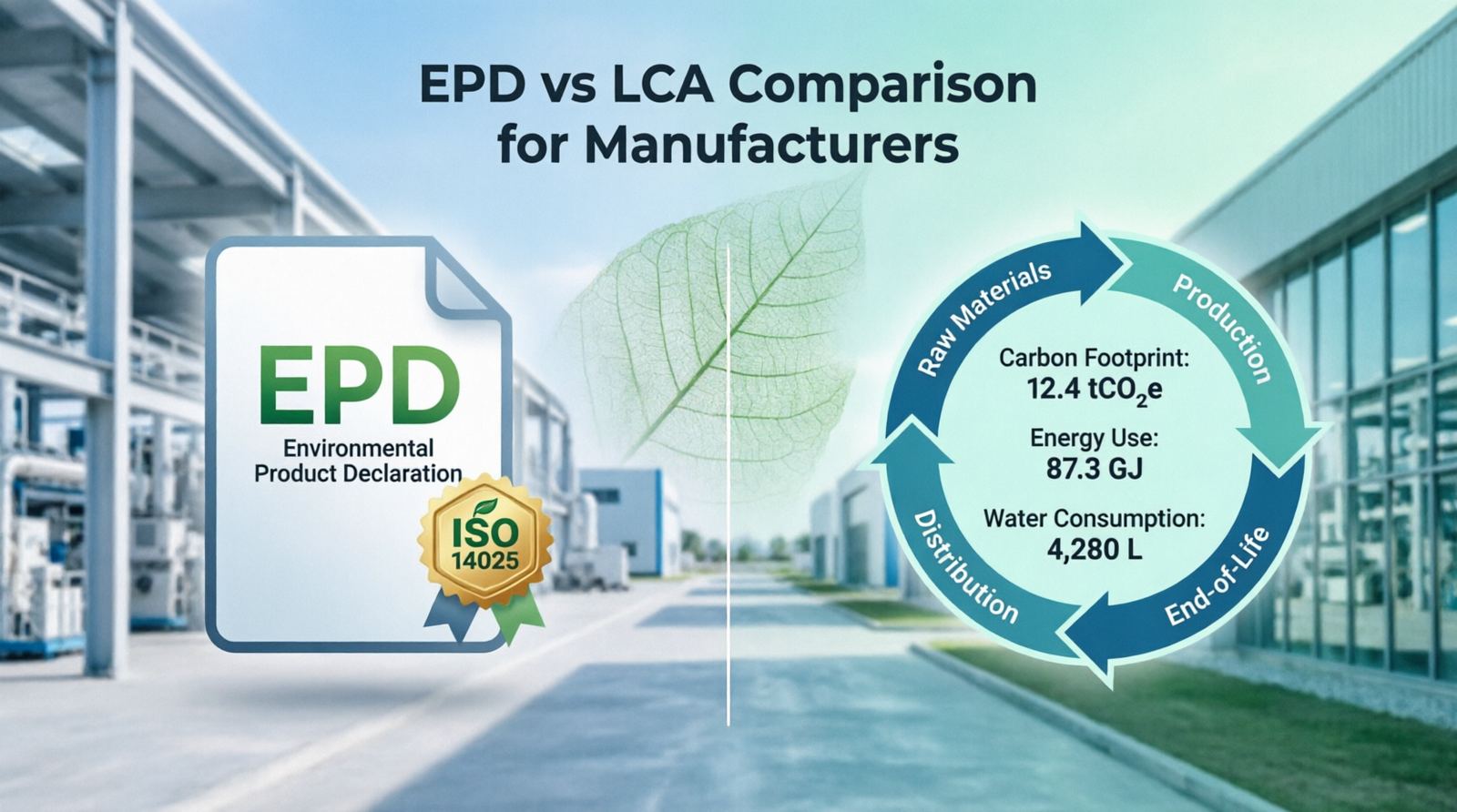
Think of it this way. The LCA is the research. The EPD is the published report based on that research — independently checked, standardized, and accessible to anyone who needs it.
EPDs follow ISO 14025 — the international standard for Type III environmental declarations. They must also follow EN 15804 for construction products. Every EPD is based on an LCA. But not every LCA becomes an EPD.
What makes an EPD different from a raw LCA study:
- It is independently verified by an accredited third party
- It follows a standardized format using a Product Category Rule
- It is publicly registered with a recognized program operator
- It is accessible to architects, project teams, and procurement bodies
- It is valid for five years from publication date
LEED project teams, procurement bodies, and green building assessors require EPDs — not internal LCA studies. The EPD is the document they can use. The LCA is the foundation that makes the EPD credible.
EPD vs LCA — Direct Comparison
This table covers every key difference manufacturers ask about.
| Feature | LCA | EPD |
|---|---|---|
| Definition | Scientific study of environmental impact | Verified public declaration of LCA results |
| Standard | ISO 14040, ISO 14044 | ISO 14025, EN 15804 |
| Verification | Not required | Mandatory third-party verification |
| Availability | Internal — typically confidential | Publicly registered and accessible |
| Format | Technical research report | Standardized declaration document |
| Product Category Rule | Not required | Mandatory |
| LEED acceptance | Not accepted alone | Accepted when verified and published |
| Procurement use | Not directly usable | Directly usable in tender submissions |
| Validity period | No expiry — but data becomes outdated | 5 years from publication date |
| Who conducts it | LCA consultant | LCA consultant — feeds into EPD process |
| Cost component | Part of total EPD cost | Verification and registration add to LCA cost |
| Purpose | Internal decision making and improvement | External transparency and compliance |
The relationship is sequential. You conduct an LCA first. The LCA results feed into the EPD. The EPD packages those results in a format that the market can use.
Why You Need Both — Not Just One
Some manufacturers ask — can we just do an LCA and skip the EPD? Others ask — can we get an EPD without doing a full LCA?
The answer to both questions is no.
LCA without EPD
An internal LCA study is useful for product improvement decisions. It tells you where the biggest environmental impacts are and where to focus reduction efforts. But it cannot be submitted to LEED project teams. It cannot be used in green procurement documentation. It has no independent verification that others can rely on. For commercial purposes — specifications, tenders, green building credits — an LCA alone delivers nothing externally.
EPD without LCA
An EPD cannot exist without an LCA. The EPD is literally a report of LCA results. There is no shortcut. Every EPD — whether product-specific or industry-wide — is based on LCA data. Attempting to develop an EPD without a proper LCA produces a document that fails third-party verification.
The correct approach is always: conduct the LCA properly, then build the EPD from those results. Both are needed. One without the other is either commercially useless or technically impossible.
How LCA and EPD Work Together in Practice
Here is how the two processes connect in a real manufacturing context.
A UAE-based concrete block manufacturer wants to qualify for LEED projects. Their products are specified in construction across Dubai and Abu Dhabi. Project teams are asking for EPDs.
Stage 1 — LCA
The consultant collects manufacturing data — cement inputs, aggregate sourcing, water use, energy consumption, transport distances. UAE electricity grid data is used. Regional raw material sourcing data is applied. The LCA models environmental impact from cradle to gate — raw material extraction through manufacturing and delivery to site.
Results show Global Warming Potential of X kg CO₂ equivalent per declared unit. Energy use, water use, and waste generation figures are calculated for all required impact categories.
Stage 2 — EPD Development
LCA results are compiled into an EPD document following ISO 14025 and EN 15804. The applicable PCR for concrete products is applied. System boundary, data quality, and declared unit are documented clearly.
Stage 3 — Verification
An independent verifier reviews the LCA methodology, data quality, PCR compliance, and EPD document completeness. A verification statement is issued confirming compliance.
Stage 4 — Registration and Publication
The verified EPD is submitted to the International EPD System. It is published publicly with a unique EPD number. The manufacturer adds the EPD to product datasheets and their website.
Commercial outcome
LEED project teams in Dubai and Abu Dhabi can now specify the concrete blocks and count them toward their MR credit threshold. Competitors without EPDs lose those specifications. The entire process — from LCA start to EPD publication — took four months.
That is how LCA and EPD work together. One feeds the other. Both deliver the commercial result.
LCA Scope — What Gets Measured and When
Understanding LCA scope helps manufacturers know what data they need to collect and what the EPD will cover.
Cradle-to-Gate
Covers raw material extraction through manufacturing — up to the factory gate. This is the minimum scope accepted for most LEED applications. Most construction product EPDs use cradle-to-gate as their declared scope.
Cradle-to-Gate with Options
Adds transport to site and installation stage data as optional modules. More complete than basic cradle-to-gate. Provides additional data for project teams calculating whole-building environmental impact.
Cradle-to-Grave
Covers the full life cycle — raw material extraction through manufacturing, transport, use phase, and end-of-life disposal or recycling. The most complete scope. Required for some product categories and some green building standards beyond LEED.
Cradle-to-Cradle
Extends cradle-to-grave to include recycling and material recovery loops. Relevant for products with significant recycled content or recyclability benefits.
For most UAE manufacturers targeting LEED compliance, cradle-to-gate is the starting point. Your consultant confirms the required scope based on the applicable PCR and your target green building standards.
Common Mistakes Manufacturers Make With LCA and EPD
These errors are common — and all of them are avoidable with the right consultant from the start.
Conducting an LCA without knowing the PCR requirements
The LCA must follow the applicable Product Category Rule. If the PCR requires specific life cycle stages, impact categories, or allocation methods — and the LCA does not follow them — the entire LCA may need to be redone. Identify the PCR before starting the LCA.
Using global average data instead of UAE-specific data
Generic global LCA databases produce less accurate results for UAE manufacturers. UAE electricity mix, regional transport distances, and local material sourcing affect environmental impact figures significantly. Always use regionally appropriate data.
Treating LCA as a one-time exercise
LCA data becomes outdated when manufacturing processes change. An EPD built on outdated LCA data fails renewal verification. Maintain your LCA data as your processes evolve.
Confusing LCA with carbon footprint assessment
A carbon footprint assessment measures only greenhouse gas emissions. An LCA covers multiple environmental impact categories. An EPD requires a full LCA — not just a carbon footprint study. These are not interchangeable.
Attempting EPD development without LCA expertise
EPD development requires specialist LCA knowledge. Manufacturers who attempt to compile EPD documents without proper LCA methodology produce documents that fail third-party verification. Use experienced consultants with proven EPD delivery records.
Skipping verification to save cost
Third-party verification is mandatory for a valid EPD. Some manufacturers attempt to reduce costs by minimizing verification scope. This produces an EPD that fails program operator acceptance — wasting the entire LCA and EPD development investment.
EPD and LCA for Saudi Arabia Manufacturers
The EPD process in Saudi Arabia follows the same international standards as UAE — ISO 14025, EN 15804, ISO 14040, ISO 14044. But Saudi-specific LCA inputs matter.
Saudi Arabia’s electricity grid has a different energy mix than the UAE. Transport distances from raw material sources differ. Local material availability affects procurement assumptions in the LCA.
Saudi manufacturers exporting to international markets or supplying LEED projects under Vision 2030 developments need EPDs that reflect Saudi manufacturing reality — not UAE or European averages.
Key Saudi Arabia green building contexts where EPDs apply:
- LEED v4 and v4.1 projects — same credit structure as globally
- GSAS — Global Sustainability Assessment System — recognizes EPDs in material credits
- Saudi Green Building Forum sustainability requirements
- Vision 2030 mega-project procurement specifications — NEOM, Red Sea Project, Diriyah
A single EPD developed with Saudi-specific LCA data serves all of these simultaneously. Manufacturers who develop EPDs now position themselves ahead of procurement requirements that are tightening across all major Saudi development projects.
Questions Manufacturers Ask About EPD vs LCA
If we already have an LCA study, how long does the EPD take?
If a current, complete LCA study exists and follows the correct PCR methodology, EPD development can move significantly faster — potentially 6 to 10 weeks from EPD document preparation through verification and publication. The LCA stage — typically the longest part — is already complete.
Does our ISO 14001 certification replace the need for an LCA?
No. ISO 14001 is a company-level environmental management system standard. It covers how your organization manages environmental impacts. An LCA is a product-level quantitative study. ISO 14001 and LCA are complementary — but ISO 14001 does not substitute for LCA or EPD.
Can we use a competitor’s EPD as a benchmark?
Published EPDs are publicly available. You can review competitor EPDs to understand industry benchmarks for your product category. This helps you assess whether your product performs better or worse than the industry average — relevant for LEED Option 2 credit eligibility.
What is the difference between a background LCA system and foreground data?
Foreground data is your specific manufacturing data — your actual material inputs, energy consumption, waste generation. Background system data covers upstream processes — energy grids, raw material production, transport modes — sourced from LCA databases. Your consultant combines both to produce a complete LCA.
Does the LCA need to be updated every time the EPD is renewed?
If no significant manufacturing changes have occurred, the LCA data can often be reviewed and confirmed rather than fully redone. Significant process changes — new materials, new suppliers, new energy sources — require LCA updates before EPD renewal.
Can one LCA support multiple EPDs for different products?
In some cases, yes. If multiple products share similar manufacturing processes and material profiles, one LCA study can support multiple EPDs — reducing total cost. Your consultant assesses whether this approach is appropriate for your product range.
EPD vs LCA — Quick Reference for Manufacturers
Use this summary when explaining EPD and LCA requirements to internal teams or clients.
- LCA = the scientific study that measures environmental impact
- EPD = the verified public document that reports LCA results
- LCA is internal — EPD is external and publicly registered
- LCA alone does not qualify for LEED — EPD does
- EPD requires LCA — there is no EPD without an LCA
- LCA follows ISO 14040 and 14044 — EPD follows ISO 14025 and EN 15804
- EPD requires third-party verification — LCA does not
- EPD is valid for 5 years — LCA data needs updating when processes change
- Both are needed — one without the other delivers incomplete outcomes
EPD and LCA Checklist for UAE and Saudi Arabia Manufacturers
- Confirm which green building standard or procurement policy requires your EPD
- Identify the correct Product Category Rule before starting LCA work
- Confirm required life cycle scope — cradle-to-gate minimum for most LEED applications
- Collect UAE or Saudi-specific manufacturing data — energy, materials, water, waste, transport
- Use regionally appropriate LCA databases — not generic global averages
- Ensure LCA methodology follows ISO 14040 and ISO 14044
- Develop EPD document following ISO 14025 and EN 15804
- Complete independent third-party verification — mandatory not optional
- Register with a program operator recognized by your target green building standard
- Publish EPD and communicate availability to specification teams immediately
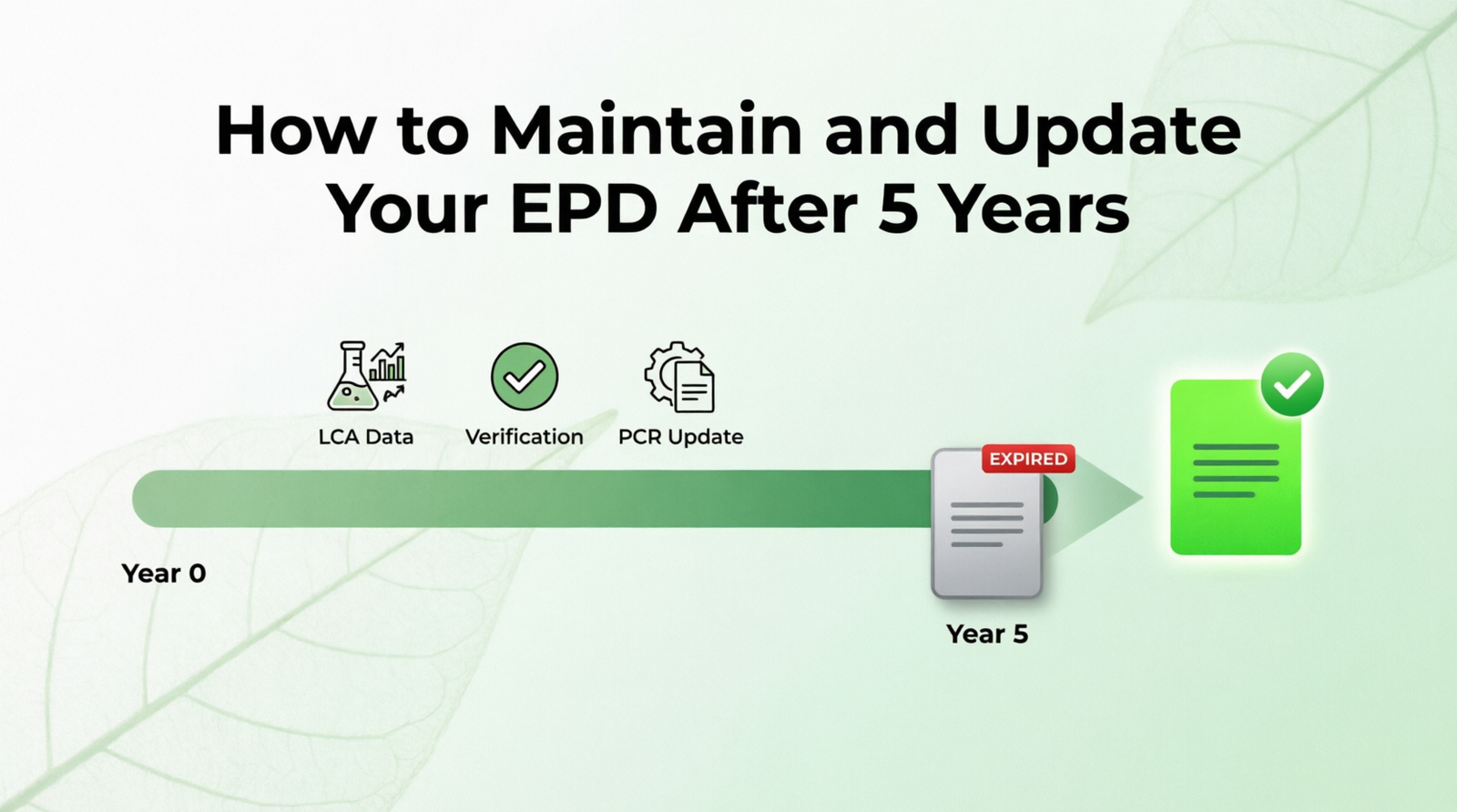
- Plan EPD renewal 6 months before 5-year expiry — start LCA review early
Frequently Asked Questions
Is an LCA study confidential if we decide not to publish an EPD?
Yes. An LCA study is an internal document. You are not obligated to publish it or develop an EPD from it. Many manufacturers conduct LCAs purely for internal product improvement decisions. If you later decide to develop an EPD, the existing LCA can be used as the foundation.
What environmental databases are used for UAE and Saudi LCA studies?
Recognized databases include ecoinvent, GaBi, and the European Life Cycle Database. Regional data sets for Middle East energy grids and transport are applied where available. Your consultant selects the most appropriate and current data sources for your specific product and location.
Does an EPD replace the need for product testing?
No. An EPD reports environmental impact — it does not cover product performance, safety, or regulatory compliance testing. EPD and product testing serve different purposes. Both may be required depending on your product category and target market.
Can a distributor develop an EPD on behalf of a manufacturer?
EPDs are issued to the entity responsible for the product — typically the manufacturer. A distributor can facilitate the EPD development process but the EPD is registered in the manufacturer’s name. If you distribute products, encourage your suppliers to develop EPDs and share the published documents for use in project submissions.
How does EPD data contribute to whole-building LCA calculations?
Architects and sustainability consultants use EPD data from individual products to calculate the whole-building environmental impact. This feeds into green building rating credits beyond the MR credit — including credits for overall carbon performance and embodied carbon targets.
Start Your EPD and LCA Process
Understanding EPD vs LCA is the first step. The second is starting the process with the right support.
Envirolink provides complete LCA and EPD development for manufacturers in UAE, Saudi Arabia, and across the GCC — from initial scope definition through verification, registration, and publication.
Whether you need a full EPD guide, help understanding EPD importance, or are ready to start your EPD development and verification — the team is ready.
Contact Envirolink today for a free consultation and fixed-price scope assessment.