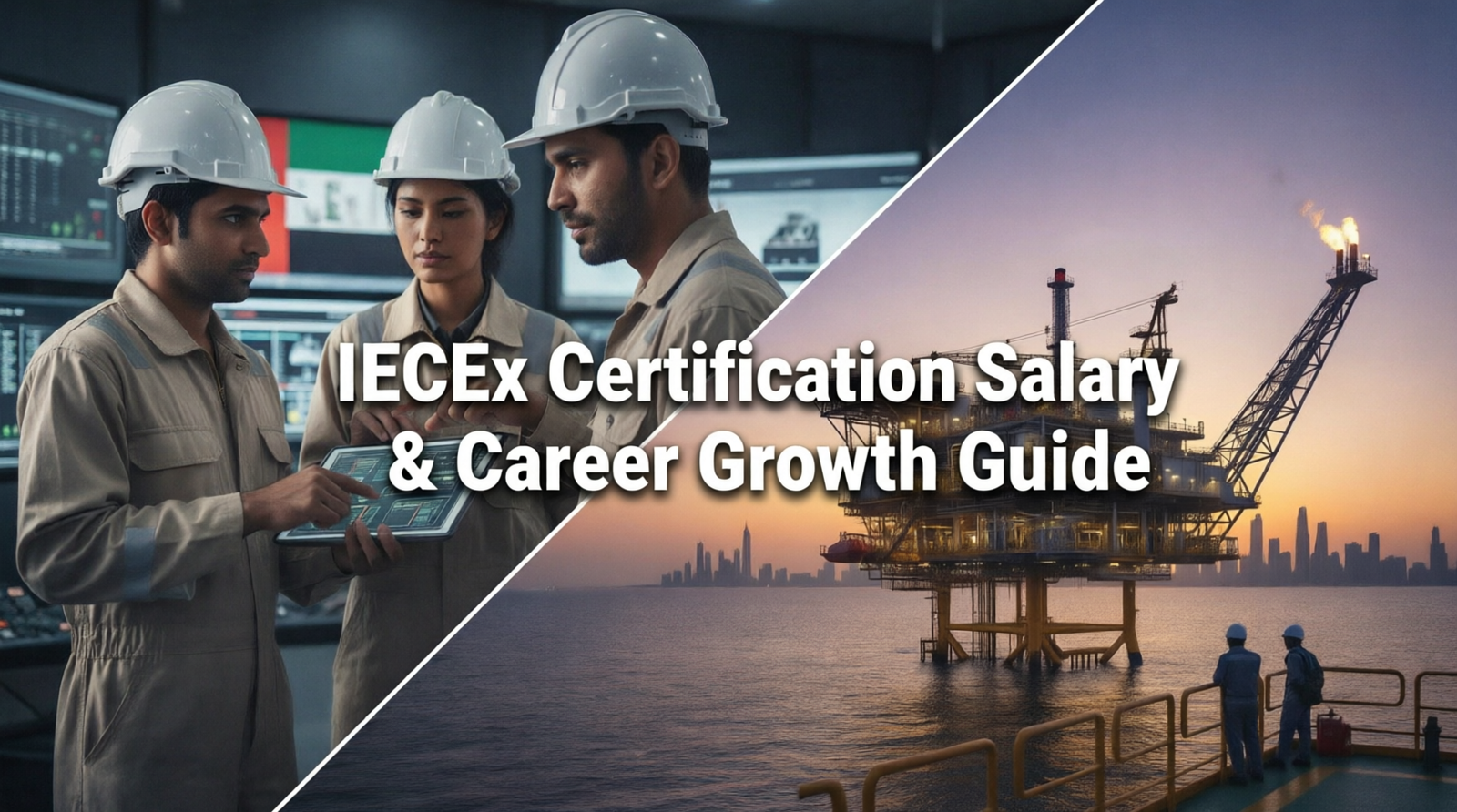
IECEx Certification Salary & Career Growth Guide: How Much More Do Certified Professionals Earn in the UAE & GCC (2026)
If you work anywhere near an oil and gas plant, refinery, LNG terminal, or industrial facility in the UAE, Saudi Arabia, Qatar, or India, you’ve probably heard colleagues mention IECEx certification. What doesn’t get talked about enough is the part that actually matters to most people considering it: does it pay off, and by how much?
This guide breaks down what IECEx certification typically does to a hazardous-area professional’s salary and career trajectory across the GCC and India, so you can decide whether the investment makes sense for your situation — not just what the certificate covers on paper.
📄 Free Download: The Complete IECEx Certification Guide Want the full breakdown — competency units, certification steps, costs, and regional requirements for UAE, Saudi Arabia, Qatar & India — in one document? Download the Complete IECEx Certification Guide (PDF) →
Why IECEx Certification Moves the Needle on Pay
IECEx certification isn’t a generic training completion certificate. It’s a third-party, competency-based credential issued under the International Electrotechnical Commission’s Certificate of Personnel Competence (CoPC) scheme, which means an independent assessor has verified — through practical assessment and written exams — that you can actually work safely with equipment in explosive atmospheres, not just that you sat through a course.
Employers in oil and gas, petrochemicals, LNG, mining, and pharma treat that distinction seriously, for a simple reason: an uncertified technician working incorrectly on Ex-rated equipment can cause an explosion. A certified one has been independently tested against that exact risk. That’s why national operators and majors — including ADNOC, Saudi Aramco, QatarEnergy, and India’s ONGC, BPCL, and IOCL — increasingly name IECEx competency directly in contractor and hiring specifications rather than leaving it as a “nice to have.”
When a credential becomes a hiring gate rather than a preference, it naturally pushes pay for certified holders upward, because the pool of qualified candidates shrinks relative to demand.
What the Salary Difference Actually Looks Like
Pay premiums vary by country, employer, and role, but the pattern across the region is consistent: certified professionals command noticeably higher day rates and monthly packages than uncertified peers doing similar work, and the gap tends to widen with seniority and with the number of competency units held.
Entry-to-mid-level technicians and electricians (Ex 002 — Installation, Inspection & Maintenance) Certification here is usually the first step for hands-on staff. It typically unlocks eligibility for hazardous-area maintenance contracts that uncertified technicians simply can’t bid for or be assigned to, which translates into steadier project work and stronger day-rate negotiating power on a per-contract basis.
Design and project engineers (Ex 003 — Design Verification & Documentation) This tier sits closer to project leadership. Certified design engineers are frequently the ones signing off on hazardous-area drawings and equipment selection for EPC contractors, a responsibility that carries meaningfully higher compensation than execution-only roles.
Safety inspectors and compliance officers Certification here supports movement into audit, verification, and compliance leadership positions — roles that sit above field execution in both pay grade and reporting line, particularly on major operator sites where compliance sign-off authority is tightly controlled.
Specialist unit holders (Ex 007 Intrinsic Safety, Ex 006 Increased Safety, Ex 005 Flameproof Enclosures) Professionals who stack specialist competency units on top of a base certification tend to see the strongest pay differentiation, because they qualify for niche, higher-risk work that generalist-certified staff cannot perform — instrumentation design for intrinsically safe systems, rotating equipment protection, and enclosure verification, for example.
Across the region, professionals holding IECEx certification generally report earning meaningfully more than uncertified peers in equivalent roles, with the gap most pronounced for those holding multiple competency units rather than a single base unit.
Regional Snapshot: UAE, Saudi Arabia, Qatar & India
UAE — With ADNOC and Dubai/Abu Dhabi’s industrial and energy diversification (including growing hydrogen and renewable projects that carry their own hazardous-area requirements), IECEx-certified electricians, inspectors, and engineers are positioned for both stronger day rates and longer-term contract security compared to non-certified staff in the same trade.
Saudi Arabia — Saudi Aramco’s technical specifications and Supplier Safety Management System (SSMS) manual reference IECEx competency directly. For contractors and staff working Aramco-linked projects, certification is increasingly the difference between qualifying for a tender role at all and being excluded from it — which has an obvious effect on earning potential.
Qatar — The scale of Qatar’s LNG sector means certified hazardous-area professionals are in consistent demand from QatarEnergy and its EPC contractors. Certification here tends to open access to longer, better-paid project assignments rather than short-term contract work.
India — With PESO’s regulatory role and increasing adoption by ONGC, BPCL, and IOCL, IECEx certification is becoming a differentiator for engineers targeting multinational employers or GCC-based contracts, where the credential is recognized without the friction of translating a purely domestic qualification.
How Fast Does the Investment Pay Back?
This is usually the real question behind “is it worth it.” Training and certification for a single competency unit typically runs from roughly USD 1,500 to 3,500, with multi-unit packages costing more upfront but pricing out cheaper per unit. Set against that, most certified professionals recover the training cost within their first year through improved day rates, tender eligibility, or a role change — often faster in the GCC, where certified-only project assignments are common and pay differentials show up immediately rather than gradually.
The clearest payback comes from three levers working together: access to work you couldn’t previously bid for, a stronger negotiating position on rate, and eligibility for the next role up (inspector, design engineer, or project lead) rather than staying capped in a purely execution-level position.
Career Paths That Open Up After Certification
IECEx certification is rarely a career endpoint — it’s usually a gateway to one of a few common next steps:
- Field technician → Senior maintenance lead: Additional competency units and years of verified field work support a move into supervising maintenance teams on hazardous-area contracts.
- Installation engineer → Design verification engineer: Moving from Ex 002 into Ex 003 shifts you from execution work into the design sign-off side of projects, typically a higher-responsibility, higher-pay track.
- Technician → Safety/compliance inspector: Strong field experience plus certification supports a move into inspection and audit roles, which carry sign-off authority most operators pay a premium for.
- Generalist → Specialist consultant: Engineers who stack specialist units (intrinsic safety, flameproof enclosures, area classification) increasingly move into consulting or training roles themselves, advising EPC contractors or delivering training to the next generation of candidates.
Getting Started the Right Way
The salary and career gains above depend entirely on holding a genuine, verifiable IECEx CoPC — not a generic training completion certificate. Before enrolling anywhere, confirm the provider is an officially recognized IECEx Recognized Training Provider (RTP), and that your eventual certificate will be entered into the public IECEx On-Line Certification System (OCS), where employers can verify it directly.
Extrainings, delivered through KL Training Academy — an accredited IECEx RTP covering the UAE and India — runs training aligned to current competency units with practical assessment components that mirror the real CoPC exam, across facilities in Abu Dhabi, Dubai, Qatar, Saudi Arabia, and India.
Frequently Asked Questions
Is IECEx certification worth it financially?
For most hazardous-area professionals in the UAE, Saudi Arabia, Qatar, and India, yes — the certification typically pays for itself within the first year through better day rates, project eligibility, and role progression, especially once a second or third competency unit is added.
Which competency unit gives the strongest salary boost?
There’s no single answer — it depends on your current role. Field technicians usually see the fastest return from Ex 002 (installation, inspection, maintenance), while engineers aiming for design or compliance leadership benefit more from Ex 003 or specialist units like Ex 007.
Do employers actually pay more for IECEx certification, or is it just a hiring filter?
Both. In many GCC contracts, certification is now a prerequisite just to be considered for hazardous-area work — but once you’re in, certified staff also typically negotiate from a stronger position because they’re a scarcer, verified resource.
How long does it take to see a return on the certification cost?
Most professionals in the region report recovering their training investment within six to twelve months, driven mainly by access to better-paid contracts rather than an immediate raise in a fixed salary.
Ready to start? Get in touch with Extrainings to find the right IECEx competency units for your role and region.