Why Concrete Manufacturers in UAE Need EPD Now
Concrete is the most used construction material in the UAE. Every tower, road, bridge, and infrastructure project depends on it. Yet concrete is also one of the largest contributors to carbon emissions in construction.
That combination creates pressure — and opportunity.
EPD for concrete in UAE gives manufacturers a way to prove their environmental credentials with verified data. It replaces vague green claims with numbers that buyers, architects, and project developers can actually use.
Short Answer: An EPD for concrete in UAE is a third-party verified document that quantifies the environmental impact of concrete products across their full life cycle. It follows ISO 14025 and EN 15804 standards and supports LEED, Estidama, and sustainable procurement requirements in UAE construction projects.
What Is an EPD for Concrete Products?
An EPD for concrete products is a standardised declaration. It measures the environmental footprint of a specific concrete product — a block, a panel, a ready-mix formula, or a precast element.
It is not a general company sustainability statement. It is product-specific and data-driven.
The declaration covers impact categories including:
- Global Warming Potential (GWP) — measured in kg CO₂ equivalent
- Ozone Depletion Potential
- Acidification Potential
- Eutrophication Potential
- Abiotic Resource Depletion
Each category tells buyers something real about the product’s environmental profile.
Concrete EPD vs Generic Industry Data
Many specifiers accept industry average data in early project stages. But for LEED v4 credits and serious procurement decisions, product-specific EPD carries far more weight than generic datasets.
A concrete manufacturer with its own verified EPD stands on solid ground. One relying on averages stands on assumptions.
Why Is EPD Important for Concrete Manufacturers in UAE?
Green Building Projects Demand It
UAE construction is scaling up green building targets. LEED v4 and v4.1 projects require EPDs from at least 20 permanently installed products to earn the Building Product Disclosure credit. Concrete almost always qualifies as a permanently installed product.
Developers actively seek concrete suppliers who already hold EPD certification. It saves them documentation time and speeds up credit applications.
Government Infrastructure Projects Prefer It
Abu Dhabi and Dubai sustainability frameworks encourage verified environmental data in procurement. Concrete suppliers with EPDs gain a meaningful advantage in government-linked tender processes.
Export Markets Require It
European buyers require EN 15804-compliant EPDs for construction products. If UAE concrete manufacturers plan to export to Europe or work with European contractors locally, EPD for concrete in UAE is not optional — it is a baseline requirement.
It Reveals Where Cost Savings Hide
The Life Cycle Assessment process behind every EPD shows exactly where environmental impact occurs. For concrete, that is usually the cement content. Reducing cement without sacrificing strength cuts both carbon and raw material costs simultaneously.
How Is Carbon Footprint Calculated for Concrete EPD?
This is the technical heart of the process. Understanding it helps manufacturers prepare better and faster.
Stage A1 to A3: Product Stage
This covers raw material extraction, transport to the plant, and manufacturing. For concrete, this means:
- Cement production emissions (typically the largest share)
- Aggregate quarrying and transport
- Water and admixture inputs
- Energy used in batching and mixing
Most of concrete’s carbon footprint sits in Stage A1 to A3. Cement alone can account for 70 to 90 percent of the total GWP figure.
Stage A4 to A5: Construction Stage
This covers transport from the plant to the construction site and the installation process. Distance to site and delivery method directly affect this figure.
Stage B: Use Stage
For most concrete products, the use stage has minimal environmental activity. However, carbonation — where concrete slowly absorbs CO₂ — is sometimes included here as a biogenic carbon offset.
Stage C and D: End of Life and Beyond
Stage C covers demolition, transport, and disposal. Stage D captures reuse, recycling, and recovery potential beyond the system boundary. Recycled aggregate potential in concrete gives Stage D genuine value.
EPD Requirements for Construction Materials in UAE
The UAE does not yet operate a single national EPD program. However, internationally recognised standards apply directly to UAE projects.
ISO 14025
This is the foundational standard for Type III environmental declarations. All concrete EPDs in UAE must comply with this standard.
EN 15804
This European standard provides the core Product Category Rules (PCR) for construction products. Most program operators accepted in UAE — including IBU and EPD International — follow EN 15804 as the basis for concrete EPDs.
Product Category Rules (PCR) for Concrete
Concrete has specific PCR documents that set rules for the LCA study. These rules define:
- System boundary requirements
- Which impact categories to report
- Data quality standards
- Comparison rules between products
Using the correct PCR is mandatory. An EPD based on the wrong PCR will not earn LEED credits or pass verifier review.
Step-by-Step Process to Get EPD for Concrete in UAE
Getting your EPD for concrete in UAE follows a clear sequence. Here is what to expect at each stage.
Step 1: Define the Product
Specify exactly which concrete product or product range you want to declare. Ready-mix concrete, precast panels, blocks, and pavers each follow different PCR rules. Be precise from the start.
Step 2: Collect Primary Production Data
Gather 12 months of actual production data. This includes cement quantities by type, aggregate sources and volumes, water consumption, energy use by type, admixture inputs, and waste generated. Real data produces stronger, more credible EPDs.
Step 3: Engage an Accredited LCA Consultant
Work with a consultant experienced in EPD for concrete products. They model the full life cycle using specialised LCA software and apply the correct PCR rules for your product type.
Step 4: Run the LCA Study
The consultant calculates all environmental impact indicators across the declared life cycle stages. They apply UAE-specific background data where available and internationally recognised datasets where local data is unavailable.
Step 5: Draft the EPD Document
The LCA results are formatted into the EPD document following the program operator’s requirements. The document includes all mandatory disclosures, data quality statements, and system boundary descriptions.
Step 6: Independent Third-Party Verification
An accredited verifier reviews both the LCA study and the EPD document. They check data accuracy, PCR compliance, and calculation methodology. No EPD is issued without passing this step.
Step 7: Registration and Publication
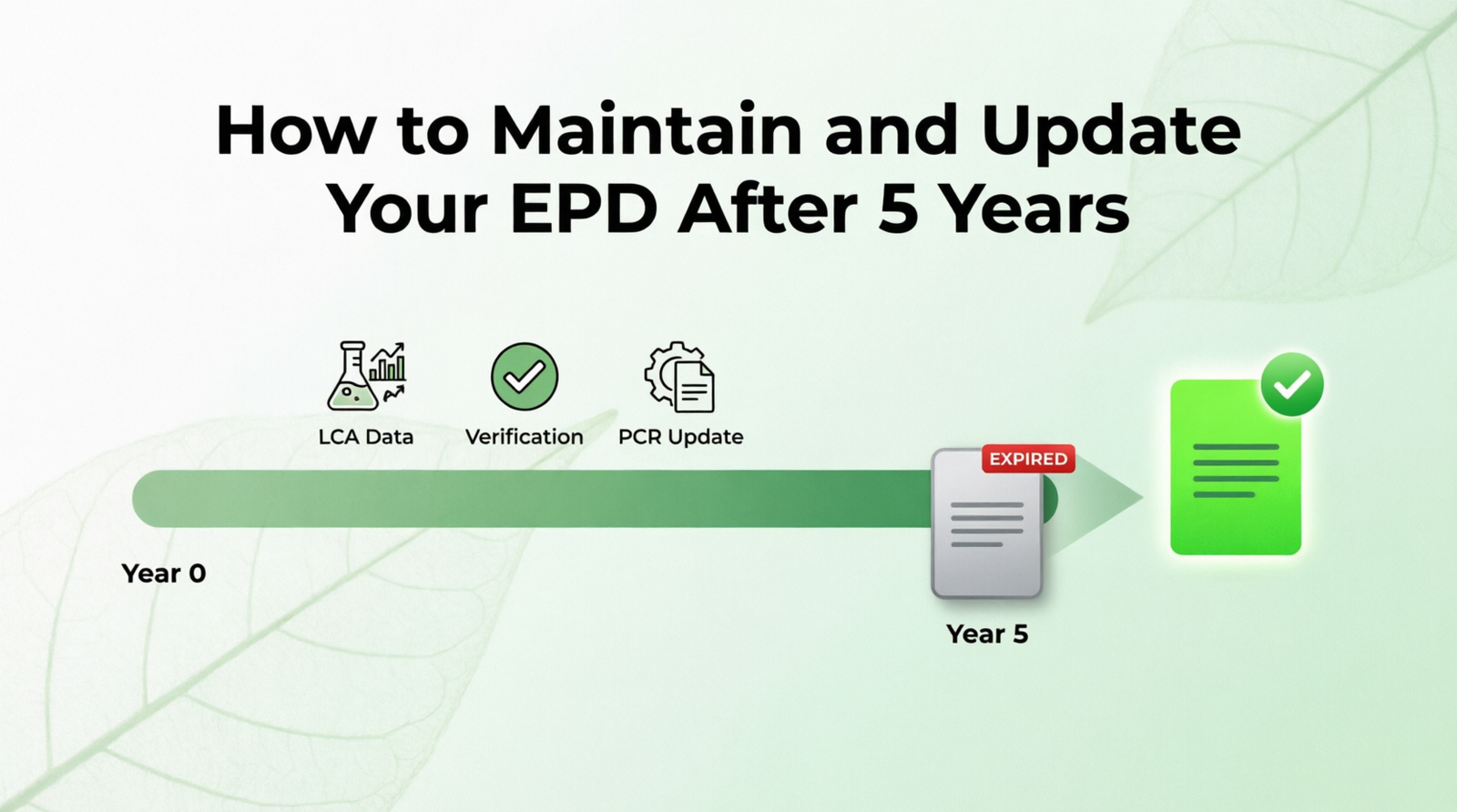
The verified EPD is submitted to a program operator for registration. Once registered, it receives a unique identification number and becomes publicly available. It is valid for five years from the date of issue.
What Standards Apply to Construction EPD in UAE?
| Standard | Role |
|---|---|
| ISO 14025 | Defines Type III environmental declarations |
| EN 15804 | Sets PCR rules for construction products |
| ISO 14040/14044 | Governs the LCA methodology |
| ISO 21930 | Specific to sustainability in building construction |
Verifiers check compliance with all applicable standards before approving any concrete EPD.
Concrete EPD Example: What the Numbers Look Like
A typical ready-mix concrete EPD for a C30 grade mix might show:
- GWP (A1-A3): 280 to 380 kg CO₂ eq per cubic metre
- Acidification: 0.6 to 1.2 kg SO₂ eq per cubic metre
- Primary Energy Demand: 1,800 to 2,500 MJ per cubic metre
These numbers vary significantly based on cement type, supplementary cementitious materials used (such as GGBS or fly ash), and local energy grid mix.
Manufacturers who replace Portland cement with GGBS or fly ash see GWP figures drop by 20 to 40 percent. That improvement shows clearly in the EPD and becomes a direct selling point.
Common Pain Points for Concrete Manufacturers Pursuing EPD
“Our data records are incomplete.”
Start collecting now. A 12-month production record is the minimum. Many manufacturers begin data collection three to six months before formally starting the EPD process.
“We don’t know which cement supplier data to use.”
Your LCA consultant sources cement EPDs from your specific suppliers or uses verified industry datasets. Supplier EPDs produce more accurate results and stronger final declarations.
“We produce many mix designs — do we need separate EPDs?”
Not necessarily. A range EPD can cover multiple mix designs under one declaration. Your consultant advises on whether a single EPD or multiple declarations best serve your market needs.
“We’re worried our GWP figure looks bad.”
An honest GWP figure is better than no figure. Specifiers compare across suppliers. A higher GWP with a clear improvement roadmap still beats a competitor with no data at all.
Benefits of EPD for Concrete Manufacturers in UAE
Win More Tenders
Concrete suppliers with EPD certification win specification battles. Developers and consultants prefer verified suppliers. It reduces their own due diligence burden.
Earn LEED Credits for Your Clients
Every concrete product with an EPD helps your client earn LEED material credits. That makes you a preferred supplier for green building projects — the fastest-growing segment of UAE construction.
Identify Manufacturing Improvements
The LCA process pinpoints high-impact inputs. For concrete, optimising cement blends based on EPD data reduces both carbon output and material cost. The business case is direct.
Build Export Market Access
European construction markets require EN 15804-compliant EPDs. UAE manufacturers with concrete EPDs can enter European supply chains or serve European contractors operating locally.
Frequently Asked Questions: EPD for Concrete in UAE
Why is EPD important for concrete manufacturers?
EPD proves your concrete’s environmental performance with verified data buyers and developers trust.
How is carbon footprint calculated for concrete EPD?
Carbon footprint is calculated across raw materials, manufacturing, and transport using LCA methodology.
What standards apply to construction EPD in UAE?
EPD for concrete follows ISO 14025, EN 15804, and ISO 14040/14044 standards.
How long does a concrete EPD take in UAE?
Typically three to five months depending on data readiness and product complexity.
Can one EPD cover multiple concrete mix designs?
Yes, a range EPD can cover multiple mixes under one verified declaration.
Does EPD help win LEED credits?
Yes, concrete EPD contributes directly to LEED v4 Material Disclosure credits.
Who verifies concrete EPDs in UAE?
An independent third-party verifier accredited by the program operator checks all EPD submissions.
Final Word
EPD for concrete in UAE is moving from a differentiator to a baseline expectation. Concrete manufacturers who act now build a verifiable sustainability record while competitors are still figuring out where to start.
The process is structured. The benefits are measurable. And the market reward for early movers is real.
Start with your highest-volume mix design. Build from there. Your EPD becomes the document that wins the next tender your competitor cannot match.