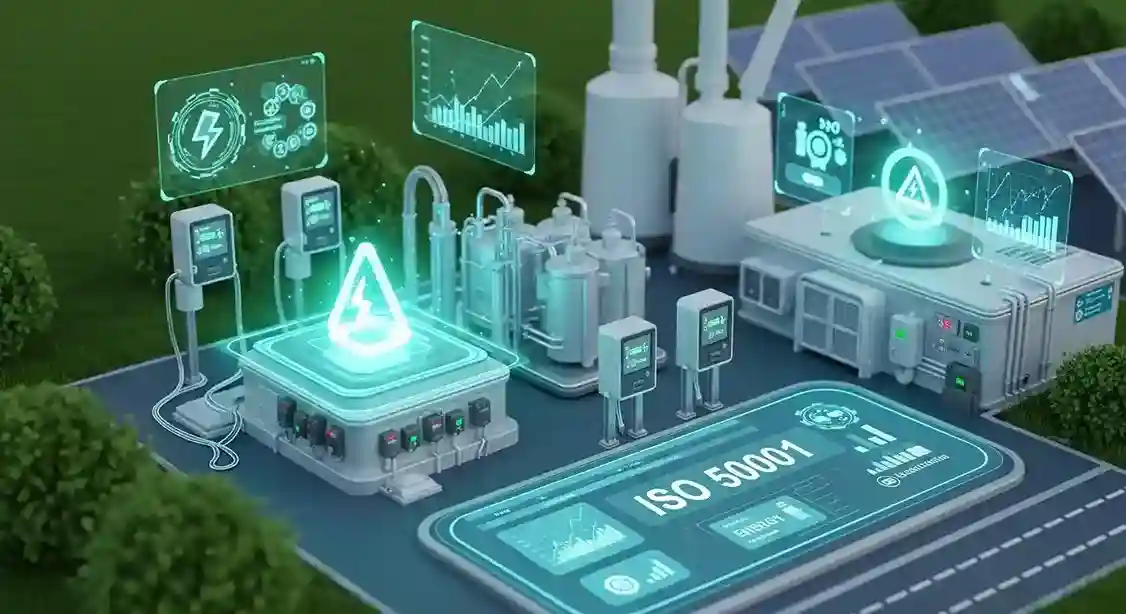
Are rising energy costs eating into your operating margins? Is your organisation under increasing pressure from investors, clients, or regulators to demonstrate measurable sustainability performance? ISO 50001 Certification is the internationally recognised answer — a structured framework that turns energy management from a reactive cost concern into a strategic, continuously improving business function.
This guide covers everything you need to know: what ISO 50001 is, who it applies to, what the requirements involve, how the certification process works, and how to get certified with expert support.
What Is ISO 50001 Certification?
ISO 50001 is an international standard published by the International Organization for Standardization that defines the requirements for establishing, implementing, maintaining, and continually improving an Energy Management System (EnMS). It provides organisations with a systematic, data-driven framework to manage energy consumption, identify efficiency opportunities, and reduce both costs and environmental impact on an ongoing basis.
ISO 50001 Certification is not a one-time energy audit. It is a management system standard built on the Plan-Do-Check-Act (PDCA) cycle — the same continuous improvement structure used by ISO 9001 Certification and ISO 14001 Certification — ensuring that energy performance improvements are permanent, measurable, and independently verified.
Featured Snippet: ISO 50001 Certification is a globally recognised standard for Energy Management Systems (EnMS). It helps organisations systematically reduce energy consumption, cut operational costs, meet regulatory obligations, and demonstrate ESG and sustainability commitments through a continuous improvement framework audited by an accredited third party.
Why ISO 50001 Certification Matters More Than Ever in 2025
Energy costs, carbon reporting obligations, and sustainability expectations have converged in 2025 to make energy management a boardroom priority — not just an operational concern.
Here is the pressure organisations face without a certified EnMS:
- Carbon disclosure requirements under frameworks such as TCFD, CSRD, and SEC climate rules now demand verified, auditable energy performance data that informal energy management cannot reliably produce
- Public sector tenders and large enterprise supply chain requirements increasingly list ISO 50001 Certification or equivalent energy management evidence as a mandatory qualification criterion
- Energy-intensive industries operating in the EU face compliance obligations under the Energy Efficiency Directive, where ISO 50001 certification is recognised as an accepted alternative to mandatory energy audits
- Investors and ESG rating agencies are downgrading organisations without credible, third-party verified energy management systems — directly affecting access to capital and valuation
- Organisations without structured energy controls are consistently overpaying for energy, maintaining inefficient equipment longer than necessary, and missing the compounding financial benefits of systematic efficiency gains
The organisations that certify today lock in lower energy costs, stronger ESG credentials, and regulatory resilience that competitors without certification simply cannot match.
Who Needs ISO 50001 Certification?
ISO 50001 is applicable to any organisation where energy consumption is a significant operational factor — regardless of sector, size, or geography. The standard was specifically designed to be scalable, meaning it works for a single manufacturing facility and for a multinational operating dozens of energy-intensive sites simultaneously.
Manufacturing Facilities with High Energy Loads are the most common candidates. Cement, steel, glass, chemical, and automotive manufacturers consume enormous volumes of energy — and even modest percentage reductions in consumption produce substantial cost savings and emissions reductions at scale.
Oil, Gas, and Utilities Providers operate complex energy systems where efficiency losses compound across large infrastructure networks. ISO 50001 provides the systematic controls to identify and eliminate those losses consistently.
Data Centres and IT Infrastructure Companies have become among the largest energy consumers in the modern economy. Certification demonstrates to clients, regulators, and investors that energy efficiency is built into operations — not bolted on as a marketing claim.
Hospitals and Healthcare Institutions run facilities that operate around the clock with significant HVAC, lighting, medical equipment, and refrigeration loads. A certified EnMS reduces costs without compromising clinical operations or patient safety.
Food Processing and Cold Storage Businesses depend on continuous refrigeration and temperature-controlled environments — energy-intensive processes where efficiency improvements directly protect margins and product quality.
Large Commercial Buildings and Real Estate Portfolios face growing regulatory pressure around building energy performance ratings. ISO 50001 provides the management framework to drive consistent improvements across multiple sites.
Educational Institutions and Universities managing large campuses with diverse energy needs use ISO 50001 to reduce utility costs, meet sustainability commitments, and demonstrate responsible stewardship to students and funders alike.
If your organisation has significant energy bills, carbon footprint reduction targets, or stakeholder pressure to demonstrate sustainability performance with verified data — ISO 50001 Certification is the credible, measurable path forward.
ISO 50001 Certification Requirements You Must Understand
To achieve ISO 50001 Certification, your organisation must implement a structured Energy Management System that satisfies the standard’s core clauses. These requirements translate into specific policies, processes, measurements, and records that auditors will evaluate against the standard.
Energy Policy — Top management must establish and formally approve an energy policy that commits the organisation to improving energy performance, complying with applicable legal requirements, and supporting the provision of information and resources necessary to achieve energy objectives.
Energy Planning — Conduct a systematic energy review that identifies significant energy uses (SEUs), establishes energy baselines, defines Energy Performance Indicators (EnPIs), and sets measurable energy objectives and targets with specific timeframes.
Significant Energy Uses (SEUs) — Identify the facilities, equipment, systems, processes, and personnel that account for substantial energy consumption or offer the greatest opportunity for improvement. SEUs receive dedicated monitoring, control, and action planning under the EnMS.
Energy Baselines — Establish documented reference points for energy performance against which future improvements are measured. Baselines must account for relevant variables that affect energy consumption — such as production volume, weather conditions, or occupancy levels.
Energy Performance Indicators (EnPIs) — Define quantitative metrics that allow your organisation to track energy performance over time. EnPIs may measure energy intensity per unit of output, consumption per square metre, or other sector-relevant metrics appropriate to your operations.
Operational Controls — Implement procedures and controls for all operations and activities associated with significant energy uses, ensuring that energy-efficient practices are embedded into daily operations rather than left to individual discretion.
Monitoring, Measurement, and Analysis — Establish metering, data collection, and analysis processes that produce reliable, timely energy performance data. This data drives decision-making, demonstrates improvement, and provides the evidence base for certification audits.
Legal and Regulatory Compliance — Identify all applicable energy-related legal, regulatory, and contractual requirements and demonstrate through records that the organisation remains in compliance on an ongoing basis.
Internal Audits — Conduct planned internal audits of the EnMS to verify that it conforms to the standard’s requirements and is effectively implemented and maintained. Audit findings must be documented and addressed through corrective action.
Management Review — Senior leadership must periodically review the EnMS to assess its continuing suitability, adequacy, and effectiveness — and make documented decisions about energy objectives, resource allocation, and system improvements.
Continual Improvement — Demonstrate ongoing improvement in energy performance through measurable reductions in energy intensity or consumption, documented through EnPI data, action plans, and audit records over time.
These requirements combine to create an EnMS that is not simply a documentation exercise but a genuinely operational system that produces verifiable, year-on-year energy performance improvement.
How to Get ISO 50001 Certified: Step-by-Step Process
Step 1 — Initial Energy Review and Gap Assessment
Conduct a comprehensive review of your current energy consumption patterns, existing management practices, and documentation against ISO 50001 requirements. This baseline assessment identifies your significant energy uses, quantifies current performance, and reveals precisely what must be developed or strengthened before certification.
Step 2 — EnMS Design and Documentation
Develop all required EnMS documentation — including the Energy Policy, energy planning records, EnPI definitions, energy baselines, operational control procedures, monitoring and measurement plans, and audit schedules. Documentation must be controlled, version-managed, and approved by appropriate authority levels within the organisation.
Step 3 — Energy Objectives and Targets Setting
Working from your energy review findings and baselines, define specific, measurable energy objectives and improvement targets with assigned responsibilities, resources, timelines, and methods for evaluating results. These become the performance commitments against which your EnMS will be judged.
Step 4 — EnMS Implementation Across Operations
Roll out the EnMS across all relevant departments, facilities, and functions. This includes staff training on energy awareness and roles, deployment of monitoring and metering systems, integration of energy controls into operational procedures, and establishment of data collection and reporting processes.
Step 5 — Monitoring and Measurement Activation
Activate your energy data collection systems and begin generating EnPI measurements against established baselines. Ensure data quality is sufficient for audit purposes and that trending analysis can demonstrate performance direction over time.
Step 6 — Internal Audit
Conduct a full internal audit of the EnMS implementation against ISO 50001 requirements. Document all findings, raise non-conformances, and implement corrective actions before the external certification audit is scheduled.
Step 7 — Management Review
Senior leadership formally reviews the EnMS, evaluates energy performance data against objectives and targets, assesses audit findings, and approves all actions and resource commitments required to proceed to certification.
Step 8 — Stage 1 Certification Audit
The accredited certification body reviews your EnMS documentation, energy planning outputs, and system design to confirm that the system is adequately structured and ready for a full implementation audit.
Step 9 — Stage 2 Certification Audit
Auditors conduct an in-depth assessment of EnMS implementation across your operations — verifying that energy controls are active, monitoring data is reliable, and the system is producing genuine energy performance improvement aligned with your stated objectives.
Step 10 — Certification Issued and Maintained
Upon successful completion of both audit stages, your ISO 50001 certificate is issued and valid for three years. Annual surveillance audits confirm continued compliance and ongoing improvement, with full recertification required at the end of the three-year cycle.
Key Benefits of ISO 50001 Certification for Your Organisation
Measurable Energy Cost Reduction — A certified EnMS systematically identifies and eliminates energy waste — delivering real, compounding reductions in utility bills that go directly to the bottom line. Organisations typically report energy savings of ten to thirty percent following full EnMS implementation.
Carbon Footprint Reduction and Net Zero Support — ISO 50001 provides the management infrastructure to set, track, and verify emissions reduction targets — making it a practical foundation for organisations committed to net zero pathways or science-based targets.
Regulatory Compliance and Legal Risk Reduction — In many jurisdictions, ISO 50001 Certification is accepted as an alternative to mandatory energy audits under national energy efficiency legislation, reducing compliance burden while satisfying regulatory requirements simultaneously.
ESG Performance and Investor Relations — Certification provides independently verified evidence of energy management maturity — directly supporting ESG disclosures, sustainability reports, and conversations with investors who increasingly evaluate environmental governance as a financial risk factor.
Competitive Advantage in Tenders and Procurement — Public sector contracts, large enterprise supply chains, and international partnerships increasingly require verified energy management credentials. ISO 50001 Certification satisfies these requirements in a single, globally recognised credential.
Improved Operational Efficiency Beyond Energy — The discipline of systematic monitoring, measurement, and continuous improvement that ISO 50001 installs across energy operations consistently reveals broader operational inefficiencies — delivering process improvements that extend well beyond energy management alone.
Stronger Brand Credibility with Customers and Communities — Certification is visible, external proof that your organisation is acting on sustainability commitments — building trust with environmentally conscious customers, community stakeholders, and the talent market.
Foundation for Integrated Management Systems — ISO 50001 shares a compatible High Level Structure with ISO 14001 Certification and ISO 45001, making it straightforward to integrate into an existing environmental or occupational health and safety management system.
ISO 50001 vs ISO 14001: Key Differences Every Organisation Must Understand
Organisations considering ISO 50001 frequently ask how it relates to ISO 14001 Certification, which many already hold. The two standards are complementary — but they are not interchangeable.
Scope and Focus — ISO 14001 is a broad Environmental Management System standard covering all significant environmental aspects of an organisation’s operations, including water, waste, emissions, land use, and biodiversity impacts. ISO 50001 focuses specifically and exclusively on energy performance management.
Performance Improvement Requirements — ISO 50001 uniquely requires organisations to demonstrate continual improvement in energy performance through quantified EnPI data measured against established baselines. ISO 14001 requires a commitment to environmental performance improvement but does not mandate the same level of quantitative energy performance measurement.
Energy-Specific Tools — ISO 50001 introduces energy-specific concepts — energy baselines, Energy Performance Indicators, significant energy uses, and energy reviews — that have no direct equivalent in ISO 14001. Organisations holding ISO 14001 still need to implement these additional elements to achieve ISO 50001 Certification.
Regulatory Recognition — In several jurisdictions, ISO 50001 Certification carries specific regulatory recognition as an accepted alternative to mandatory energy audits. ISO 14001 does not carry the same energy-specific regulatory exemptions.
Integration Potential — Both standards use the same High Level Structure, making integrated implementation highly efficient. Organisations that hold ISO 14001 have a significant head start toward ISO 50001, with overlapping requirements for legal compliance, internal audit, management review, and continual improvement already in place.
For organisations serious about both environmental management and energy efficiency, holding both ISO 14001 Certification and ISO 50001 Certification together creates a comprehensive, integrated approach to environmental and energy governance.
ISO 50001 and Other Related Standards: How They Connect
ISO 50001 and ISO 9001 — ISO 9001 Certification establishes quality management system foundations that many organisations already have in place. The PDCA cycle, internal audit processes, management review, and document control requirements common to both standards allow organisations with ISO 9001 to integrate ISO 50001 efficiently — reducing duplication and audit burden.
ISO 50001 and ISO 45001 — Organisations implementing ISO 45001 Certification for occupational health and safety management can integrate ISO 50001 requirements within the same management system framework, particularly where energy-related operations intersect with workplace safety hazards.
ISO 50001 and ISO 22301 — Energy resilience is increasingly recognised as a component of business continuity planning. Organisations holding ISO 22301 Certification for Business Continuity Management can strengthen their energy security and continuity provisions by implementing ISO 50001 alongside their existing continuity framework.
How Global ISO Certifications Supports Your ISO 50001 Journey
Global ISO Certifications provides comprehensive end-to-end support for organisations pursuing ISO 50001 Certification — from the initial energy review through to surveillance audit preparation and ongoing EnMS maintenance.
The support process covers initial energy review and gap assessment, customised EnMS design aligned to your industry and facility profile, full documentation development including the Energy Policy, EnPI framework, baseline calculations, and operational control procedures, staff training and internal auditor development, internal audit coordination, certification body selection and scheduling, and post-certification surveillance support.
The entire process can be delivered remotely, making expert ISO 50001 support accessible for organisations across any geography or operational scale. Contact Global ISO Certifications today to begin with a free consultation and receive a tailored certification roadmap for your organisation.
Frequently Asked Questions About ISO 50001 Certification
What does ISO 50001 Certification mean for an organisation?
It means your organisation has an independently audited Energy Management System that meets international standards for energy efficiency, regulatory compliance, and continual improvement — providing verified evidence of your energy performance to clients, regulators, and investors.
How long does ISO 50001 Certification take?
Most organisations complete the process in three to six months. Organisations with existing management system experience and good energy data infrastructure may move faster, while those building their EnMS from scratch typically require the full timeline.
Is ISO 50001 Certification mandatory?
ISO 50001 is voluntary in most countries, but it is accepted as an alternative to mandatory energy audits under energy efficiency legislation in several jurisdictions including the EU. It is also increasingly required in public procurement and large enterprise supply chain contracts.
How much energy saving can ISO 50001 deliver?
Documented outcomes vary by industry and baseline maturity, but organisations typically achieve energy intensity reductions of ten to thirty percent over the first certification cycle through the systematic identification and elimination of energy waste.
Can ISO 50001 be integrated with ISO 14001 or ISO 9001?
Yes. ISO 50001 shares the same High Level Structure as ISO 14001 Certification and ISO 9001 Certification, making integrated implementation straightforward and reducing the overall cost and complexity of maintaining multiple management systems.
Does ISO 50001 Certification cover multiple sites?
Yes. ISO 50001 can be scoped to cover a single facility or multiple sites within a single certification — making it particularly valuable for organisations with large property portfolios or multi-site manufacturing operations.
What are the ongoing requirements after certification?
Annual surveillance audits verify continued compliance and ongoing energy performance improvement. A full recertification audit is conducted at the end of the three-year certificate validity period.
Is ISO 50001 Certification the Right Investment for Your Organisation?
If your organisation faces rising energy costs, growing regulatory obligations around carbon and energy reporting, or increasing stakeholder pressure to demonstrate credible sustainability performance — ISO 50001 Certification is not a compliance exercise. It is a financially sound, strategically important investment that delivers measurable returns from day one and compounds in value with every year of improved energy performance.
The organisations that build certified energy management systems today are the ones that will meet tomorrow’s regulatory requirements without disruption, win the contracts that demand verified sustainability credentials, and operate at lower cost than competitors who are still managing energy reactively.
Get in touch with Global ISO Certifications today to begin your ISO 50001 journey with experienced consultants, a proven process, and full remote support available worldwide.