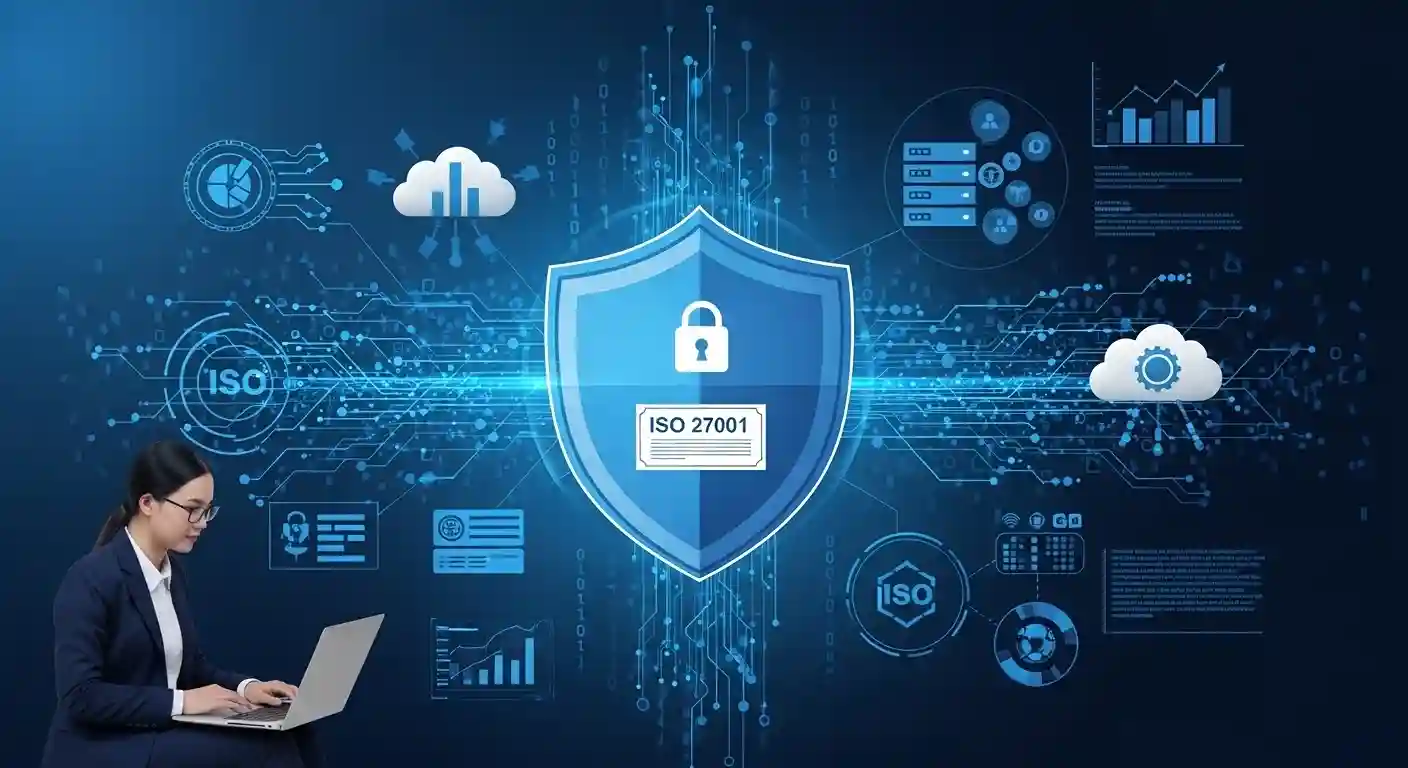
Is your business handling sensitive customer data, financial records, or confidential digital assets — but unsure how to prove you are protecting them? ISO 27001 Certification is the globally trusted answer. It gives your organisation a structured, auditable framework to manage information security risks — and signals to clients, partners, and regulators that data protection is taken seriously.
This guide covers everything: what ISO 27001 is, who needs it, the exact requirements, the certification process, and how to get certified faster with expert support.
What Is ISO 27001 Certification?
ISO 27001 is an internationally recognised standard published by the International Organization for Standardization that defines the requirements for establishing, implementing, maintaining, and continually improving an Information Security Management System (ISMS). It provides a risk-based, process-driven approach to protecting information assets — rather than relying on one-time fixes or reactive security policies.
At its core, ISO 27001 Certification ensures your organisation systematically identifies threats, evaluates vulnerabilities, and deploys the right controls to protect data confidentiality, integrity, and availability.
ISO 27001 Certification is a globally recognised standard that helps organisations build and manage an Information Security Management System (ISMS). It covers risk assessment, security controls, regular audits, and continuous improvement to protect sensitive data from breaches and cyber threats.
Why Does ISO 27001 Matter More Than Ever in 2025?
Digital transformation, hybrid work, and AI-powered operations have dramatically expanded the attack surface for businesses of all sizes. Data breaches are no longer rare corporate events — they are frequent, costly, and reputationally devastating.
Here is why ISO 27001 Certification has become non-negotiable in 2025:
- Regulatory pressure from GDPR, HIPAA, and national data protection laws is increasing year on year
- Enterprise clients and government procurement agencies now require suppliers to demonstrate verified information security controls
- Cyber insurance providers offer better rates for certified organisations
- Remote teams and third-party integrations have multiplied entry points for attackers
Without a certified ISMS, your business relies on informal practices — and that is a risk most modern organisations can no longer afford.
Who Needs ISO 27001 Certification?
A common misconception is that ISO 27001 is only for large IT companies. Any organisation that stores, processes, or transmits sensitive information — digital, financial, personal, or strategic — benefits from certification.
IT and Software Development Companies handle client data, cloud platforms, code repositories, and access credentials across distributed teams. Certification proves their security posture to every enterprise client they serve.
Banks, Fintech, and Financial Institutions manage high-value regulated data and transaction records under strict compliance requirements where a breach carries catastrophic legal and financial consequences.
Healthcare Providers and Medical Data Processors must protect patient records and clinical data under HIPAA and equivalent national regulations — ISO 27001 provides the framework to do exactly that.
E-Commerce Platforms and Digital Agencies face constant threats to consumer payment details, behavioural data, and proprietary digital assets — all of which fall squarely within an ISMS scope.
SaaS Startups and Tech Scale-Ups use ISO 27001 to build enterprise-client credibility early, demonstrating mature data security practices before a major breach forces the conversation.
Government Contractors and B2B Suppliers increasingly face procurement mandates that list ISO 27001 Certification as a non-negotiable contract condition.
ISO 27001 Certification Requirements You Must Understand
To achieve ISO 27001 Certification, your organisation must meet requirements structured across the standard’s clauses and its Annex A controls, aligned with ISO/IEC 27002:2022.
Defined ISMS Scope — Document which departments, systems, data types, and locations your Information Security Management System covers.
Risk Assessment and Treatment — Identify threats to your information assets, evaluate vulnerabilities, and develop a risk treatment plan selecting controls based on likelihood and impact.
Statement of Applicability (SoA) — A mandatory document recording which Annex A controls apply to your organisation and why. This is one of the most scrutinised documents during any certification audit.
Information Security Policies — Formal approved documentation defining your organisation’s rules, responsibilities, and approach to protecting information.
Access Control Implementation — Systems ensuring only authorised users access sensitive information, with clear role-based permissions.
Incident Response Procedures — A structured process for identifying, reporting, managing, and learning from security breaches.
Internal Audits — Regular ISMS performance reviews conducted before the external certification audit.
Management Review — Leadership-level evaluation of audit findings with documented corrective actions.
Continuous Improvement Evidence — Ongoing updates and improvements showing your ISMS evolves with new risks.
These requirements are not compliance checkboxes — together they form a living security system that matures over time.
How to Get ISO 27001 Certified: Step-by-Step Process
Step 1 — Conduct a Gap Analysis
Compare your existing information security controls against ISO 27001 requirements. This reveals what is already in place and what must be built before certification.
Step 2 — Define ISMS Scope and Objectives
Identify which business units, locations, processes, and systems your ISMS will cover. A well-defined scope prevents audit surprises and keeps implementation focused.
Step 3 — Risk Assessment and Treatment Plan
Map information assets, identify threats, evaluate vulnerabilities, and select Annex A controls that reduce risk to an acceptable level.
Step 4 — Implement Policies, Controls, and Procedures
Develop and deploy all required documentation, technical controls, and operational safeguards — including access management, encryption policies, supplier agreements, and incident response plans.
Step 5 — Staff Training and Awareness
Ensure all relevant personnel understand their roles within the ISMS. Human error remains the leading cause of data breaches, making training a critical control.
Step 6 — Internal Audit
Conduct a thorough internal review of your ISMS implementation. Document findings and resolve non-conformities before the external audit.
Step 7 — Management Review
Leadership formally reviews the ISMS, approves corrective actions, and confirms organisational commitment before certification begins.
Step 8 — Certification Audit (Stage 1 and Stage 2)
An accredited certification body conducts the formal audit. Stage 1 reviews documentation and readiness. Stage 2 evaluates whether the ISMS is fully implemented and effective in practice.
Step 9 — Certification Issued and Maintained
Once both stages are passed, your ISO 27001 certificate is issued. Certification is valid for three years with annual surveillance audits required to maintain it.
Key Benefits of ISO 27001 Certification for Your Organisation
Data Protection at Scale — A structured ISMS reduces the likelihood of data breaches, unauthorised access, and costly security incidents across all operations.
Regulatory Compliance Alignment — ISO 27001 maps closely to GDPR, HIPAA, and other major data protection frameworks, reducing compliance duplication and audit burden simultaneously.
Stronger Client and Partner Trust — Certified organisations win more contracts, especially in sectors where data security is a non-negotiable client requirement before engagement.
Competitive Differentiation — In competitive tender processes, ISO 27001 Certification consistently sets certified organisations apart from uncertified competitors.
Improved Internal Accountability — Clear policies, access controls, and documentation create a culture of security responsibility across every team.
Faster Incident Recovery — Defined response procedures mean your team knows exactly what to do when incidents occur — reducing downtime and reputational damage significantly.
Lower Cyber Insurance Costs — Many insurers offer preferential rates to organisations with certified information security management systems in place.
ISO 27001 vs Other Security Frameworks: Key Differences
ISO 27001 vs SOC 2 — SOC 2 is a US-based reporting framework primarily used by service organisations serving American clients. ISO 27001 is an internationally certifiable standard with broader global acceptance across industries and regions.
ISO 27001 vs GDPR — GDPR is a legal regulation focused on the rights of EU data subjects. ISO 27001 is a management system standard. Implementing ISO 27001 provides most of the technical and organisational measures GDPR requires, but the two are not interchangeable.
ISO 27001 vs ISO 9001 — ISO 9001 Certification is a quality management standard. ISO 27001 focuses specifically on information security. Both share a compatible High Level Structure, making integration straightforward for organisations pursuing multiple certifications.
ISO 27001 vs ISO 27701 — ISO 27701 Certification is a privacy extension built on top of ISO 27001, adding requirements specifically for Privacy Information Management Systems. Organisations addressing both security and data privacy often pursue both standards together.
How Global ISO Certifications Supports Your ISO 27001 Journey
Global ISO Certifications provides end-to-end support for organisations pursuing ISO 27001 Certification, from initial gap assessment through to surveillance audit preparation.
The process includes initial security posture review, customised ISMS design aligned to your industry and risk profile, full documentation drafting including the Statement of Applicability and risk treatment plan, staff training sessions, internal audit coordination, external certification body scheduling, and post-certification surveillance support.
Whether your team is in one location or distributed globally, the entire process can be delivered remotely. Contact Global ISO Certifications to begin with a free consultation today.
Frequently Asked Questions About ISO 27001 Certification
How long does ISO 27001 Certification take?
Most organisations complete the process in three to six months depending on size, existing security maturity, and available internal resources.
Is ISO 27001 Certification permanent?
No. The certificate is valid for three years. Annual surveillance audits are required during the validity period, followed by a full recertification audit at the end of the cycle.
Can small businesses get ISO 27001 certified?
Yes. ISO 27001 is fully scalable and applicable to organisations of any size. Small businesses often benefit significantly because certification opens doors to enterprise clients who require it as a supplier prerequisite.
Does ISO 27001 cover cloud environments?
Yes. ISO 27001 covers all information assets and systems — including cloud infrastructure, SaaS tools, and third-party integrations — as long as they are included within the defined ISMS scope.
What is the difference between ISO 27001 and ISO 22301?
ISO 22301 Certification focuses on Business Continuity Management — ensuring your organisation can continue operating after disruptions. ISO 27001 focuses on protecting information assets from security threats. Many organisations implement both for comprehensive operational resilience.
Is ISO 27001 Certification Right for Your Business?
If your organisation handles any form of sensitive information — and today virtually every business does — ISO 27001 Certification provides the structured framework, external validation, and business credibility that informal security practices simply cannot deliver.
It is not a compliance exercise. It is a strategic investment in the resilience, trustworthiness, and long-term competitiveness of your organisation.
Get in touch with Global ISO Certifications today to begin your ISO 27001 journey with expert guidance, a proven process, and full remote support available worldwide.